

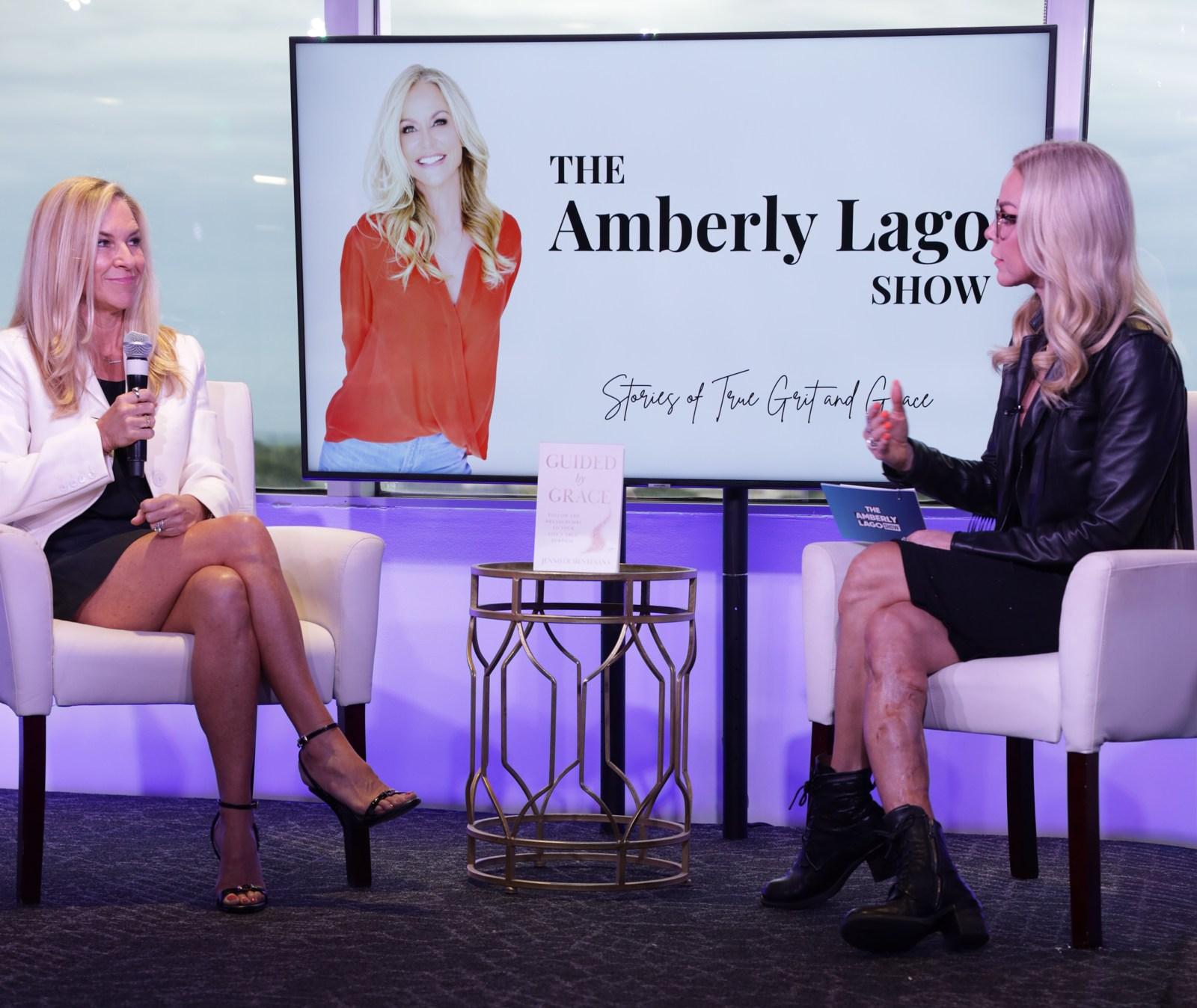
Season 6, Episode 251
From Tragedy to Triumph: Brian Bogert on Harnessing Pain for Personal Growth

About This Episode
In this episode of The Amberly Lago Show: Stories of True Grit and Grace, host Amberly Lago welcomes human behavior expert Brian Bogert for a compelling conversation on the power of communication and personal transformation. Brian dives deep into his life-changing accident, the immediate and long-term impact, and the profound lessons derived from this experience. They discuss the importance of non-verbal communication, personal awareness, and how recognizing our triggers can lead to healthier relationships. Brian also shares his transformative insights on moving from reaction to response, embracing pain to avoid suffering, and the symbolic significance of his tattoos. Join Amberly and Brian as they explore the depths of human resilience, the journey of self-healing, and the powerful ripple effects of personal growth in this inspiring episode.
If you are ready to leave your mark by discovering your message and sharing it with the world, you've come to the right place!! Let's work together to build your influence, your impact, and your income! Join the tribe you have been waiting for to activate your highest potential and live the life you deserve! Join the "Unstoppable Life Mastermind!" and let us know you are ready for greatness! Read the "True Grit and Grace" book here and learn how you can turn tragedy into triumph! Thank you for joining us on The Amberly Lago Show: Stories of True Grit and Grace! If you find value in today's episode, don't forget to share the show with your friends and tap that subscribe button so you don't miss an episode! You can also head over to amberlylago.com to join my newsletter and access free downloadable resources that can help you elevate your life, business, and relationships! Want to see the behind-the-scenes and keep the conversation going? Head over to Instagram @amberlylagomotivation! Audible @True-Grit-and-Grace-Audiobook Website @amberlylago.com Instagram @amberlylagomotivation Facebook @AmberlyLagoSpeaker
Full Transcript
Welcome to the Amberly Lago show. Stories of true grit and grace. If you're ready for breakthrough, if you are ready to level up your life and business, then I'm so glad you're here. Because today's guest I refer to as the. The one second psychologist. It's kind of hard to explain what he does, but we have Brian Bogart with us here today. He is a human behavior expert. He's. He's a speaker. He's a. He is a really good friend of mine. I like to call him my brother from another mother. And I love that when we get on the phone, he talks to me and says, hey, dude. And so I'm so glad you're here, dude.
I am, too.
Ryan, thank you for coming in. And I also have to say really quick, thank you for being here, because you are gonna not only be on the show, but you're coming tomorrow for our Mastermind retreat. Because one of your many specialties is you are like, this pro at hot seats at talking to someone, and, like, that you can get down into, like, what is the root problem or cause and how can we fix it? And so you're gonna be doing hot seats with my Mastermind members. We got a few in the audience here today. So thank you for being here.
I'm excited to be here. I mean, I lead with impact first and, like, when there's a chance, have a room of open hearts and open minds that are, like, ready to receive, it makes my job way easier, too. And so to know that that's the environment I'm walking into and that there's already emotional safety and trust that's established as a foundation.
They already love you.
Well, thank you. But the space that you facilitate creates a lot of that opportunity. And so whenever I have a chance to align with people like you, I do, because the mission I'm on is way bigger than myself. It is about me, but it's bigger than me, and it's going to require collective impact with a lot of us pulling in the same direct.
Yeah, well, I'm just. I'm so excited. The ladies, I've been putting your links, they've been stalking you, so they're really excited. Some got to meet you today. Do you think? Okay, so I didn't even mention in the intro like that. And I'm sure a lot of interviews that you do, the first thing they say is, he went through a traumatic injury, and they talk about the accident first. And I guess because we know each other and I see you in so many different ways. I forget actually sometimes. Well, all the time actually, that you have been in a traumatic accident. But so I left that out of the intro. You have overcome so much. And I think one of the reasons that we connected so deeply at first was that we can relate. Although our stories are very different, there's so much similarity. And so I want to get into a lot of what you talk about, but can you just share for some people in the audience that don't know what happened, because your story is unbelievable and what you've overcome, can you share
a little bit about it? Yeah, I'll give a condensed version. You know, it was August 10th, 1992. It was 6:10pm, 115° day. It's funny, I say a condensed version and then I give the context.
It was 115 degrees.
Yeah, it was 115 degree day. But we went for a one inch paintbrush to our local Walmart just to finish a home improvement project. And so as we were getting back to the car, anyone who's known me for more than like two minutes knows I talk fell, I walk fast, I have a bunch of energy and like I always have. And so it didn't surprise anybody to know I was the first one in the car. Waited for my mom to get caught up because this was back in the days before key fob. So I had to wait for her to literally stick the key in the door. And as I was waiting there, a truck pulls up in front of the store and the driver, middle passenger park and get out. And the passenger all the way to the right felt the truck moving backwards. So he did what any one of us would do, scoot over, put his foot on the brake, but he instead hit the gas.
Oh my goodness.
So a combination of shock and force had him up on the steering wheel, up on the dashboard. He's going 40 miles an hour across the parking lot by the time he got to me. And I didn't have any time to react. So he goes up under the median, up under the tree in our median, hits our car, knocks me over, runs over me diagonally, tearing my spleen, leaving a tire track scar on my stomach and severing my left arm completely from my body. And my mom, the next thing she hears is my brother's voice. And she says, mom, Brian's arm is over there. And as she looks up to hear where he's pointing and focusing, she sees a trail of muscle cooking like hamburger on the parking lot. And you know, I have to pause and I always honor and say this because there was a woman there that day, other than my mom, that saved my life. There was a nurse that walked out of the store right when it took place. And I said for years that I was forever indebted to her for her choice to go into action in that moment. Two years ago, I got to meet her on the 30th anniversary of the accident for the first time.
You are kidding me.
It was a magical moment and it was really cool. But I asked her, I said, why? And she said, I didn't even think. But then I also learned that she had a friend there that day who was also a nurse who had all the same sets of training and skills, who turned her head and went on, what other way? No. Yeah. And I want to be clear, though. I have no mal intent, no resentment, no nothing towards this person. It's well within her choice to do. But why I pause and honor is because the woman who chose to go into action has had a ripple effect that's now impacted tens of millions of lives. And we're on an impact to have an impact of a rebellion as quickly as possible. Her choice to go into action that moment, stop the bleeding on my wound and instruct innocent bystanders to grab a cooler and fill it with ice and get my arm on ice within minutes. If it had sat on that 115 degree asphalt for more than 10 minutes, it's dead.
Yeah.
Right. And so she made all this happen. And so without her, I either wouldn't be here with you today or I'd be here with you today with a cleaned up stump.
Well, you know what I wish? I hope that someday I can meet the man who really saved my life because my femoral artery was severed and people were not running up to me. In fact, one lady looked and fainted. This one man came up right away, ripped his belt off and made a tourniquet around my leg and saved my life. And I would love to be able to meet him someday.
Essentially, what happened with her. I mean, my mom talks about it and recounts. She's like, she's looking around and this is before cell phones, right? Like it's 1992.
Yeah.
So. So, you know, she's looking around and literally just asking like, for somebody to help. And most everybody's just standing there.
Yeah.
And so this woman truly, like, sounds similar to this man. Like the one person who chose to do something is the reason that you're here. And I don't have a day go by that I don't think about that because I can have that type of impact in any moment with any person if I'm just present and paying attention and take action. And take action. Right. And so there's a whole lot that's connected to that. But I go there because I think it's important for people to understand the power of choice and the power of action in moments that we may not even realize the full impact of it. And I've had the chance to get to know her, talk to her in detail. I'm going to be meeting her for the first time in about three months, which is going to be really, really cool, because it was just over the phone that I've spoken with her.
Wow.
But what I've learned in all this time, I mean, I've been doing this for 32 years now in this type of recovery, is every time I tell my story, I'm not only reminded how unique it is, but I'm also reminded how unique everyone else's stories are. And I think that that's the biggest thing that I always have to say after I talk about my story is like, regardless of the extremities of your stories, they're yours. Whether it's a big T or a little T trauma, it doesn't really matter. It's a matter about how it got imprinted in our body and what were the thoughts and beliefs and feelings that were formed as a result of our experiences. Nothing else matters. So even this game of comparison where most people are like, oh, well, my trauma is not that big compared to yours. I'm like, it's not even comparable. Like, why even go there?
I say the same thing because I have people go, oh, well, my pain is nothing like yours. They're like, I don't have crps. I just stubbed my toe. I'm like, pain is pain.
Pain is pain. And so that's where I paused to that, because it's like, look, if you hear my story and there's shock and awe, okay, I understand that. Right. It's normal to me. But what I really want everybody to do is just to pause long enough to pay attention to the lessons they can extract from their own stories so they can become intentional in how they apply them in their lives moving forward. And we all have the ability to do that. And we also all have the ability to tap into the collective wisdom of other people's lessons to shorten our grip to learning. As long as we're not comparing.
Exactly.
And so that's kind of part of the mission that I'm on.
Yeah. And I love that you said that because the part about we can learn from other people. And I think that's why I'm. That's why I started my mastermind. Because when I started out, you know, doing what I do, you know, speaking in a podcast, an author, I was like, just trying to figure it out. I had no idea what I was doing. And I was like, what if I brought people together and I could shorten that time span and they could. I could tell them, oh, don't do this. I did that, and it didn't work. Do this, and it works. You know, what do you think it. So I can only imagine how the recovery, how brutal that was. And I've listened to a lot of your interviews and heard you talk about it. When did you know that you wanted to go and speak and coach and help other people? Was it always that way?
So I took a long breath on that one because I haven't really talked about one element of something that always took place early in my life very often or really shared it with many people. But I'm feeling compelled to at the moment because the quick answer is no. No, I did not have a plan to do that. I was thrown on stage as early as age 7 because I have a unique story and because I'm not shy.
They put you on stage at night?
Oh, I was on, I mean, how many telethons and TV shows and things? Because my story was unique and I was never shy. And so from early on, it's just always been something that I've done. And I would tell you that there were periods in my early teen years that maybe there was some thoughts about it, but I don't think that it was ever really given much validity and likely just because of my external circumstance and some of the conditioning and beliefs that I was going through. But it wasn't until 27, 27 when I realized that I had everything I thought I ever wanted. When I chased the model of what. Because that's what the world teaches us. What house, what car, what amount of money, what amount of success. And I was really in seek of who I was. You know, there's lots of different pieces in my story in the middle components. But at 27, that's when I realized that I had everything. My bank account was full, but I was empty.
Wow, that's powerful. Because you know what? So many people feel that way.
Yeah. And that's one of the things that I also recognize and realize is that like, because of some of the early circumstances that took place in terms of how people didn't believe my story, didn't believe me, didn't see me put limitations on me because they couldn't see my potential through their limited lens. Right. Like, and would just layer all these expectations on all the things I would and wouldn't ever be able to do. Like, I, in a lot of my life was like, really put into these boxes, and. And therefore, I was also always going to just fight that and argue that. But it also really disconnected me. And so one of the things that I really talk about a lot is it's like, look like I know what it's like to be the only one in every room. There's no one I've met that has the same situation, the same experiences that I do to the exact degree. You and I are sitting in here both having had similar injuries, and we have some resonance and understanding of that, but yet we can walk into a room and not be completely alone. However, most rooms we are, and it's a rarity. Right. That we aren't. And so when I can understand that, one of the things that I really pay attention to is I also can recognize that I am a white man that has privilege just for those two reasons. And you said it early on in the call, most people don't even notice my arm. And many times I've had friends for years and they wouldn't even know, which to me is astonishing, giving how visibly different they are. I'm not unconscious. I'm not worried about the looks.
Also told me, oh, I didn't even notice.
Like, nobody does. And so why I say that is because although I can recognize, like, all those dynamics of who I am, do I know what it's like to be a black woman? I don't. Do I know what it's like to be a transgender individual in certain states or at all? No, I don't. Do I know what it's like in multiple other categories of people who are often in the fringes of society, who are often overlooked, who often are suppressed or repressed in some capacity because of culture, society, their parents, or conditioning. Like, I know all of that. And so if I understand all those pieces, then I can relate to people in those capacities. And that's what I think allows me to be objective and non judgmental because, like, at the end of the day, like, I know what it's like to be the only one and how isolated and lonely that can be for so many periods in our lives.
Yeah. Did you ever try to hide your arm?
Oh, yeah.
Okay. Because I used to try to hide my leg. I didn't want anybody to know. In fact, I remember pulling up to my daughter's school one time and I was, I had my oldest daughter with me, who was, I think she was about 13 at the time. And we were pulling up to the preschool and I was in too much. I couldn't walk. But I did not want anyone else to see me walking on crutches because I just wanted to be normal. And I sent my daughter in to go pick up my youngest, and the teacher wouldn't let her take her. And so I had to get on my crutches and go get her. And I was angry. I was like, you forced me to be seen. You know what I mean? And now I could give a crap about being on. I have Canadian crutches, and, man, I can book it on those things. And I don't care if I have crutches. I really don't. But it took a while. It took a journey. How did you get through that journey? Because there are a lot of people that have insecurities or they're trying to cover up something or hide something. How did you take the veil off of that? How did.
There's layers. There's lots and lots and lots of layers. And so there's not a really quick answer. One thing I do think that's important to acknowledge, that's different, and you're in my lived experiences, is that I was 7, so I grew up with this and my brain, because of PTSD and the way that it's wired, I don't have any memories of my arm. Not like this, really. And when I watch home videos, you're like, oh, wow. It's shocking for me to see my body in a typical structure. And so it's just a different lived experience. So there's a lot of. For as much as where I say I hit it, I hit it. Probably in less obvious ways than maybe you might have having happened as an adult. And now you're adjusting to something that's life altering. Yeah, for me, I didn't really have a choice to not have it be on the public because like I told you, I was thrown on stage, like, and on TV shows, and it was like all over the news. And now.
Did you like being on the table? No, No.
I mean, I, I, I, I. Yes and no. I like the impact that came from it. Yeah, I, I like the relationships that came from it. I think that it was something that had to be a part of my path. But no, I didn't when did you start liking it? I still don't. I still don't.
I'm just laughing because, I mean, I. I'm blessed that I get to do a lot of keynote talks. I get to do a lot of events and. And if people only knew. Like, I still get so nervous. I get so in my head. I wake up every morning and I'm like, three more days until I get on the stage in front of a thousand people.
Yeah.
I get freaked out. And then when I'm done, I'm like, I feel so good.
Yeah.
But it's. It's a lot. Do you do that?
So I do. Now, what I was saying is that I don't necessarily like the whole TV concept, like, in the idea of it, but I can have a conversation and if I don't think about everything else, then it doesn't matter. Like, I don't mind.
I forget. Oh, yeah.
I love to be. I love to be on stage. I feel like it's one of the most authentic places that I actually live and exist. Because we were talking about it before show. It's like this concept of challenging. And that's. By the way, there's two loops that I haven't closed. The first is.
I'm sorry, it's the add in me.
We're both in it, so. But there's. But there's two that I. You had asked me a question before, like, did I always know the story that I didn't tell you, but I said where it came from and what pushed me down the path. I also had a recurring vision and dream for the very strong part, first part of my life.
You did.
Have you seen the movie Irobot?
No, I haven't.
Okay. So there's this. There's this sketch in this thing where he's, like, seeing this future vision of himself and he draws this sketch and he's like this solo outline on top of a mountain with like hundreds of people around him or thousands in terms of this on stage. Right?
Yeah.
And I always had this repeat vision that I was supposed to be speaking to people, really. And so I've only said that maybe three or four times, like, to anything that's on a recording. Because it. It's something that I'm now, like, allowing myself to go back and visit.
Yeah.
But it was never a conscious thought. It was always something that I just think I now can reflect back on and realize that I probably was being given indications. I just refused to listen to them or life was too complicated. But how did I learn to get comfortable in my skin. It's been a process, and it's been really starting to understand, like, really, who am I? But also, what are the things that matter? Right? The times that I would hide or would feel most uncomfortable would be in college when I was at the pool or at the beach and, like, wanting and believing that, like, I have the body type and structure that I could have been shredded, but I can't lift weights in the same way without creating damage to my body. So there was, like, this internal negative belief and narrative, right. When I went into the professional world, like, there would be times in meetings that. Particularly with, like, dress clothes or a jacket, I feel like my arms look dramatically different in length. And so I would learn to stand with my hands crossed between my back. Right? And just, like, that was a postural thing, and it didn't look unnatural, but it was, like, also an attempt to hide. Yet I've also been in multiple places with my shirt completely off, and it doesn't and hasn't mattered. So I think it was contextual for me growing up, and it was about, like, what is the type of connection or attention or experience that I want in any given environment? And the older that I've gotten and the more established I get in who I am, the less I really think about anybody else. I, like, I don't. I don't care.
Doesn't it feel good that you. You don't care what I mean? I say that because I remember when I'd finally accepted my scars and everything, I was going. We were at the. I was at the Four Seasons with a girlfriend, and we were in our bikinis, and I had like, a, you know, like a little shawl swimsuit. It was very cute outfit, by the way. And we were walking out, and I could see these guys look at me, and I was like, oh, here it comes. Because the eyes scanned from up to down and then. Oh, and look away. Like they were, like, disgusted, you know, like, ugh.
It's interesting, though, because I think that the number of times that I believed somebody was disgusted and they were really just afraid, maybe. It's also really interesting.
They're. They're well meaning.
Meaning afraid because it's different. And they don't know what to do.
Yeah.
They don't know how to react. They don't know what to say. They don't know how to bring it up. Yeah, Right. And especially in the context of somebody eyeballing a woman. Right. Like, it's their face, just. But my point is, is like, but, like, they weren't expecting it, right?
Yeah.
They were shocked. So, like, that's something that I got used to really early. Was that, like, type of reaction?
Yeah.
What's been fascinating is, like, so I did not always have a sleeve of tattoos, but I've had them now consistently for about four or five years, maybe three years. I always lose track of time.
People look at that.
I'm sure people look at this arm over this arm. And so I used to get really used to, like, having tank tops on in the summertime or walking around in a pool or a water park with my kids. And, like, almost always, the attention was drawn to my upper arm over here. And now, even with my shirt off, more people look at my tattoos than
they look at this.
And so it shifted, like, perspective for me because it's like, my scars are the stories that were chosen for, but my tattoos are the stories I chose for myself. Right. And so part of getting.
I want to talk about that tattoo on that arm.
Yeah.
So go ahead and finish. And I want to make sure the top.
I don't. I don't have any loops to close on it. I was just. I was just talking through the concept. But, like, with. I think that's what's interesting is, like, I feel so comfortable with ink on my arm. But what's funny is I was afraid to have visible ink for years.
Really?
Yeah. Because I was operating in such deep levels as shame that, like, my lack of ability to be comfortable, my skin was more than just the physical, physical appearance. Right. I wasn't comfortable in who I was. And so the thing is, most people learn lessons physically first, which is what my experience was. But what I also. And it leads directly to this tattoo, is that when I shut off physical pain because it exceeded my ability to cope, I also shut off mental pain, emotional pain, and spiritual pain for 20, 25 years and didn't even know it. Right. And so I'm operating in this unconscious bias, always through a purely physical or intellectual experience in this world, but was completely numb to my emotions, my understandings, body, my spirit. And so the real shift, honestly, in getting so comfortable goes to one of the concepts we teach, which is this idea of a strong spine and a soft front. So when you get to a place where you are healed and have accepted. Right. Like, the unavoidable precursor to change is acceptance. So until you accept the current state of things, you can't alter them. Like, until you can reach that place in mental, emotional, physical, and spiritual capacities, like, it's really Difficult to stand unwavering in a environment, but that's what a strong spine is. I know who I am, what I'm willing to do, what I'm not willing to do. My heart, my intent, my soul, my desires, my value, my boundaries. And I know how to communicate them effectively, which means that I can go anywhere and be with anybody, in any environment, and be completely unwavering because I'm still comfortable. It's kind of like the last rap at the end of the movie 8 Mile with Eminem, when he just, like, throws all this shit out there and is like, here's everything now. What do you have on me? And the guy's speechless because all he had was the crap that Eminem just completely owned, right? But when you have that strong spine, that's how. That's the experience. It's like, what do you got? Like, I'm good, right? Which allows me to then have what I call the soft front, which is where my wife and kids come in, right? And I think of them, if they want to come to dad for love, light, leadership, right? They want to be led. They want anything that I can provide for them. Do they want to come in? If they want to be consoled and lay their head down on a metal chest, piece of armor?
Yeah.
No, they want my heart. And so these three words came out when I was 35, less than a year after I'd executed my buy sell in my last business to go do this full time as a coach, to get to the core of helping people discover who they are and live their best lives at the highest level. Ten months later, my wife and I sat on our back patio, and she went on to tell me the things I'd done, ways I'd shown up, patterns that had still created, had caused her to lose who she was. It was like a dagger to the heart. That was like the first moment that I realized that. That I was creating damage in my house in ways that I was unconscious, too. And the idea that I was doing anything other than making my family not only protected, but feeling and experiencing safety, like, was a really brutal pill for me to swallow. But it was coming up in moments, and it was perceived control in moments that we were able to work through quickly. But it was really anger. And anger is not a primary emotion, it's a secondary emotion. And it's always designed to protect. It's big energy, designed to push everything and everyone away. And I already have a big energy, and I also have an ability to infuse life into people. So imagine A just sneered look on my face and how that can also cut somebody to the soul. That's what my wife and my kids were dealing with. And then it would be things like my wife saying something as simple as, hey, honey, what do you want to do with the kids this weekend? But my shame and my anger filter would cause me to hear it this way. Hey, honey, you've not done enough to be good husband and father here recently. So what are you going to do to make up for it this weekend? Now all of a sudden, I feel like I'm being challenged. I'm like, shit, Like, I'm a great husband and father. Like, what do you mean? I've done all these things and what do I do? I puff my chest, I get all my energy up and I rattle off the 10 things I've done in the last few days to show her I'm a good husband and father. Wasn't what she asked me.
Yeah, yeah, right.
And so I think you're an expert
communicator though, because it's. I mean, honestly, my daughter and I, Ruby, like, we communicate so well. It's almost. I feel like sometimes we share a brain because we can even kind of glance at each other and start laughing or we just know. And we are very sensitive to the same things. And my husband, not so much. You know what I mean? I mean, he's the most awesome man, but the way he communicates is so different than the way Ruby and I communicate. And so it's a lot of head butting and everything that you're saying is making sense. Strong spine, soft front.
And so it went from being in what I believed was the best place in my marriage I was in a month before that conversation to not knowing if I would be married for another 30 days. And so a lot of what I teach now is also a byproduct of what I had to create for myself to actually move through that period in terms of actual repair. And so it was about 10 days after that conversation that I went and tattooed these words on my arm in which say what? Trust, Surrender, Breathe. Because what was happening more often than not, and this is, I think, what disconnects most people in this world. It's a lot of what I teach. My intent was never to create harm. My intent was not even to believe that I was being defensive. In fact, I was unconscious to it. I didn't even realize that's what's happening. So I was in a place where I often would feel misunderstood. I would feel like I wasn't being believed like I could be, like, communicating everything that I desired and it wasn't being accepted. But here's the reality. The world will never judge you based on your intent. The world will only judge you based on your actions. My actions were communicating something differently than what I intended to communicate. And again, what's really important to pay attention to with this is that when I say communication, 7% of communication is in the words that we use.
It's so true.
38% is in the delivery, the tone and the cadence. 55% is the non verbals. And so it's our cells reacting in moments to historical beliefs, pain, trauma, triggers that transport us. And we believe that we're reacting to what's right in front of us and has everything to do with the cellular memory being activated. So it's about separating in those moments and really having the opportunity to like, understand is what I'm intending actually being communicated. And so this was one of the big things, because I started to realize how reactive I was and how defensive I was. And it was because of a lot of the patterns that even had been created in our own household, let alone the years before we were together. How long you been married? We have been married. We're going on 14 years, 18 years together. And so that's what I say, though, often now. I mean, we're in a beautiful place now and have been. I mean, within 18 months, the patterns of anger were reversed in our household. The generational patterns were reversed. We both were on paths of like, tangential healing and like, deep levels of trust and intimacy. And so I talk about now. It's like we've been together for 18 years. We hid from each other unconsciously for 14, and she's only felt truly emotionally safe with me for about 36 months.
Wow.
And so it's not a coincidence that we have the best life we have now after three, four years of very intensive work. But it also, to the point of everything is layers. But I'm visual and I'm like, kind of dense in my own ways, as all the ways that I'm not dense. I'm very dense in some ways. And so I need like visual reminders of some things. And to the point that, like, these were the first pair of stage shoes that I got when I left my other business. And I used to have the statement of be where your feet are. And when these were made, I put B or my wife had these made for me. I have to give her credit, she had B stitched on the inside of the Tongue so that I could always pay attention. Because presence. I can always look down and be like, I'm in here right now with you guys. We have this amazing audience of women that we're going to get to spend some time with tomorrow. Like, this is all that matters right now, because this is where I am. And this was no different. It was to slow down long enough to truly trust, to surrender the greater outflow and not have to control the outcome and to breathe through the moment. It's what created a lot of freedom. Because moving ourselves from a place of reaction to response is everything.
Because it proves from reaction to response is everything.
Because reaction.
I have to, like, I'm going to listen to this. And because you give so much great information, I have to, like, I want to listen to it every time. I've told you this before. Every time I talk to you, I want to take notes seriously. And by the way, I'm very visual, too. I'm a visual learner. I. Very visual. And I've wanted to get a pause tattoo because there are moments when I'm like, I need to press the pause button. And I sometimes need. I think I want a little pause tattoo, and maybe I'll get one and just go, okay, pause. Okay, breathe. Yeah.
But legitimately. So this got me through learning how to create new patterns in my reactive cells so that I could not create damage in my house anymore. Because I made a promise to my wife that day. I was gonna do everything in my power to ensure it. And over the course of the Next, I think, 18 months, it only happened three or four times.
Wow.
And I knew I would. I'm human, right. I'm not perfect, but I also, like, it was so foreign to my experience and lived experience, this idea of her harming my family. Yeah, Right. And I wasn't hitting them or yelling at them, but it's like the emotional safety is everything.
It is. Safety's really big for me. But I know my husband, he's. I don't think he listens to the podcast anyway. I'm kidding. But, no, he. I was coming home, and he was backing out. I didn't know he was leaving. My daughter just got a truck. So we're always kind of trying to rearrange the cars in the driveway and stuff. And so I'm pulling up, and I've got a car full of groceries. And he had gotten on the phone with me and said something, and I was like, oh, I'm going to see him in a minute. Okay. Okay, bye. Click. And then I Get out of the car. And I called him back. I'm like, well, where'd you go? And he goes, oh, I told you I was going to the store. You know, he. And I was like, well, you don't have to yell at me. And he goes, I wasn't yelling at you. And I'm like, I'll see you later. Click. And he didn't realize he was really yelling. But I am so, like, sensitive or, like, tone is. I'm so sensitive to tone, and so is my daughter. And so. But when he got home, and he would never in a million years ever want to do something to intentionally, like, yell or hurt. But that's just. I mean, that's.
It's the deep patterns that we're stuck in.
It's the deep patterns. And it's also him being a lieutenant commander and yelling at get. I mean, I used to have to tell him, hey, I'm not one of your officers. You're home now. You know, but he came home and apologized, you know, which is.
Which says a lot, right? Like, ownership to me, like, that's where I'm at in my life is like, I'm never guaranteeing that I won't create damage again. And I'm never expecting anybody in my life to never intentionally or unintentionally create damage in my life. Like, it could happen. But, you know, the other thing about what I talk about often is this concept of the trash from our past, right? All of this is tied to the trash from our past. These emotional triggers, behavioral reaction, like, all of it. It's all tied to that cellular memory. And so if we start to understand and recognize that the trash from your past is not your fault, it just becomes your responsibility once you become aware of it or you start burying others
in yours, how do you take that trash out?
Well, there's ways, and we're gonna go deep on that, I'm sure, tomorrow. But one of the things that is important is that to your. To the point of him taking ownership, if there's damage in a moment of reaction, the only way to neutralize, diffuse, and move through that energetically is to create repair. Ownership is the greatest and fastest way to create repair, because it's not about the blame and the fight. And so that's my only belief, and that's probably my only standard for expectation for the relationships in my life, is if you are made aware of the intentional or unintentional damage that you're creating in my life, in the life of my family and my kids, my Wife. My. My world. And it's brought to your attention and you don't find a way to step into ownership and create repair. That's where I cut people off.
Yeah, Right.
Because that's all we can ask of people.
Yeah.
And then the hope is we get to a place where that reactive state is no longer the primary pattern and we're not having to seek and use all this extra energy to create repair all the time.
Exactly.
And that's like where we're at in our house now. Right. Is just we had to establish such a deep level of trust because again, we had 14 years of our own patterns. So a simple look from across the room could make her think that I'm about to go off and I feel centered inside. Right. And so like we're having to relearn those even non verbal communication elements that exist with us. On top of the fact that our son is on the autism spectrum, by the way, I probably am as well. I just never got diagnosed because it wasn't big when we were kids. Yeah, but what does that actually mean? Like, there are times and we joke
about this, you're super smart.
But like, neurodivergencies are real. Right. And there are times where I'm so laser focused or centered on something that my wife could ask me a question and it's like just a very literal response or complete ignoring because I didn't even hear her.
That's the same as me.
And like these things happen and we take them as personal offense. And so now there's times where I'm like, I don't know always the volume that I'm at, I don't always know the tone, like as good as I am, as intentional as I am, and how well I do it with people and on stage and with my family, I'm human. I'm not perfect. And I screw this up too. Right. But it's like now I don't get defensive in the same ways. And Ashley can tell me, hey, dude, I don't know what's going on with you, but like you're reacting right now. Or she can say like, hey, neurodivergent dude over there, like, get present for a second. And it's like, I don't react to that in the same way anymore because we aren't fighting with each other anymore. We want the same thing. So it's a matter of how do we communicate to find the path, to get there, knowing that we both have our own shit, we both have our own unique wiring and we both have all the stuff with ourselves and our kids and sensory. And it's like, so give some grace, but understand it.
Yeah, I'm so. Well, it just makes me feel so not alone when I. When we talk because we are so much alone in so many ways. And I've had both my husband and my daughter get upset with me because they're like, mom, I was talking to you. And I'll be so laser focused that I don't even. It's. I don't even hear. It's not like I'm trying to ignore. I just don't even hear. I know we've got to wrap the show up. I need to have like five hours with you on the show. Like, we could. I could just.
Well, you've got a videographer there tomorrow, so, like, we'll have plenty of time.
I mean, do you know I didn't even ask you any of the questions. I have 10 questions we didn't get to.
So let's ask at least one. Pick the best question off there and I'll make sure that we address it because that way you'll feel like you at least hit your list.
Okay. Okay. Let's ask you this. One of your key teachings is about embracing pain to avoid suffering. Can you explain what this means and how people can use pain as a tool for growth?
Yeah, I'm going to give a really quick version of this. We have to understand two things before we can describe the concept. We have to understand our nervous systems, and we have to understand the definition of pain. Our nervous systems are there, hardwired to anticipate risk and threat, to protect us from harm or loss of life. Right. It's hardwired so our nervous systems are the core to everything. But what does that mean? 150 years ago, if you and I had had these injuries, we wouldn't be here. Somebody who got a cut on their leg could die. But that's not the reality for most of us anymore. So it's time to update our operating system systems. Right, like. And understanding that most of what we're reacting to actually isn't creating harm, it's creating harm inside. But it doesn't need to. If we can rewire. And so that's the first piece that we need to understand. But then pain, right? Pain's defined as short term, intermittent, a direct cause from something and alleviated once that direct cause is removed, then what do we do as humans? We throw adjectives in front of it and fuck up the meaning. Right. Which is acute and chronic. Yeah, acute maintains it. But chronic implies that it's no longer pain because it persists after the direct cause is removed and it's not short term. So let's stop calling it chronic pain and call it what it really is, suffering. We don't want to admit that suffering exists, particularly when it's a direct result of our choices. Right. But again, I said it earlier, the unavoidable precursor to change is acceptance. And so we have to be able to recognize that this is something we can do. I believe that we all must choose our pain or our suffering will choose us. So what does this concept look like? At the highest level? We can embrace the pain of hitting the gym for 30 minutes a day to avoid the suffering of aches and pains from a sedentary lifestyle.
Lifestyle.
We can embrace the pain of a difficult conversation with a loved one or spouse to avoid the suffering of being stuck in a loveless marriage or really frankly wanting out and not having a pathway to do so. Right. We can embrace the pain of the fit our our kids are sure to throw when we haven't put down their mobile device at the dinner table to avoid the suffering of years of lost meaningful connection and conversation we can never get back. Right. We can embrace the pain of firing a top salesperson as a business to avoid the suffering of losing all our other top talent and stagnation as a result of the fact that they were the greatest cancer in the culture. Right. Like, we can embrace the pain of the difficulty of actually looking inside and unpacking the trash from our past and transforming it into the treasure that it really is to avoid the suffering of being isolated, disconnected, feeling unworthy, and feeling like we're never going to be enough in this world. Right. Like, if we understand that suffering is a choice, then it's a matter of understanding systematically. And there's a deeper, longer answer on how to actually go through through this process and apply it to everything in our lives. But that's it at a high level, which is everything is always about choice. You know, I'm a big believer that we can choose the change we want, or we can choose to change when we don't want change. But one of the greatest lessons my dad ever taught me supports this whole philosophy, which is this idea that no matter what, guaranteed always in life, you will have a minimum of two choices. They both might be shitty. You can be held up at gunpoint. Your choice is hand over all your worldly possessions or get shot. Yeah, but the point is, again, going back to ownership, it's your Choice so you can step out of victimhood really quickly. When you can start to realize that everything in your life is a byproduct of your choices. If you don't like the results or you don't feel like your intent is being understood, change your actions. If you don't like the answers or the outcomes that you're getting, change your questions. Right. But again, the point is, is what are we willing to do to explore how we get to freedom? Because the whole point is embrace pain, avoid suffering. But that's. That's the only path to gain freedom.
Oh. So, ladies that are here in the studio, can you understand why I love this man so much and why I wanted him to come speak to the Mastermind tomorrow? He's amazing.
Thank you.
So tell everyone where they can find you.
Yeah.
They can coach with you. They can just get more of Brian. Where's that?
If you're a website person, you can Google my name and you're gonna find plenty. You can also go to Brian Bogerd. If you're social media, it's Oggert Bryant on all channels. We have a ton of free resources. We have a whole lot of ways to enter into our world. And at the end of the day, we know that 99.99% of the people that we impact are never going to pay us a dollar. We're okay with that. It's a matter of just aligning and ensuring that we provide the opportunity for people to have access to the help they need, even at zero or low cost.
Well, thank you. And you know what? You guys take a screenshot of this and tag me@amberly lagomotivation and Brian@ Bogerbrian on Instagram. When I see that, I will share it on my social media. And I just want to appreciate. Thank you. Thank you. Thank you for coming in and sharing your wisdom and thank you for tuning in to the show. And we'll see you next week.
Pain to purpose to joy.
Never Miss a Conversation
New episodes drop regularly. Subscribe on your favorite platform and never miss a conversation.