

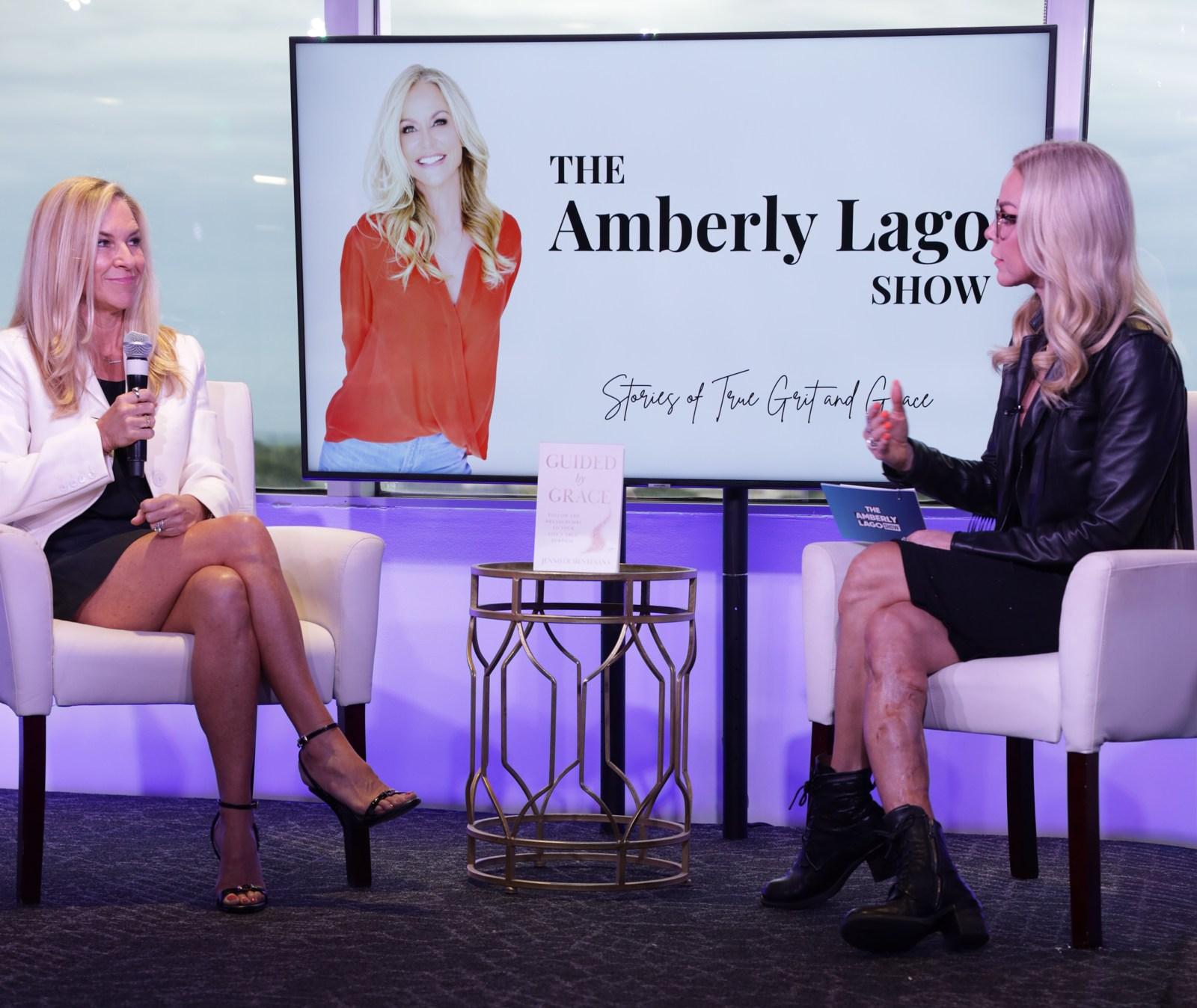
Season 2, Episode 73
Decluttering Limiting Beliefs with Samantha Joy
A conversation with Samantha Joy

About This Episode
"Fear is just that period of build up where we tell ourselves a story."
I was introduced to today's guest by a mutual friend, Sterling Hawkins, and I will be forever grateful. Samantha Joy is one of those people that feels like sunshine. Since becoming friends with Samantha, we have hosted rooms on Clubhouse, held webinars and have had some deep conversations about how to design a life of happiness and purpose. I'm excited for you to hear her perspective on some of the most powerful topics such as imposter syndrome, mindset and overcoming fear.
Samantha Joy is an Identity Coach and Founder of The Less Effect Method and is taking the personal development world by storm. She is the #1 bestselling author of "The Less Effect: Design Your Life for Happiness and Purpose." Her coaching approach supports CEOs and Founders in shifting their identity to their most authentic self by clearing out aspects of their life rooted in an old story. The result is enhanced mental clarity, an improved sense of self, and the ability to design an environment that attracts abundance and fulfillment. As a former Vice President and single mother, Samantha possesses the resilience and experience necessary to give her clients the real deal, challenging mainstream topics like mindset and imposter syndrome. She embodies her life's purpose by demonstrating that we are simply a product of our environment and with the tight tools, we can curate our surroundings to manifest all the we desire.
In this episode, Samantha shares how she has built her confidence as a coach, speaker, and on social media, how to handle fear, and how to live with intention.
Here's what you will learn:
- How Samantha got started making change in peoples' lives (1:21)
- How to tap into your most authentic self and design a life of happiness and purpose (7:32)
- How to face your fears (14:51)
- Why intention in communication is important (22:25)
- How to identify loss versus alignment and flow (27:31)
- How Samantha is using Clubhouse to expand her brand (31:08)
- How addiction play out in the current social media landscape (41:20)
Screenshot your favorite part and post to your IG story and tag me @amberlylagomotivation and @samantha_joy__ so we can see and repost to our stories!
Follow Samantha
Mentioned in this episode
Hiitide Book Club: I am excited to share that registration for the True Grit and Grace Book Club is now OPEN!!! https://hiitide.com/crews/true-grit-and-grace
Unlock your highest potential and start living the life you deserve!
Read the True Grit and Grace book here and learn how you can turn your tragedies into triumphs!
Thank you for joining us on the True, Grit, & Grace Podcast! If you find value in today's episode, don't forget to share the show with your friends and tap that subscribe button so you don't miss an episode!
You can also head over to amberlylago.com to join my newsletter and access free downloadable resources that can help you elevate your life, business, and relationships!
Want to see the behind the scenes and keep the conversation going? Head over to Instagram @amberlylagomotivation!
Audible @True-Grit-and-Grace-Audiobook
Full Transcript
Welcome to True Grit and Grace, a podcast designed to empower you to claim your resilience and thrive through life's challenges. I am Amberly Lago, a mindset coach, fitness expert, and bestselling author. Each week, I'll dive deep with the world's brightest thought leaders and elite performers to share tangible tools and practical advice to inspire you to keep your eyes on the prize and forge ahead. So get ready to conquer your fears, heal any trauma, lead with your heart, and elevate your life with grit and grace. Hi, and welcome back to True Grit and Grace, where I have someone so special with me today. She's one of my wonderful friends that I feel like we have such a similar path, so I cannot wait to share her with you. She is a mindset and empowerment coach. She is the founder and creator of Joy Lab, and she has a book. I have it right here. I have read it a couple of times. Called the Less Design youn Life for Happiness and Purpose. Samantha Joy, welcome to the show. Thank you for being here.
I'm so honored to be here with you. Amberly. This is amazing.
Oh, I love you. And we. We just got off Clubhouse.
Okay.
We were on Clubhouse together. She pinged me in. She had what holds this room every Monday. I think it's what, at 8:30 Pacific?
What time? Pacific? Yeah, yeah.
And it's about decluttering, limiting beliefs. And so I can't wait to get into your story. We met through our friend Sterling Hawkins, who's been on the show as well. And I don't know how he knew that we would become such great friends, but it's like he knew. And then the more that I get to know you, the more I realize we have in common. I mean, with your dancing, your bodybuilding, when you were living in the Bay Area, just your whole journey. So can you just share a little bit about your journey to what you were doing and that big aha moment where you were like, you know what? I want more. I want to be fulfilled. And it led you to where you are now, just making such huge change in people's lives.
Oh, thank you. Yes, thank you for that introduction. I am very humbled. So it is interesting to think about an isolated moment, and I do have one, and I will share it. But what I will say to preface it is that I always knew there was more for me, you know, I definitely, at some point in my life, you know, where as kids, we're like, we don't want that. We do want that. We're very vocal. And then at some point in my life, a lot of us can relate. I started to do what others wanted, and that led me. I'll just keep it high level is that led me to majoring in accounting, of all things. I had grown up dancing. I was so creative. I was acting and singing and all the arts, but performing arts, and ended up in accounting because I was good at math and it was something that everyone needed, so it was safe. And so I followed that path. I can only speak to my own experience. I would feel it in my body, like your body tells you when something's not right. And it was telling me through this journey, I would have little aches and pains and things, and stomach aches. You know, just this life isn't for me. So I spent like 10 years in public accounting and in that world and.
And you were really successful at it.
I was.
You really climbed up to the top of that world, which is a huge accomplishment.
I did. I did. And that's definitely something we can dive into as well. Right. We were talking about decluttering beliefs just moments ago, and, you know, it was, gosh, I have so much to say about that. But I definitely did excel. So if I was a bit cutthroat in my professional life of if I'm not hurt or I don't get to contribute or be a part of this, you know, I always knew I had that inside me as I'm intentional. Right. I didn't want to just be along for the ride. Then I'm going to move on to something else. And so eventually I found myself in a position as the vice president of technology for a company out in New York. And I basically kind of like, ran the show. They were wonderful. My employers were wonderful, and they really trusted me. And so I had a lot of autonomy. But at the end of the day, I was still selling someone else's product, selling someone else's service, selling someone else's dream. I still had to wait to be paid, you know, and the paychecks had someone else's name on it on the bottom. You know, it was just like I knew there was more for me. And so I. Yeah, I had the isolated moment. My aha moment was on a phone call. God, he must be sick of hearing about this, because I have told the story so many times, but I'll never stop telling it because it was such a powerful moment. My mentor at the time and a close friend now. His name is AJ Mirza. We were on a phone call, and I was actually on a business trip to New York. I live in Denver now. I lived in Denver at the time. And I was. I had been traveling there so often, and I was on a call with him in my hotel room, and I'm like, you know, I had been coaching, doing my side hustle for years, and it was. It had been grown out of consulting for so many years. And so it was almost like an extension of that, so I could still have a piece of myself and a piece of my dream, but I was still navigating that, and I just felt a little bit flat. I'm like, I'm serving these people. I have wonderful moments. But, like, there's something else. There's something more. By no coincidence, very shortly before that conversation, a little time had passed since the conversation. I discovered minimalism, and I had started applying it to my life. And between that experience and this. This call that I had with this mentor, aj, he asked me, you know, when. When was the last time you felt like you. Where you were just, like, on fire, you were free, you were light, you were just. Anything was possible. And I realized it was a few moments. It's. You know, I had moved like six or seven times in a decade. Some of it was for jobs, some of it was for relationships, Some of it was just to move. And I realized I felt really light and free and, like, wonderful and limitless every time I'd move into a new place. Because what do we do when we move? We. I'm going to use the word purge, and I want to go back to that in a minute. But we purge things, right? We're just like, let's get rid of it all. We leave relationships behind because, you know, proximity or whatever else, it's just easier to leave relationships when we're removing ourselves. We leave jobs and routines and sometimes patterns in a way, because we're out of that same routine. And how good do we feel when we shed and let go of things? So I feel great. But I was still operating from limiting beliefs. I was still operating from an old story. So I. Everything would be recreated, right. I'd accumulate crap again. I get into more bad relationships.
I kind of becomes a cycle. And you just repeat that cycle until you get down to the core of those beliefs and what they are.
Yeah. And that's why, you know, I did start out as a mindset and empowerment coach, which set segued into becoming now an identity coach. Identity was where all this came together for me, was that's it. You know, I'm still. I had experience where I was operating from an Old identity that wasn't serving me. So then nothing was changing in my life. So when I found minimalism and my mentor at the time, he really helped me to understand that I was doing the same things because I still had the same perception of myself. So we started to dig into that, and I was like, I don't know, the less effect just kind of organically happened because I started to take that same thing. Intention that we take when we declutter, we'll say, declutter our things. And applying that to our, I call it, social environment, which is, you know, the people in our lives, our relationships, the people closest to us, and applying that same intention of taking inventory. Does this serve me? Are these people moving me forward in my life of what I desire? You know, and then applying that same school of thought to habits and things we're doing every day and everything else that kind of rolls into the intangible, which is, you know, obligations, you know, things we always say yes to when we don't really want to do them. And really, the biggest thing I can say about it is that aha moment helped me to hone in on the moments that I felt the most like me the most in my truth and connected to myself. And to go with that. And how did I go with that is I had to shed a shit ton, right? Just shedding, shedding, shedding, shedding. And it's a snowball effect. And I know you've experienced this and yeah, just. Just really being like, it's clear now that I had a story. It's so clear that I had a story and a reason that I had to hang on to all these things. And it's what a story means. Story is not true. And so, yeah, I started. Oh, my gosh, did I start to release. And what was interesting is it made so much space where my entire company now was formed through this experience. And the less effect is my. Is my method, you know, of helping others shed so they can step out of that person they thought they had to be and into the person they really are? Right.
Well, how do you. When. When you're helping someone really identify who they are? What are some of the first questions that you ask them when they're. They feel lost or they've been telling themselves the same story? That's not serving them. How do you do that?
Yeah, so the very first piece of this journey, I'll say, isn't, let's just get in there and start throwing stuff out, because that's purging. That's why I'm going to go back to that. What does that lack? That lacks intention. So I love that question because it's setting the foundation of we got to start digging this up and getting clear on what these beliefs are. Otherwise we're just going to keep going back to that old behavior and the old patterns. So it's often around. The common theme of the work we start with there is around connecting back to childhood. Because somewhere along the way, like I mentioned, a switch was flipped and we found it more important to please others and please ourselves or for whatever reason we had to cover ourselves up with, again, things, people, habits, whatever it is, to.
Oh, yeah, yeah. I mean that it all makes sense. And I remember a therapist once told me I was in a horrible relationship and it was so toxic. And I went to her and I was like, can you believe he said this and that and this to me? And she said, you teach people how to treat you. And I was like, oh, like, she put it on me. And it was me. I was allowing him to treat me a certain way because I had always been treated that way by the men in my life. And so in a way, it was kind of what I was telling myself I was worthy of or. And it wasn't until I changed that that I was able to have a relationship. And now I'm married to my husband who was like, treats me with respect, who shows up for me, but I had to work on myself before I could get that. And it's not perfect by any means, we or not. But I finally feel like after two failed marriages, the third time's the charm. And it's work and it's intentional work on ourselves, on our relationship, on us being together separately and together. And so, yeah, I love that you talk about the intention and the stories that we grow up with. And I'm an overcoming people pleaser, so I totally get that part of it too.
Oh, I can relate so deeply. And it is not. It's not uncommon. We all, on some level, as human beings, we crave validation and we crave acceptance. And that's not necessarily a bad thing. It is about understanding why we do what we do, are we doing. And this is what I ask my clients all the time or my students in my coaching group, are you, when you're making a decision, are you doing it for someone or doing it for yourself? And then if we're doing it for someone else, that's when we, you know, back to your question about where does someone start? Yes, it is starting about, you know, around Our childhood. And when we stop doing that, and then it's digging into that of what are our fears? Let's lay all our fears out. What are our fears if we don't show up as the person we thought we should? What's the worst that could happen? As a game that I play with people, I say game. It's not. Sometimes it's very difficult, challenging, but it's, what's the worst that could happen? That's a hard question.
I always like to ask, what is the best that can happen, too? Like, I always like to think, what's the worst can happen? And then what is the best thing that could happen? Because sometimes that is surprising. Like, it opens your mind to possibilities you never even dreamed of.
And what I find is when we're able to face fear head on, make friends with fear, and really put it out there, what's the worst that could happen? We can. We can more clearly see what. What's the best that could happen? Like, this is also a possibility and in a lot of cases, a probability. So doing that and really just starting to unpack why we thought we had to be this person. And it almost always circles again back to childhood. Like, it's this full circle moment that a lot of people have. And it's really powerful. And I know I've gone through it as well. And then we, you know, there's two pieces to having a shift or a transformation take place. And it's an internal and external. And the internal is. I've had the aha moment. Like, I understand now, and I feel it in my body. A lot of times when we have that breakthrough, right? We feel it fully in our body. Like, sometimes we'll laugh or cry or, like, have some very physiological response. And that's wonderful. But if there's no part two and the integration of that inner shift that you just experienced, then, you know, it doesn't really alchemize in that way. And what we find and what I've noticed and you tell me, Emily, if you've experienced this, is once we have the inner shift, the universe is like, here's your test. Let's see how you do.
And it's like, every time, 100%, it is like when I am like, oh, I really need to work on healthy boundaries. I, in that day will get a million phone calls and a million reasons that I have to really stand my ground and put up some healthy boundaries. And I will get tested on it, like, over and over and over.
It's kind of amazing, though. It's like, I'm the universe, I have faith in you. Let's see what you can do now. Now that you've experienced this inner ship, let's see what that looks like for you in your life. And that really it solidifies it. And that's when we go back to identity. That's when we really start to feel rooted in that identity. And that is why I got into the work now that I do around identity work of declutter. Like we declutter, right? Because everything in our lives is a manifestation of and reflection of who we believe we are. Our identity, the things in our home, the relationships that we form and maintain, and the habits and the patterns and the things we say yes to and the routines. All of that, you know, is. Is a reflection of our identity for better or for worse. Right? And so the idea, and that's really
what, based on our self worth, the stories we tell ourselves, what we believe that we were capable of doing. I mean, that's so much, I mean, to work on, you know, I mean, I say that just because, I mean, I still work every day on my self worth. It wasn't until I started really. And I think it helps when other people come in and help you along with that. Times when I've been really scared, like right before I was given my TED talk and I was so scared and I had one of my clients say, amberly, you have gotten through 34 surgeries. You can stand on a stage and talk. And I was like, oh, it shifted something in me. Like, if I can get through all of that, then I can do this next thing. And so sometimes that's what I like to do is think about the hardest thing I've ever gone through and how I made it through. And that gives me the confidence to keep moving forward. And that's why I. Like you were talking about facing your fears. How would you suggest someone face their fear when they are terrified to do something?
You dive into it. And what I mean by that is you really do play out the worst case scenarios. And I mean, you write them down and you read them and you look at them and you sit with them.
God, that's got to be uncomfortable.
You know, it is.
And I've never done that, actually.
Yeah. Oh, it is. It's really powerful. It's really powerful because then you start to. They become not real. Because fear is not, you know, fears, they're not really a real thing. You become more aware of. You have clarity around what has been holding you back. And a lot of Times when you're reading it back to yourself, you go, oh, that's not true. That's not true. That's not true. What is the likelihood of this happening? And it does open up. What is the best thing that could happen? It truly opens that up because you've now put down the baggage.
It freaks me out to think about it, even. I mean, seriously. Like, I think about. I'm about to give a huge talk. I'm speaking with Kevin Harrington and Sharon Lecter and Mo Love. I mean, it's crazy, these speakers. And I'm. If I start to sit there and go, oh, my gosh, what if my slides don't work? What if I.
You're doing it right now. Good.
I swear that I'm like, what if I say something that's just horrible? What if I can't log on to because it's virtual? What if I can't log on? Like, I start getting more freaked out.
But what if they all happen? What. What. What happens then?
Then I start thinking I blew it. You know, Like, I start talk. That negative self talk. And that. Man, that negative self talk is something I have to. I literally have to talk to myself to. I feel like I talk to the negative part and go, amberly, stop. Stop it. Let it go. It's over. It's done. I mean, just something as simple as, you know. I was talking on Clubhouse with Grant Cardone. Do you know who Grant Cardone is? We pulled me up on the Clubhouse stage to talk, and I had. Right when they asked me to speak, I had just finished doing pushups, and so I was out of breath, and I get on there, and I'm like, yeah. And I was like. After I talked, I was like, oh, my gosh. I was terrible. Oh, my God. That was my one chance. I blew it, and it's terrible. What do you do when you start having that inner critic or the villain or whatever you want to call it, come out? What do you do?
Well, I really dive into it. I ask the questions of, like, what if it is what if. What if this, what if that? What if this, what if that? And you got to go to the next level. You got to go to the next. You got to peel back the next layer, which is answer the what if questions. They're in question form. What if my slides don't work? What if I'm out of breath in front of. Or, you know, there's 10,000, 20,000, because I know in grants rooms, they're massive. And, well, I don't know. People probably think you're pretty awesome for doing push ups while you're listening to a clubhouse room. There's that people know that you're human. You know, you just dig into it because you won't. If your slides don't work, you won't die. Like you will be here with us still.
And then I think it's also like really thinking about what is the most important thing, like what really matters. And I think that's what a lot of your book. And the less effect method, everything that you do, it really gets you to think about what truly matters in life.
Yeah.
Getting to our core, it really, it really got me thinking about what really does that really matter? Do those thoughts really matter? I mean, is it like what you just said? Are you going to die? No. Well then it's okay. Who cares?
You got, you have material for like another time. You have an anecdote that's great. You know, like people. And I think with you know, going back to clubhouse people like real like my son will be in the background or just insert awkward moment here. You know, whatever it is, you know, breathing heavy from push ups, whatever it is, it's like we're joining each other in our daily life, everyday life. And how cool is that? And so if your slides don't work, then people will go, oh yeah, I remember that time I did something and it didn't work. Or you know, it's, it's, it's. We make up these scenarios like this one talk is our defining moment. And it comes from too. This is where you start to peel back the layers is it comes from a place of like maybe lack, right. Saying this is my one shot. This is my one shot I got. And if I'm done for. And that's. That's a story that's not true. Saying this is one of many things that are going to. No matter how this goes, even if I blow it, whatever, that we're always our own harshest critic, right. But even if I blow it, there are going to be so many plentiful abundant opportunities for me, you know, along the way. And going back to what you said, what is the best thing that could happen? You know, you might mess up the slides and this is scary, right. It's like even thinking about it is crazy. But then you're not. If you do this work before the talk, then you go into the talk like, well, I'm prepared for anything at this point, you know, and it'll go how it's going to go. But fear is an interesting Thing because we don't fear the thing we create. It's like this build up that when we do the thing we're like, oh. And it completely disappears. So fear is just that period of buildup where we tell ourselves a story. And so we get to choose. That's where we bring intention into it, is we get to choose what that story is. Right. We get to sit in that period of time before this talk or before the thing, whatever the thing is, and imagine the best thing to ever happen or imagine it being imperfect and it's still being amazing. Right.
I love intention. I mean, before I do anything, I really focus on what my intention is. Whether it's, I mean, whether it's something like a talk or an interview or a social media post or a clubhouse room or a conversation with my kids or whatever it is. I really like to focus on intention and I think that gives you a little more clarity. And I think also people appreciate when you tell them. I like when somebody tells me what their intentions are. I like knowing. I like when people are completely upfront with me and they let me know what their intentions are.
Agree? Yeah. Communication is really important and authentic communication is wonderful. And you know, it's interesting because we, even through clubhouse and all of that, it's really been wonderful. It's funny that it keeps coming up. We'll see if this is still going to be around in a little while.
But I know it's crazy. Who, who knows? But it's. I have to tell you something embarrassing. I got the screen time, you know, every week it'll give me my screen time. How many hours a day I've spent on screen. Take a guess how many hours? 7, 10 hours of screen time?
Well, you know what? I had this thought before we were coming on this because we were in the room before is. I mean, you really got to dock your phone and plug it in when you do these rooms because you're also. I'm like, also like, I can barely use my phone because I'm always in the rooms or on social media or something. And so this is an interesting part we can explore is. Well, it's the habits part of a lot of the journey of decluttering, which is so vital. But the idea of good versus bad habits, you know, I don't like to say good versus bad. It's detaching from meaning around things. The intention piece, if. Look, did you say 11 hours? 10 hours?
10 hours and 12 minutes to be exact.
Okay. All right, so shake all the shame off. Don't have shame. Here's what we're gonna shake it off is you were you. I bet you you were not. I could tell you what I know you were not doing. You were not just sitting in a lazy Boy, eating bon bons, scrolling your phone for 10 hours.
No, I was doing push ups while I was on a clubhouse.
There is intention. That's when I go into this work with people, like with clients around. Habit.
And this isn't wine, by the way. It's plexus in my buc ee's glass that my girlfriend gave me. It just looks like, ooh, Amberly, you're hitting the wine.
It matches your shirt. Beautiful. Yeah, it's, you know, it's not about. Let's take it from this part of things. Minimalism, right? Everyone's like minimalism. It means less. It means living off the grid. It means, like, you can't make money. You got to saying, oh, we should focus on what's important. All of that. That is not the way this works. Okay. At least it's not the way that I work with people. Abundance is wonderful. Living in your highest potential so you can serve the most. Your cup is the most. Full is my jam. That's where I come from when I support others. And so it's not about less. It's not about less money or less scratch screen time or less things. It's called the less effect because it's tied to intention. It's less of the things that weigh us down. It's less of the things that aren't moving us in the direction that we. We want, that we dream about. And so I love that example of. And I love your vulnerability. It's beautiful. Of. I. I'm telling you right now, people listening, like 90% of them are like, okay, I thought it was just me. It's my deepest, darkest secret that I spent 10 hours on my phone. However, I see you on there, I hear you in the rooms. I see all the stuff you're posting. It is beautifully full of intention and contributing. You know, it's full of contribution. And so.
Thank you. And if anybody was out there wondering if that was me posting and answering comments, and there's your answer. Yes, it's me trying to do it all.
And.
And. And I need help with that too. I need a little help with that. It is intention. What. What your intentions are. Sorry, go ahead. And you're helping me feel better about the 10 hours and 12 minutes, by the way.
And only, you know, maybe how it could have been done more efficiently or better Right. Air quotes. Better. Because you know who you are. This is a journey, like you said. This is not, you know, when we declutter, this is not like, okay, and we're done. And that was, that was hard, but we made it. I mean it is ongoing. And so it's kind of like I, you know, I always kind of liken it to like a diet. Like this shouldn't be like a fad diet. This is a lifestyle. So how can we create that ease in your life and the intention in your life so that you can go through it knowing how to navigate and that the way that you are navigating is very connected to your truth and to yourself. Because this culture, this western world, this like very heavily in the toxic masculine of trying to label and control and fix and manipulate. Not manipulate, but like, you know, like we always have our hands trying to, trying to do something versus the let's just align ourselves with our truth and let's be in a high vibrational frequency. Not to sound too woo woo. But it's, it's the idea that when we have taken the time to create space and then be intentional with what we're bringing in, that's where we get into what they call the flow. If you've ever, anyone who's listening, if you've ever experienced the flow, that's what that is. You're in alignment. So when you lose something, again, I'm going to put it in quotes, when you lose something. When we experience a loss in many ways, a lot of times it was because we were not in alignment. So we're not really experiencing loss, we're experiencing alignment in that moment. Right?
Yeah, that totally makes sense. And there is a feeling when you're in flow and when you're in alignment, because things just easily come in, everything kind of falls into place. I mean, yes, you're working hard. A lot of times I can be working hard at something, but it just doesn't seem like I'm struggling with it. It just seems like I'm loving what I'm doing and things kind of come my way that are meant for me. And so there is a difference between that and, you know, I don't know if you ever achieve balance. I don't know, I don't think complete balance is possible, but I think harmony and alignment is possible. And I think it is being aware of you, yourself, your habits and what you're doing. And for me the first step was like by acknowledging that, by making sure I see what my screen time is and I pay attention to that. And it's always exciting when something new comes out here. I was thinking, and I know at one time you were thinking, like, I'm done with Instagram. I'm going to get off of here for a while and everything. And so many people that I've talked to are like, I'm done with social media. I'm not posting as much. You know, forget this. And I'm spending less screen time. And then out comes Clubhouse. And just for instance, this weekend, I had someone ask me to moderate a room with them on Saturday. And it was Vera Wang. So of course I'm like, yeah, I'm going to moderate with you. I'd be honored. The room went on for three hours. It went longer than that. I actually quietly left the room. I was like, I can't be on here for all day long, you know. So I think it's getting intentional with the amount of time we want to spend on work, play, you know, social media, our relationships, and knowing what our values are. Knowing that, you know, my first value is health and sobriety and then family and whatever sparks joy and adventure and work for me is that I love what I do. And so everything does kind of get kind of off sometimes, because I love what I do so much that I could literally do it 247 and I have to go, whoa, whoa, whoa. Or sometimes I have my family say, dude, you've been working. You've been in your office for 12 and a half hours. You've not even come, like, stop. So I'm like, okay, got to back up. But I think a lot of it is just realizing, okay, taking a look at what's going on, and instead of wearing blinders to things, have you found yourself on Clubhouse a lot? And if so, how are you kind of navigating your way, your time and your business around it?
So I will be honest with you. I feel this FOMO of I'm not on there enough because I have created boundaries around it. So I run my room every Monday morning at 8:30am Pacific, and I will join one or two rooms of people that I know that have ongoing rooms that I can contribute to in the week. And that's it. Once in a while, if I'm driving to the gym or from the gym, like a long drive like that, I will tune in. I really love the conversation. I love the dynamic in there. Like, it's really. It feels good. And that's it for me because I do feel like I'm not. Maybe I'm not growing fast enough. Or it's endless. Right? You could go in there as much as you want. There's no barriers.
Well, I'm glad you brought that up. And first of all, if you're listening and you're like, what the heck is Clubhouse? Clubhouse is an audio app where you can. It's kind of like any and every kind of conference you could ever imagine. You're walking down the hallway and you see a room that says, decluttering, limiting beliefs. And you see another room that says, you know, true grit and grace, be unstoppable. You see another room that says, how to be a woman and be a boss, babe. Or, I don't know, whatever. There's so many rooms and names and there's support groups. There's even Clubhouse Anonymous, because people are already, like, spending 12 hours a day just on Clubhouse alone. But you can learn so much, and it has just exploded, and so many people are on. And I remember, you know, getting on and going, oh, my gosh, I love this. And now I have to say that I get a little bit of that fomo. Like yesterday, I was supposed to moderate a room at 4, and I chose to take a family day, and we went to the beach, and I was in. In the moment of being at the beach, and I totally forgot that I was even moderate, which I'm glad. Or I probably would have been trying, you know, been at the beach trying to, like, moderate the room. But I think it is so much about, like, setting those healthy boundaries and giving yourself time and being intentional whether you want to contribute to a room. But also, I have to be really careful not to look at numbers because I get all caught up in, oh, gosh, well, people just don't like me. I don't have that many people that follow me. I guess I just. I'm not saying something good. They're not following me. And that's when I have to talk to myself again and be like, stop it. Get to know who you are. Be clear on your truth and your message, and the right people will come in your life. And it's the. It's the quality and not the quantity. That's what I remind myself all the time. Quality, quality, quality. And I would much rather have the quality than, like, huge numbers. It's the quality. Are you feeling like that at all? Like, looking at. Yeah, I just think it's easy to get in that comparison trap sometimes.
The more we use it, the. This is what I find. The more that we use it, the more intense that poll is. And that comparisonitis is like when we try to. When we keep. Keep at it. So what if we can. It's boundaries everywhere. Everywhere it's boundaries. Any new app, any anything, people, jobs, anything. It's about boundaries. And we know as entrepreneurs, like boundaries are huge in order to stay in line with our values. And like, I love what you said about balance. That's something I've often said is there's no such thing as balance, but there is creating harmony and just tuning into that. And am I in harmony right now? And if not, what is the thing that's got to go? Because at the end of the day, yeah, the numbers don't matter. None of that matters. Like, even when, you know, a thing that comes up a lot with the less effect course or the program is when we're in the physical environment, piece of it, when we're shedding things. And it's very sacred experience, sacred process. It's kind of we dive into why we accumulate and consumerism and why we feel like we need to things and the meaning that we give them. Like, why do we do do that with things that are just inanimate objects, you know, when at the end of the day it's not what matters. So digging into when we, if we go buy a Ferrari, it's not like about the actual like metal or whatever the car is made out of. And like the thing, it's about that we can drive fast, we get to feel powerful, we get to feel like the wind in our hair. We get to. We feel excited. It always comes back to a feeling, right? It's not about the thing, it's about the feeling that the thing could possibly elicit. And then when we get to the feelings, we can tie those to the values and if they align with our values and then understanding like ways to get there that don't involve accumulating, don't involve, you know, trying to please other people. And all of that, social media in general is. It is a blessing and a curse. There was a time where I used it and I realized I'm using it because I want connection and I'm lonely. So this is how I'm going to do it versus, you know, maybe this was pre Covid, right, like where we could connect more. But the idea is, what are we using it for right now? And if we're not using it in this way that does tie back to our values and what we truly want, in the end we need to do something differently. And it's a discipline, it's setting boundaries. Sometimes we have to reset them. Sometimes we fall backwards. And just being aware of that and I know, yeah, over the last two weeks of the year, I'm like, I'm out of here. I need to, like, take a very long break. And I hired someone. I came back differently. I got a landline. I got a freaking landline so I could, you know, I'm a single mother, and when my kid's not with me, I still need some way to be for someone to get, you know, his dad to get ahold of me or anyone if there's an emergency. Originally, I'm like, I have to have my phone near my head when I sleep at all times, just in case or whatever the reason. And so at least when I'm in my home, you know, I think people forget that our phones have a power button. Like, I want to ask everyone, when's the last time you shut your phone off? And not because it died. That's not intention, but intentionally shutting your phone off. So I have moments in my day where my phone is off. Like, it's not on. It is off. And so that's where, you know, if we want to talk about habits and things around that. You're not broken. You don't need fixing just because you keep going back to a habit. You just need to change your environment. Because if your cues and your triggers are on a silver platter for you, if you're trying not to use a phone, but your phone's near you all the time, like right now, sorry, guys, but it's near you. I just got off clubhouse. You're going to fall back into it. This is how the brain works. We have to rewire our habit loops. We've got a cue or a trigger. We've got the behavior, which is what we know is the habit, the action. And then we've got a reward. I don't love the word reward. Because if it's an unhealthy habit, it's not really a reward. It's more of a payoff. So we need to rewire that whole thing. And if we've set up an environment around us physically, socially, with people, and our schedules and routines are all saying, no, fall back into the habit. Like, do the bad thing, do the unhealthy thing, what do you think we're going to do? It's, you know, if a lot of times I do compare it to Alcoholics Anonymous is it's, we don't go to bars anymore. We have a new environment. We surround ourselves with community and socially with people that have a common goal. Right. And so there's a reason things like this work, because you're changing the environment, which removes the old cues and the triggers.
And I was thinking about that this morning. It is that the people that you hang around, especially when it comes to, you know, Alcoholics Anonymous, which, I mean, I know I'm not supposed to talk. You're not supposed to talk about Alcoholics Anonymous on the radio or anything, but I like to share that I'm sober because when I got sober, I did change the people I was hanging out with. I wasn't going to bars and doing that. I was drinking at home to try for pain. And so I got rid of things that, in my environment that would. And now, you know, some people don't even like the idea of drinking out of a wine glass. But if somebody gives me a buc ee's, I don't know if you know what buc ee's is. If they give me a buc ee's glass, by golly, I'm going to drink out of it. But, you know, we have to change our environment, change the people. People that we're hanging out. And to make it easier, I think, in order to be successful with whatever we're trying to achieve, because you're right, it's really much easier to fall back into that habit, that crutch or whatever it was. And it gets easier, I think, once we've created those new habits. But for me, shoot, my alcoholism is always in the background doing pushups, just waiting for me. Just waiting for. For me going, hey, I'm over here. You want to join the party over here? And I have to do everything I can to be like, nope, I've got my tribe. I've got my morning ritual. I've got my belief system, and that's not who I want to be, but it's very. It's. It takes. Like you said, all going back to intention. Now, I know you teach this, and I had the honor of being a part of one of your groups and speaking at one of your groups. Do you have that ongoing? Can people join your group to where they get those lessons that you teach and get to hear from guest speakers. How do people join that?
Oh, so I will have a public reopening of it. A relaunch of the Joy Lab is the name of the coaching group. It is a membership model. And yeah, once I reopen it to the public, it should be. Was supposed to be this month, but I have another launch for my online course happening. Lots of things going on. So it Likely will be next month. And yeah, we're reopening next month. And I'm so excited. And we were so blessed to have you as a guest speaker in there because you, gosh, you gave us so many gems. And I'm reading your book and just your. Your life is so inspiring in the way that you have. I have to give you this. Like, the way that you have overcome everything is phenomenal to the point where, I think, you know, people may meet you. I said Amberly had in her story, how old is your daughter that you were picking up video?
Yeah, she's 12.
And yeah, and you're picking her up. And I think I said to you, like, anyone, the reason I posted it.
You know that, right? No, I'm the reason I posted it because it was in my story. And you wrote, oh, my gosh, this means. So I'm picking up Ruby and you wrote to me and said, oh, my gosh, this means so much more. Knowing what you've been through and it's so true. That really hit my heart. I was like, oh, my gosh. So that's why I shared that in a book of you.
Yeah, your book was so powerful and watching. I mean, someone might see you and say, oh, my gosh, she's so strong. I think that's what I said. She's so strong she could pick up her 12 year old. And I'm here like, oh, my God, she's been through so much. She, like almost lost her leg in like 30 odd surgery. I'm crying.
Sorry you're making me cry.
But it's like, it's just such a simple thing that once I learned more about you and this, it was just so inspiring and it's such a. Yeah, it just like got me. Because I'm also a mother and I,
we have so much in common and we connected on such a deeper level and we didn't even get into that. I've got to have you back on the show just to talk about motherhood and being an entrepreneur and being a single mom because, y', all, she's a badass and she has started this business and not just any business, I mean successful with a waiting list of people to get into her joy lab. And I loved being a part of the group. Such beautiful souls. I connected with every single person after I spoke at your group, every single person. They were so incredible. And to see and hear them share their transformation because of you, that just really touched my heart. So, I mean, you are incredible, all that you do. And I love Single moms. Because I was a single mom for so long, and I think that building my fitness career was so much more meaningful to me. And buying my first house was so much more meaningful to me because I did it on my own. It was like me and my daughter Savannah and the world. It was like, we got this girl, you know, and so I was a single mom from, like, the same time, I think, as you, about the exact same time that you became a single mom, I was a single mom. And so our stories, we have so much in common, and I feel this. Just this bond with you. And so I feel like I could talk to you all day and if you would be willing to come back on the show sometime and talk about, you know, being a mom and being an entrepreneur and your coaching business and how you launched that. Would you do that?
I would love to, because it's honestly interesting, the shift, especially when we talk about identity, the shift that happens firstly when you become a parent, right. Mother or father, whatever it is. I do think going through the added stuff that mothers go through or women go through with the birthing and all that, but that on top of then becoming a single parent, it just shifted my priorities. It shifted my identity, and it really gave me so much, so much purpose. It sounds so cheesy, but my son has really become my reason and not my excuse in every way. So while I find I have a little less time to put towards business and things like that, my time that I do put towards it is so full. It's so full of, like, just so much purpose and so much meaning and drive in a way that didn't exist before. And you're right when. Yeah, achieving little things in my life when I'm, you know, I have supportive family and friends, but you're. At the end of the day, it's kind of like it's all you, you know, and. And when I. When I cross a milestone, it's. It's amazing. I'm so. I feel.
And I hope you celebrate those milestones so big, because it is amazing and you're amazing. I want you to tell people where they can reach you. And also, y' all follow her on Clubhouse so you can listen in on Mondays and on Instagram at Samantha Joy, but tell people where to find you so if they want to get on your wait list for your course.
Oh, yeah. So Instagram is probably the best way, and I'm sure you'll have it listed in the notes. It's Samantha. Underscore. Joy. Underscore. Underscore. And Amantha Joy on Clubhouse. And then, yeah, I have a lot of different little offers and things that you can snag in my Instagram bio. And the course wait list is on there as well if you'd like to get in there. The Joy Lab will be reopening in March of 2021. Ooh.
And the book.
And the book I'm bringing up, get this on Amazon.
One of the, one of the reasons I love your book too, and I've read it twice, is because I like that it's shortened to the point. And I've got things I don't know if you can see pages turned and things highlighted in it, but I love, I was like, oh, this is a book I can read. I love it. So, yes, y' all can grab her book and give her a follow. And if you found, you know, some value out of this episode, which I know you will found value from, Samantha, go ahead and screenshot it and post it to your Instagram and tag us at Amberly lagomotivation and Samantha Joy so we can see it and say thank you or even share it too. And thank you for listening in. I would love to, you know, get your feedback in a form of a rating or review. And Sam, thank you so much for being on the show. I just love you. I could talk to you all day. So I will see you on Clubhouse. I'll hear you, we'll keep in touch. And I just really appreciate you. I adore you. Thank you.
Thank you. And we have you. You're in my room. You're my special guest in a couple weeks. So I'm so excited for that and this is such an honor to be here. Thank you so much for this opportunity, Emily. It's wonderful.
Thank you. Thanks so much for joining us this week on True Britain Grace Podcast. If you like it, please rate it or share it with your friends. That would help, too. If you're not yet on the newsletter list, come over to Amberly Lago.com and jump on it. While you're there, you can grab a free downloadable gratitude journal. And you might just want to check out my book or even check out my monthly motivational membership. Thanks again for tuning in and we'll see you next week.
Pain to purpose to joy.
Never Miss a Conversation
New episodes drop regularly. Subscribe on your favorite platform and never miss a conversation.