

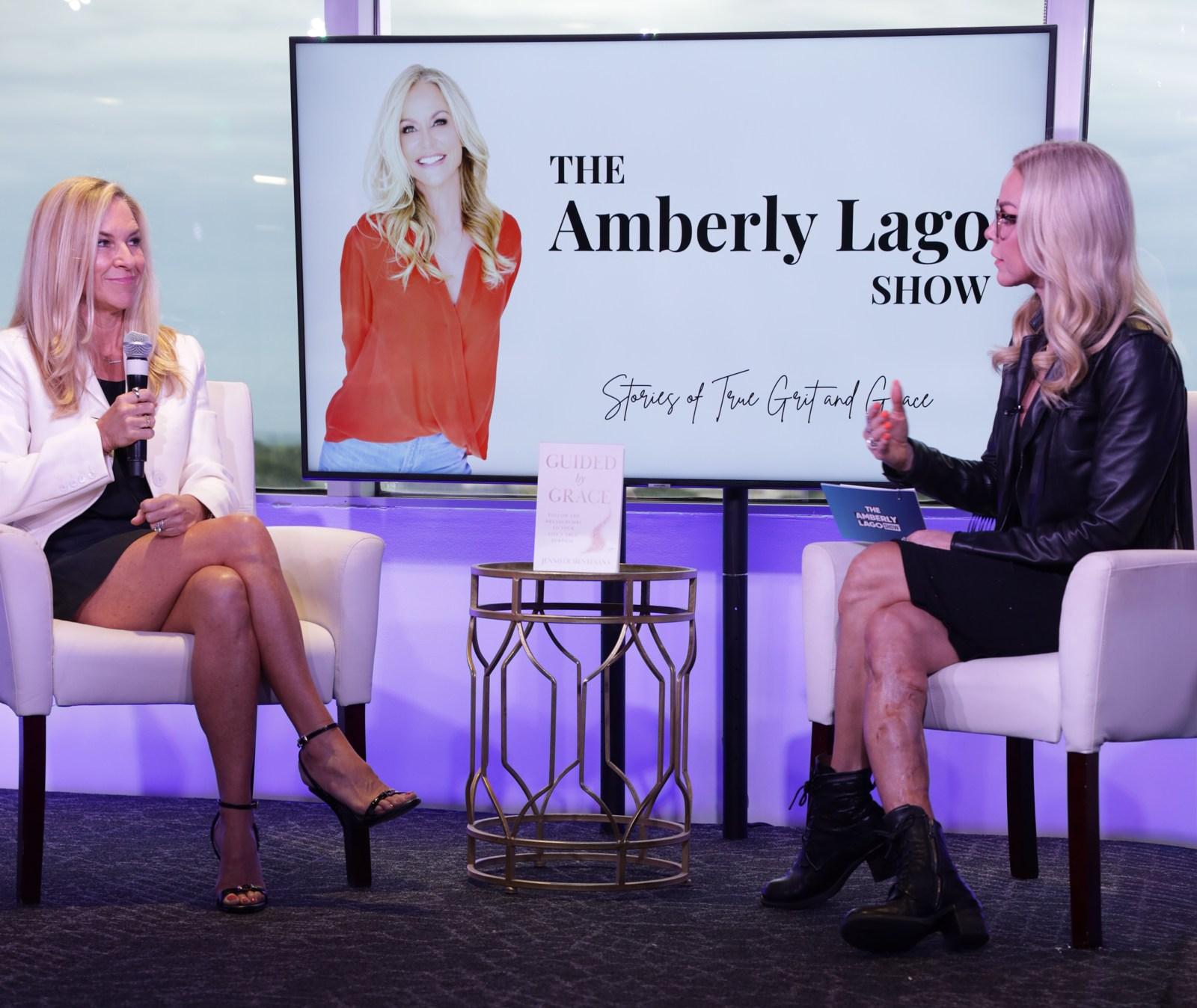
Season 6, Episode 228
Creating Legacy and Wealth: Garrett Gunderson's Tips for Entrepreneurs

About This Episode
In this episode of The Amberly Lago Show: Stories of True Grit and Grace, host Amberly Lago welcomes financial expert and New York Times Best Selling Author Garrett Gunderson to shed light on wealth-building strategies and the art of mastering your money mentality. Garrett unveils essential finance hacks for entrepreneurs, the concept of a family bank through cash value insurance, and ways to leverage comedy to make sense of finance. They candidly discuss personal battles with money perceptions, the importance of investing in oneself, and strategies for nurturing an abundance mindset over scarcity. Dive deep into their personal experiences with wealth, struggles, and breakthroughs, as well as the implications of Garrett's unique methods on personal growth and financial understanding. Join Amberly and Garrett as they navigate through the realms of financial intelligence, wealth psychology, and achieving sustained prosperity in life and business.
Learn more about Garrett:
Garrett Gunderson is a renowned entrepreneur, financial educator, and New York Times bestselling author. With a passion for helping individuals and businesses achieve financial independence, Gunderson is known for his expertise in wealth-building strategies, asset protection, and cash flow optimization. Through his books, speaking engagements, and consulting services, he empowers people to take control of their finances and create lasting prosperity. With a focus on innovative financial solutions and a commitment to personal development, Gunderson continues to inspire and educate audiences worldwide.
If you are ready to leave your mark by discovering your message and sharing it with the world, you've come to the right place!! Let's work together to build your influence, your impact, and your income! Join the tribe you have been waiting for to activate your highest potential and live the life you deserve! Join the "Unstoppable Life Mastermind!" and let us know you are ready for greatness! Read the "True Grit and Grace" book here and learn how you can turn tragedy into triumph! Thank you for joining us on The Amberly Lago Show: Stories of True Grit and Grace! If you find value in today's episode, don't forget to share the show with your friends and tap that subscribe button so you don't miss an episode! You can also head over to amberlylago.com to join my newsletter and access free downloadable resources that can help you elevate your life, business, and relationships! Want to see the behind-the-scenes and keep the conversation going? Head over to Instagram @amberlylagomotivation! Audible @True-Grit-and-Grace-Audiobook Website @amberlylago.com Instagram @amberlylagomotivation Facebook @AmberlyLagoSpeaker
Full Transcript
Welcome to the Amberly Lago Show. Stories of true grit and grace. Hey there. Thanks for tuning in to the Amberlee Lago Show. I'm glad you're here because today we're going to talk about something that we haven't really tapped into into this show much about money and wealth building. And I have the expert on money. I have the amazing New York Times bestselling author and Wall Street Journal bestselling offer several times. He's got 10 books. We're going to talk about one of his books today that I can't wait to dig into, Money Unmasked. I have Garrett Gunderson here with us. He is a speaker. He does programs. And I can't wait to dig into this. So get your notepad and pen because you're going to want to take notes. Welcome to the show.
You're so welcoming and easy to be around. You know, you have such a pleasant nature and like, so inviting. So I appreciate being here.
Oh, thank you so much. Well, I big shout out to our friend Carrie, Jack, who introduced us.
Yeah, love Carrie.
I knew when he introduced, when he introduces me to somebody, I know they are pure gold. But I will get into these. We're going to get right into these.
I only knew how much I relentlessly teased Carrie because I don't know, like, one of the things I do is comedy. And I'm actually in Dallas tonight to roast someone, you know, which is one of my favorite things to do. And anyone that's ever written a book is very roast worthy. I'm sure someone could really tease me about stuff in my book, you know.
Well, you know what, that's interesting that you bring that up because you are funny and you make learning about money more interesting because most of the time it's very intimidating or it's very boring and you bring comedy into it. In fact, you went and did a comedy show and your wife said, yeah, he was. You're actually kind of funny.
Yeah, she made that mistake because what happened was in like 2006, I'm at a black tie function at the Four Seasons and had drank too much tequila and someone at the table's like, you should go up and tell some jokes. And when the band finished, I went up and got on the microphone, slurring my words, not landing the jokes. My wife left the room. No, she went back to the hotel. She came back. I was still up there drinking and telling jokes. And so for the longest time, when I would say, hey, I've been speaking and people laugh a lot, I Think I should do comedy? She's like, I don't know if you're as funny as you think you are.
Oh, my goodness.
And then. And I was like, but they're laughing. She's like, yeah, but you're making them money, so they're being nice. That's literally what she said. And then we're at this baseball game and I kept making her laugh. She goes, where'd you hear that? I'm like, from my own brain. And when she said kind of funny, I translate it into comedic God. And so that was the problem. And within. Within a few days, I was speaking an event. The guy said I was hilarious when he introduced me. So I told some jokes and then I did an open mic a few days later. And four years later, I filmed a comedy special.
And now you. Oh my goodness. And you have like a one man show and you're.
That's my favorite thing in the world to do. Very challenging. It's probably like 2011, 2012. I was speaking at MIT. I'm on the bus next to another speaker. I'm like, what do you do? He goes, a one man show. And in my head I was like, what the hell is that? And then he did it, and it was phenomenal.
And you rehearsed and practiced and practiced that to get it down and you did your reps.
I mean, I hired a director, I hired acting coach because I was a horrifically bad actor the first day I tried.
I'm glad that you share that. So people know that you're just like, oh, I'm gonna do this. Like, it takes a lot of work. And you were saying it took seven. Was it seven years to write this book?
Yes. And this book is heavily like influenced by the theatrical keynote, the one man show. So they're very hand in glove and very similar about these like four money Personas and how we can heal our relationship with money and understand what kind of our subconscious beliefs are they. Do they sabotage our success or the things that we could do to be more, you know. And part of it is even when I had the dream to have a one man show, it came to me in a dream. I turned to my wife. I'm like, I want to do a one man show. She's like, that's cool. What's that? She didn't even know, but she's supportive. And I immediately go into this formula that's in this book, which is co creation. Who's one person I can call right now to move this forward that can support and inspire Me and keep me accountable. So I called that guy that did the One man show. He told me who his director was, he told me who his movement coach was, and I just got into action.
Wow. So you had a movement coach, too?
Yeah, his name is Jean Louis. He coached Austin Butler in Elvis. If you saw him, I mean, like, he's just next level. Jean Louis is the best. And he's just so. Yeah, so. And just this week when I spoke to him, I was like, man, your movement on stage. So it was intentional because of work with guys like Jean Louis.
Wow. Help me understand my body as a speaker. Just can you? There's a lot of speakers that listen to the show and a lot of people that want to be speakers. This is off the money subject for just a minute, but what's some advice you can give me as a speaker when I'm on stage?
So the two things I do before I go on stage. Well, three things that I do primarily is I listen to five different songs that have five different rhythms to them. And this is weird, but I'm just in my room and I just move my body based upon the rhythms. And what it does is it brings forward my emotions and it loosens me up. And then I do Jean Louis constructive rest. He has a book called Back to the Body. And I listen to his voice for 15 minutes while I. While I relax and rest. And then when I stand up, I stand up much more straight, much more broad. And I let my. Like the way my knees lead with my feet, it's so much easier. And so I used to bend down or crouch down sometimes, and now I just take up more.
You're making me sit up.
I let my hands do a lot of the talking in bigger ways. And so it just like the crowd can, like, feel that in a much bigger way. So.
Yeah, that's amazing. Well, you know what, What I do before I go on stage is push up some pray, which is very similar because it's. And then when I get on stage, I dance. I can't help myself. I used to be a dancer.
That's great.
And I used to. I had somebody that told me, don't dance on stage. Like, that's not professional. So now I dance on stage every single time. And in fact, I'm having an event in April and I'm planning a whole, like, flash mob dance.
Well, I'm. I'm 45 years old and white, and I do spoken word. When I finish the One man show, you know, it's like I want to
hear That I haven't heard that yet. So I want to hear that. I don't want to hear that. I'm going to watch, I'm going to find. Is it on YouTube?
I'll share it with you. I'll send it to you. Even though I opened my comedy special is I wrote every different phrase that's negative about money. And I wrote like an entire rap around that and performed it like a music video because it's called the American Dream. And it's like, hey, these are all the things that are kind of holding us back. And then I just say, wake up. This isn't a dream. It's the American Dream. And then we go into the special. So I just like using elements of performance because it's fun, it's challenging, and I think it's more engaging.
Yeah. And, you know, one thing that you talk about, of the many things that I love that you talk about is mindset around money. And I think so many of us are held back by our mindset. We don't have that abundant mindset. And I remember, I remember the first time, it was my very first time launching a course. And I told my husband, I was like, yeah, I'm launching it today. It's, you know, 1197. And he goes, you really think somebody's going to buy that for $11.97? I'm like, no, eleven hundred dollars. Like, that was the difference in, like, I'm like, oh, no, I'm thinking bigger. Like, you know what I mean? Can you talk a little bit about mindset? Because I think so much of every. It starts with the right mindset.
Well, one, as I think people have a hard time valuing themselves. And that's what part of the problem with the mindset is. We've been indoctrinated that we have to sacrifice to succeed. And usually when we sacrifice, we allow other people to take over and then we feel controlled and suppressed by that. And then people become like victims and they blame everyone. Where if we really understand, like, what we're capable of in the world of service and solving others and solving problems and adding value and really invest in ourselves, it's about exposing those skill sets in the biggest way. And what has to happen is understanding the shadow Personas and the winning Personas of how we view money. And so the shadow Personas are always in isolation and scarcity and selfishness. And where the winning Personas are in collaboration, co creation, they're in really, like, thinking about impact and vision and being compelled by something that's beyond our reach, which allows for other people to support us and gather around. And, like, everyone wants to be part of something bigger. But vision's such a rare commodity in today's world because there's such a lack of vision, and people get stuck in trading time for money, and then they get in the scarcity of cutting back and scrimping and budgeting, and no one shrinks their way to wealth. And yet that's the mindset that far too many of us were taught as children. Live within your means. We can't afford this. And then we have that kind of circulating in our mind as a cloud that prevents us from being more expressive and productive and profitable.
Yeah, I love that. I think so often, you know, when I'm like, oh, this is a big risk. This is a risk, but I'm doing it, and I know the money will come. The money does come. It.
Right?
It does.
You create value first, and then money follows. Yes, because money follows value.
Yeah. How so? You're saying for someone to just, like, focus on, well, what is the value that they can bring? And you know what? I heard Dean Graziosi talking about this a lot. Like, in a time right now where there's so much fear about our economy and money, and he's like, just keep creating something of value, and you will always have money.
And you could look at all the time, people take in fear and complaint and blame and negativity around what's happening in the economy. And if we just allocated that time to something, investing in ourself, our emotional intelligence, our financial intelligence, into something that's creative, even having a hobby. A hobby will transform people's lives, because as we get older, it's like, oh, that's for kids. But if you could do something that you lose track of time, and it's not about you making money, you start to be able to listen to your intuition. You'd be able to start to just kind of listen to yourself. And I think that our purpose is more about what we remember than what someone tells us. It's just that we forget about that because of the stressors of life. And I think that we're at our worst when we succumb to stress and scarcity.
Yeah.
You know, if I haven't slept and I'm overly stressed, I'm more likely to be short with my kids or frustrated with something that's going on. But, like, I think a big part of our money is we take care of ourselves, and then all of a sudden, we're the best version of who we are. Not the worst version of who we are, but when people don't understand money, they get very scared, they get very fearful, and they either start to hoard it or chase it at the expense of enjoying life along the way.
Yes. You said something in one of your videos, by the way. Y' all have got to check out his YouTube. You're like YouTube famous. I'm like, what the heck?
I should have been doing more YouTube earlier. But, yeah, I'm starting to get a little bit of momentum there.
So, yeah, my kids.
Friends think that I'm YouTube famous because they have like 80 some thousand subscribers.
87,000, by the way.
So. So. But yeah, it's, it's. It is kind of nice. It just took me a while to figure out what I wanted to do because I haven't been on social media most of my life.
Yeah, I will leave me. I didn't get on social media until I wrote my first book and then I didn't. I'm on TikTok now only because my daughter told me I was too old to be on TikTok. And I was like, oh, watch this. Yeah, watch. Well, what would you say to somebody who has a lot of fear about, like, they don't want to lose their money, they don't want the government to take their money. They, you know, they're hiding money under the mattress. What's one thing they can do to start to shift their mindset towards a mindset of abundance?
What's their first memory of money? I'd take them there. What's the very first memory they ever
had that makes sense.
It's going to tell them where they stopped maturing when that was the first negative experience.
Yeah.
So I remember my first memory was hearing my mom and dad talk about it. And the mine, my dad was a coal miner and the mine was on strike and them talking about, like, how they were going to handle their bills and how they, you know, and I was thinking, man, if I could just make enough, my whole family would be okay. Yeah, right. Which. Which was helpful but unhealthy because then I. In my 20s, I just relentlessly worked.
That's what I did. I had four jobs in my. By the time I was a teenager, I had four jobs and I just had that mindset. I have to work hard, I have to work hard, I have to work hard.
There's never enough, though. That's the problem. And my family, my great grandfather came over from Italy and his wife was pregnant, but he couldn't put food on the table. So he didn't meet his daughter till she's seven years old. So that permeated in every cell of my family's body, that you've got to hold on what you got or else you could be separated from your family. And so they hoarded cash and they did everything they could to save it, but then it became like an obsession that ruined their ability to enjoy each other. As a matter of fact, my grandfather and his sister didn't Talk the last 10 years of her life over a money issue.
Wow. Yeah. Money is, I think, maybe the biggest in marriages. Maybe the thing that the. That couples fight over.
Yeah. It's listed as the number one reason for divorce. Now, I. I believe that this is what I think. This is my theory. I'm not like, I haven't proven this completely out, but I. My belief, just from the people I've talked to and thinking about it, is they list money because when we're in scarcity around money and fearful of money, we stop dreaming. And when marriages are good, they're excited about their future. When marriages aren't good, they're remembering when it was better in the past. And so if people feel like their best years aren't ahead of them and money is the reason, then the non breadwinner will start to feel a lack of stability, a lack of security, and figure out, what can I do to get security? No longer thinking about how do I have love in this marriage and how do we support each other? And so, I mean, when I was first married, my wife's a patient woman because I actually was a miser at first, really, because that's what I learned from my family. And they put cash in coffee cans, put it in the cellar. And so, like, I remember her dad was like, hey, you know, if you want to live in our basement rent free, you can. So I told her, I'm like, hey, we can live in your parents basement rent free. She's like, sex free if you think that's where I'm living. And I was like, okay, I can't
wait to meet your wife. She sounds amazing.
Pushing back. And I was like, but then even our first Christmas, I bought her a phone case that didn't fit her phone because it was in a clearance bin. Like, I was a miser. And it wasn't until this woman, Nancy, was talking to me, she's in the financial space as well. And she's like, I wonder what it's like living in the financial prison you built for your wife. Wow. I was like, oh, Damn, I'm an A hole. And it was one of those before and after paradigm shifts.
Yeah. Sometimes that's all we need is just to hear a certain thing that will just completely shift it for us.
And if you're triggered by it, you gotta look at it because it's striking your nerve. Because there's something there.
Yeah. Right.
And it's usually some promise we made as a kid, like to never feel that again, never experience that again. And it's like paradoxical. We hide it from ourselves. So it's just things that remind us and we start pushing away and nobody understands the behavior but us.
Yeah.
And even it's hard for us to assess because we didn't want to feel that again.
Yeah.
So we just start pushing away.
Well, it's interesting, the relationship, the different relationships people have with money. In fact, you know, my husband might be upset, me saying this. Sorry, honey, if you're listening.
But you're glad he listened. I mean, that's. That's nice.
Yeah. Yeah. Glad he listens.
Actually.
He actually does. He'll put it on. Yeah.
My wife has this book on the nightstand. I don't know if she read it, but, you know.
Yeah. I bet she subscribes to your YouTube, though.
My kids watch a little bit of it. Well, I have my oldest actually doing some of the editing for me.
Oh, man.
That's how I get to get the education to them, right?
Yeah. Yeah. Awesome.
At a family thing the other day, you know, as you say, dad, create a life you don't want to retire from. My 18 year old. It felt really good.
Oh, that's awesome. That's awesome. Yeah. I had my daughter in the studio with me yesterday. But yeah, when my husband and I first got married, I was like, oh, no, you're not. We're having separate bank accounts and you are not going to be on mine. And it wasn't until my motorcycle accident when he couldn't access money to pay bills that he was like, I was in a coma. And we had to make some changes that shook us up in every way. But a lot with the money. And so much about the money is trust and that sort of thing. But one thing that you talk about is how a lot of people build their legacy, but they're not living their legacy. And I think a lot. There's a lot of entrepreneurs that listen to the show and there's a lot of entrepreneurs that are struggling because they're grinding.
Right.
They're burning out.
There's no time for the legacy. That's for someday.
Yeah.
Because there's no more capacity.
Yeah. There's like no more hours in the day.
Why, why do we have such a negative relationship with the word contentment? Like, I've been contemplating this a lot.
Yeah.
Like, I think we could still grow and be content.
Yeah.
But I think most people confuse and think it's complacent.
I think it's how what society is teaching us, like, no, you gotta strive for more. You gotta, you know, which. That's nothing wrong with striving for more. But like.
But what is more? Yeah, that's the question. Like, and when is more enough?
When is it the question? That's the question my husband asked me. He's like, you work so hard. When's enough enough? You know? And I'm like, but I love what I do, you know, but you're right. When are you going to be content?
I put most of the stress on myself with artificial deadlines that I created.
Oh, I do the same thing. You should see the sticky notes that are on my computer, in my journal, in my calendar, old school calendar. Like, yeah, I do the same thing.
And I'm like, I get why I did it when I was younger because I was trying to. I was trying to validate being lovable.
Uh huh. Look. Hey, I'm wearing a necklace that says worthy that my friend Leah Valencia gave me right off of her neck. And I did more, worked more, provided more. And that's how I felt. Worthy was, I can provide for my family, I can work hard. And that all changed. I had to discover my worth.
When I think of like the. The depth of love I have with my wife has nothing to do with accomplishment. There's no prerequisite. It's not even explainable necessarily. Yet in the world, I had been easily swayed and trapped into what I call like winning the booby prize. Okay, I'm helping everybody else out at the expense of my own health, at the expense of my own family. And I think maybe that's just what we do in our 20s. Yeah, maybe it's.
But some of us still.
But some people still do that. And now it actually has an impact on health. I feel the effects if I start getting into the striver mode and pushing too hard. And I have to remind myself, I'm like. Because the name of my theatrical keynote, my one man show, is called Already Won. Like, look, we've already won. The fact that we're alive, the fact that we have intrinsic value because we're human. I feel like we're all interconnected there's all these reasons that we've already won. We're just so good at figuring out what's not already done and thinking that that somehow defines us.
Yeah.
You said to me, you're like, oh, you're in your Internet or YouTube famous. And I immediately was like, well, right. Or I say I said something to you earlier, and you like, oh, well, like, it's just kind of this nature that we're, like, striving for this perfection.
Yeah.
But perfection isn't actually attractive. It's. It's. It's somewhat repulsive because it has us. Like, it has us.
I always say it's boring.
Yeah. And, like, when people are constantly talking, like, about themselves to me in such a way without any of the. I'm like, oh, man. They really are struggling, loving themselves. Oh, and my life changed one day where someone was, like, doing that, and I was like, I'm just gonna become a fan of theirs, just gonna cheer them on. Then we became super close friends. Like, sometimes the people that need love the most seem like they don't because they're putting on a facade. And, look, money is just something that's all wrapped up in this. Because I think underneath every human is three words. Mi lovable. And money, for a lot of people, becomes the way that they try to achieve love, preserve love, or determine whether they're worthy.
Oh, my goodness. I remember there was a guy who asked me out years ago, before my husband and I got married. This is, like, 20 years ago. And he kept asking me out. He drove a Lambo, and he lived in a mansion. He had motorcycles and a lot of money. And he kept asking me out, kept asking me out. And finally, I did go to lunch with him. And we would go to lunch, and he pulls out his black American Express card, and the waiter was flipping out. And I was not phased. I just wasn't phased by that. And he finally had said something about, are you just not into cars or you're not impressed? Are you? And I was like, I'm into people. Like, real connections. But he got so much of his worth from flashing out the world.
The World Validator did that for him, I'm sure.
Oh, it did. But he was shocked that I didn't. And I wasn't trying to be mean. It's just that didn't. That's not what. I don't need your money. Like, that's. You know what I mean? Yeah. Well, I want to get into some. Some tips like that you have in your book.
Okay, cool.
I've got three pages of questions. I think I need to have you on again just so we can go over some of these. We talked about mindset. How do you, well, how do you create long term health or wealth? Health and wealth.
But yeah, it's very similar. I mean, I think that first off, we have to understand like what we're capable of. And it's about making more money first. So a lot of people skip that step or they don't find the right career for them or they don't create the right career for them because they circumvent the steps of discovery and get stuck in trading time for money or stability or perceived security or benefits. And so often or they think that getting a degree is going to get them there. But the reality is there's not enough contemplation about what do I really want, what am I capable of, who do I want to serve, how do I want to serve? And what ways can I expand my skill sets? What ways outside of a classroom do I want to invest and discover so I can be more creative? Like, whether it's like what you did,
you hired a movement coach, a director, like you did, because you expand, you're like, this is what I want to do. How can I get better? Add more value.
And you got to take it. Like, I think that part of creating wealth is taking a leap on yourself. You know, like a lot of people are afraid to take that leap because it's easier to work within a structure that you could blame someone else or it's not necessarily all your fault. But wealth only begins when responsibility is taken. That's the only way to have sustainable wealth. Investing in ourselves. But investing in ourselves comes down to three categories. Number one, quality of life. Because if you have a good quality of life, you're going to have more energy, you're going to, you're going to feel more vibrant as time goes on. Second is you're going to invest in the skill sets. And then third, invest in assets that create cash flow. Most people are investing in things that create no cash flow. They're waiting for 10, 20, 30 years to see if it works. And 95% of the time, according to the U.S. department of labor, it doesn't get them where they want to go. So they've spent all this time and energy sacrificing and budgeting, and it doesn't get them where they want. Where I would say they'd be better off investing in themselves and then automate their savings. So take a percentage off the top every time you get paid, put it in a savings account so you don't even have to think about it. You've paid yourself first, then you don't have to budget, you just load up whatever's left over.
So how much do you pay yourself?
15%. And that might be a lot for some people, but there's these four eyes that help people get there. Number one, most people overpay the IRS. So if you're a business owner, like 93 plus percent of people are tipping the government. Yeah, they just don't know, you know. Interesting. You can renegotiate interest rates, you can refinance, you could reallocate underperforming funds to pay it off. Number three, investments. There's a lot of hidden fees and non performing fees. And so if you can remove those, you'll have more wealth. Or there's a lot of people with insurance have improper structure. If you only serve the catastrophic, not the inconsequential, you keep more of your money. So those four eyes are a good way to find cash that's being lost to institutions to get you to your 15%. And the reason for 15% is we have inflation, we have tax fluctuations, we have planned obsolescence. Things break down, you have to replace them. We have technological change. And my favorite is propensity to consume. When I married my wife, she knew five foods, tacos, burgers, corn dogs. And then I introduced her to this whole other world. There's no going back. That's propensity to consume a luxury once enjoyed becomes a necessity. Right.
Well, I want to go back to the insurance part. Tell me about that. Like what kind of insurance should people be spending money on? I mean, we just got, they just, they moved to Texas, they upped our insurance. And then just yesterday my husband was like, they just raised the insurance $150 more. I don't know why I got a call. So what kind of insurance are you talking about?
So car home liability, disability and life insurance are going to be the main insurances to cover. And so if we're talking about car home liability, the first dollar of insurance you pay for is your most expensive dollar. The last dollar you pay for is the least expensive because it's the least likely to happen, but the most catastrophic.
Yeah.
So what that means is raise your deductibles to a place where you have enough cash to handle it. And if you can write the check for it and go to sleep tonight, don't insure it. You only insure something that could actually harm your legacy or be Costly enough to put you in a bad situation. So now you're just transferring big risks, not small risks. So if I had, you know, like, if I had a. My insurance go up here in Texas, I go, all right, what are my deductibles to have the same car and homeowner insurance company get the multi policy discount. I would go get other quotes and I would look at using an umbrella policy that sits on top of the car in the home, because you probably have more than one car. And what it does is it covers liability for everything in a more economical way with bigger dollars. So what you could do is take lower limits of liability on your car and home, put the umbrella on top of it. And all of a sudden, like we had someone here in Texas, her name was Glenda. We saved her $1,003 because she had Progressive and she had Allstate. I'm like, let's just pick one of the two, I don't care. And let's take your $100 deductible on your car and your $500 deductible in your home, move it to 1,000, and let's just add this umbrella policy. And what happened was it actually cost her $300 for the umbrella policy. So she saved about 700 when it was all said and done. Yeah, per year. And what the risk she took was $900 a year. So every two years she's ahead. Wow.
Yeah.
And you don't want to make, you don't want to make claims on fender benders or anything like that because it's going to raise your insurance rates. Just cover those on your own. Now, the biggest one, and I wrote a book called what Would the Rockefellers Do? That's very heavily talking about this is how we handle our life insurance.
Okay, I want to know about that. And just side note, I was having one of the. I had 34 surgeries and out of the 34 surgeries, I was going in for an ankle surgery. It wasn't as major of a deal to just put my leg back together. And the doctor goes, my husband goes, well, could she die from this? And the doctor looked confused. He goes, because I just upped her life insurance. And I just want to know. So, yeah, I want to know. But he was like, oh my God, this couple is crazy. But I want to know about the life insurance. What should we be doing with that?
Well, if you don't know anything about life insurance, the most important thing is to get the amount that would indemnify the loss so it's your economic value. Yeah. So if I were to die, I want my wife to live the same lifestyle as now.
Yeah.
And I can have an estate plan that says if she remarries, that person doesn't get to live the same lifestyle, but she does. Right. And the kids. And so I want to make sure that if I die, the amount of insurance that comes in would replace that over time.
Okay.
Some people are like, oh, well, I have millions. I'm like, but if you could never earn another dollar, is that a lot of money? And that changes the perspective.
Yeah. You're really good at, like, explaining things and also being able to explain it in a way that I understand it, you know.
Well, thanks.
No, I'm serious.
I think a lot of us writing a lot, you know, helps for sure. So you start there and then you go, all right, well, what's the right type of insurance after that? And I'm, I'm very partial to the thing with the most guarantees that's going to be around one day longer than me. So the death benefit comes into my family. It's the same thing the Rockefellers do, which is you buy, not you buy participating mutual life insurance companies, whole life policies. You overfund them so they, it's properly structured so it has more cash, less commission, and then a death benefit that's guaranteed to be around instead of having go away.
Oh, that is so helpful. I can't wait for my husband to listen to this, too.
You didn't even say the bad thing about your husband because we skipped over it.
Oh, oh, no. It was just that probably with the separate bank account. So I was like, you can't be on my account. That was it. You talk about building your own family bank. Let's talk about that a little bit.
Yeah, that's. So look, banking has its issues like regular banks. Yeah, right. I mean, and, and, and when you put money in a bank, they have to have reserves, but a certain percentage of their reserves go to cash value insurance.
Yeah.
Because it has a better rate than what the reserves do and has tax advantages. So why not just skip that step and do it yourself? And I use the banks with. I put very little money in the bank, but I like, they're convenient to pay bills and have accounts and work with my QuickBooks. But anything more than a month or 45 days goes into my cash value. My cash value, you know, might earn anywhere from 3, 4, maybe 5%, which
is a lot bigger than what savings had been.
And there's no tax on it. And it has a death benefit. And if I ever need long term care in the future, I can use 70% of my death benefit to pay for a nursing home. So it just removes all of these kind of risks. And here in the state of Texas, it's 100% protected from liability or bankruptcy, where your bank accounts not. And the number of mutual life insurance companies that have got out of business in the last two decades.
Yeah, it's kind of crazy, isn't it?
There's none. It's all been banks.
Wow.
So all the banks are going out. These companies aren't because banks are lending out their money too often. They're lending out more than $1 at a time. So think about it. If you get a loan from a bank, say it's a thousand bucks you have to deposit into a bank to use it. But when you deposit, it's a. It's borrowed money.
Yeah.
But they take and lend that out again.
Yeah.
Even though it was borrowed money. So they could do that like six or seven times. Insurance companies don't have that. They're not fractionalizing.
Yeah.
So that's part of the stability. And they also have very strict parameters of where they can allocate funds because they have to have reserves for claims. But even in 2001 when there was the, the towers came down and there's people that died didn't really do much to the insurance companies. They paid claims quickly. You know, when 2008 happened and the banks just got decimated, these companies were just fine. So I like to go with companies have been around for 100 years, always paid dividends, you know, plenty of guarantees. So.
Yeah, yeah. Well, you said in one of your videos, or maybe it was one of your posts, like how do you increase your income by 50% in a year? Or something like that. How do you, how does somebody, right now, today, how could they get richer in the next year?
So there might have been one. There's a few different ways to do this. So like let's say that someone's, let's say that someone's close to retirement age. If they have a death benefit, they can do things like charitable trusts, which are really cool. If you have like business that you're selling or a house that's you don't live in, like real estate or stock, you can actually donate to charity, get a tax deduction, sell it, fund the full charitable trust and live off the income. And they just have to keep at least 10% when you die, which essentially means you might have boosted your income 20 to 50% because you didn't have to pay tax.
Wow.
And you know, it's been around forever. That's one way. If it's someone that's in their earning years, how could they increase their income 50%?
Yeah.
I think that it depends on the business. But for example, in a business where, if it's a service based business, you would survey your customers and say, here's a service I've been offering. What other things would be really valuable to you? And you just create partnerships to offer those services.
Yeah.
And you get paid on those partnerships. So I do that with accounting firms or legal firms or stuff like that to provide more financial benefit to my customers without having to go build a brand new business as an example.
Oh, that's awesome. Well, I have a personal kind of question because I get frustrated with this. So I use Stripe and they take
a lot of money, a lot of fees.
Yeah. Yes.
They just keep going up.
Yeah. It's so frustrating. I mean, it's convenient.
Have you seen the movement? A lot of the movement is they're actually, the people are now like the business owners adding the fee to the customer.
Well, you know what?
And I don't know if that's what
you want to do. That just happened without me even knowing it because I got the fee and I was like, oh, wow, that was this much money. And they actually charged her credit card this much money. So they actually charged the client.
So I don't know what to do with like smaller purchases like books. But when someone's hiring me to speak and it's 25 grand, or they're hiring me to consultants. 25 grand, I'm like, here's my wire instructions.
Yeah, yeah.
If you want to pay via credit card, I add the 3% premium.
Yeah.
Just to, just to encourage them. Or they could do an electronic transfer or what, you know, or whatever, or overnight a check. I'm just encouraging them to cut out that middleman.
Yeah.
The most I can.
What I've done as well, especially with speaking, I'm like, okay, you can either give me a check or, or here's my bank wiring. I got it saved on my phone. Right.
So it's like it's saving every party involved.
Yeah. Yeah. Okay. Well, I was just curious about that. I. I just wish I could get rid of Stripe actually. But I need something for people to click and buy.
There used to be this membership that you could join that would give you like the first hundred thousand dollars on Stripe with no transaction cost. But it's gone now.
Oh really?
So I knew like I find out about little hacks over time, but.
Yeah. Well, what is a hack?
And I favorite.
What is one of your favorite hacks? That's what I want to know.
Well like one is sustainable wealth doesn't come from hacks. But like just thinking about like little tactics and, and tips, what would be my. I just think that saving tax is the biggest thing a business owner can do. It's just, it's the, it's the biggest movement. So there's four main ways that people miss saving tax. People know about deductions, that's fine.
Yeah.
But if you don't know about section 199A, that's one of the biggest deductions a business owner can take if they have employees to lower their tax rate or if you don't know, I don't
know what that is.
So do you have employees anyone? W2. So because you have W2 employees, you might. Let's just say that your tax rate's like 37 and a half. It might go down to 29% because of this pass through deduction called section 199A.
Okay.
And so it's because you have employment. Employment. And you know, it's like what Trump originally was saying he was going to lower the tax rate on all corporations ended up becoming this.
Oh wow.
But the four main ways, they're moving active income to passive income. So if you're the main owner of your business, you can be an S corporation, take a reasonable salary, which you could do calculations on that. And then for working on your business, you take distributions. Distributions, avoid self employment tax. So that's anywhere from 2.9, 3.2 or 15.3% depending on the amount we're talking about. Just because you've paid yourself with two checks instead of one.
Wow.
Or you can move ordinary income to capital gains if you're a really high income earner. And so there's ways to do that. Like if you did, if people are buying your books internationally, you can run it through an international sales corporation. It's all capital gains, which is going to be half your tax rate or tax free, like the charitable trust I just told you about or a thing called tax arbitrage, which is if you spend a dollar, you get more than a dollar back. Most people spend a dollar, they save 30 cents. That doesn't make sense if you weren't going to do it anyway. I believe in like I collect art and then I buy them in collections. And then after three Years, I can donate them for the full value versus what I buy a collection. And I got it at a discount, so it goes from book value to appraised value. And so now I'm giving artwork to museums every year and getting back $2 for every dollar I spend.
Wow, that is amazing.
Yeah.
I'm seriously gonna listen to this again and take notes because can you see? I'm just like, what? Okay, tell me. So thank you now. Well, and y', all, you can get all of these I say hacks. Cause I like my secrets. Okay. In money and masks. I mean, this isn't your only book.
It's my newest book, other than a children's book that just came out this year. Yeah.
And I can't wait for the. The children's book and the comedy book. So.
Yeah, that one. I don't know. Maybe in a couple years it'll come out. The manuscript's done. I don't know. I gotta find the illustrator. I've gotta work on the promotion behind it. But I'm excited about it because I feel like we need a Finance 101 book that everyone would read.
Yeah.
And if you're laughing the whole time.
Yeah.
You're learning three times as much.
Yeah.
And it's so true. It could be, like, one of those, like, table books that you just leave on the table. Right. Flip through or you're waiting.
Well, I think it would be, like, a really good book for me to give to all my Mastermind members.
Or, like. Yeah. And I think, like, graduation gift. Like, I'm just thinking, like, how. Because people are still buying all the places they'll. They'll go from Dr. Seuss as a graduation gift. And that's great. But, like, I think this could be way more practical.
Yeah. Yeah. You're amazing. Thank you so much for being on the show. Tell people the best place to find you and your books. And I'll have this in the show notes, so y' all don't worry. I'll have all of this in the show notes so you can find him easily. You definitely want to subscribe to his YouTube and also subscribe to or go on Instagram. I, like.
I just started doing Instagram for the first time.
You did?
Yeah, I just.
You've already got so many followers, and I was binging your videos.
I went and spoke at an event, and someone said, you should. You belong on Instagram. I'm going to help you build a few followers. And just as a favor, they got me those followers. I don't know how they got there, um, but just two months ago, from the time we're recording this, I was like, I'm committed to posting three times a day on Instagram. And I'm committed to while I'm in the sauna answering comments on Instagram. Although, like every fourth comment is, hey, do you want an editor? Do you want a thumbnail? Whatever it is. But yeah, yeah, I'm actually really trying to engage and understand the marketplace as much as I can, so I can customize what I'm building to really support them. But yeah, YouTube's been my home for the last couple years. That's where I have a little bit more following. But I am. I'm working the Instagram and I actually gonna start putting quotes on Twitter or X or whatever it's called.
Or Twitter X, whatever. Yeah. What? I gotta change those on my website to X now instead of the little bird. But yeah, tell us again where you can.
So garrettgunderson.com youm can take the Money Persona quiz there. You can buy books there. You could read my blog. I love writing, so I write a blog every week.
That is amazing. That's amazing. So you write your blog and if you go on his Instagram, you can click one of the links and watch his videos there too. So you offer so much value. Thank you again for being on the show. Thank you. And thank you all so much for tuning in. I appreciate you take a screenshot and share it on your Instagram. When I see that at Amberly Lagomotivation. And you can also now tag, since now Garrett is on Instagram. Tag him.
Garrett B. Is in Boy Gunderson Garethson.
Well, as soon as you put your name up, it pops right up. So when I. When I see you share, that just really goes straight to my heart. And I share it on my story when I see that. So until next time, thank you and we'll see you soon.
Pain to purpose to joy.
Never Miss a Conversation
New episodes drop regularly. Subscribe on your favorite platform and never miss a conversation.