

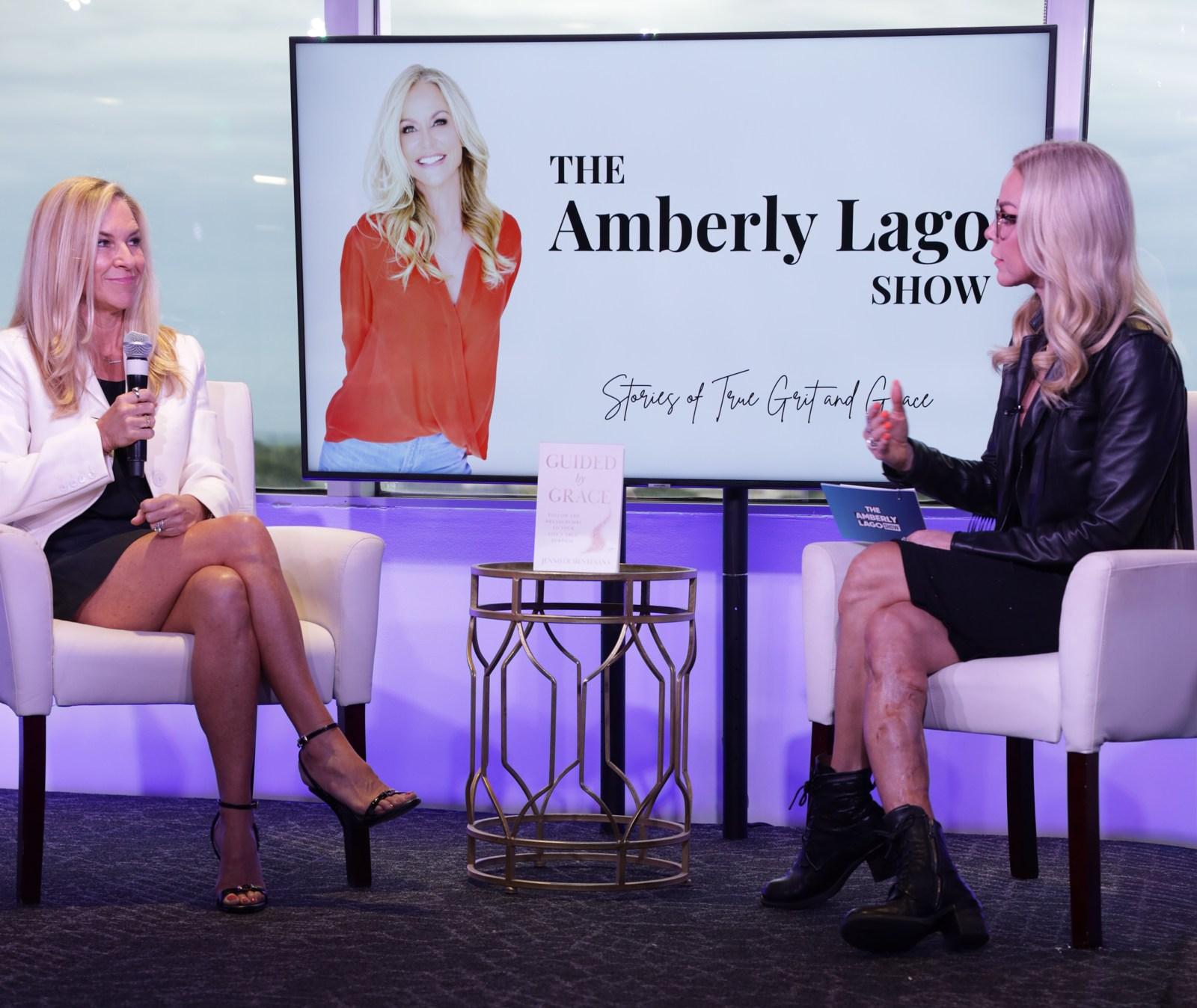
Season 6, Episode 227
Unleashing Potential with Justin Roethlingshoefer: Health, Habits, and High Performance
A conversation with Justin Roethlingshoefer: Health, Habits, and High Performance

About This Episode
In this episode of The Amberly Lago Show: Stories of True Grit and Grace, host Amberly Lago welcomes performance coach and author Justin Roethlingshoefer for a deep dive into the intricate relationship between health, wellness, and performance. Justin shares his personal journey, characterized by an early obsession with health metrics, a battle with anorexia, and his path to recovery through God's grace. They discuss the societal pressures of physical appearance, the importance of a top-down approach to wellness, and the intertwined nature of spiritual, mental, physical, and emotional health. Sleep, consistency, and heart rate variability also take center stage as Justin sheds light on their impact on well-being. Furthermore, he discloses the actionable steps towards habit change presented in his latest book "The Power of Ownership." Join Amberly and Justin as they dissect the crucial elements of a balanced and intentional lifestyle, debunk health myths, and emphasize the power of personal growth and health optimization.
Learn more about Justin:
From a young age Justin Roethlingshoefer has always been self-motivated to improve, developing the discipline and work ethic necessary to excel. At 13 years old his father said "son, talent will get you noticed but consistency will get you paid" and that set up his quest of founding Own It.
Over the last 20+ years Justin has worked with Stanley Cup Champions, NHL MVPs, Super Bowl Champions, Olympians, 8, 9, and 10 figure entrepreneurs and fortune 500 companies. After completing his MS in Sport Performance and Human Biology, Justin sought out post graduate work in functional medicine. He has worked as a Performance Director in the NHL & NCAA, and founded a private camp for professional hockey players focusing on healing them from the inside out. He is an Amazon best selling author for his books: Intent, Blueprint, and the Own It Manual. They focused on peak performance, human optimization, and applying data and testing to create personalized blueprints.
Justin's knack for making the complex simple is among the best in the performance industry. Nobody takes the latest research on nutrition, training, and recovery, and packages it into digestible, systematic and applicable steps, so that you can have agency and live differently.
https://justinroethlingshoefer.com/speaking/
http://Thepowerofownershipbook.com
If you are ready to leave your mark by discovering your message and sharing it with the world, you've come to the right place!! Let's work together to build your influence, your impact, and your income! Join the tribe you have been waiting for to activate your highest potential and live the life you deserve! Join the "Unstoppable Life Mastermind!" and let us know you are ready for greatness! Read the "True Grit and Grace" book here and learn how you can turn tragedy into triumph! Thank you for joining us on The Amberly Lago Show: Stories of True Grit and Grace! If you find value in today's episode, don't forget to share the show with your friends and tap that subscribe button so you don't miss an episode! You can also head over to amberlylago.com to join my newsletter and access free downloadable resources that can help you elevate your life, business, and relationships! Want to see the behind-the-scenes and keep the conversation going? Head over to Instagram @amberlylagomotivation! Audible @True-Grit-and-Grace-Audiobook Website @amberlylago.com Instagram @amberlylagomotivation Facebook @AmberlyLagoSpeaker
Full Transcript
Welcome to the Amberly Lago Show. Stories of true grit and grace. Hi there. Welcome to the Amberly Lago Show. I have a real treat for you today. I have my friend Justin Rothling Schoeffer, which it took me a while to learn his last name. He is. Oh, my goodness. He's got a new book coming out. He's the founder of Own It Coaching. He happened to be out here in Dallas doing a keynote. He travels all over doing speaking and I'm like, yeah, I want to have you on the show. Can you come and stop by the studio? I'm so excited to talk about his journey to where he is today because you're going to be so inspired. You're going to want to take your health back. He really, look, he helps you take control of your health, wellness, mindset to feel and perform your best. So he's going to teach us all his tricks and tools today. Justin, thank you for being on the show. Welcome to the Amberly.
So great to be here. Amberly. We've had such a long relationship virtually, and now that you actually get to. Can you believe this is the first time we've met in person?
I know. And it's been. Yeah, well, I forgot to say he's got a top podcast and I had the opportunity to be on your show. Or was it a summit that I spoke at?
No. So we, we had you speak virtually to our audience and then we had you on the podcast and then we've got you coming back speaking to our couples collective here in. I know I can't in a few months. So it's been, it's this crazy, like two year virtual relationship that has now culminated with an in person meeting here in Dallas, which is so exciting.
And I had the chance, I got to read part of your new book that's coming out, which I was like, oh, no wonder. There was instant connection because you and I both grew up athletes. But there's something that your dad said to you and so when you were 13, you really dove all in as far as like the health and how could you be your best? And he said, talent will get you noticed, consistency will get you paid. And you took that to heart. And can you take us back to when you were that age and you started really like going all in as an athlete?
Yeah. So I think the unique part about this is that when he said that to me, I was 12 years old and I was actually playing hockey with 14 and 15 year olds and I had gone through like this, this tough season. If you Will where just nothing was clicking and wasn't seeing the results that I was looking for. And I still remember he put his hand on my lap and he looked at me dead in the eye and he said, son, talent will get you noticed, but consistency will get you paid. And immediately, something clicked inside of me that said, man, how do I become the most consistent version of myself? What is it that I can start to control? What is it that I can start to lean into? I'm not enjoying my outcomes right now, but if I'm honest with myself, my outcomes are simple. The lagging effects of my habits and behaviors that I've been engaging in inconsistently and unintentionally for the last little while. And I've just been relying on what it is that I've been God given, which is a little bit of talent, and that won't get me to where I'm trying to go. And so it was that moment that I was like, I'm going to start taking ownership of some things. And I could take ownership of how I slept, of how I ate, of how I trained, of how I recovered, of how I prepared myself for what it was that I was ultimately striving towards. And. And when I say I went all in, Amberly, like, I went all in. Like, I was the weird kid. So at 13 years old, I asked my parents for a heart rate monitor. They go, what, are you sick? Like, is something wrong with you? And I was like, no, no. I just. I want to know more about this thing, more about this thing that I'm living in. So I started to measure heart rate variability, started to measure my training load and my heart rate during sleep versus during exercise and training bouts. I started to measure brain waves. I started to look at my blood level.
How did you measure the brain waves?
It was again, through a simple device that was available back then. It was through Pulse API. And I would wear a heart rate monitor at night. I would wear three sensors. Oh, yeah. Heart rate monitor at night. Three sensors that tracked brainwave states to look at alpha theta data when I was sleeping.
The depth of this is like, how many years ago?
This is 20, 21 years ago.
21 years ago. I mean, now you hear of more things like that because, like, I see you're wearing the watch I usually wear the Oura ring. And I got obsessed about the whole sleep. And I'm so glad, by the way, that my daughter, who's 15, is here at the studio with us and that she can hear it because she's an incredibly talented Horseback rider. So I'm glad she's hearing, and the audience, too, but I'm glad she's hearing exactly how you went all in, like with your sleep, measuring your brain waves. And then what about your food? Did you change your food up?
Yeah. So I. So I actually started to look at all the macronutrient breakdowns. I started to actually understand what was happening from. Again, when you start to look at blood work, I went and got blood chemistry done every quarter. And then I'd ask my doctors for the information back so that I could dive into it and start to look at some things.
What were they looking at in your blood? Were they looking at hormone levels, sugar levels?
So to be honest with you, even at that level, like, at that age, all they were doing was a simple CBC and a cmp, which is looking again at vitamin levels, looking at glucose levels, looking at cholesterol levels, fat levels, and really just overall nothing really specific to what we know now of what we actually do and how we operate with people at the cellular level. And looking at micronutrient deficiency, which is what I would have loved to do, but that didn't even really exist back then because, remember, this is 21 years ago. And even when I wanted a heart rate monitor, we went with. I had to go with Polar. Polar was one of the first ones that actually did heart rate monitoring.
I used to put those when I was a personal trainer. I had a polar heart rate monitor that I would put on some of my clients 100%.
And think about this. This is the craziest part. You can get these things for like 20, 30, 40, 50 bucks now. And it's not a big deal to have a wearable device or a heart rate monitor or a pulse oximeter or something like that. That's fairly cheap. Well, that's just 21. A Harib monitor was like $1,000.
Was it $1,000?
It was $1,000. And my parents came to me. They were like, justin, like, what do you need this for? And I said, guys, honestly, I just need this thing. It's going to help me. It's going to really help guide me. It's going to, like, help propel me and take ownership of my health in a unique way. And they were like, justin, this thing's so expensive. And I said, pool, grandma's money pool, grandpa's money pool, the aunt, uncle's money pool, your guys money. And pool my birthday and Christmas money, because this is what I want to do.
Wow. And now most kids that age would be Spending money on, you know, video games. Video games, fast food. But not you. You were focused, laser focused on your health. That must have made your parents really proud.
It was. And it was to an extent, because I think for.
Were you obsessive about it?
This is where it really where I, I almost went to a deep end where it became obsessive and it became something for me because I didn't have the full knowledge, I didn't have the full education. There's a difference between knowing enough to be dangerous and there's enough of being truly an expert and educated. And I feel like on my journey there was this, I had to actually go through this time. So between the ages of 14 to 18, I actually became extremely anorexic.
You did? I didn't know that.
Yeah, extremely anorexic. Fourteen, I was about 100.
And there's not a lot of guys that talk about that.
No, it's, it's, it's taken me a while to be able to talk about it, to be honest with you, because it was, it was embarrassing for a long time and something that, so you would deprive yourself.
So the difference between the, you know, like I had some unhealthy eating habits when I was a dancer. I didn't. And even in the fitness industry, I didn't realize, like, it's not normal to eat a lot and then think, oh, I have to go run extra now. That's, that's not normal. Like I was doing way too much. So you were just depriving yourself of food.
So I had a multitude of things that was going on with me. So I was obsessive and compulsive about every behavior. I had major body image issues. You did in terms of how I looked. I went from, I was a heavier kid, so teased a lot, made fun of. I was always a very old soul, was always very interested in what was actually happening. You have a 13 year old kid that's wanting to look at heart rate variability, for example. So always different. And so I never felt like I really fed in. But a lot of that body image issue stuff was something that came out very heavily in this age bracket for me. And so I would run to classes, I would do 50 squats and 50 pushups before I allowed myself to put classes, pick my books up out of my locker. I would do.
Wow. So it was very like obsessive, compulsive almost totally.
I would run up and down the stairs three times before I was allowed to sit at the dinner table. After I ate dinner after you. 10 push ups, 10 sit ups. I would.
Did your parents see you doing this?
Oh, yeah.
And what did they say about it?
I mean, what could they do? They had conversations with me. They sat me down. I think here's the thing about my family. They are so loving and so kind and so supportive. That's all they knew how to do, was love me more, support me more and try to give me everything that they could. They took me to the doctors, they took me to the therapist. They took me to all the people that they thought could help, but really nothing set me free. There was this constant fear just crippling me inside that had its grips on me. And at 16 years old, I came up from the basement and when I came up from the basement, I saw my mom's face drop and I was like, I have no idea what's going on. I went to the bathroom and my face was yellow. Oh my God. You actually come back. And we went and got some testing done. I was going through liver and kidney failure.
Oh my gosh.
I had dropped from 148 pounds to 95.
I had no idea this about you.
Let me tell you.
When I was a dancer and then I was going through a horrible relationship. I turned vegetarian and I got off the plane from LA back. I came to see my family here in Dallas and my mom looked at me and she same thing. Her face dropped and I guess I was yellow. And she looked at me and said, where's my Amberly? Because I was like £112 and I'm five' eleven.
Yeah.
You know, so. Wow. I did not know that we had that in common.
Yeah. Yeah.
So what did you do? You saw, you were. Did they take you to the hospital, get you.
Oh, yeah, I still remember that. I mean, and here's the thing is I never identified as somebody who was anorexic. I never identified as somebody who was sick. I never identified with somebody who had an eating disorder because that's not something that I saw myself. I still remember walking into a lot of these eating disorder clinics, looking at everybody else in their skin and bones, being fed through feeding tubes going, that's not me. I don't need to be in here because I would leave and I'd go step foot on the ice playing AAA hockey. I would go step foot into the weight room. I'd go step foot in places where I felt like that's where my identity was, but still just this crippling fear that I couldn't eat anything. And I had to be able to perform and ultimately show up. And so I say all of that to say that the only thing that actually changed my thought process was I had a coach at 12 years old who I hadn't seen for about five years, and he saw me at 16. And I walked in the door, and he looked once, twice, and the third time, and he goes, oh, my God, Justin, right? He goes, are you okay? And I said, yeah. What's wrong? Like, yeah, absolutely. He called my parents that night. He said, hey, I want to really start working with Justin because something's not right, something's not okay. And we started to actually work on a lot of these things. And to be honest with you, it was God's grace that ultimately freed me from this and this realization that I had to choose myself and that I was already chosen. I was already chosen by him, and that I didn't need to prove myself to anybody. I didn't need to. I didn't have to say that I was good enough to be loved or good enough to excel or to exceed, but simply that just being me was enough. And I think that part of my journey was so imperative to shaping who I became and where I went. Because at 18, I came to the States on a hockey scholarship. I went and got two undergraduate degrees. I went from there and got my master's degree. I went from there and did my postgraduate doctoral work in heart rate variability and sleep. And it was all of this experience and knowledge of understanding it from a firsthand experience, understanding what the constitute of stress, mental, physical, spiritual, emotional, does to your body internally and how it can actually create just this massive disintegration of your health. And when you treat health, mental, physical, spiritual, emotional, in a disintegrated way, you will see the disintegration of your health. It will fall apart. It's like putting a rotten apple in a healthy bowl of fruit. It's only 24 hours before the rest of that fruit is rotten. And so you can't treat these areas separately. They all have to be treated together. They all have to be looked at together as one holistic unit. Otherwise you'll never actually get that true health that you're searching for.
Well, I thought about you. I mean, I've been looking forward to this interview and everything that you share. And by the way, y' all follow him on social media, because the things that you post are so inspiring. And I'll have the links in the show notes. But I thought about you because I was like, I have a headache and I feel A little inflamed today. And I'm like, I know what Justin would say to that. There are a lot of entrepreneurs that listen to the show. There are a lot of entrepreneurs that are really stressed out. And a little stress in the gym can be good. We grow from that. You know, you lift heavy, get stress, those muscles, and you get bigger muscles. But like the chronic everyday stress and the grind and what I see people doing every day, that's like slowly killing themselves or they're hitting burnout. What is one day, one way somebody can reduce that stress in their life, that they're like, yeah, I wake up with headaches and thought that was just part of, you know, being a mom and an entrepreneur or, you know, building up my business or what I'm doing. What is one thing that somebody can do today to start reducing their stress?
So the, I mean, the first thing, it also always starts with awareness. And I think a lot of times we're just not aware of where we're at. And there's this quadrant system I talk about where we've got. In the upper right hand quadrant, we've got this overreaching quadrant. You want to build a business, you want to build a family, you want to get fit, you want to change your circumstance. Life does a great job of stressing us and applying stress to us and helping us overreach. We have to live in this quadrant. This is a non negotiable. If you want a life that's extraordinary, you have to live here. But the thing is, type A people, people who are pushers, people who are achievers, they think you live here, and that's not the case. If you're gonna be pushing and you're gonna be exalting and you're gonna be operating in this quadrant, you also have to operate in this bottom left hand quadrant, which is called regeneration. And you have to find a rhythm that tosses and turns back and forth where you're able to push, able to overreach, but then also able to intentionally and consistently behave in this regeneration quadrant and build up life by design that intentionally puts you going back and forth so you can perform and execute and live in what I call ownership, which is when you have that mental clarity, you have that energy, you have that focus. Because if we spend too much time up here, what ends up happening is we slowly start seeping down into that burnout space, into that space where we actually feel hopeless, we feel joyless, we feel like we're just.
You get to a point where you just don't care.
Yep. And you just feel like you're bogged down. And the crazy part about it is the longer that you spend down here, we actually put ourselves into what I call this area of fake health.
I want to talk about that.
Because on the far right side, you've got this true health space where you're vibrant, you're focused, you're clear, you feel good every single day. You've got more than enough energy to take the kids to school, to get done your to do list, to connect with your spouse, to get to the extracurriculars, to get all your to do's done. But then sleep well and look after yourself, and there's more than enough time. Then there's death and disease on the far left side, which is you got diagnosed with cancer, you got diabetes, you've had a stroke, you've had a heart attack, you're getting your chronic illness dealt with. But the middle space is where 90% of us live, called fake health.
Disease free, but you feel you're inflamed. Brain fog. Yeah.
Disease free, but symptom free.
I love when you explain it that way.
And when you're disease free and symptom full, you've got the brain fog, you've got the inflammation, you've got the headaches, you don't. You've got the weight gain you can't explain, you've got the gut issues, but you call that normal. You say, that's what it takes to build a business. That's what it takes to be a mom.
This is what I always love that people tell me, because now, you know, I'm. I'll be 52 soon. People like, oh, well, that's how it is when you get.
That's what happens where you turn 50,
you're going to gain weight, you're going to. Your skin's going to look bad. You're like, these are things I hear. And I'm like, but no, that's not how I want to be. I'm not. No, I'm going to.
I'm different. I'm different.
I'm like, that's not what I envisioned for myself. No. You know, and I do feel a difference in some that, believe me, I feel a difference. But it's like, yeah, People say, well, that's just how it is. And it's like, no, you're saying there can be something different.
Totally. These are all lies. Fake health. We don't have to live there. The world tells us that that's where we have to live. That's what normal feels like. But in actuality, the longer we live there, the faster that window closes, when all of a sudden it shuts and it thrusts you into this death and disease bucket where all of a sudden you wake up and you have diabetes, or you wake up and you have anxiety, or you wake up and you're 50 pounds overweight. It didn't happen literally overnight. It happened because you earned your illness. We earn our health, or you earn your illness based on the decisions and behaviors in which you continually have over and over, over again. Because chronic stress, our body doesn't know the difference. Mental, physical, spiritual, emotional, chronic stress leads to chronic inflammation. Chronic inflammation leads to chronic symptoms. Chronic symptoms that we consider normal. We just stay there and we live with it leads to chronic illness. And chronic illness is the leading cause of death in the United States at 71%. And it's amazing to me when we think about that, the leading cause of death in our country, 93% of those deaths are preventable through habit and behavior change. And so this is this concept to me that it comes back to really making sure we can educate, we can equip, and we can empower people with the information to take them from a state of knowing, because there's no shy of information out there on how to take ownership of your health, how to feel good. There's no shortage of information. People know what to do, but they still need to be convinced of it. If I can take them to a state of understanding what to do, they understand their body, they understand how the impacts of their habits are having. They understand what's going on. They're now convicted to create some change. And that's where I want people to get to. And so that's why I constantly talk about taking the same philosophies that the same systems, the same principles that we used at the NHL level with some of the best athletes in the world for the last 12 years. And now making those same systems, those same practices, those same philosophies available to everyone. So we democratize health, we democratize high performance, we democratize a highly intentional lifestyle so that now the outcomes that you're having are inevitable. It's inevitable that you're gonna feel good. It's inevitable that you're gonna have a great night's sleep. It's inevitable that you're gonna be mentally, mentally clear. It's inevitable you're going to lose the weight you want because you're acting in accordance with the habits and behaviors that make those outcomes.
I just love this. So Much. And I think the thing is, people don't realize that when you feel good, you can do more good. And I had. I was. I was burning the wick at both ends. I was really. And I had an assistant who. Oh, my gosh, I loved her. I love her. She had three kids and was like, I'm not going to work anymore. And I'm like, please. I was like, I'll babysit for you. Like, what can I do to convince you? But she told me something that really hit home for me. She said, amberly, your impact is only as strong as you are healthy. That's good, you know, And I love that you talk so much about health, about faith, about consistency, which is key. And I think that there are a lot of people out there that, you know, preach about how to be motivated and how to move forward, and they're obese. And to me, that's. That screams there's a problem, I think, you know, and I'm probably gonna get a lot of hate for saying that on the show, but, like, it screamed a problem. That when I was underweight, there's a problem. It screamed a problem. If. If you are walking up the stairs and you're out of breath and you can barely manage just to get up the stairs, there, there. Do you believe that there's a balance between, like, not that everybody has to be, you know, look like a magazine cover or anything like that, but I think they do have to take their health in their own hands so they can do better as a mom or dad or in their work or an athlete. And it is mind, body, spirit. Because. And look, I had somebody tell me that I needed to be on antidepressants. It was. A therapist said, well, you need to be on antidepressants because if you have to move your body to feel good, better than something's wrong with you. And I was like, but it does move my mood. Like, no, I know if I work out, I'm going to feel better. What would you say to somebody who's like, but I just can't work out? And, you know, this issue with losing some weight is not my fault. It's the medication I'm on. Or, you know, what would you say to that person?
The thing I tell it to say to people all the time is, you're not broken. You're not broken. There's nothing wrong with you. What I mean by that is the outcomes that you're experiencing are simply the lagging effects of your habits and behaviors, and it's not something internally that's broken in you. It's your order that's broken. And here's what I'll. And here's what I'll speak to that.
Oh, that's good.
The world has told us that you have to look a certain way, you have to weigh a certain amount of weight, you have to have six pack abs, you have to look like the magazine cover, you have to look a certain way in your clothes.
Especially with social media.
Totally. It's become absolutely perverse in what we see in our culture. But because we've taken what I call a bottom up approach. So physical first, let's be on this certain diet, let's work out this many times, let's execute these types of habits, let's cold plunge these amount of times. I have to sun, I have to get these things done. Yeah, the world's put this on us because I have to look a certain way, I have to cross this finish line. It ultimately poisons your heart. When it poisons your heart, it erodes you emotionally. So now you have a state of fear, you have a state of overwhelm, you have a state of anxiety, you have this emotional erosion that happens because we lead physically. That emotional erosion continues to drop the strength of your mind. So it's now I'm not good enough, it's now I'm not worthy, it's now I'm not far enough along. It's I'm never going to be able to do this. Which only takes you further away from what you're called to spiritually. That's what happens in the world we live in. Because the culture tells us to take that bottom up approach. Physical first erodes you emotionally, which degrades you mentally, which separates you spiritually. Well, how about if we took a top down approach? If we connected spiritually to the identity and desires that we have that are placed in us for what we're called to, which then all of a sudden solidifies and renews our mind, that tells us, no, you are exactly who you need to be. You are exactly where you're supposed to be, you are exactly good enough, exactly how you are, which then gives us the confidence, purifies our heart. That confidence to step into what we do, knowing that we can step in powerfully to then take action physically for what it is a priority in this season of our life. Is it going to the gym five days a week. Cool. Is it training for that marathon? Cool. Is it changing your diet? Cool. Is it focusing on recovery? Cool. But what does it look like? Because now Your order is right now. Your alignment is right now. You're not doing it for anybody other than yourself. And you now have a purpose and a reason that makes it intentional. Because the way I define performance is not outcome driven, not the way the world defines it. Rather, my definition of performance is the capacity and desire to intentionally and consistently behave at a level equal to your God given potential. And so if we can be intentional and consistent with behaviors and do them over the course of time, we can increase our capacity to match the level of desire in which we have.
Well, that's so good, by the way. That's so good. But. And I wrote something down here to talk because you said stop chasing results and start chasing the process. Chase the lifestyle.
Yeah.
And I love that you talk about it. Yeah. You don't have to look like somebody on the magazine cover. But it really ultimately is your actual health and how you feel. And you talk a lot about the consistency, but you also talk about how important sleep is.
Yeah.
So what amount, how much sleep should someone get?
Again? Anytime somebody asks me for a definitive answer, I always say, you're gonna hate my answer and I apologize. But it depends on who you are. It depends on who you are. Even like, what's the best thing somebody can do? It depends on who you are. It depends what season of life you're in. And so what I come back to is, what I come back to is the truth. The truth of sleep is that we sleep in 90 minute cycles. We have four stages of our sleep. We have slow wave sleep, we have deep sleep or REM sleep. We have a light sleep cycle and a wake cycle. It takes 90 minutes approximately for anybody to get through that full cycle. And all the data shows us that we need approximately five cycles per night. Well, five times 90, five times 90 is about seven and a half hours of sleep per night. And so if we need seven and a half hours of sleep per night and this is where we need to get into it, well, I should probably design my life accordingly. And I should probably try to be in bed by 10pm sleeping by around 10 or 10:30. If I'm waking up at 5 or 5:30 to get my 5 and a half, to get my 5 full cycles to bring me to 7 and a half hours of sleep. And the more consistent I can be with my sleep and wake time, it means that I'm gonna be getting better quality sleep. It means I'm gonna be getting deeper sleep. It means I'm gonna be getting more restorative, that I'm Going to be able to actually feel rested when I wake up. And it will create circadian rhythm, regularity, meaning that melatonin is high at night, cortisol is high in the morning, which will make me tired at night and wired in the morning. But the way we work is we go to bed so inconsistently. We go to bed with such poor habits and hygiene that we go to bed wired, and we wake up tired because we've now created inverse circadian rhythms.
Oh, that's good. That is good. Okay, so I have to admit something. The night before last, I get in bed, and my heart was just going racing. It was racing. And now you and I are both doing books, which is. No, that's the big deal. Writing a book is no joke. Putting on events you're speaking, traveling different time zones.
Yeah.
What do you suggest? When someone has that pounding out of their chest, like, fill their heart, You've, like. Almost like you feel your whole nervous system vibrating. You're wired is a great way to put it. Just wired.
Yeah. So there's two types of nervous systems that we have that are primarily always in battle with one another. One's not always on and one's not always off. It's almost like a dimmer switch. It's called the parasympathetic nervous system, which is more of, like, your rest and digest and then your sympathetic system, which is your fight or flight and go mode. And so what we typically see is people who are constantly wired at night, they are having a sympathetic overload or sympathetic tone late at night. And so what we need to do in our night routine is we want to make sure that we're preparing ourself for what is the most important thing that we do during the day, which is sleeping, which is going to give us the energy to ultimately restore us into where we're going. So a simple framework I have for people who are wanting to get the best night's sleep and really make sure that this is something that's optimal, is three hours before bed, we stop eating because there's 400 times more melatonin in our gut than produced by the pineal gland in our brain. And so if we're eating food late into the evening before we're going to bed, now all of a sudden, we don't get the melatonin release we need. We're now having to have a battle between digesting our food and actually getting us into deep stages of sleep. We're going to see an increase in cortisol when we should actually be Seeing an increase in melatonin, but we're going to have that battle. So three hours before bed.
But see, the way you explain really helps. I like to know why.
Totally.
Because people say that all the time. Don't eat three hours before you get. But. But why?
Yep.
You know what I mean? And that I think is when I, when I was in the fitness industry for 26 years, that was the time that was the hardest for my clients is they wanted to eat at night before they go to bed. Their willpower was out the window. They were good all day. Maybe they're in their.
But I'll even come back. Maybe they weren't good all day and they just didn't have good habits throughout the day. And that's when all of a sudden they were starving because they didn't eat all day and they didn't create a good eating window. They didn't create good eating habits throughout the day. So now they're starving at night and now they have time on their hands, they're not busy. So now it's like, oh my gosh, I'm going to eat the house. And then I don't sleep well. And it just creates this downward pinwheel. And so that takes us to number two, which is two hours before bed, which I'll get into answering your question in a second. I know I've taken a long way around it, but two hours before bed, no more decision making, no more cognitive thinking and no more problem solving. So shutting off all of your creative work, shutting off all of your work for the day, shutting off, I'm so fired. Shutting off, shutting off all of these hard, critical, analytical thinking. Because when we're thinking, thinking, remember mental, emotional, physical, spiritual stress, your body doesn't know the difference. So if now all of a sudden it's 8:30, 9 o' clock at night and I'm thinking, oh my gosh, how am I going to get my schedule done? How am I going to get this done? I've got to change this in my schedule. I've got to change this.
I have this, I have to do this, I have to do.
Yeah, your brain starts thinking about, okay, how am I going to problem solve this? How am I going to find the solutions to this? So it keeps going and it keeps going, it keeps going. And that's why you can't actually shut down. Which probably has a part of a reason why your heart was going so heavily that night, was because you're actually starting to think about that process. And then one hour before bed, no More blue light. Because for every 30 minutes of blue light exposure after sunset, it delays melatonin release by up to one hour. And so.
So no tv. No tv, no watching Shameless on Netflix.
So, no. So there's a caveat to this. But no blue light. It's on your phone, it's on your tv, it's on your computer, it's on your iPad, it's on all of these things. However, if you go on your phone and you can go in and you can actually put it onto night shift mode, where it actually pulls out all the blue light from your tablet, your iPad, your iPhone, so you can still actually utilize them, or you put them on grayscale. So it actually eliminates all of that brain stimulus as well.
I did not know that.
And then the other thing my wife and I do, because we are those people at night that the thing we love to do together, to wind down, is watch some stupid show that just kind of puts us into a space. I'm the guy that wears red light or blue light blocking glasses. So red frames. That eliminates about 90% of blue light that that's coming in. And the other thing that we do at night that really helps is we dimly light our house. And 90% of the time, it's all done through candlelight.
Yeah.
And it just sets the ambiance, sets the environment for where we're trying to go. And I talk about a lot of these things in my book, because heart rate variability is that measure of how your body's adapting to stress and strain. It's that language for, are you adapting well based on your habits and behaviors, or are you not? And then I give you eight levers or eight things that you can take control over. So exercise and movement, nutrition, sleep, hydration, environment, self care, immune function, and mindset. And so when you look at these eight levers or these eight handles that you can pull, and you now have a different habit set under each that you can start focusing on, you begin to have agency over your health to say, oh, you know what? I'm actually having a downward trend in heart rate variability, meaning my body's not adapting super well to my current habits and behaviors. It brings awareness. And now where on my journey am I not focused well enough that I can reestablish some intention to build a consistent habit around this? And once we understand heart rate variability and our eight controllables, our habits and behaviors, it's then that we can double down on some of our cellular testing, our DNA testing, our epigenetic testing. Our hormone paneling to learn more about this body so we can get more specific, more refined, more individualized in each of those domains and then continue to identify further what tools are going to be able to exponentially increase our ability to have capacity and do more.
Oh, this is so good. So we're running out of time. I want to make sure people know where to get your book. And also one thing that I think is really important is accountability. Like sometimes people just need that accountability. You have coaching programs and so tell people where they can find out more, how they can get connected with you and where can they find your book?
Yeah. So thepowerofownershipbook.com is where they can find it and get access to all the beautiful tools and resource vaults that we have access to there. And then for our coaching programs, OwnItCoaching.com is the best place in which to go. Like I said, it is truly a holistic model where you come into our ecosystem and you're gonna have three different accountability members behind you. You're gonna have a mental performance coach, you're gonna have a health coach, and you're gonna have a medical advisor that oversees everything. So when you get your testing done, you get your technology through your wearable device and then you ultimately have your coaching to help guide you and pull you along. It's literally an end of one solution.
Yeah. And I mean, look, you just came back. You go into corporations and work with huge companies to get all of their employees, like tell them how they can take back their health and feel better mentally, spiritually, physically. And so I just think it's amazing all that you're doing. Your book is coming out in April and we've got the same publisher, but it's the power of ownership. I just looked at your website. It's beautiful, by the way.
Thank you.
What now? So if somebody pre orders that is there, what do they do? You have stuff that you give them?
Oh, 100%. It's. You have to, right? You have to. So if you sign up early, get the pre order, you're going to have access to the resources vault, you're going to be a part of the pre launch team. You're going to get access to three lives with me again. You're going to go into a raffle to actually have me come out and do a keynote with you and your audience or your family or you, whoever. So we're going to give away five of those in that, in that component as well.
That's awesome. I know that Coach Dar did something similar to that to do. I don't know if you know her. She's one of my friends. I love her. But I am so excited for your book. So, yeah, y' all go out, follow Justin, check out his book. And like I said, I got to read part of it. And I was like, oh, my gosh, this is amazing.
Thank you.
And I feel like I could have talked to you for. I need to have you back on because this just, like, touched a little bit of all that you do. But thank you. Thank you so much for being on y'. All. Thank you so much for tuning in to the Amberly Lago show. And take a screenshot of this. Or if you're listening on Spotify or Apple, take a screenshot and tag us. Tell everybody your handle on Instagram.
Ustinroth is where I can be found. R O E T H. Yes.
I was gonna say spell that out, because I would probably spell it wrong, but yes. And me at Amberly Lagomotivation. And until the next time, we'll see you soon.
Pain to purpose to joy.
Never Miss a Conversation
New episodes drop regularly. Subscribe on your favorite platform and never miss a conversation.