
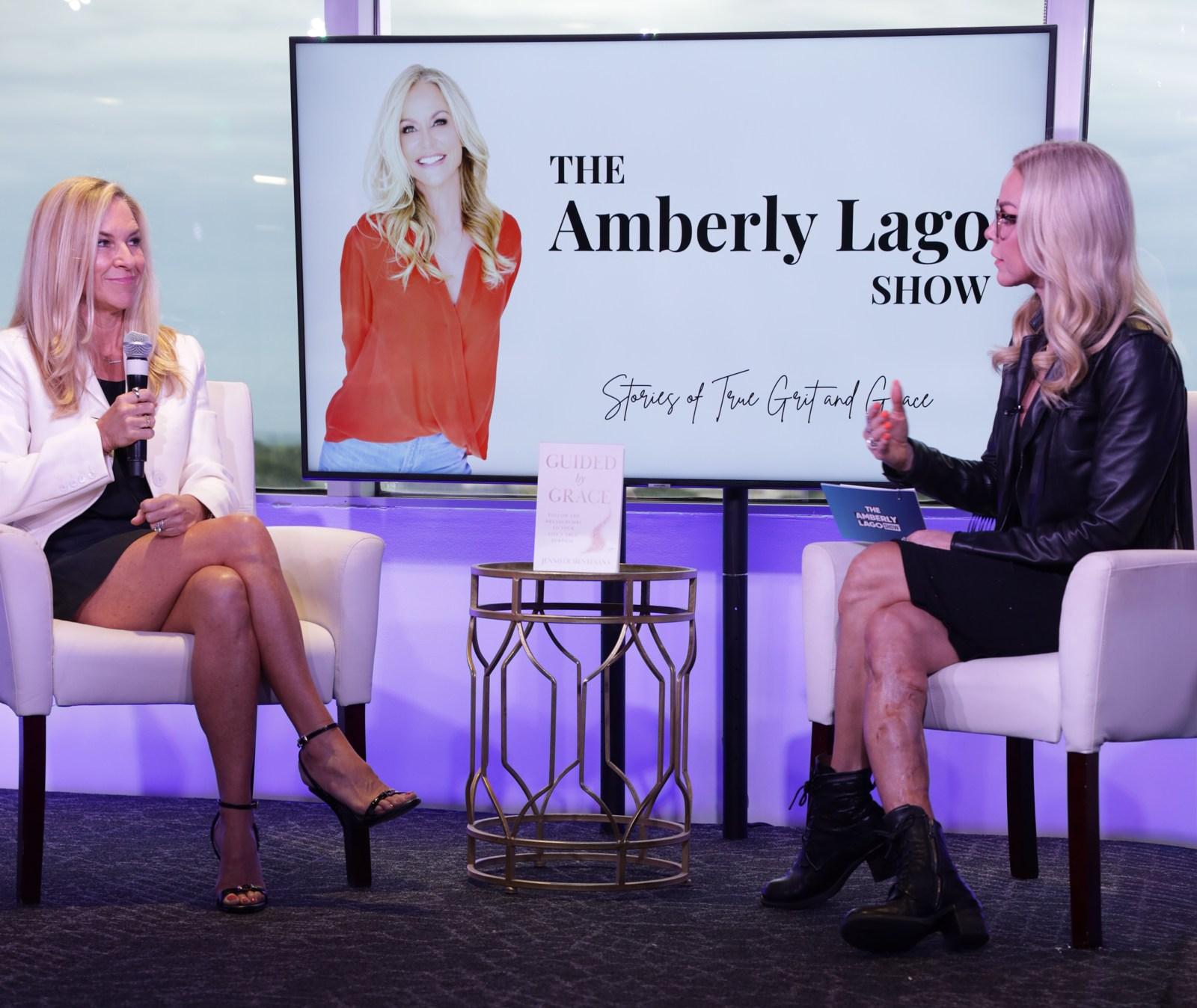

About This Episode
In this episode of The Amberly Lago Show: Stories of True Grit and Grace, host Amberly Lago welcomes facial feature decoder Brian Galke to unravel the mysteries of our faces and what they can reveal about our personalities and predispositions. With insights from Galke's expertise, they examine how even the subtlest facial traits can offer deep reflections of our character traits and social preferences. From the social implications of lip shapes to the significance of eye angles, this conversation exposes the subconscious messages our faces express. Galke also shares fascinating historical contexts of facial reading and its practical application in professions such as jury consulting. Join Amberly and Brian as they discuss facial features as keys to understanding behavior, the impact of face reading on communication, and the transformative art of connecting through our physical expressions.
Learn more about Brian:
Brian is an Introverted/Extroverted professional who discovered the secret to success:
Improving Communication Skills.
In order to overcome his social anxiety, Brian intentionally pursued positions where people naturally came to him for help (Retail, Service Industry, Helpdesk, etc). With every job, he sought to improve his social skills through learning tips and tricks to interact with others effectively.
But what was the one skill that changed everything for Brian? The ability to Decode Facial Features. By learning how to interpret the subtle signals that people's faces give off, Brian was able to better understand and communicate with others, which in turn helped him succeed professionally and personally.
As Brian's communication abilities grew, so did his career. Each new social skill he acquired brought him another promotion, leading him to leave the Helpdesk to become a Corporate Trainer, move into Sales, and even be flown around the US to present to high-profile clients worth over $1 million. Eventually, he was promoted to the esteemed position of Regional Vice President of Sales with a $40 Million Dollar book of business.
Brian left the corporate world to teach this skill to audiences on stages alongside renowned industry leaders such as Janine Driver, Brad Lea, Steve Sims, Greg Reid, Alex Hormozi, and more.
Social Media:
Website: https://subtleskills.com/
Instagram: https://www.instagram.com/subtleskills/
Youtube: https://www.youtube.com/@subtleskills
LinkedIn: https://www.linkedin.com/in/briangalke/
TikTok: https://www.tiktok.com/@subtleskills
Facebook: https://www.facebook.com/subtleskills
Cheatsheet: http://www.getthecheatsheet.com/
If you are ready to leave your mark by discovering your message and sharing it with the world, you've come to the right place!! Let's work together to build your influence, your impact, and your income! Join the tribe you have been waiting for to activate your highest potential and live the life you deserve! Join the "Unstoppable Life Mastermind!" and let us know you are ready for greatness! Read the "True Grit and Grace" book here and learn how you can turn tragedy into triumph! Thank you for joining us on The Amberly Lago Show: Stories of True Grit and Grace! If you find value in today's episode, don't forget to share the show with your friends and tap that subscribe button so you don't miss an episode! You can also head over to amberlylago.com to join my newsletter and access free downloadable resources that can help you elevate your life, business, and relationships! Want to see the behind-the-scenes and keep the conversation going? Head over to Instagram @amberlylagomotivation! Audible @True-Grit-and-Grace-Audiobook Website @amberlylago.com Instagram @amberlylagomotivation Facebook @AmberlyLagoSpeaker
Full Transcript
Welcome to the Amberly Lago show. Stories of true grit and grace. Hey there. Welcome to the Amberly Lago show. I'm so glad you're here. I have a very special friend. A real treat for y' all today. So grab your notepad and pen because you're going to want to take notes. I have my friend Brian Galky here with us, y'. All. He's a sought after speaker, but he's also the founder of subtle skills. And what he does, he is a facial feature decoder. Yes, you heard that right. And he's actually done that with me. And I was amazed. And I was like, I gotta have you on the show. He's an expert in that. He's going to teach us some skills today on really how to build deeper connections, more success in your business and your personal life. And really learning to decode facial features empowers you to communicate with empathy, mental health, build trust effortlessly and forge meaningful connections that transcend your typical interaction. So if you're ready to really build instant rapport with people, learn how to be a better communicator, even if you want to be better in sales. Seriously, this man's amazing. Welcome to the show.
Thank you for having me.
Oh, my gosh. I've been so excited about this. Yeah. So tell. I want you to tell people exactly how you kind of got into this because you've been doing it for years.
Absolutely. So I met my mentor, Mac, in 2010. I was invited to dinner by a friend who was in town from. Sorry, was in Dallas from out of town. And I show up to the restaurant and I'm like, okay. I show up. She said, hey, I'm not going to make it. And I thought, oh, here we go. And she said, no, no, you need to come to the trade show and meet this guy. And I'm like, why do I need to come meet this guy? And she said, well, he reads faces. And I go, I'm not going over there for that. And she's like, no, no, you got to come meet him. And so finally I went, but since this guy ruined my dinner plans, I thought, I'm going to prove that this guy's a fraud.
And.
And so I went over there with all intents to blow holes in this guy. I thought, I've read body language books, how to win friends and influence people. So I thought, there's no way. I've never heard of this. But when we sat down at a table, he started dissecting everybody. And I was paying attention, like, is he Saying the same thing. Do they have the same facial features? Because I still want to prove him wrong. And he dissected everyone. They got to me. I'm like, all right, let's see how this goes. And he nailed me. And I'm like, okay, how do I learn this? And the cool thing was he was an attorney who learned it for jury consulting and ended up loving it so much that he left his law profession and did this around the world. Well, I'm lucky living here in Dallas. He's based out of Fort Worth. He went to TCU for undergrad and law school. And so I would drive From Dallas to Fort Worth, 45 minutes each way for twice a month for group study. And it was just one of those things that I thought, okay, I'm still going to go out and test it. And I would take the book with me or the flashcards, and I'd lay them out when I went ate dinner, because I traveled for work, and people were curious. And so that's how I got feedback. And was it 100%? No. But was it high 90s? Yes.
Wow.
Yeah. And it changed my life because I'm an introvert by nature. And so what are introverts? We're stuck in the prison of our own mind a majority of the time. But when I'm focusing on you and your facial features, I'm not thinking about me. Yes.
Well, okay. So when we first met, we met. I was speaking in an event. Yes. And we started talking, and you were. I was asking, what do you do? And you told me, and I was fascinated with it. And then you were so generous enough, like, you sat at a table with me.
Right.
And you started decoding my facial features, and I was like, whoa, how do you do that?
Yes.
One of the things that I thought was the most interesting is I asked you, I was like, what is going on with me? I see sometimes in a podcast interview or when I'm on video or taking pictures, like, one of my eyes is smaller than the other eye. And you were explaining that to me that your left eye is, I think, your personal life and your right eye is your work business.
Correct. Yes. I love that you got it. Yes.
Well, that was. Yeah. Because I think it's my right eye that was kind of squinting up. I don't know.
So our eyes, the way it works is the one that's more open. We're more open to taking the outside world in. So if your smaller eyes on your personal side. And an easy way to remember it is if I say hey, are you married? That's a personal question.
That's how I remember it.
And a wedding ring goes here in the US and so if it's this size that's small, you're more reserved on your professional or personal life. If it's this eye, which is your professional eye or business eye, then it's smaller than. You're more reserved on that side. And it's constantly changing all the time. So our body is a biofeedback machine. So there are so many different things. Like, I have these lines here in my ears. They're called heart lines. These little, like, lines that go across these. So if you see that on anyone, that somebody has to keep an eye on their cardiovascular health. You can talk to doctors, nurses. They'll notice these lines.
Are you serious?
Oh, yeah, absolutely. You can talk to any doctors. I don't have one. You don't have it, But I do. I just wanted to show on somebody else. But you can always see if somebody's sick, their cheeks are sunken in. If you work yourself too much, this part of your eye will swell. Our body gives us feedback all the time on what's going on inside our head. So it's the mind creates movement, movement creates muscle. There's 42 muscles in our face. And when our parents said, don't make that face or it gets stuck that way, there's some truth to that. So as we keep making faces over and over again, our faces will change. And in my presentations, I show a picture of me at 18, vers 38. And at 18, my eyes used to angle down.
Well, what does that mean, when your eyes angle down?
Those are people who worry about the downside of things. So when I was raised, my parents like, hey, go for it, but what if it doesn't work out? What's your plan B? What's your plan C? It wasn't just that, oh, go for it. Everything will work out. So I always had to make sure. What are the potential downsides? Am I prepared? And the reason I bring that up is because your eyes angle up quite a bit. So that is somebody who's looking for the upside of things. Oh, yes.
See that? See it? Yeah.
So when you look. So if you go from the inside of the eye here to the outside, they'll either angle up, they'll be even, or they'll angle down. And they can be completely different based on. Are you an optimist at home or are you an optimist at work? But what's unique about your face is. And we've talked about this before. They both angle up. So I know if I'm talking to you or anyone who's both eyes angle up, I need to keep it very positive in the conversation. Because if I come in telling you about my horrible day and why I hate my job and everything, you'll give me about 30 seconds and then you're kicking me out.
Yeah. It's so true. And I mean, even when I used to have, back in the day of clubhouse, you know, I had a couple. One room, I had a club, True Grit and Grace club. And one room was for entrepreneurs. Another one was for like a support group for chronic pain, chronic illness. And as much as people really tried to be positive, it's hard getting through chronic pain. I know because I live with it every day. And they were trying to be positive, but I noticed I was like, I can't be in the room. I don't want to hear all the negative stuff. Stuff. I want to just focus on the positive. In the entrepreneurial room, I was like on fire. I loved it. I was energized. I was eating it up. So. Yeah, that's so true. I've been dying to ask you this though.
Yes.
So Ruby, my 15 year old and I were wrestling around and we like to play around. And of course I don't have the best balance on my right leg and I got off balance and did face first into the coffee table. Two black eyes. I think I may have cracked my nose a little bit. Eight stitches. Now I have scar. Now they're calling me Scarface.
Can't even see it until you point it out.
So when you see somebody with a scar like this, I'm like, what do you think?
Nothing. Because we all have scars. It's just how visible are they? So I had to have a skin cancer cut out right here. So I have a scar, but until I point to it, people don't immediately notice it. So it's the exact same. So I will.
I see it and I find myself like touching it, like, oh.
So I actually talked about this in the last time. Ironically, I was at the same studio. What I highly, highly recommend everybody listens to is the High Five Habit by Mel Robbins. So what it is is when you get up in the morning, before you brush your teeth or anything, you walk to a mirror and you give yourself a high five. Why? Because we see everything that's wrong with our face when we look in the mirror. When you start celebrating yourself in the mirror, it makes a world of difference. So I wouldn't have noticed your scar until you just pointed out. Exactly. I have one here from the same thing. Skin cancer. My head looked like a football at one point. I. I don't even. I forget I have it until we've talked about it.
I never used it.
Exactly. So we All. Our scars are very visible, but kind of like emotional scars, we're the only ones who really know that we have them. So even physical ones, unless it's something blatant like you see in a lot of cartoons, the hero or the villain has the scar that goes all the way across here, and then the eye that's, like, grayed out that we notice. But if it's all little scars, we don't pay that much attention. But the crazy thing is, I wouldn't even notice that. But what I would notice is when you squint, you have more than two lines, which is perfectionist, like, tendencies.
What now? Oh, I've got two.
You've got. If you raise up and squint down, you have more than two. Yeah, see? So you have more than two. So that's.
I am like. It's always really strong right here.
That's perfectionist, like, tendencies. So I know if I was working with you and I was sending you information, it better be grammatically correct. It better have, like, good spacing things of that nature. You're right. Our faces constantly tell us, how should other people talk to me? And one of the things that blows people away is you wear makeup. So you spend 15 minutes to an hour. I don't know how long it takes you in the mirror telling the world, pay attention to these features in my face. So you spend a short period of time for the rest of the world, the whole day, to know how to interact with you. Right? So women can make their cheeks look wider, they can make their lips look larger than they are, they can make their eyelids look larger, which you don't have a lot of eyelid. And we'll talk about that in a minute. But women constantly highlight a lot of the features that they want us to pay attention to.
Okay, what. What features did I want you to pay attention to?
Well, you obviously have lipstick on, right? And you have an amazing cupid's bow. So this area right here is the kinesthetic physical touch line right here.
Okay. And y' all gotta watch this on YouTube. If you're listening. He's pointing to, like, right in between, like, underneath your nose.
Right down. Yeah, below the nose and above the lip, where it comes into. So yours actually comes down into an Arrow. That's what's known as a cupid's bow. And it's a subconscious sign that says, listen to me when I talk. That's a genetic one.
I keep telling my husband that.
Well, see, and that's all you have to do, is just highlight this. When you want to have a conversation, you want them to listen, highlight that little cupid's bow that you have right there.
Okay. I am just fascinated with this. So when you walk into a room, do you find yourself, like, looking at everybody's face like, oh, what? Okay, how should I talk to them
if I want to?
Yes.
So it's not. When I walk in, I immediately start doing it. But if I'm trying to figure out, oh, I want to get to know this person, what do we have in common and what's different? So let's take you and I. Okay. So on your professional eyebrow, it's definitely angled like mine is. So what's my angle? Help me understand it so then I can help other people. But if you had a rounded eyebrow and I have an angled eyebrow, well, then I know it's not what's your angle. It's how do you help take care of everyone first? So that's how we start looking at people. And the crazy part is we're all amateurs at decoding facial features. And that's because every book we ever read is a key. There was only two ways to describe the characters. Through their actions and through their facial features. Every cartoon, every fairy tale, every storybook you've ever read, they told us, who's a villain, who's a hero, who's going to take care of us? So every caretaker has big, wide, rounded cheeks. Out here, they're known as healer cheeks. Every villain has angled eyebrows plus a downturn nose, plus a pointed chin. So if you.
Wait, you said I have angled eyebrows.
So do I. Yeah. On this side of it.
No.
Angled eyebrows are helping you understand it. What's your angle first? So if you think about every villain, they're only thinking about what's in it for them first. Now, the difference is an angled eyebrow just means I need to understand what's in it. But then there's other facial features as well that go along with it. So there is no right or wrong facial feature. But if I saw somebody that had an angled eyebrow and a downturn nose and a pointed chin, I would pay attention.
You'd be like, you are a villain and I'm out of here.
Exactly. I would pay a little more attention to them than I Would for other people. So there's so many different things. So have you read Love Languages, the
book I am dying to read that I want, because I've talked to my husband about the love languages. Explain to the audience.
So there's a book called the Five Love Languages, and it's by Dr. Chapman. And what it is is how to understand. There's basically five different ways that people feel love. So it's time and attention, physical touch, acts of service, gift giving, and words of affirmation. So the reason I bring that up is because you have this little line right here. So for people who are listening, it's below the lower lip and above the chin is this little line that's a verbal affirmation line. So for you, I would know sincere verbal compliments go a long way.
That's my number one love language.
And then your second one is physical touch, because it's this area right here. And so when you start looking at people, you figure out, okay, some people are about praise, some people are about pay. But you're a praise person because your face says, this line tells me how to talk to you. Here's the crazy part. Edgar Allan Poe, Dickinson, they all took the same courses that are taught to attorneys called physiognomy, which is how to understand other people based on their facial features. It's not judgment. It's just figuring out what do we have in common or how do they want me to talk to them. So our faces are constantly changing all the time. Because as we make faces and we move, like, you can meet someone who is out of a bad relationship, and it can be a bad professional relationship or a bad personal one. And all of a sudden they're smiling and you go, oh, my gosh, you're glowing. Well, that's because they started smiling versus frowning a lot. And so our faces are constantly changing.
So it's so true. I had a client that got a divorce, and it was like, immediately you could notice a difference? Yes, like, in her happiness. Like, I'm like, oh, my gosh, you look so happy, like a weight has been lifted off of you. What does it mean when someone has one line in between their eyebrows instead of two?
That's called the freight train line. So if anybody has this line goes across here, when they squint, they're like a freight train. They're going to run full speed ahead once they make up their mind towards anything. And you have one of two options. That is you can either get on board and try and help steer right, change tracks When I say steer, people freak out. You can't steer a train. Help you change tracks later. Or you can stand in front of a train. And how well does that work for us? Not very good at all. So, yes, that's called the freight train line that's right there. So you just have to know, let them run, and you can get on board and help change tracks. But if you try and stand in front, tell them why it's not going to happen, you just get run over.
Wow. Well, that seems a little like me too, though. I don't know. Well, I have several lines.
That's just it. We don't have to have just one. So I teach very basics. Like there's three basic, basic shapes of eyebrows. There's straight eyebrows, get straight to the point. Angled eyebrows. What's my angle? Help me understand it. And rounded eyebrow. People think about the people around them, but you can be combinations of them.
And what if you get Botox and it changes at all?
That just paralyzes the muscles here and sometimes like here or up on your forehead. So when I go and I ask people, hey, raise your eyebrows up or squint down, they can't. I go, okay, we'll just skip that. And that usually means Botox, right? Yeah.
I'm like, yeah, yeah.
But do you know what the number one plastic surgery right now is?
What?
Lip enhancement.
Is it?
Yes. So when we say the phrase keep a stiff upper lip, we're telling people, stop sharing your emotions. Be stoic. So people who have a very flat upper lip, if you ask them a lot of personal questions, immediately, that's kind of like getting in their face.
Oh, wow, that's interesting.
So if you meet someone who has a flatter upper lip, ask them about work, ask them about external things. Then when they start sharing personal information, then the floodgates are open. You're allowed to ask. But people with very thin upper lips, you can go to former communist countries where they weren't allowed to have an opinion. And what do people have to do over time? Keep your mouth shut. And that's how it can actually affect our lips and make our lips smaller over time. So if you've ever seen someone who's in a relationship where you're told, shut up, you're stupid, be quiet. And somebody does this enough times, they'll flatten that upper lip. Then they get out of it and they start talking and it slowly grows back.
And that makes sense because I actually, you know, as a kid, a lot of times was like, you don't Say anything. Shut up. Quit talking. Like, a lot. Yes. And my first boyfriend used to make fun of me and he called me like chicken lips. He goes, you have no upper lip. And over time I feel like I have a little bit more. But I do wear lip liner. That helps. Yes, but that really makes sense if you think about it. That's so interesting.
You came from fitness, so what is it about? It's about different movements, is how you create bigger muscles. And so we've all seen the big guy goes to gym with big shoulders and chest, little tiny legs. That's not genetics. That's what muscles he chose to move. Same thing. Our face is 60% genetics. What are we born with?
And then how. Our environment.
Our environment, it's known as epigenetics. What does our environment come down even to a DNA level? So what household are you raised in? What are you told to do? Are you good at sports? Are you good in school? What faces do you make? Do you have a good love life? Does it suck?
Do you have a good love life? What does your face look like?
Well, you'll smile more, right? And then depending on. You can actually meet someone. We talked about this after one of the events. If somebody has a very full upper eyelid, they're a we person. So I was raised in the day and age of Dr. Seuss. So the more lid you see, the more we think in terms of we. So if you see someone that has a very full upper eyelid, they love to do things together.
Okay, what do I have?
You don't have a lot of upper eyelid. You're fine doing things by yourself. And then if other people join you, it's a bonus, but it's not a requirement. So that's true. Yeah. So that's why. And with a lot of speakers, we see that. Why? Because we spend time on the road away from friends. We're excited to see people, but we're okay with doing things by ourself at the exact same time.
Yeah. And it's. That is so true because I love events. It's my favorite thing to be, you know, connecting with people from stage and then going out and meeting people at the book signing or something. But then I need to go back to my hotel room to recharge and be by myself.
Yes. And there's nothing wrong with that. So even if you're a wee person, it's fine. So I have like a dating course called Looking for Love and all the wrong faces dot com.
I love that.
And it's just like let's say you and I don't have a lot of eyelid and we meet somebody who has eyelid. Well, then you just have to think, okay, I know sometimes I need to go out of my comfort zone of doing things by myself and include them. But you can have those difficult discussions early on and say, hey. And you don't have to tell them that it's their eyelid. You can just say, hey, I know you enjoy doing things a lot of time together. The way I recharge is being alone. So sometimes I'm going to do things by myself. If I'm doing too many things by myself, let me know and I'll remember to invite you to more things so you can have those discussions. Because when you look at someone's face, you think, what does my face say about me? What does their face say? What do we have in common and what's different?
Oh, that's so good. And when we first talked about this, I showed you a picture of my husband.
Yes.
And he knows, like, in the morning, that's my time alone.
Yep.
And he'll come out and goes, I know it's your time alone. I'm just getting a little something to eat. I know it's your time alone.
Yes.
And you looked at him and you're like, he's got a very large eyelid.
Yeah.
Yeah.
And so he enjoys doing more things together. And so you. Because you don't have a lot of eyelid, you have to remember to include him on things that you can, because you obviously can't bring him on all your trips. So when you're home, even if you're running simple errands, hey, you want to go with me? Allow him to do things with you, and I'll create a happier thing.
When I was married, and you know what? Remember you told me about how when you were married, your wife wanted you to, like, watch TV with her or. And my husband, same thing. Like, I'm sitting on the couch. I don't really. I can. It's hard for me to sit still.
Same.
And I can sit with the TV on and kind of be watching, but I'm responding to some emails or I'm editing show notes or responding to DMS on Instagram because it makes me feel better to do something.
Like, same exact way we would watch. She loved to watch Handmaid Tale. And I could pay attention. I would be reading a book, and I like to write in my books. I underline. I read or underline and type my thoughts out while I'm Reading a book. And she's like, you're not paying attention to the show. I'm like, no, I am. And what do you want to know that's happening? So I couldn't tell you every single specific thing, but I was paying enough attention to the show, but I was reading at the same time, because I get that same, guilty, I'm not doing enough. I was in Salt Lake City the other day, and after snowboarding, everybody was just wiped out. And we're like, let's watch a movie. And then I'm sitting there thinking, well, should I get my laptop? Because I liked the movie. But it was just, you know, I felt like I should be doing more. And I feel like that's kind of a. It works against us sometimes because we can't just sit and relax unless we're forced to. But it also is. What moves us forward is I love constantly learning.
I do too. I am like a self development junkie, and I want to constantly learn. And I also enjoy thinking about, okay, what am I? What's the next thing I get to do? You know? And so I just like that. But it was interesting when you looked at my husband's picture, because I was like, okay, what? Tell me about this.
What do we have in common? What's different? Yes. That's the beauty of it. I'll actually do that at when I'm on event, because everybody goes, oh, you're cold reading us. You're only saying nice things. I'll say, look, show me a picture of somebody on your phone. I'll tell you what their face says about them, and then I'll write it down so that I can't even get a reaction out of you. But this is what all the things it'll say. And people are always blown away because this used to be part of the education system until Henry VIII said, I don't like the idea that vagabonds and thieves can use this against their fellow man. And he had it yanked out of the educational system.
I didn't realize that.
Yes. So it's still taught to authors and artists for character development. It's taught to attorneys for jury consulting. And there's tons of books out there. Not as many as body language, but it's still out there. Now people get very confused and think it's phrenology, which is bumps on the head. And phrenology was pretty much racist and said things like, if you have a bump here, you're a criminal. Let's throw you in jail. This is about learning to understand and build rapport with others, not judge other people.
Yeah. And that's what I love. And I think that every. We have a lot of entrepreneurs that listen to the show. And the thing is, we're always selling something, whether it's our coaching, our book. We're trying to sell, you know, event planner, that we should be the speaker at their event, or we're just trying to sell our spouse on this idea that we have that we think is great. We're always selling. And this also really allows people to know how to talk to people to be better in sales.
So relationships, anything. Can I use a simple analogy real fast?
Yeah. And. And. But I also want to know.
Yeah.
Before I forget, because I might forget. After you tell us this, will you say, should we be getting on calls with people? If it's a sales call or a zoom call. Phone call. Zoom call.
So I'm a fan of both. Here's the thing. If you know who you're going to meet with, you look them up on LinkedIn ahead of time and you say, what does their face tell you about them? That's what I absolutely loved about this. This was the first proactive skill I'd ever seen in my life. Everything else I've learned, body language, statement analysis, that's all reactive. You have to be in the room and watching people.
Yeah.
But this one.
This one, you can just look at their face. So you don't necessarily have to get on zoom. Right. Because honestly, zoom sometimes sucks the life out of me. Like, I gotta get a break because I. I want to be moving.
Yes.
And I feel. I like to move. And I feel like it also sparks creativity to move.
I agree wholeheartedly. When I'm on a phone call, I'm doing victory laps around the island in my condo because I have to be walking and talking at the same time. Zoom calls are good, but I'm so distracted by what's going on, I'm not looking. So what I bought myself for Christmas was a monitor. Not quite this size, but I have my camera here. And then I put my monitor past it. So I'm looking past my camera to see the people that I'm talking to. Because if not, what do you end up doing? You look down at the people instead of looking at the people when you're on a zoom call. So that's something I bought is a monitor that's kind of hidden by my camera. It's on spring, so I can raise it up. Oh, yeah, I'll send it to you. Because that way I'M looking, and I can still see the people, but I'm looking and making eye contact with the camera at the exact same time.
And I learned that. I remember the first time I ever did. I did. It was actually a podcast, but the way she did it was like, really? It was the first time I'd ever been on Riverside. I. I think. Yeah. And we got off, and she was kind enough to say, amberly, you know, you need to stare into your camera. And then I heard Oprah Winfrey say something about, like, you stare into that camera because you have to know that your energy has to go through the camera, through wires, to the other side, out their monitor. And I'm like, so now I have to remember that takes a talk about subtle skills. That takes skill to learn to look into the camera. Oh, like looking into the camera.
Exactly. Looking into the camera. A very simple way to do it. And this is my friend Joe Ingram. He gave me this tip. Go get a small little post it note, draw an arrow on it, and put it right where your camera points. And so that way, you're just constantly looking at that arrow, and it's aiming right at the camera versus looking around and everything else. It was a game changer for me.
I love looking at people. Yes. That's what. So it was hard. I really like looking at people's faces, and some of that is to see their reaction.
So I'll show you when I get home. I'll take a picture of my setup and I'll send it to you, because that Brian Bogart is actually the guy that taught it to me. So he puts his camera here, and he puts his monitor behind him. So he's looking past the camera, and he still sees all the zoom. So he's taking it all in, but he's creating that eye contact that creates connection with people, even over a zoom call. Yeah.
And it's so much about connection, and being able to decode these facial features is what really does help you build rapport and create those connections faster.
Oh, 100%. The analogy I was gonna give you earlier is we talked about, we have things that we want to talk about personally, professionally, but we all conceit on a salesperson because we call it commission breath, but we're doing it all the time because we get excited about something and we want to talk to people, and so we're pushing what we want without thinking how am I creating connection with the other person?
So I know I. I get so excited sometimes. I'm like, oh, my gosh, yes, this event we're doing in Dallas is going to be amazing. These speakers are coming in, and I get.
Which. It is a good lineup, by the way. I have seen the lineup and everybody who's coming. It's going to be an amazing event. Yeah. What are the dates again? The 18th and 19th.
18th.
Yeah.
19th and 20th and 21st is for mastermind members only.
That's right. Okay.
Yeah. Freaking crazy, crazy line.
Yeah.
Wow. I'm so blessed.
Here's something funny. We actually met a few years ago. I met you. You didn't meet me. We actually met about five years ago at Secret Knock when you were speaking to Greg. But then I ran back into you at Success North Dallas and at Ken's event, and that's when we became friends.
Yeah, yeah, yeah. There was so many people at Secret Knock that we didn't really get a chance to like.
Well, I was. I wasn't even speaking that. I was just then as an attendee, but I loved your talk, and so that was one of the things I'm like, I want. And so I started following you then, and I had no idea that you now live here in Texas.
Yeah. Yeah. Had to move here and check it out. Good thing I didn't lose my accent, because.
That's right.
They don't like California people moving over.
You better change your license plates as soon as anybody comes across.
I was like, I don't want my car getting keyed. And then I tell people, but I was born here.
Exactly. I'm just returning home.
I'm just returning home. I just had a little bit of. In California. Yeah. So when you are meeting a lady friend.
Yes.
And you're looking to see, like, gosh, is she somebody I could be in a relationship with? And this could go for. If somebody is, like, wanting to meet a guy and see, Absolutely. What are some of the things that you like, really look at first, whether you're deciding, I'm gonna ask her out or I'm running the other way.
For me, personally, how full is their eyelid? Because I do a lot of things alone. And so I look for the full eyelid. I look for the. How deep is the line here? Because that's a verbal affirmation, and I'm not. I always say thank you, but I know it has to be more sincere. All I look for is a thinner upper lip, because if it is, they're not gonna talk a lot. And I enjoy conversations. And then I'll look at. I know. I think, what's my angle? Help. I always have to understand it before I make a decision. But I'm going to look, and if they have a very rounded eyebrow, then I know they're going to be very supportive. If they have a straight eyebrow, I know they're going to be very much straight to the point. So it's. There is no right or wrong, but there are definitely things that I'd pay attention to. If they had the downturn nose and the pointed chin, I'd go, ooh, okay, let's have a conversation. But for me personally, you would.
You'd be like, I'm out of here.
I would, yeah. But I'd also look at, like. Do they have larger ears or smaller ears?
Larger eyes. What does that mean?
If it's large ears and small eyes, they're auditory. But I'm a visual person, so I talk and I like. I like movies, I like TV shows. So if they have very large ears, they're probably going to want to go to music concerts and I'll go, but it's not my first thing to go to. I would rather go to a seminar and watch and learn.
I might way. I like visual even learning. I like to see something. Yeah.
So those are a few of the things like. And I. But you can come up with systems. So when I was married before, she had very full upper eyelids and she was very auditory. So I know we had to do a lot of things together. But because she was auditory, if I'm going to the store, she knew she had to text me what she wanted or I was coming back. Like two of the right things and five of the wrong things.
Yeah.
If she was going to store, she didn't want me to text her. I had to just tell her what to pick up. And because she was auditory, she would remember it. So you come up with systems that you can overcome anything. We can. Sometimes it's the opposites that attract. So it's fine. But you have to come up with systems when you know those things.
Yeah. That's amazing. Well, you, you know, you're speaking, traveling all the time, so thank you for making time to come into the studio.
Of course. Happy to be here.
And you're doing some amazing things. I love seeing you on all these stages and all that you're doing. But tell people how they can learn more because you ought. Well go check out his Instagram for sure. And LinkedIn.
Yeah.
But tell people the best way that they could maybe work with you. Sure. Get some of your courses so they can connect.
Yeah. On all social media. It's subtle. Skills. S U, B, T, L, E. Skills. For some reason, people can't spell that. So anybody who's listening, just go to decodetheface.com makes it a lot easier to get to the exact same place. And then on LinkedIn, I'm just Brian Galky. So that's it.
Okay. And we'll have all that in the show. Notes. Thank you. Thank you so much. You know, I always love talking to you, and I think we could just talk for hours. So I'll have to have you back on the show.
Happy to come back anytime.
Thank you all for tuning in. And you know what, Go ahead and take a screenshot. Whether you're watching on YouTube or you're listening on Spotify or Apple, take a screenshot. Tag us at Subtle skills on Instagram. Subtle skills. And is there a dot or anything in between there? Is it?
No, just Subtle skills. Skills. All one word.
Subtle skills. And then me, Amberly Lago, motivation. And when I see that, it really touches my heart and I share it back on my story. But I appreciate you tuning in. And Brian. Yes. Thank you so much for coming the show. Thank you. That was awesome. I'll see y' all next week. Thanks.
Pain to purpose to joy.
Never Miss a Conversation
New episodes drop regularly. Subscribe on your favorite platform and never miss a conversation.