

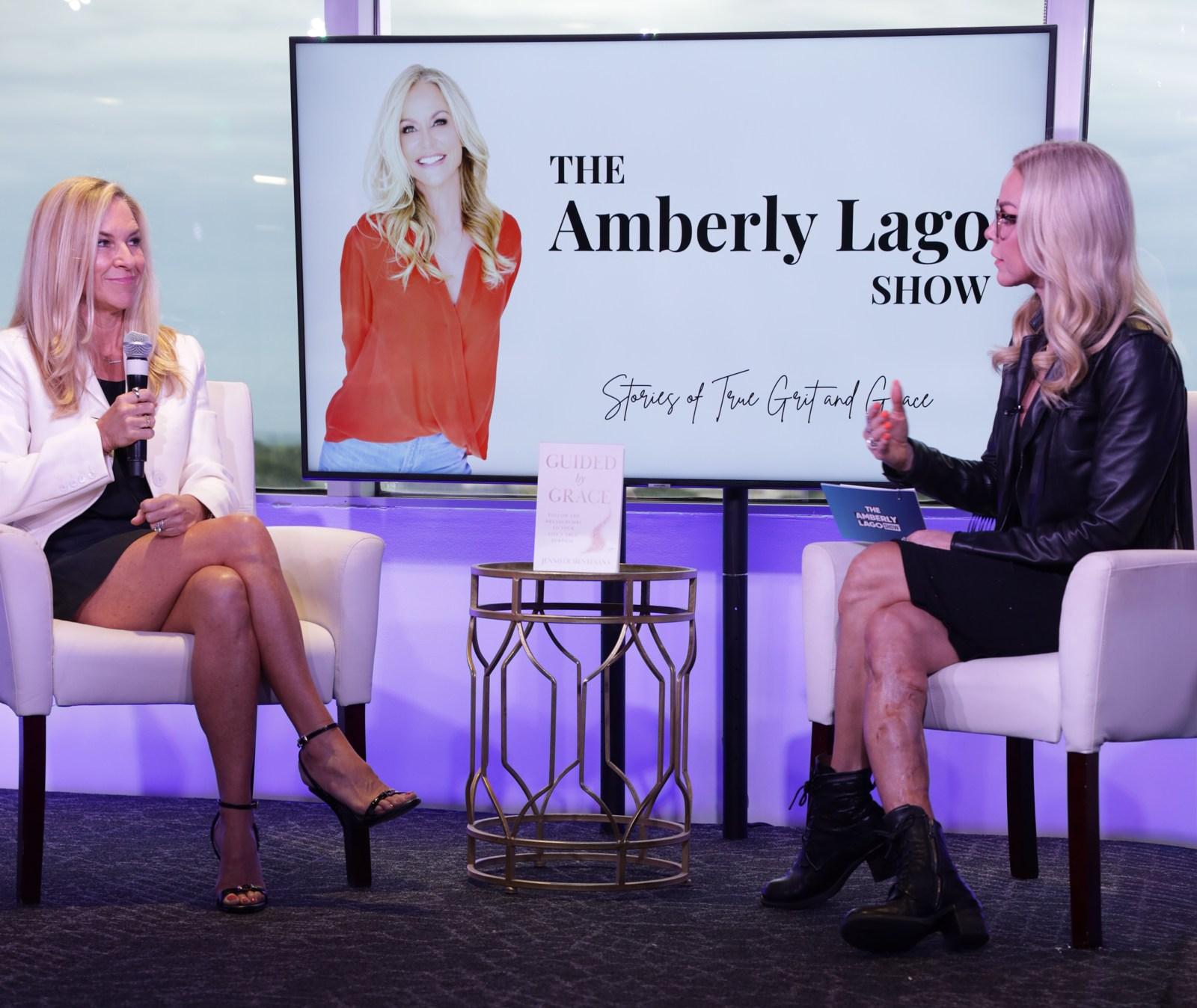
Season 6, Episode 303
Building Strong Foundations for Your Child's Future with Jordyn Koveleski Gorman
A conversation with Jordyn Koveleski Gorman

About This Episode
Welcome back to another episode of The Amberly Lago Show! This conversation is for every parent who has ever found themselves Googling a parenting question at 2 a.m. and somehow ended up feeling even more overwhelmed than when they started.
In this episode, I sit down with Jordyn Koveleski Gorman, licensed speech-language pathologist, feeding specialist, mom, and founder of Eat Play Say, an online resource helping more than 700,000 parents navigate speech, feeding, and childhood development with clear, expert-backed information.
Jordyn shares the personal story that first led her into speech-language pathology. At just 16 years old, her mom became critically ill with bacterial meningitis and spent eight days in a coma. Watching a speech-language pathologist help her mom with swallowing and cognitive recovery introduced Jordyn to a career that would eventually become her purpose.
Years later, becoming a mom herself completely changed her perspective. When her first son developed torticollis and a flat spot on his head, Jordyn experienced firsthand how frustrating it can be to know something isn't right with your child but struggle to find the right answers. That experience helped inspire Eat Play Say and her mission to give parents the reliable guidance she wished she'd had herself.
We talk about the pressure parents face today, from sleep expectations and co-sleeping to purees versus baby-led weaning, picky eating, developmental milestones, speech delays, and tongue and lip ties. Jordyn reminds us that research matters, but so does recognizing that every child is different and sometimes the best approach requires parents to pivot.
One of my favorite parts of this conversation is Jordyn's reminder to trust your intuition. Parenting doesn't have to be about doing everything perfectly. It's about paying attention to your child, asking questions when something doesn't feel right, and getting support when you need it.
We also dive into early speech development and why communication begins long before a baby's first word. Jordyn explains the importance of imitation, why pausing gives toddlers the time they need to process language, and what parents can do if they're concerned about their child's development.
If you're a parent, grandparent, caregiver, or simply someone who wants to better understand early childhood development, this episode is packed with practical information, reassurance, and expert guidance to help you feel a little less overwhelmed and a lot more confident.
We Discuss
-
How Jordyn's mother's illness inspired her career in speech-language pathology
-
Becoming a mom and realizing that even experts don't have every parenting answer
-
Her son's experience with torticollis and what inspired Eat Play Say
-
Why today's abundance of parenting information can actually make parents more anxious
-
Learning to trust your intuition while still using evidence-based guidance
-
Safe sleep, co-sleeping, and why every family and child is different
-
Creating a positive relationship with food from a baby's very first meals
-
Purees versus baby-led weaning and why it doesn't have to be one or the other
-
The difference between normal food preferences and picky eating that may need intervention
-
Early signs to watch for in speech and language development
-
Why imitation between 6 and 12 months is important for communication
-
The "power of the pause" and giving toddlers enough time to process language
-
Why parents should never blame themselves for a developmental delay
-
Early intervention resources available for children ages 0 to 3
-
Understanding tongue and lip ties and when they may need professional attention
Timestamps
00:00 Introduction to Jordyn Koveleski Gorman and Eat Play Say
03:00 How her mother's bacterial meningitis inspired Jordyn's career
07:00 Becoming a mom and experiencing developmental challenges firsthand
11:00 Her son's torticollis diagnosis and the inspiration behind Eat Play Say
15:00 Parenting information overload and learning to trust your intuition
19:00 Sleep expectations, co-sleeping, and finding what works for your family
24:00 Starting solids and building a positive relationship with food
28:00 Purees versus baby-led weaning and why parents don't have to choose one approach
32:00 Picky eating versus normal food preferences
36:00 Early signs of speech and language development
40:00 Why imitation is important before a baby's first words
43:00 The power of pausing when communicating with toddlers
46:00 What parents should know if they're worried about a speech or developmental delay
49:00 Early intervention and when to seek professional support
52:00 Tongue and lip ties, feeding challenges, and functional symptoms to watch for
To Connect with Jordyn Koveleski Gorman
Instagram @eatplaysay
Website Eat Play Say
Free Resources & Downloads Eat Play Say Freebies
To Connect with Me
New and Exciting!!
Every episode, the whole archive is searchable! Look for a moment, or ask a question and get an answer drawn straight from the episodes, with the clips it came from.
amberlylago.com/podcast
Bring Me to Your Next Event
Looking for a keynote speaker who will inspire your audience with practical tools for resilience, joy, and meaningful connection? Learn more about booking Amberly for your next conference, corporate event, or leadership retreat:
Get Your FREE Joy Playbook
Ready to spark more joy in your everyday life? Download Amberly's free Spark More Joy Playbook and discover simple, actionable practices to help you build resilience and embrace more joy, no matter what life brings.
go.amberlylago.com/smj-workbook
Download Your FREE Gratitude Journal
Start cultivating a daily gratitude practice with Amberly's free downloadable Gratitude Journal.
mailchi.mp/9beab9de1b2c/gratitudejournal
Let's Connect
-
LinkedIn: linkedin.com/in/amberlylago
-
Instagram: instagram.com/amberlylagomotivation
Watch the Podcast on YouTube
Catch full video episodes and exclusive content on YouTube:
youtube.com/c/AmberlyLagoMotivation
Read My Books
Discover Joy Through the Journey and True Grit & Grace and find more resources to help you live an unstoppable life:
Join the waitlist for my Mastermind
Enjoying the Show?
Be sure to subscribe, follow, and leave a review! Your support helps us reach more people who need a little more hope, resilience, joy, and encouragement. Every review makes a difference, and we're so grateful you're part of this community.
Full Transcript
What do you tell parents about the sleep thing with? Is it okay if they sleep with you? Should you kick them out of the bed? What's the best thing?
This is a good example of like what the AAP recommends, which safe sleep is super important. You can't force your baby to do something. You can't force your kids to sleep in the crib without you. So we do need to figure out what are some other safe ways to navigate these challenges. Same thing with like eating purees versus baby led weaning. Not every kid's going to do the right way or the way that you want them to eat the food. We have to be able to pivot. It's what's best for development.
Honestly, what are some early signs a child's speech might not be on track and when should a parent truly be concerned?
Yeah, the first thing that we're really looking for for speech and language skills is imitation, oral imitation. And that happens when kids or babies 9 months, 10 months old trying to imitate like blowing raspberries, imitating facial expressions. We know from research if we don't have that imitation, we're not very likely to get a single word by themselves at 12 months of age, which is that milestone. So we're already looking for things between 6 and 12 months of age and it's that imitation.
Hey mamas. And the daddies out there too. We have a very different kind of episode today, one that I have been super, super excited about because let me ask you something. Have you ever googled parenting questions at 2am and ended up more anxious than when you started? Because I know I have still. I've got a teenage daughter and one that's grown and I still find myself in, in that situation. But today's guest is here to calm the chaos. Jordan Ki Gorman. And I, I'm hoping I'm saying that right because I did practice a little bit. She's a licensed speech language pathologist, feeding specialist, a founder of Eat Play say an online resource source. She serves over 700,000 parents, y', all who are tired of conflicting advice and just want clear expert backed answers. She's worked in intensive pediatric feeding units. She's helped families through complex developmental challenges. She's also a mom of two with one on the way who knows what it feels like to to feel overwhelmed and unsure. She's created Eat Play say because even as a specialist she couldn't find one trustworthy place for developmental guidance. And today she's here to help us go from I don't know what I'm doing to. I've totally got this. So y'. All. Also, you got to follow her on Instagram because her Instagram stuff just goes viral. That's how great. I mean, it's such good advice. So welcome to the show, Jordan. Thank you for being here.
Gosh, thank you for having me. What an awesome introduction. I'm, like, pumped up. I'm like, yeah, thank you.
Yeah, let's do this. Yes. I have been so excited to have you on. And even though my kid, like, I'm really praying to be a grandmother, I keep telling my oldest daughter, just have one and give it to me, you know? But still, it's interesting that, you know, you. You talk about, like, early developmental, like, when to give your child solids and that sort of thing. Just this morning, my daughter called me from school, not feeling well, and I'm like, did you eat? So even though I have a teenager, I'm still like, what are you eating? Did you eat any breakfast? You know, she doesn't want me to pack her lunch anymore. So I think that talking to you is going to help mothers, grandmothers, and so many more know how, how and what to do and get rid of the. The chaos and. But I want to go back to when you were only 16 years old and your mom became critically ill and a speech language pathologist. And she was. She was a. Was she a speech language pathologist?
Yeah, she was. Yeah. My mom came down with bacterial meningitis when I was 16, and it was pretty scary. She was in a coma for eight days. They didn't really know what was wrong with her. When she woke up, she had difficulty swallowing because she was intubated. And I remember this adorable, short, blonde speech pathologist in the cutest outfit with a lab coat comes in, and I'm 16, into fashion, and I'm like, who is this doctor? She's so cute. And she explains to me, I can help your mother with swallowing. I'm going to do a cognitive exam. I'm a speech pathologist. And I was like, wow, I get to look cute and work in a hospital and help people sign me up. So, making light of that situation, that was when I first got introduced to the field of speech pathology and how you could work with adults with babies with toddlers. And she kind of pointed me in the direction of how I ended up here. So something good came from that horrible situation. My mom made a full recovery. She's fine. She's the nana to my almost three babies now, and she's great.
That was going to be. My next question was, how is your mom from that? I mean, I was in a coma and. And I know waking up with tubes down your throat, I really don't suggest it. It's not fun. But I was gonna. I was gonna ask how. How your mom is now.
Yeah, she has a hearing loss in her right ear, so that's very common from a bacterial meningitis diagnosis. And she was on some soft food for a little while as her throat healed from being intubated. But she made a full cognitive recovery. And you'd never know. You would never have.
That is. That's miraculous. That's amazing. And I love that you say that something good can come out of a bad situation because it puts you on the path that you're on today. That one person. Sometimes all it takes is one person in our life, and it's like a light bulb moment. And now look at what you do. You had years of clinical experience and then you became a mom. What humbled you the most in that transition from just being a mom? It. It changes. It's life changing. You can't really explain. You try to explain it to people, but when. When they go through it, it's like, oh, wow, you know, this is. This is a life changing moment. Was there a moment that kind of humbled you in that situation?
Yeah. So my son was born in 2021, and he had a lot of body tension. He was just very tight when he was born. And even though I worked in a hospital and I was a speech pathologist and I understood how muscle groups worked, I was like, why is he so tight? I don't understand. Pediatrician was having trouble helping me. Excuse me. He ended up having torticollis, which is where the neck. The neck muscles are very tight. Babies kind of in the womb, they stay in one position, and when they come out, they're supposed to stretch out. He didn't stretch out. And I was trying everything I could. He ended up developing a flat spot on his head. And it seemed like no one wanted to help me with this problem. Pediatrician was dismissing me. Family was like, oh, it'll round out. It's not a big deal. I just had nowhere to go for help with this specific issue. Finally ended up getting him into a helmet to help round it out.
Yeah.
And then I recognized there was so much I could have been doing ahead of time if I would have known. And that's kind of where the fire came up underneath. Eat, play, say of how I could help parents get the information that I Didn't have across speech feeding and then also development as I built my team of other experts.
Wow. Yeah. That's because it's when your child, you're like, I know something's not right for good for you, for advocating for your child, for yourself, for your family, to get the answers that, that you need for that. And now is your son. How old is your son now? He's what, six?
He's four? He'll almost be five. Yeah.
Maybe I could do math.
That's okay. No, he's almost five. And we just had a photo shoot, a maternity photo shoot for this baby, and he found his helmet. And he comes running into the baby's room in the nursery and he's like, I wore this helmet when I was a baby and it made my head round. He's so proud. It makes me feel good as a mom, like I made a good choice, you know?
Yeah. And it's. You know, I remember being worried when Ruby, my youngest daughter, was born because she was so big and she was stuck. She was stuck breech and her legs were stuck up by her head. And I remember going into the doctor and saying, yeah, you know, her head's here and her feet are here. And they're like, no. I'm like, no, I'm telling you, her head is right here and this is where her feet are. And they did the ultrasound and they said, oh, wow. Well, you're. You're right, she is stuck Breach. You're going to have to have a cesarean. And I was like, wow. And then later, when she was born, the doctor admitted to me, they said, do you know when I told you that the ultrasound machine was broken, it was my last checkup. And I said, yeah. They said, we thought there's no way that you could be carrying an eight pound baby. Or she was like eight and a half pounds because you didn't look like you could be carrying. And I said, but you were. And I said, why wouldn't you listen to me? I told you where her head was. But when she came out, her legs were stuck up and they would shake a lot. And they finally. And I was worried, and they're like, oh, don't worry about it, but I wish that I had you back then to talk to and go, what do I do? You know, what, what's this? Because you could point. You can point people in the right direction, but did you ever find yourself overwhelmed by pairing parenting advice? I mean, what does that say about the systems that we're asking parents to navigate now?
Yeah. You know, it's funny because we live in a digital age where we have so much information, yet we all at the same time feel like we don't have any information because it's so overwhelming. I remember I was most overwhelmed with sleep. The pressure of like 3 hours by 3 weeks, 6 hours by 6 weeks, 12 hours by 12 weeks. And I put this crazy pressure on myself that my kid needed to be sleeping like it was an Olympic sport. He needed to be in his crib untouched for X amount of hours. And that was what made me successful as a parent. And I feel like that is the harmful part of parenting where it's overwhelming and you're, you have to hold yourself to these standards that. Who created these standards? Why aren't we just listening to our intuition more? I don't know. So I really try to encourage parents to first and foremost listen to your mom gut. It's never going to steer you wrong. And then also take the research and what we know and apply it to your situation. But what the research says and what's right for you aren't always going to align.
Yeah, I love that you say listen to your intuition and about the sleep thing. So I had some pressure on me about. And maybe I'm going to get in trouble by saying this, but like with. I was a single mom with my first child. I mean I was divorced by the time she was a year old and pretty much before that I was a single mom, to be honest with you. I really, I was. But my daughter slept with me and especially when I was a single mom for years and till she was like 10 years old, she slept in the bed with me and I slept. And we still joke about this, but I slept holding her little foot. And she's fine. She's turned out to be a great child. She's in Connecticut, going to school at Yale, studying medicine. But there were so many people that were like, oh, your daughter still sleeps with you and, and came down on me. What? I know you're supposed to put them in their crib. I know it. But what do you tell parents about the sleep thing with. Is it okay if they sleep with you? Should you kick them out of the bed? What's the, what's the best thing?
Yeah, so I had a similar situation. My first kid was a crib sleeper. My second kid, my daughter, she was like, absolutely not. This is a death trap. Get me out. Like I cannot be in here. And I felt like a first time mom all over again. And I did co sleep with her. For a very, very long time. And I really feel like if you look culturally at the whole world, most of the world is co sleeping pretty safely. And there are like the La Leche League. There are resources that are actually science backed where parents can find good information about co sleeping. But that is a huge shamer in parenting. And I felt like I couldn't say to my audience of hundreds of thousands of people, like, I failed. She's not in the crib and she has to be with me or else I'm getting zero hours of sleep and she's miserable. This is a good example of, like, what the AAP recommends, which safe sleep is super important. You can't force your baby to do something. You can't force your kids to sleep in the crib without you. So we do need to figure out what are some other safe ways to navigate these challenges. Same thing with like eating purees versus baby led weaning. Not every kid's gonna do the right way or the way that you want them to eat the food. We have to be able to pivot. It's what's best for development, honestly.
Yeah. And I mean, I, I even, I tried to get my daughter in the crib. I even climbed in the crib with her. I was, I was really tiny back then, like really thin. And I even got in the crib with her and it just wouldn't work. So she ended up.
That's some dedication.
But you know what it made me think of? So now my youngest daughter is actually my fur baby nugget. And I got a golden doodle, and she's just the sweetest thing you ever saw. And my family was like, My husband was like, absolutely not. She is not sleeping with us. Well, wouldn't you know that she follows me. She's my little shadow. She will get up and is. She can be passed out asleep, but as soon as I get up to go to bed, she's right after me and she sleeps with me. And I just saw a study where dogs actually live longer if they sleep with their owners. And if a dog sleeps with you in bed on their back with their legs open and their legs up, it means that it's. They release oxytocin and they live longer. And I was like, well, if a dog lives longer, then wouldn't it be correct if a child will live longer? I don't know. That's my thinking.
But I put some money behind that study. We need to figure that out. Yes, we need to figure that out. It would give parents a lot More peace of mind? Yes.
Well, you, you talked a little bit about food, solids and all that. And it was so different when I had. My kids are 13 years apart. So it's kind of like I was. I had two only children because they're so far apart. And I did things so differently as a single mom than I did with my youngest daughter and with her food. Like I would grow vegetables in the garden. I made her own baby food. I pureed everything with the magic bullet. And I, you know, so intentional about organic and this and that. There's so much pressure about food, food and there's so much information like you said, and especially pressure around starting solids. What's one thing you wish every parent knew about the first month of food?
Yeah, that's a really great question. The first month of food is really. You're setting the foundation of a child's relationship with food. So taking the objectivity out of like how many ounces of puree did they have? How many meals did they sit for? How many spoonfuls did they eat? And instead, how was their demeanor in the high chair? How was their excitement when the food arrived? Did you have fun feeding your baby? Did they look at you? Did they try to feed you? You feed them? Did you establish a good routine with them? Are mealtime something that you both look forward to? Because if you don't have that, mealtimes are just going to be a fight going forward. It doesn't matter how much they eat because it's not going to be an enjoyable experience. And we really want that connection right from the start with the caregiver.
Oh, I love that. And it just. I. A question for you. And I wonder if you notice this with your children, because when I was pregnant with my oldest daughter, all I had morning sickness with both of them. But all I could eat when I was pregnant with my first was like bean burritos and, and pad Thai. Like that was it. And now those. That's her favorite thing to eat. And with my youngest daughter, I never ate burgers. I didn't like burgers and all I wanted was a burger. I would have to pull over. I'd be going down Ventura Boulevard and had pull over into like even like a fast food place to get a burger. And I would just like demolish this burger and all. She, she loves burgers. We were at In N Out last night. Do you feel like what you eat when you're pregnant, your child is gonna like, like those foods more when they are born?
Yeah, I mean there is or is
that just a weird coincidence with me?
No, there's actually some research to support that. The amniotic fluid that they're like breathing in and kind of tasting, especially towards the end, does have a taste of whatever you're eating. My. I was obsessed with avocados with my son. Couldn't touch them with my daughter. Son loves them, daughter hates them. So very similar.
Wow. Wow, that's. That's interesting. I didn't even think about that with the amniotic fluid being that. Wow. Yeah, that is interesting. Purees versus baby lead weaning. Does it have to be one or the other?
No. And I really wish that the fight on social media would just end already about this. It's like a decade long fight at this point.
Really?
Yes. And I mean, I love a good mom Facebook group. Okay. I'm giving things away right now in mom Facebook groups and like, I don't need this high chair, this extra high chair, whatever. I love that. But some of the mom Facebook groups is where we get that this is the right way. No, this is the right way. No, this is the right way. And moms aren't really supporting moms, especially when we're talking about the division of like, purees versus baby led weaning. And you can go into feeding your child and have all of the greatest ideas. Like, I would. I wanted to do baby led weaning with my son. He was like, absolutely not. Feed me. I love you. Please give me a bite of food. I want you to give me the spoon. I tried to feed my daughter a spoon. She was like, get away from me. I want a chicken wing. I was like, okay. So the temperament of your child is going to actually really dictate which way of feeding is best for them. And having a combination approach, you pretty much never fail. Keurig's on the spoon. Plus letting them hold their own food. Win, win all around.
Yeah. Yeah. I love that. And I love how you just emphasize how making feeding that time when you sit down and eat fun. That was like, I remember my youngest, she loved soup. So I would make big batches of homemade soup and she'd be like, soup, soup, mama. And we would sit and have soup and she'd pick the little vegetables out of it, you know, And I think that's so important to emphasize the fun. And you can introduce some really healthy foods when it's fun, you know, and so I love that. What's the difference between normal picky eating and something that needs intervention?
Yeah. So this is a very loaded topic. But Just broad level, what I tell parents is there's picky eating and then there's preferential eating. We're all preferential. Like, I won't touch cottage cheese. I don't care what you give me. I'm not touching it. I will eat other dairy foods, other high protein foods. I'm not touching the lumpy cottage cheese. Does that make me a picky eater? No, but I have preferences. If your little one doesn't like a certain fruit, vegetable, or protein, look at the other things in that category. Are they eating other fruits with similar vitamins, other vegetables with similar nutrients? Are they able to get protein from other sources? If they are and they have a handful of foods that are similar, typically not a problem. Keep introducing the foods that they're saying no to. But I really wouldn't worry. It's when they have pared down so much that there's only a handful of options total that you kind of want to look into that more and see how you can help them.
Yeah. Like if they only want to eat chicken nuggets, there's. There's a problem. We got a problem.
Right. And there's no other protein source. We got to look into how we can get past chicken nuggets to something else. Yes.
Yeah. Yeah. And that's even with us even having a teenager now. You know, she eats all kinds of protein, from tofu to turkey to amazing. Yeah. And sushi. She's like, she's a really good eater. But I want to move on to some speech and communication. And I'm fascinated with this and how some babies speak early. Some people talk more. I remember my mom told me so my brother is two years older than me, and I started talking before my brother did. And she said that I freaked somebody out one time in the grocery store. Because we're in the grocery store and I'm sitting in the cart and I look like I'm just barely old enough to be sitting up in the cart. And somebody came over and said, oh, what a cute baby. And I looked at them and I said, thank you. My name is Amberly. And they just looked shocked and went the other way. And so my mom was like, you started talking and you just would not stop. And I'm like, yeah, I know my nickname was loudmouth because I was always, like, cheering people on in the stands and stuff. But what are some early signs a child's speech not might not be on track? And when should a parent truly be concerned?
Yeah, the first thing that we're really looking for for Speech and language skills is imitation, oral imitation. And that happens when kids are babies, 9 months, 10 months old, trying to imitate like blowing raspberries, imitating facial expressions, imitating ba ba ba ma ma ma. All of those things before first word. We know from research if we don't have that imitation, we're not very likely to get a single word by themselves at 12 months of age, which is that milestone. So we're already looking for things between 6 and 12 months of age. And it's that imitation.
Oh, that's so good. Well, it's, it's interesting because my brother ended up having a very. He's serious, like stuttering and so he didn't start talking and then he sometimes still stutters. But he did go to speech classes. But it's interesting. I never thought of looking at the signs that young at six months to see if they're imitating those types of things. You talk about pausing when speaking to your baby. Why is that so powerful?
Yes, the power of the pause. I love talking about this. It's because when toddlers, toddlers are kind of like on a delay. Think about like low speed Internet when you're talking to them, they are processing and it's loading whatever just happened. And they have to first of all get your get attended to. You especially if they were doing something else. Let's say they were playing with the ball and you said, charlie, touch the book. They'd have to take their attention away from the ball. Look at you. Mommy said book. Where is book? Okay, I found the book. Now I need to tell my body that's still learning how to move to go touch the book. That's a whole like 10 second process because they haven't done all of that before.
Well, I feel like you could be talking to me at some time at some moments though.
I think we could all benefit from a pause now and again.
You know, I think I could benefit from this actually. Yes.
Yeah. I mean, this is the first time that they are making these connections, showing you that they can do things like think about the first time you ever did something, a new sport, any type of new routine. It, you were slow at it and it took you a little while to learn how to do it. And then as you did it more, you got faster and faster and faster and you didn't need as much help or as much time to learn that skill.
Yeah. And you know what, you're saying this, and I know I've talked about my fur baby nugget, but she's a puppy. And it's interesting. The way that you just described it is the same way. Not, don't get mad at me. Y' all that are listening going, she's describing a puppy. But nugget, I'll say something and she will look and she'll look over slow and then go get the ball. It's like you're describing kind of her process. So I'm. I'm going to be. I'm going to be more patient with her. Okay. For moms who worry, like, they're. They're like, well, I'm a little worried. My child didn't. Isn't talking yet. Did I do something wrong? What would you say to them?
No, no. I mean, I always tell parents, you'd have to really do some crazy stuff to mess up. Quote your child. You are not the reason for your child's delay. I'm a specialist. My child, my one child had torticollis. My second child needed PT because she didn't crawl, stand, or walk on time. And then got there. And I knew I did everything in my power I could have done, and I still needed professional help for them. And that's okay. That's totally okay. That's why it's there. The main thing when you recognize that an issue has come up or you're concerned is to do something about it. That's the best thing you can do for your little one. In the United States, early intervention evaluations are free for zero to three years of age in all 50 states. So you can call, get an evaluation for absolutely no money. They come to your house through the eval and tell you what they think and give you tips if your little one needs help.
That's so great to know because I didn't know that. I didn't know that you could. There was a resource out there like that. But also, Jordan, you know, I love that you share that there are certain things that you've struggled with, because I know I like to learn from people who aren't like, how can I learn from a mom that everything's perfect? They've got a perfect child, they've got the perfect pregnancy. All the things I'm like, no, I need help. Like, I want to be able to talk to somebody who I can relate to. Like, you've gone through it, so I can learn from you. So I love that you share that, and I'm sure that's why there are thousands and thousands and thousands of people who follow you for your advice. I wanted to ask you, speaking of speech and communication, about tongue and lip ties. And this one also, I mean, I feel like I know we're talking about infants, but I can also relate to so much of this in my life because I didn't know what that was. And it wasn't until I moved to Dallas and got a new dentist that she was like, oh, yeah, you actually have a tongue tie. And I'm like, a what? She goes, a tongue tie? And we should get that fixed. And I haven't yet, but explain to everybody listening what that is and me. And do I need to get that fixed?
That's a really great question. So this is another very polarizing topic in. And honestly, in the professional world, but a tongue tie, by diagnosis, there has to be a functional deficit. So, like an infant sleeping with their mouth open where, like, their tongue can't rest up under their palate. For an adult, it would be like, if you have TMJ pain, you have trouble swallowing, you're snoring at night. If there are functional issues, babies and toddlers are having trouble eating, speaking, breathing, then it's worth looking into getting some therapy and getting it corrected. But a lot of people just think, oh, if you have a piece of skin connecting your tongue to the floor of your mouth, that's a tongue tie. But that's not true because we all have that skin.
Yeah. Yeah.
Are you having any issues?
Well, I love my dentist and she was like, oh, wow. You know, she's rubbing my jaw and she's like, you have major 10. And I was like, oh, yeah, I feel that. And so, yeah, I guess I have some tension there. Little lock jaw kind of stuff going. It's not locked, obviously.
Right.
But yeah, she said I should have the surgery, but yeah. How should a. How does a parent know you.
You would typically know that there is a difficulty based upon the difficulty with feeding or speaking first. Oh, you wouldn't look at the mouth and go, oh, I think you have a tongue tie. You would have difficulty breastfeeding, difficulty bowel feeding. They can't chew solids very well. They're breathing out of their mouth. Their tongue's super forward in their. In their mouth. If you're noticing those things, a tongue tie is worth looking into. Doesn't necessarily mean one is there. But typically you see the issues first before looking to see if there's a tongue tie.
Well, you know What? I've had 34 surgeries on my leg alone.
Oh, my gosh.
Yeah, I, I really don't want to have another surgery or procedure. I'm like, I'm I've had enough, so
I don't blame you.
It hasn't bothered me. I don't. I can deal with a little tension. I'll just rub my jaw. I don't want to have something done with that. Okay, now we're moving on to the power of play. And you talk a lot about this on your Instagram. Seriously, y' all need to go follow her on Instagram. You. I love how you emphasize play so much. And you know what? I'm not just about play for infants. I think play for every age there is. We need to play more. And I think that it needs to be incorporated into every day. I just. Like earlier, I had a little break. I went out in the yard and ran around a little bit with the dog, threw the ball, and just played and played. But why is play actually one of the most powerful developmental tools that we have?
Yeah, we know little ones from 0 to 5 years of age learn best through play. So that is literally just looking at what's going on around something as simple as watching mom empty and load the dishwasher and then they go over and get a box and they empty and unload their dishwasher. Looking at general movements, general everyday activities. That is play. It's how they are learning how the world works. That way they're going to learn how the world works. What things are called how to interact with others around them by watching what's going on, not by sitting down and reading a book about it or doing flashcards that are. What's this? What's that? Those things aren't going to teach them how the world works. Them playing and interacting with everybody is.
That's great. What do you think are some of the best ways to play other than like making play an everyday thing, like you just suggested? When they're watching you, you can make play out of their watching you unload the dishwasher. I love that you say that because there are probably some moms listening, going, well, I don't have time for play. How. What are the. The best things you can do when you're. If there's somebody going, I don't have time for play, what are some of the things they could do?
I would love every parent to just take your child with you with what you're doing, and also then tell yourself, this is going to take 2.5 times longer than if I just did it myself. You need to have that talk with yourself that it's not going to be a quick task. Laundry, making the bed, putting clothes away, whatever but your little one is going to be fascinated by pulling the wet clothes out of the laundry that get stuck. And they'll think it's hilarious and then put it in the dryer. The bed sheet, when you flip it up in the air and it looks like a parachute. They're going to get so excited seeing that all of that is play. And there's even research to support that that is more useful and beneficial than sitting face to face on the floor with a plastic toy in front of you.
Yeah, well, speaking of sitting, I want to talk about the W. The W. The W sit.
My daughter still does that.
Okay, I want to. I want to talk about that. Because my youngest daughter would always do that. And I would lift her up and sit her with her legs out in front of her. I was so, like, freaked out it was going to bother her knees, and her knees actually sometimes bother her. But being a former fitness trainer, I know there's some misalignment because she's an equestrian and she is. Her inner thighs are like steel. She can, like do the whole stack at the gym, the whole stack of weights for the amazing hip adduction. But the abduction machine where you put your legs out is like a struggle for her. But it's because she's used to squeezing a horse. And anytime there's kind of a misalignment, there will be some pain usually. But I want to know, like, the W sitting. There seems to be a lot of controversy on Instagram or on social media about that. You tell me your take on it.
Yeah, if. If you're a person who likes to read. We have a blog on our website too that if you just type in W sitting in our search bar, you can read it and see the visuals. But the main thing is when, until about three years of age, it's pretty much normal. You wanna look at their back. If they're W sitting with their feet straight behind them and their knees forward and they're hunched, it means their core strength not super strong. And it's a compensatory sitting strategy because they can't sit up tall cause their core is weak. But if they're sitting in a W and their back is straight and they're kind of using it as a way to move, like almost getting in a crawling position to grab a puzzle piece or go get a book, typically not something to really worry about. They're just using that position to get in and out in other positions. But after three, we do want to encourage more of that, like side sitting where you And I sit that way right where one leg is out and the other leg is in the middle instead. Because it's better for their hips. Yeah.
And then I've even heard where you're not supposed to sit, like crisscross. I'm like, well, they do it in yoga.
I know. I mean, crisscross, applesauce. I grew up with that. You can't take that from me.
I know. I grew up with that too. I mean, come on. Well, why do you think so many parents feel dismissed when they bring concerns to pediatricians?
Oh, this is another loaded question. I love it. I mean, the system is kind of broken. Honestly. I. We put all this pressure. I feel for pediatricians. I really do. They have a 20 minute well visit. You got a family coming in with a stack of questions. You know, how are we supposed to answer all of these questions? How is that one person in a 20 minute well visit supposed to answer all these parents questions? And they're going to take the questions that require the most effort or really are like the red flags and go with them. So sometimes it can leave parents feeling dismissed because they didn't get all their questions answered because there's just not enough time. That's part of the reason why I created Eat Play say to try to give parents resources of where to go because the system is just broken. We need an hour. You need 90 minutes to talk to your pediatrician. And one person just can't know everything.
Yeah, I loved my pediatrician. For my oldest daughter, he was amazing. He was probably, you know, the rare diamond in the rough pediatrician that I. I think he felt for me because I was seeing a single mom and he did spend. And I was so young and he did spend more time with us and was so kind. So I love that. Yeah, he was Dr. Kivitz. Still remember him. It's been 30 years ago. What's the danger of relying on scattered Google searches on develop for developmental guidance?
Yeah, you. I feel for parents, if you Google something, you just want an answer. And now with AI, you know, Gemini, they're just pulling whatever at the top. I just did a Sunday newsletter about this. I asked Chat GPT questions about if my baby hates tummy time, what does it mean? ChatGPT was like, it means nothing. All babies hate tummy time. And I was like, no, that's not correct. It's just pulling information that gets the most traction on Google. So you're not guaranteed the right answer. You're guaranteed, like the most common answer. And what we're finding out is that these common answers are steering parents in the wrong direction.
Yeah.
So if you're going to use a search function, use the search function on eatplaysay.com to plug my own website here.
Well, no, no, I was just gonna say that, though. Seriously.
We have hundreds of blogs on all different types of feeding, breast and bottle feeding, playtime, toddlerhood, literally everything. And then we have the sources. So then you're able to say, okay, where did Eat Play say get this from? And you can fact check it. I know Google's easy and ChatGPT is even easier, but grain of salt with all of that.
Yeah. Thank you. And. And tell us the website where they can check out all the resources again.
Yep. Eatplaysay.com we have two search bars on there. Use them.
Yeah, thank you. And you know what? If you're out for a run or you're driving or something, all of Jordan's information, it's in the show notes so you can find it. And I'm pro. I'm sure that I probably freaked you out, Jordan, when I got you on and we were talking and I was like, well, I printed out. I've really been looking into your stuff and I have 26 pages of questions, and I do. You're so wise and you're so amazing. And I could literally. I know why people go to you for information because you are so amazing at everything that you do. And you're probably thinking, I'm going to have this baby before we get through 23, 26 pages, the questions. But you are welcome to come back anytime to the show. I just, I. I just love all that you've shared and I know you're going to help so many. I'm going to need to go and get resources. I'm saying I'm going to be a grandmother someday. I'm crossing my.
Breathe it. Breathe it into existence. That's right.
Yes, I'm going to hold. I'm hoping my youngest daughter will hold off a little bit longer, but, you know, maybe my oldest daughter will decide she wants to do that. Crossing my fingers. But the best place for people to find you is your website. What? Tell them again one more time.
My website is eatplay, say.com and my largest following is on Instagram, which is just Eat play say, we'd love to have you over there.
Yeah. And you, your videos go viral. Y' all go check her out. And you're just fun to watch, too. You're just fun. Even if you're not a new mom or whatever you're just fun to watch. So thank you so much for being on the show, Jordan. I just. I loved this conversation because it's not just about speech or feeding. It's about confidence as a mom, as a grandmother. It's about replacing fear with clarity. And you give so many people clarity with all that you share through your Instagram, through your blog, through your web website. And it's about reminding parents that they're not crazy for asking questions. I mean, I always like to ask questions, and they're not alone in figuring it out. If you're listening right now and you've ever felt overwhelmed, unsure, worried, or if you're missing something, let this be your episode. This episode. Let it be your permission just to breathe and take it all in and share this with a new mama or a new grandma or a friend and tag us. I love when you take a screenshot and tag me on Instagram. I love to share that right back when I see that. So thank you so much for tuning in. Y' all keep being resilient, sparking joy and being unstoppable. Jordan, thank you so much for being here.
Thank you so much for having me. This was so much fun. I can't wait to come back again soon, hopefully. Yes.
Well, you'll have to come back with your new baby.
Yes. I got to show you if. Is it a boy or a girl? We don't know. We're going to find out.
That's so exciting. I love that. I love that. Well, congratulations. And hopefully I'll get to see you in person someday soon.
I would love. That would be great.
I would love that. Thank you so much.
Thank you.
Pain to purpose to joy.
Never Miss a Conversation
New episodes drop regularly. Subscribe on your favorite platform and never miss a conversation.