

Season 1, Episode 55
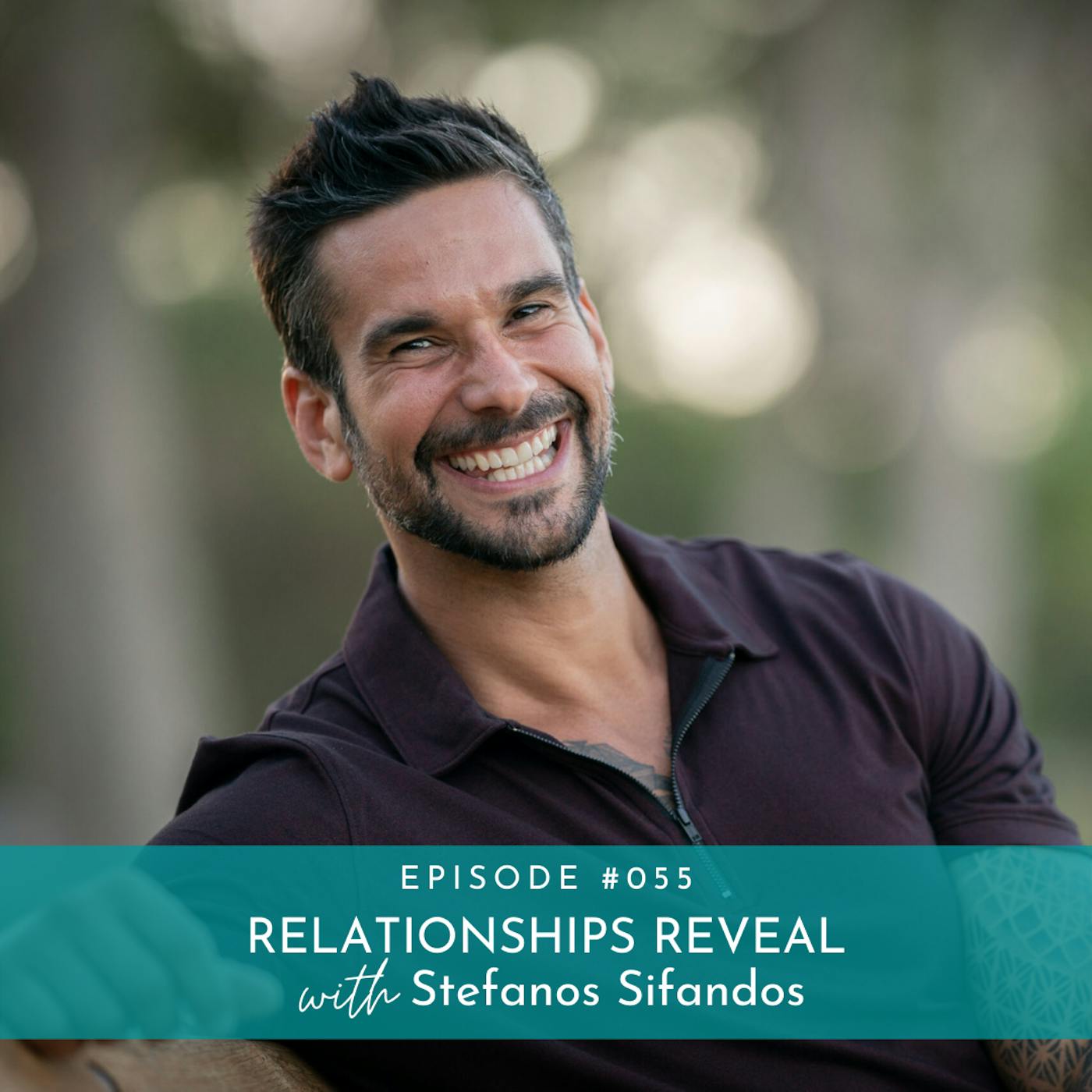
Relationships Reveal What Needs to Heal with Stefanos Sifandos
A conversation with Stefanos Sifandos
About This Episode
It seems like everyone is having to re-learn how to be in relationships during this pandemic, and I know many intimate relationships have ended or transformed in the past year for so many. I am so excited to bring you this episode with Stefanos Sifandos, because he has so much wisdom to share on this exact topic.
Stefanos is a trained educator and relationships expert with a background in behavioral science. He empowers human beings to have healthier, more fulfilling relationships. His philosophy merges the best of Eastern and Western philosophies and he's worked with thousands of men and women from many walks of life. His mission is to be a voice for the voiceless; to assist individuals in actualizing the fullness of their potentiality; to relate consciously to each other with authentic love; be a conscious steward of Earth and continue to evolve and expand the entirety of his being.
This conversation is one you are going to want to take notes on. Stefanos shares so many incredible insights into how we relate to each other in masculine and feminine ways, and how we can heal our deepest wounds through healthy relationships.
Here's what you will learn:
- How Stefanos became a relationship expert and how is empowering others (3:24)
- The roles of masculinity and femininity in relationship (8:21)
- Guidance to be your best in your relationships during the pandemic and stressful times(16:25)
- The steps of transformational change (23:51)
- Stefanos guides us through the steps of managing internal patterns and relationships (32:36)
- How to build confidence in a relationship (41:23)
- How to go from breakdown to breakthrough for ourselves (52:31
Get in touch with Stefanos:
Unlock your highest potential and start living the life you deserve!
Read the True Grit and Grace book here and learn how you can turn your tragedies into triumphs!
Thank you for joining us on the True, Grit, & Grace Podcast! If you find value in today's episode, don't forget to share the show with your friends and tap that subscribe button so you don't miss an episode!
You can also head over to amberlylago.com to join my newsletter and access free downloadable resources that can help you elevate your life, business, and relationships!
Want to see the behind the scenes and keep the conversation going? Head over to Instagram @amberlylagomotivation!
Audible @True-Grit-and-Grace-Audiobook
Full Transcript
Welcome to True Grit and Grace, a podcast designed to empower you to claim your resilience and thrive through life's challenges. I am Amberly Lago, a mindset coach, fitness expert, and bestselling author. Each week, I'll dive deep with the world's brightest thought leaders and elite performers to share tangible tools and practical advice to inspire you to keep your eyes on the prize and forge ahead. So get ready to conquer your fears, heal any trauma, lead with your heart, and elevate your life with grit and grace. Hi. Thank y' all for being here. I'm Amberly Lago, and today on the show, I'm excited to bring Stephanos Stefanos on. He's a trained educator and relationships experts with a background in behavioral science. He empowers human beings to have healthier, more fulfilling relationships by enabling them to let go of the past and embrace their highest selves and create their desired future. His philosophy merges the best of Eastern and Western methodologies to promote spiritual balance and empower people in life and love. From trauma release to navigating the murky waters of modern masculinity to helping women understand the men in their lives, he helps people escape negative patterns and cultivate positive sense of self. He's worked with thousands of men and women from all walks of life. I mean, we're talking about special forces, soldiers, Olympic gold medalists, elite fighters, and everyday people. So I think we need his expertise more than ever right now, especially with what's going on in our world with so many uncertainties and. And relationships just being really hard right now. So thank you so much for being here. I've been excited to talk to you.
It's great to be here. Thank you for having me.
Thank you. Yes, I have been. Well, I learned about you from one of my good friends, Erica Lippy. I heard your interview on her podcast, and I know you've been on some huge podcasts. One of my other favorites was Earn youn Happy With Lori Harder. And I love all that you share. And I have so many friends right now that are going through the end of a divorce or during pandemic when they were actually locked under the lockdown under the same roof with their partner. They're like, this is not what I want the rest of my life to look like. And they're getting a divorce, and relationships can be difficult anyway, but when you throw in a little extra adversity trauma. COVID 19 it's so. It's been tough. I would love to know a little more about what got you so passionate, inspired to really dig deep and learn about how to be this, you know, and become the expert that you are on relationships.
I appreciate your kindness. I don't know if I call myself an expert. I think I'm learning something new, many multiple things every day. When it comes to more aware styles and embodiment practices of relating, what really kick started it for me was, you know, for many years I just wasn't in that space. I was very, very curious about the human condition and the human mind and the cosmos and what's our nature of reality and all of that. But I was never really willing to delve deeper into my own traumas and my own pains and my own belief systems and what made me me essentially. And it wasn't until I really did that a number of years ago, a few years ago, about six or seven years ago, that and look, to be clear, I was very much exploring consciousness and exploring what does it mean to be in relationship with ourselves and with others in the most profound way. But my shadows just kept coming up and I was really out of integrity who I was as a man, as a person in the world. And so again until a few years ago, I started going really delving really deep into why do I behave the way I behave, why am I thinking what I'm thinking, why am I denying certain feelings but embracing others? Why am I attracted to certain actions but not others? And really just started to unpack who I was. And that really required a great deal of work on my own. The parts of myself that were wounded and traumatized and needed attention and needed healing and really going deep into all of that, all of those aspects, that is me. And so that's where that journey began. But ultimately was this from childhood, this void of not feeling connected and feeling very isolated, not feeling understood, being judged. Growing up in a volatile, violent, abusive household, it really shaped a lot and much of who I was in the world and how I treated others, how I treated myself, how I saw myself, how I gave and receive love and allowed intimacy into my life and where I armored up my heart and where I really built very thick walls between me and other people. And the confusion around that because part of me was, yes, come into my world, but then the greater parts of me was no, go away. And that was the fe coming through. That was the inner child that was screaming for attention and love and didn't know how, how to get to that place. And really having not worked through my own shadows and my own demons. And so as I started really unpacking that and coupled that with many years of formal study into human consciousness, the pieces of the puzzle started coming together for me because it was greater levels of integration because I was doing my own inner work, as opposed to using theories and principles and models and teaching other people and somewhat superficially understanding it myself. But only at one level was only this, this IQ level of understanding and being in the world, as opposed to this fuller integration, which is a continual process. Growth is a continual process. It doesn't stop. And so to answer your question, that's essentially where, where that's come from is this, this having a void of human connection, intimacy and trust as a very young child and then carrying that ideology and those sets of beliefs into my intimate relationships. And the thing that tied it up for me was, you know, I thought about all this stuff consciously and I'd given it attention, but unconsciously I was being pulled in other ways. And that was from my conditioning that was left unaddressed and unattended to. And you know, we look at the mindscape, we look at the conscious self being a few percent and the unconscious self being 95 plus percent of who we are, how we are in the world. And so I had to go deeper into that. And that's, that's a continual journey, I think, for all of us, not just, just for me.
Oh, it is such a journey. And I really, as you were speaking, I'm like, so much came up for me and you know, it's so true. We heal what we reveal. But I did the same. I did not want to take a look at a lot of the traumas and things that had happened. And so I would want to show up in the world as a certain way and I would attract certain relationships into my life, but I didn't let anybody get too close and I was very guarded. And I remember it hit me years back when I first met my husband and he said, you won't let me help you? He said, why won't you let me help you? And I think it was from a young age I had learned to be self sufficient. But it did in a way where I wouldn't let anyone in. I wouldn't let myself be vulnerable enough to admit to myself sometimes even that I needed help. And that was a huge light bulb that went off when he asked me, why won't you let me help? And because he's a very masculine man. He's six four, he's a retired lieutenant commander. And, and I always thought of myself as, I'm strong and I don't need anyone and all this and that. And so I also love when you talk a lot about masculinity and femininity. And you did a post recently on Instagram about do you believe that exists? And so I would love for you to talk or share more about the roles of masculinity and femininity and how that plays, you know, what, how we show up in our relationships with ourselves, with others. Because I thought that was really interesting. It really caught my attention.
Yeah. So the essence of that post was just to provoke some thought around what attributes and characteristics are we giving masculine energetics and what are we doing the same for feminine energetics and beyond this polarity, which is very useful, by the way. But I think before we can get to the polarity, it helps to understand that human traits and human characteristics are just that, they're human. So sometimes we look at masculine energetics. Firstly, masculine, feminine resides within every single one of us. Two wings of the same bird, two. Two sides of the same coin. So we all have these expressive states like it's do, do and be, energy, go and flow energy, active and passive energy. And we associate these energies with masculine and feminine. So masculine is not exclusive to men, feminine is not exclusive to females by any means. But it can get confusing. And so we often will look at these characteristics. So compassion and empathy and the flow of emotion we can attribute to feminine characteristics or feminine states of being. Right. It's not wrong or right. It's what we is how we understand. It's how we understand the world. We learn through contrast, right? When we have contrast, we can compare, but in our society we over compare and that becomes a pathology to some extent. And that's probably another conversation for another time. But contrast really helps us understand the world, right. And piece the world together so we can function more effectively and create more harmony and intimacy and all the good things that we value as human beings. The desirable states are the happiness, the joy and so forth. Because sadness and confusion and feeling disparity within ourselves, these aren't desirable states of being. Anger, aggression, frustration, they're useful, useful states because they teach us something about ourselves. They reflect back to us where we need to evolve or improve. But to be in that space, quote unquote, permanently or in an ongoing way, it's not sustainable and it's not desirable. And so the essence of that post was to say, hey, we're humans first, right? Yes. Being directed, being purposeful, being in and on mission. These are masculine qualities. And as human beings, we all carry these Qualities, and we all need them. Let's go beyond the cultural conditioning for a moment and let's look at what role these qualities play in our lives. And do we need more of it or less of it as an example? Because if we need less of it, then maybe we're being a little too extreme. If pursuit, for example, is considered this masculine quality, and yes, it is. You know, you'll find that most women, especially women that I work with, and I get these questions all the time around a man in his. In his power, in his pursuit. And so when he's pursuing the feminine outside of himself, it's very attractive to women. And so, yes, I'm speaking to a heteronormative cisgender understanding. But remember, these are energetics. They reside within all of us. Doesn't matter what your sexual orientation is, doesn't matter what gender you identify with. It's, it's. These energetics are within all your. Of all of us, and they complement each other. Right? And so again, the essence of that post was to stimulate some thought about what do you need more of in your life and what do you need less of in your life? And even just for a moment, pause the masculine, feminine thing, and I love masculinity and femininity, but pause it just for a moment and just look at where you are surplus in your life and where you are deficit within the parameters of your own being and your own expression and what's important to you and the type of relationship dynamic that you want. For example, if you're a woman and you're in a heterosexual relationship, or you are single and you're a heterosexual woman, what type of man do you want in your life? Not just the characteristics that he holds, but how does he bring the best out of you? How does he support your quote unquote words, and what qualities would you assign to that? And what does he need to do and who does he need to be in order to hold that space for you? So, you know, witnessing to be the witness, again is this masculine quality. And again, when I speak with women, my female clients, they absolutely adore and thrive in the space of being witnessed. That doesn't mean that a man doesn't want to be witnessed by the woman that he's with. It's just in a slightly different way. And so, you know, we're looking at these energetics and, and just saying, okay, yes, there's an evolutionary component to this, right? And so this is why it's a far more complex conversation than we think it's not just about. It's this narrative around cultural conditioning and that we are putting cultural values on masculinity and femininity. It is also beyond that. There is this component of evolution. Hormonally, men and women are different. Brain. The way our brains are structured to some degree is a little different. Not massively different, but a little different. Our anatomy is a little different again. Yes, we're very similar. We have basic human needs that we, that we all, we all have to meet, to be seen, to be heard, to be accepted, appreciated, respected, to be understood. We all have these needs. We all want to give and receive those in equanimity and in equity. Right. And when we look back at how we've evolved, we look at early on in our evolution, in our creation, whatever that looks like, whether it's a million years ago or a few million years ago, based on the humanoid composition, men were engaged in certain roles and women were engaged in certain roles. And over time that's affected the cultural norms that we live by as well. A lot. Yeah. And so many of us don't want to admit that we don't want to accept that. But the reason we don't want to accept it is because we live in a world of over political correctedness. In my. And we live in a world where equality is reigning supreme. But we're not all equal. Now that doesn't mean we can't have equity. That doesn't mean that just because you're a woman, you should have access to less resources than me because I'm a man. No, that's not fair, that's not moral, that's not equity. But we're not equal. We're different. I mean we. And we don't celebrate difference enough. And that's an issue in our society. Do we need to focus more on equity? Oh yeah, absolutely. Should we be making radical judgments and assessments on people just because of the way they look or because of their gender or because of their skin color? Absolutely not. And can we celebrate our differences? We live in these polarized extremes in our society.
We do. And you know, it's. I remember years ago when there was a. And I'm not a political person really, I'm not into politics much. But now it's like right in our face and everything's going on. But I remember years ago my mom said something to me. She said, well, and I love my mama. She's, you know, she's a true southern belle. And she said, well, you know, a woman couldn't be president. They're just so emotional. And I was like, what? Like, no, what are you talking about? Like. But there goes the statement of how we think that we're all, we have to do certain roles. Like because women are emotional, we can't do this. Or because men are so they're the bright breadwinners and the go getters that they can't be home and you know, support their, or be compassionate towards their kids or be a stay at home dad. So I think those things are constantly changing. But with our culture and the way things are and even in different cities across the, you know, the US like things sometimes get, we get put in categories or they're very masculine or they're very feminine, therefore they can't do this role or they shouldn't do this. And so I think I love what you're saying about, yes, let's celebrate, you know, the equality and celebrate the differences and take a look at that and take a look at the person. But yeah, that just really stood out to me. When my mom said that. I thought, oh, wow, you know, because some people think that only men should do certain things and only women should do certain things. But I think that we are constantly growing and evolving. I know that I am in my relationship and I have even had my husband tell me, oh, you have changed. And I was like, yeah, I hope to keep changing. I want to continue. I want to get better and learn more. Like you said, I want to always be learning. I am curious, have you had a lot more of your clients, clients come to you with issues like problems? Because there's so much going on in the world, whether it be politics or Covid. Have you been busier than ever right now with clients who are having a difficult time in the relationships?
Yeah, yeah, I have. The answer is yes. And I just want to come back to something that I think is very important that you mentioned is that as a community, as a society, we are growing and we're realizing more of who we are and more of our potential and more of, you know, we're starting to understand there is a time where it almost has to go on function and merit. For example, men can't conceive children in the way women do. We don't have that biological function. We can't come in and say, well, we want to conceive children now so it can all be equal. That's a bit of a radical example, but that's the example I'm talking about. We want so much equality and it's at the expense of what's actually sound and possible to some degree. And so in some areas of our lives, a merit based system based on how well you do or well you do in accordance with the objective, it's going to take place at some level. It doesn't necessarily make it right or wrong. Now of course, there are so many inputs that feed into that, such as the values of that culture and what the actual objectives are and so forth. And understanding that judgment and compartmentalization is a natural function of the brain, we do that to keep ourselves safe. So the fear centers of our brain or the areas of our brain that are making assessments in our environment and saying, are we safe right now? We make those very fast, superficial judgments based on again, many inputs. Our values, our familial dynamic, our upbringing, our belief systems, how we've interpreted the world, and so much more. Where we take it too far, I believe, is that these judgments that we make, we make that person either wrong or bad, or right or good, we do that too quickly and we stay in those judgments. And that's what's causing massive divisiveness, whether it be politically, whether it be medically, whether it be at a gender level. And that's where we just, we get to give a little more thought. Because again, yes, from an evolutionary perspective, we've evolved a particular way, but our prefrontal cortex, our deep seated aspects of analysis and forward thinking and problem solving, our creative faculties, they've expanded over the last million to 3 million years. And so we have to add that into the mix. And when we really live in a relatively safe society where we can calm down, take a step back and think about how do we really want to be in the world? Come back to your question about am I seeing an influx of people that are presenting more issues and more trauma? Yes, because the pressure that people are facing in society today. Yes, because of COVID in part, and yes, because of many other reasons. We're seeing that Covid has exposed flaws in our socioeconomic, socio, cultural and geopolitical systems. And we're not necessarily coping with it that bad. So what's happening is people are becoming very reactive. And from a developmental psychology perspective, their old generally maladaptive coping strategies are coming to the surface because they're entrenched, they're reactive. They were learned during a hypnagogic phase of development where we were like sponges and we were just absorbing everything. And any issues that we experienced, difficulty, challenges, pain, we developed coping strategies around that. And they usually transfer into our adult lives and they're not always the healthiest choices to make. They worked when we were younger, but not necessarily as adults. And the more pressure we feel, the more we revert back to those coping strategies. Unless we've cleared up our trauma and most people haven't, most people still live in their shadows because we live in again, such a fast paced society. We live in a society of consume more, do more, have more, create greater merit in your life, greater status, greater wealth. Nothing wrong with these things, but it's coming at the expense of other integral and important value values, such as doing deeper self work, such as clearing up the past, such as having transparent and truthful intimacy in relationships. And so people are now pushed to their edge and so they're struggling, they're really struggling. And the tension, people aren't allowed to go out as much. People have lost their jobs, people are working from home and they're not accustomed to this newer way of relating because now they're coming face to face with who really am I. And I've attracted this person in my life. But now I'm seeing them in a completely different light. What's happening? I'm confused. I'm just going to go back and revert to, well, I'm either going to push them away and I'm going to hide and shut down or I'm going to be really aggressive to protect myself because I feel super unsafe. Generally speaking, there's two extremes and everything in between. And that's what I'm seeing a lot of.
Oh yeah, I'm guilty of that. Before, I did not deal with my traumas and I remember I would pick a, get in a relationship with a guy and I'd be like, okay, this guy's different. He's, he's different. And then, nope, same, same things going on with him. And I would pick another guy and I'd be like, well, he's totally different. It was like the same guy with a different mask on. So it looked and it was just, it was the same. And I realized the common denominator was me. Like there were things that I had not dealt with and I had not worried, worked on. And it's not easy to let those feelings rise to the surface or to really dig deep to heal those feelings or else we do go to coping mechanisms. And you know, there, I mean, it's so crazy right now. Suicide rates are through the roof, you know, I mean when Covid hit alcohol sales were sky high, higher than they had ever been. Like people didn't. And I didn't have the right Coping skills for a long time. I mean, I turned to drinking too much or eating too much or shopping too much. You know, before that it was running too much when I was able to run like all these things until I really. Until I was stuck in a hospital bed and I could not get up and run and I couldn't do anything except for take a look at those feelings. How would you suggest, you know, some people that are struggling right now, what are some things that they can do to take a look at that trauma that may have happened when they were a kid and maybe they thought they dealt with it, but they have not dealt with it. What are some things that you could tell them to do to start letting those feelings come up and dealing with them?
So the first step to any form of transformational change is awareness. At least having a base level of awareness. So noticing that you're uncomfortable in situations that are repeating themselves over and over again. So you're noticing that why am I feeling this level of discomfort every time my partner says this? Or why am I feeling this anger or agitation every time that this is happening? So that level of awareness is important. The next thing is find support. Don't do it on your own. Yes, we all need to be self reliant. Particularly when I'm working with men, being self reliant is a powerful virtue and empowering virtue not only for them but for their family dynamic as well. That is super helpful when it comes to unpacking self and evolving self. Growth, growth work, growth orientated work. And we all need support with relational being. So find a support group, find a therapist, a counsellor, whatever it may be, online, virtually, in person, it doesn't matter. Whatever's going to work for you and start to gain a perspective outside of yourself that can help you see the forest through the trees. Because often we can't see that. So we need that bird's eye view and we can't do it ourselves because we're stuck in that pattern. Neurologically, those grooves are very deep. Behaviorally, those habits are entrenched. Emotionally we're charged often. And so we need to step out of that. And one of the ways we do that is having mirrored reflection. We have to be very committed to not projecting our frustrations and our pains onto our partners. Because if we do that, all we're doing is one, we're reinforcing a habit and a pattern that is not healthy for us and we're traumatizing them and making our partners feel unsafe and insecurities within themselves, which is probably traumatizing one of their wounds or many of their wounds as well. And so making a commitment to not project our stuff onto our partners is really important. And that's where the self reliance piece comes in. So for example, dang, that's hard.
It's so hard.
You're absolutely right. And we need pattern breaks. And so a tangible pattern break can be physiological interrupt. So if you're feeling that frustration, we always, we can feel it brewing, whether it's in our stomach and it's tension and it moves to our chest and there's tension there and our throat gets tired and then blur. We either screaming at someone or we're shutting down and we're withholding information or we're stonewalling whatever it is. When you feel that coming on, stop. Create space, go for a 40 minute walk, 20 minute walk, go hit the gym, do 20 burpees, you have a cold shower, drink a glass of water, interrupt what's about to happen. Then do some journaling, do some reflective practices before you project that pattern onto your partner. And that helps us break the pattern. Then we're creating space and a gap between our pain, our internalized pain and our reactivity, our externalized reactivity reaction, which is usually again, either screaming at your partner or being short with them or being abusive emotionally or physically or verbally or whatever it may be, or shutting down or withdrawing or appeasing people, whatever the pattern may be, we get to break that even if it's just momentarily and be more self reflective. So that's really important. That physiological pattern break is important.
There is power in the pause. I mean, actually one of my best friends has a tattoo on her arm and I'm like, what is that tattoo? And it's a pause button. Like it's an actual like sign for the pause. And she goes, it reminds me to pause. Like I will seriously look at my tattoo and it reminds me to pause. So I was like, maybe I need a pause tattoo. Maybe I. But, but there is such power in the pause. And then it also reminds us that it gives us our power back because we realize we have the power to decide how war we're going to respond, that we don't have to like react. But that does take time and it takes patience. And I know that I am not doing my morning routine like I should, or I'm not getting enough sleep or I haven't eaten properly, or there's something that I'm not doing right. If I catch myself, you know, wanting to chew my husband's head off or yell at my daughter or just react like that, you know? And so I always have to take a look back and go, okay, what is going on? Like, what am I not doing to create the power of pause or to make sure that I'm being resilient so I can handle things in a better way? But that is hard. That's really tough to do. And I'm sure it really takes practice because I feel like there's one thing for sure with everything going on right now is something that takes. I think this time in general, I've noticed I need a lot more patience. Or maybe that's just something I need to work on more, is my patience. And everything that goes on is just working on patience. And I try to have that with my family. I know they have it with me, but that's something that's been a little bit difficult. There's one question that I get a lot of people ask me. How do you have a loving relationship or a healthy relationship with. When you're in pain, Whether that's physical pain or emotional pain, but when one person is just not feeling good, they're just physically not feeling good, which makes them emotionally not feel. Feel very good. How do you have cultivate a loving, supportive relationship when you're in that position? I get that question a lot.
You're often with difficulties. So often we have to be responsible for our own work. And sometimes, I would say more than just sometimes. Often we get into relationship where part of us, this unconscious part of us that expects and yearns for the other to fix us or heal us. We have to be responsible for our own healing. Firstly, we're not broken. We're not. We need to recognize that we have to be responsible for our own healing. And so that means our own actions, our own behaviors, our attitudes, our beliefs, our values, what's important to us, how we want to give and receive love, speaking our truth with compassion. We have to be responsible for that. And so sometimes we need space. And sometimes people get into relationship too early. They're serial relationship addicts. Because we're addicted either hormonally to the limerence phase of relating, which is that honeymoon period where hormonally we just. We're very polarized in what we're seeing and observing. Everything's just perfect. This is great. Sex is great. Connection is great. He or she really get me. I can't get any better. And then once that wears off, because that does cloud the way we see things in a more balanced way, then our inner child stuff generally comes up and as it comes to the rise to the surface of attention, of our own attention. Oh, I didn't notice that before. Well, this isn't who they presented. Why are they being like this now? I need to make some changes and this isn't fair. They're being different and we can't see that. We're all so different too. But we're not really different. We're just. Our more authentic self is coming out. And so there's two ways I answer your question. One, the first is preventative. We have to spend ample time time in singledom, being in our own selves, understanding who we are not having the responsibility of and not that well they are. Partnerships require responsibilities and effort and they do require an outwardly directed energy and attention. And there's nothing wrong or right with that. It's just that's a beautiful part of being in relationship. We get to see ourselves through the other. We get to give and we get to receive and, and we get to share and all of that. But sometimes we're just not ready for that. We have to reach a certain level of healing. It's a standard question. People say can I still be healing and be in relationship? The answer is yes and depends where you are on your healing journey. If where you are in your healing journey is very deep and it's big T trauma, it's stuff that. It's not only big T trauma, but it's a lot of unresolved big T and and or little T trauma. And you haven't dealt with that. And you don't feel whole within yourself. You don't know who you are, you don't understand yourself. You don't know what you, what your needs and wants. Are you struggling expression, you're carrying and bringing really bad unaware habits and patterns into the relationship, then you probably shouldn't be in a relationship. And you need time to work on yourself as you do that and you mature more within who you are. And that's correlated to age. And it's not necessarily 100% only connected to age. It depends how much attention we pay to ourselves and give ourselves and how much effort we put in from a younger age as well. Generally, the environment that we're in will either be conducive to our growth or not. So for example, if we have parents or teachers or mentors that really support us in our growth journey. I met a 22 year old a couple of weeks ago, CEO of a growing tech company, grounded, 22 years old, grounded in his own being wise well traveled, aware of his shadows in a long term relationship and doing his deep work. Really, he just had an environment that was conducive to that and he also took advantage of it. He sees the bullwah. And so that's the preventative piece is spend time in singledom, doing your own work. Be active in that. Don't just spend time in singledom partying and taking drugs and forgetting about the world and about yourself. Do your work. And the second part is when you're in relationship and there's that struggle, there's that shutdown is how compassionate can we be for our partners, how can we show up for them? And knowing that we show up for them, we're actually also getting something from that ourselves that's connected to our patterns or our wounding or the things that we need to work on as well. There are a couple of ways that we can look at that where it's not just about do I stay or do I go. It's also about how can I grow through this experience.
Yeah, I love that. I've, you know, my husband and I were only together three years before I had a very traumatic accident and almost died. And so our world together completely changed. We went from, you know, our fun was riding motorcycles and we had jet skis and we worked out together. And I had a successful, thriving business with trainers that worked for me and we had a two year old to all of a sudden I am in a coma and then in a hospital bed and diagnosed with a pain disease called complex regional Pain Syndrome that leaves me in constant chronic pain. And I had such guilt for not being the woman that he married. The guilt and the shame and the disappointment, the anger, like all the emotions that went along with that, like nearly took. I wanted to die at one point and it wasn't until I could let those feelings come come up. And then I think, thank God for my children. And by the grace of God, I chose to cling on to light and hope and ask for help and move forward and really dig deep to find the tools to move forward. And I'm blessed that, you know, he's a man of his word and when he made those wedding vows and said yes to, you know, that he vowed to stay by my side. I mean, he was with me through 34 surgeries and is still by my side even though I live with constant chronic pain. But man, sometimes it's not easy because there are some things that I want to be able to do, but I feel like I'm a little bit clouded over with pain that I can't go do some of the things. And so I have this, like, major fear of missing out. Sometimes I feel like, oh, I'm just not a good enough wife, or I'm not the person he married, or maybe I have changed so much. Is he gonna. Is he gonna keep loving me? And there are a lot of people that reach out to me and they're like, you know, I'm in pain and my husband doesn't get it and he's left me and I feel like, oh, my gosh, I'm so lucky that my husband hasn't left me. How do you work on your self confidence that you're like, no, you are good enough. You are still the person that he married or whatever it may be. How do you work on your skills? Or would you tell me? Or someone that may be struggling with their confidence in a relationship? He's retired, he's doing things differently. And he's probably going to kill me for admitting this if he listens to this podcast, but he's actually said, you know, you're doing so many exciting things. You're doing all these major events and you're on TV and you're doing these interviews, and I'm afraid, what if you find someone else? So I know that in relationships we have the, you know, the ebbs and flows and the ups and downs and where sometimes we don't feel confident. What do you suggest to people that you're working with to work on their confidence about being in a relationship?
Can I ask you a question?
Yeah.
That feeling of not being enough, not feeling enough, and you're in that hospital bed and you went through the intensity and the density of that process and you ever. Do you ever feel similar feelings to that as a child growing up under any specific circumstances? I need to do more. I need to be more.
Oh, yeah, I think. I think for sure.
Is there anything specific that comes up?
We're going deep on this.
It's completely up to you. I don't want to.
No, I think so. I think that it. I think that as a kid, if you don't feel acknowledged, that can stay with you.
Where did you. Where did you not feel most acknowledged? Where you. Where you felt you needed it and wanted it.
I think that it stems from dad issues. You know, I think it stems from. And look, I love my dad. He's grown and he's, you know, he's apologized to me and he's there for me now. But as a kid, he did the best he could and he wasn't. And I think in those times of when you're going through something really scary or really heavy as a kid, like I did, and you ask for help and they don't show up, that affects you. And so I think that's where that stems from.
Yeah. So I was. I had a feeling that it was a father wound. Not that there's a formal psychological term for that. It's just. It's a. An expression that we play with in the world of psychology to help us understand certain patterns. But there's a beautiful. I'm gonna. And this is answering your question, by the way, directly. It's a really beautiful thing that it's interesting how the mind works. So whatever it is that you needed from your father that you didn't really get in terms of acknowledgment and being seen and being witnessed and having him available as a father as just screaming for that, and your heart needed that, if that's an unresolved wound or issue as an adult, we will recreate very similar circumstances. And it's really. It's uncanny to understand that. But the nuances of our psyche and the unconscious and deliberate and aware actions that we take at a micro level, compounded over many, many years, bring us to the place that we find ourselves in every present moment, whether they're decisions that we're aware of or not. So what was really beautiful in that scenario where a number of years ago, you going through turbulence in your own personal being and needing the attention and the love and the affection and the presence of a man? Because we project as adults, we project our parental wounds or our inner child pain onto our partners and onto the world. We do that consciously and unconsciously. And often our romantic partnerships are reflections of both our relationships to our mothers and fathers. And isn't it beautiful that your husband, at that point, chose to stay with you, chose to see you, chose to be with you, and you chose to let that in because, you know, as a little girl, that was really hurt, that didn't get what she really needed. And it's easy to say, oh, my dad did this and did the best he could, and that's our adult self talking. That's not the little girl talking to the inner child talking. But for you to actually receive that and not push it away and not doubt it, that's you doing your healing work as well. And I have no doubt that whatever you were going through, your husband needed that in that moment to help him with something. And instead of him turning away, he chose to stay. And instead of you pushing his love away, not believing it and doubting and not trusting it, you allowed that to come into your heart. So the interesting thing about that is that we often, you know, the present moment of whatever we're going through carries its own level of intensity and difficulty, but it's also usually the majority of the time amplified by old unresolved stuff and pain and trauma and experiences. And so one of the ways that we get to heal that confidence within ourselves is one recognizing that. That it's not the present moment is not just the present moment. It's probably an accumulation of old stuff that's unhealed, unresolved, and amplifying the present moment, the intensity of it. So we get to go and work on that stuff. To give you another tangible example, you know, challenge is a really healthy way to assist us in becoming confident. So, for example, you know, having a routine, a daily routine, setting a challenge of, I'm going to write 200 words today, and then doing that every day for 30 days or 60 days, it helps us breed confidence within ourselves and what we're capable of. Doing things that scare you on a daily basis can be really useful for that as well.
Yeah, I mean, I tell my clients, do something that scares you every day. And just doing this whole virtual world is scary. Doing all, for me, technology is kind of scary. And so doing a webinar live and having to create PowerPoints to go along with it, when I'm used to, believe it or not, I am so much more comfortable getting on a stage. Stage to speak in front of thousands of people than I am sitting behind a computer. Is that crazy or what it's like? But it does build your confidence to do those things, to do things that scare you, whether it's with your work or things in a relationship. So, sorry, I just had to agree with that really quick and. Go on. I'll stop interrupting you.
No, no. So I think. I think it's, you know, it's a really. It's a beautiful place for you to be when you're able to see all of that, when you're able to witness yourself in. Oh, okay. You know, I've been through adversity, and this adversity is bringing up old stuff, this adversity is bringing up unresolved stuff. And maybe it's a gateway and an insight into some of these deeper parts of myself that I've been neglecting. You know, it's not your husband's job or it's not your job to make him feel good about himself and vice versa. However, when we move, I have the belief that any relationship that we're in, whether we're passing someone on the street as a stranger, whether in a long term, committed, intimate relationship, whether it's one without our children, our brother, our sister, whatever it may be, we have a responsibility. We have a duty, I think, to not only honour the container of that relationship, but also honour ourselves in that dynamic. And can we be the best version of ourselves, not only for us, but also for them? And if they're doing the same thing, can you imagine that? Not only the level of healing, but the level of grace, growth and expansion that's taking place in those moments where you were really debilitated and your life as you knew it was over. Not physically over, although you contemplated that as you mentioned, and that's another layer on top of that, but your whole life, your whole everything you knew was just changing. And as a little kid, you go back to being that little girl that really needed her father in a particular way. Was your father in the military? Was he working a great deal?
He was working a lot. He was stressed and just very. You know, I grew up in a family where we didn't talk about things, you know, we just ignored the big elephant in the room. It was like, just hide your crazy and be a lady and pretend like everything's okay even though it's not. And, you know, through. Actually through some trauma that my father went through when my stepmother committed suicide and then when I had my motorcycle accident and everything changed for me. And in the process of writing my book, that was so healing, because things that you think you dealt with, man, if you can write it out, it is cathartic. It's very healing. And through his adversity later, and when he was going through a hard time, he came to me and that's when we were able to heal our relationship and move forward. And so I think that when you're going through adversity, it does trigger things, it does bring up things, but it can let you know, it can bring you closer together, or it can let you know, you can destroy your relationship with yourself and with others. And so I think it's very important to realize that you have a choice in how you're going to go and move ahead. Are you going to let it bring, you know, are you going to be vulnerable and share, share your feelings and let those feelings come up, or are you going to keep trying to suck it up, keep trying to stuff it down? And pain demands to be heard. You know, it will come up in some way, whether it's through your work or in your relationships or these coping mechanisms that you have that they might help for a little bit. For me, it didn't work. It worked until it didn't. And so I think it's really hard to look at those things in the beginning, but it's so worth it in the end when you can, you know, heal your relationships. And it's. It's. It's not ending. It's something that's always a process. We're always growing and changing. And so I don't think there's an easy answer other than, you know, you have to look at what your part is in it and how you can be the best part in a relationship. What's. It's not so easy. But you just saying, hey, how does that. What happened to you earlier? I think if we can all stop and ask, why is this triggering me so much? Why do I feel so passionately about that and kind of go back to what in our lives has triggered that for us? I think that's. That's huge because it did bring up a lot of emotion in me when you asked me that.
Yeah. Which is a beautiful indication that there's just some more stuff there to explore for you. You know, it's not about you're broken or you're unhealed. You know, I imagine you have an extraordinary story, and that story still gets to be part of who you are and everything you've overcome. And sometimes there's layers to that, you know, and we often have experiences that are really difficult because they are often dramatic wake up calls for us, not because we're on a wrong path, because we're not on the path that our higher self, God, the divine, Allah, Buddha, Jesus, whatever belief system you hold, that's not the path intended for us. And often these interventions come into play that at that time feel catastrophic. And they are. They are a complete breakdown so that we can break through into a new version of ourselves. And we've heard that saying before, you know, got to break down and break through, but doing it and actually allowing that to happen and allowing that level of surrender to take place, that's challenging. You ask about confidence. How do you build confidence? Lean in, jump with your eyes closed. I've been so, you know, at the precipice of that analogy of being at cliff's edge and looking down, there's this dark ocean, and I don't know if there's jagged coral and rocks at the bottom, I just know I need to jump. And it doesn't matter what's at the bottom doesn't matter whether it's a cool water or it's icy cold or it's warm or there's something there for me, there's a treasure at the seabed, it doesn't matter. But I just. What's more important is that I surrender and lean in and just jump. And I trust my conviction, and that's what I need to do. If we get to that point and we keep pulling back from that point and we don't surrender into that, we perceive surrender as, well, weakness. And it's not. If we keep coming to that precipice and keep coming back, we're just going to. Going to receive and have more of the same experiences just in. With different people in a slightly different environment. But we are the constant. We are that. That common denominator. And so surrender can be very powerful. It's acknowledgement that I'm no longer going to be dictated to by my past. It is an embracing of potential. Surrender is a statement that's very loud to the world and to yourself saying, I'm no longer going to be dictated to by my past. And I want transformation. I want to go there and I want to heal those relationships that were very important to me. Our parental relationships are the most important relationships we'll ever have. They set the foundation. Yes, we have more intimate, deeper intimate relationships than that, so to speak. Because of the integration of sexuality and the way that we are sexual, we share sexual energy. Outside of that dynamic, however, that parental dynamic, we deify our parents. We're so reliant on them. That, coupled with our innate intelligence and our cosmic intelligence, it sets this precedent for how we evolve ourselves. And sometimes we're not brought up in the best of circumstances and it's not about whose fault it is. But as adults, we have to be responsible to shift that if it doesn't serve us. And these experiences that come into our lives and examples for you, that accident that you had and whatever all of that was for you, it's just another opportunity to go a little deeper and to refine who you are and be that truth in the world that you know you are and that you know you deserve to be. And sometimes it's really challenging to see and feel all of that amidst that chaos and the power of pause, you know, come back and breathe for a moment and trust. Trust in yourself, trust in what's about to unravel, and trust in the people that are in your life at that time for a reason as well. I mean, how long have you been married for?
We've been together going on 15 years now.
Beautiful. It's just a really beautiful story. And that's a very inspirational story for me for someone that's, you know, newly. Newly on that path in sacred union with my beloved.
I just saw that. Happy anniversary. You've been married a year.
Married a year.
Yeah.
And so it's very inspiring for me to hear that. And I love to learn from so many different people. I never claim to know everything, that's for sure. But, you know, in that I say, okay, well, what are these people doing? Always, always analyzing people and wanting to connect and understand people. What are you doing and who are you being that allows you to be in this relationship and all the change that you've experienced in your life? It's really empowering. And we get to do that as people. We get to. We get to look at our stuff. We get to look at the whole of who we are. Right.
Mm. It's so true. And yeah, you know, there's something about my husband. There's never a dull moment. He always keeps me entertained. And humor goes a long way, and it takes, like, a lot of grit and a lot of grace to keep moving forward, for sure. Well, there's something I always ask my guests on the show. And what is your definition of resilience?
Well, for me, the definition of resilience is our ability to recover from difficulty and challenge and adversity and then continue on that journey with a newfound wisdom of self, with a new understanding of self, with a new connection to self. So resilience for me really is that ability to go, to recover from the pain, to recover from the fear, to recover from the adversity, whatever it may be, and not only continue getting on with life, because that sort of. Not necessarily easy, but that's the easy part, but it's to get on and continue with life with a new found sense of purpose, new understanding, a new set of tools, a new wisdom, new embodiment, a new learning, whatever that may be.
I could not have said it better. That should be in the dictionary for resilience right there. Your definition, that was amazing. Well, I want everyone to be able to find you. I watch every one of your videos on Instagram, but tell people where they can find you, your website and any information if they want to coach with you or anything you have coming up, of course.
So I have a couple of websites. So the easiest one is growwithsteph.com so G R O W W I T H S t e f growwithsteph.com if you want to coach or learn, grow with me there, you can apply for coaching there. There's a ton of free resources there and an amazing free assessment to know what your core fears and love blocks are. And then there's a whole sequence that you'll be enrolled into that is completely free that can just help you start breaking down those barriers that you're facing potentially in your life. Yeah. On Instagram and Facebook and YouTube and all of that. Stefanos tefanosofando okay, thank you so much, Steph.
I could talk to you all day. I just, I loved this time with you and I appreciate you making the time to share your wisdom. And I hope that I either get to see you in Austin or you're out in LA soon. I hope we get to see each other in person.
It'll be lovely. Thank you so much for your time as well.
Thank you. Foreign thanks so much for joining us this week on True Written Grace Podcast. If you like it, please rate it or share it with your friends. That would help too. If you're not yet on the newsletter list, come over to Amberly Lago.com and jump on it. While you're there, you can grab a free downloadable gratitude journal. And you might just want to check out my book or even check out my monthly motivational membership. Thanks again for tuning in and we'll
see you next week.
Pain to purpose to joy.
Never Miss a Conversation
New episodes drop regularly. Subscribe on your favorite platform and never miss a conversation.