

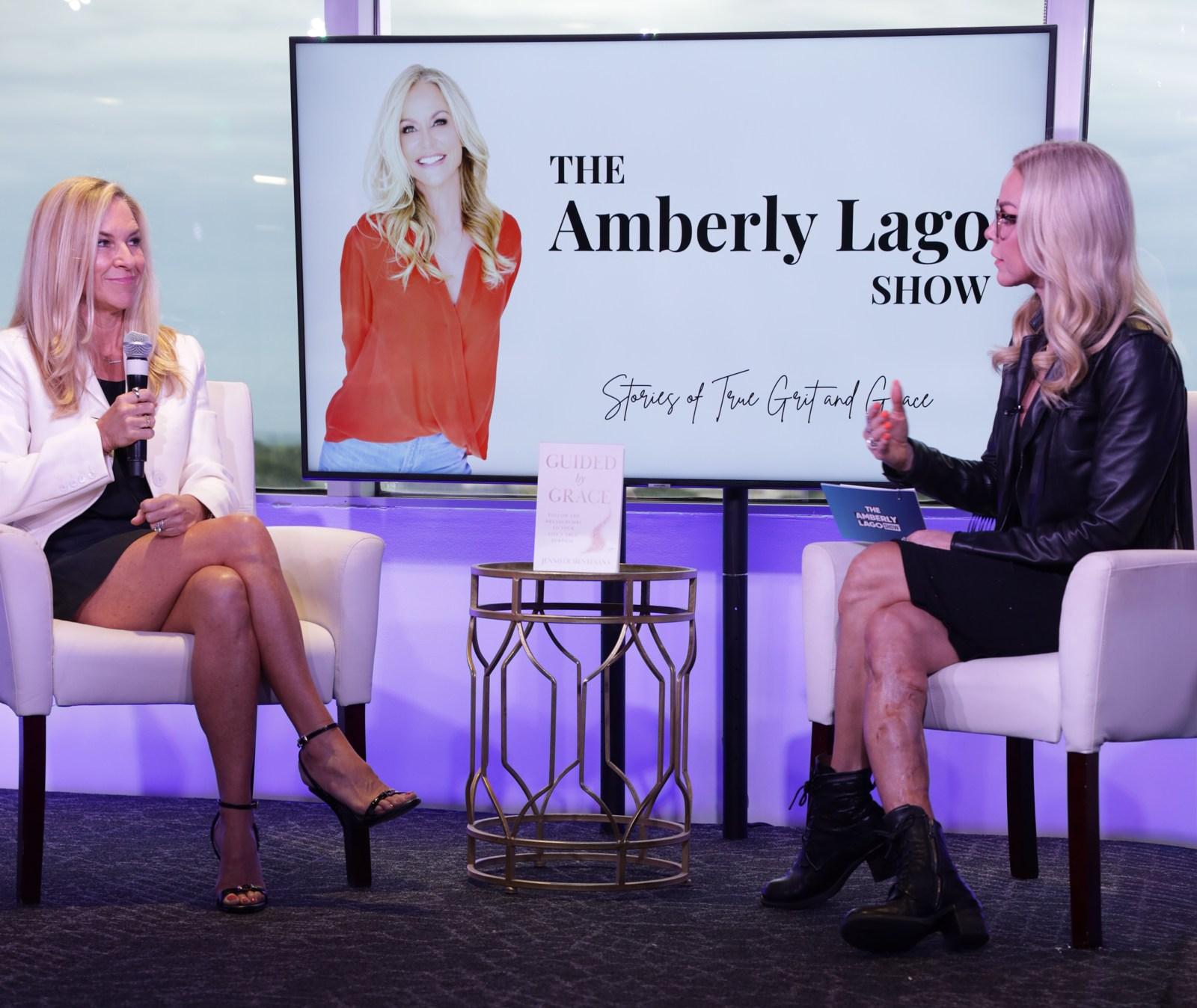

Watch This Episode
About This Episode
"You have a PhD in heart."
I've wanted to record an episode about something we all deal with, no matter how much progress we've made. I'm talking about limiting beliefs. These are the little voices in our head that tell us all the reasons we can't, we're not enough, we're not ready, or it's too risky. But these beliefs are not the truth.
In this solocast, I share a few steps that I've found help me overcome my own limiting beliefs when they come up. I also answer audience questions about finding your voice, sharing your story, and bringing your life into harmony.
Here's what you will learn:
- Step 1: Name your limiting belief (3:03)
- Step 2: Switch the belief out (12:15)
- Step 3: Let it go (12:35)
- How to improve your thinking (13:55)
- How to bring harmony into your life (15:18)
- How to share your story with the universe (18:22)
- How to stay motivated (25:15)
Screenshot your favorite part and post to your IG story and tag me @amberlylagomotivation so I can see and repost to my stories!
Mentioned in this episode
Hiitide Book Club: I am excited to share that registration for the True Grit and Grace Book Club is now OPEN!!! https://hiitide.com/crews/true-grit-and-grace
Unlock your highest potential and start living the life you deserve!
Read the True Grit and Grace book here and learn how you can turn your tragedies into triumphs!
Thank you for joining us on the True, Grit, & Grace Podcast! If you find value in today's episode, don't forget to share the show with your friends and tap that subscribe button so you don't miss an episode!
You can also head over to amberlylago.com to join my newsletter and access free downloadable resources that can help you elevate your life, business, and relationships!
Want to see the behind the scenes and keep the conversation going? Head over to Instagram @amberlylagomotivation!
Audible @True-Grit-and-Grace-Audiobook
Full Transcript
Welcome to True Grit and Grace, a podcast designed to empower you to claim your resilience and thrive through life's challenges. I am Amberly Lago, a mindset coach, fitness expert, and bestselling author. Each week I'll dive deep with the world's brightest thought leaders and elite performers to share tangible tools and practical advice to inspire you to keep your eyes on the prize and forge ahead. So get ready to conquer your fears, heal any trauma, lead with your heart, and elevate your life with grit and grace. Thank you for being here. I wanted to do a special episode on something that's been coming up for me a lot lately and that's limiting beliefs. I mean, honestly, I even get a little nervous before I press record for the podcast. And so any of you other podcasters out there, I wonder if you get any of those feelings or butterflies before. And this morning I looked on Facebook and it popped up that my memory today, two years ago today, I did my first TEDx talk. It was at Berkeley. It was a sold out event. I think there were like, I don't know, like 2500 people there. It was my very first big talk I had ever done on a stage. And this was the most beautiful stage. I mean, there were three levels of two balconies, there were bucket seats that went up and the stage was huge. And of course there was that infamous red circle and I was scared to death. And now it is two years later and I have just said yes to doing it again. I'm doing another TEDx talk and I'm telling you these limiting beliefs still come up. So I don't know if you can ever really truly eliminate those limiting beliefs for good. But I can tell you one thing, you can nip them in the bud and you can start to change them so that you can go after your goals, so you can go after your big dreams, so you can start the course or the job, or go after the relationship or leave a relationship if it's not a healthy one. So whatever it is, those limiting beliefs, those thoughts or opinions that are, that are holding you back and that their beliefs that you think are your absolute truth, you can switch that. And so I wanted to do a show today to just talk about some of the things that I've been doing to help me with those limiting beliefs. Now, the ones I have a lot are, I'm not smart enough, I'm not good enough. I have this fear of being judged that, you know, people are going to think that, oh, who does she think she is? She just needs to be quiet or, you know, I think it all comes down to. I just feel like, you know, I'm just not smart enough. So I started to really ask myself where that came from. So we're going to go over like three, four things that I do that have really shifted the way I see the limiting beliefs and what help helps me get through them. And in hopes that it'll help you if you have something come up that you feel like it's holding you back. So first of what I do is name, name your limiting belief. So whatever that may be, like, you may say, you know, I want to start a podcast, but there's just so many people that already have podcasts and it's the market saturated. Well, that might be your belief of that you're just. Your message isn't important enough. Your message is important enough. There's enough for us all to have a podcast. And that's the mindset of abundance. And just work on making your message really strong. So part of it is really starting to work on your worthiness and build up your confidence. You might say, you know, I want to be a motivational speaker, but I just don't know how to do a talk. I'm. I'm afraid that I'm going to get up there and blank out, or I just don't know what to say, or whatever you tell yourself, maybe it's that you don't feel worthy or you're a fear of being judged, which that's very common. Or maybe, you know, you feel like you want to do that, and your belief is you feel like if you make a mistake, you'll be rejected. And you don't want to be rejected. None. It doesn't feel good to be rejected. It never feels good to be rejected. But once we define what those limiting beliefs are like, what are they for us? What is that story? What is that, you know, opinion or that belief that we keep telling ourselves? What is it that's holding us back? Then we can go to, like, step two that I do is where does it come from? Like, where are those things coming from? Because I tell you, when we're born, we don't have any of those beliefs. We think we're invincible, unstoppable. And it's when things happen along the way that we start to develop those limiting beliefs. And, you know, most of the time it comes from the people around us, whether it's our parents or relatives or, you know, close family members. And sure, their intentions are well, but look, I'm A mom. I screw up and I don't even realize sometimes and believe me, I have a 25 year old daughter and I can see now some of the things that I have really messed up on and I've learned from those mistakes and I've, I'm trying to do my best now with my 12 year old. But even little things that you might not know that your kids pick up on are like you're looking at your iPhone, checking emails, scrolling through Instagram and your kids trying to tell you something and you're not making eye contact with them or you're kind of ignoring them. That message they're getting, maybe. Why are they ignoring me? Why are they looking at the phone and not looking at me? Oh, I guess I'm just not important enough. You know, when I was growing up, I, gosh, I just could not sit still. I still have a hard time sitting still. I was always getting in trouble for dancing and moving, whether I was dancing in the kitchen at home or dancing and not being still in dance class or in school. I got moved to the special needs class and that was the class that everybody said that class is for the dummies. And so that made me feel like, okay, well I'm just not smart enough. I'm in the special needs class. Then in the special needs class I was bored out of my mind and so my feet were constantly tapping. I was working on my time steps, my tap steps under the table. Not time steps, math wise time steps for tap dancing and getting in trouble for that and getting scolded for not being still. Then I was getting in trouble for we had to write out these sentences and it was so boring. And so I would write them out in like this cursive. I invented my own style of handwriting and I got in trouble for that. Like, don't be creative, be still, you're not smart enough. Like all these things that I, I was taught. Come to find out in eighth grade I got tested for academics and I guess what, you know, what class you would go in and I got tested for the talented and gifted. So they put me into a classroom for the smart kids. But I still had that little belief system that I told myself because I was in the, you know, special needs class and then I was still getting in trouble in there, that I am just not a good kid, I'm not worthy, I'm not smart enough, I'm all these things I told myself. Well, in the talented and gifted program, we ended up winning our state district. So that helped a little bit. With my confidence. But it also made me a bit of an overachiever. So then I felt like I had to prove myself. I became a straight A student and I mean, would stay up all night in order to study to get straight A's. I was in the, on the honor roll. I graduated with honors. But at what cost? At what cost? What relationships did I sacrifice to be a straight A student? What did my, what did. Was it doing to my mental health to do that? So the, the stories that we tell ourselves and the beliefs that we have affect every aspect of our life, not just our jobs and our relationships. It affects our mental health. We can sit there and just ruminate on things that we should do or, or who we should be. And I want to tell you right now, we can change those belief systems as they come up. And it, it's, it's not easy for me. I mean, I'm not saying it's easy, but at times it has been easier. So once we identify what the belief is, where do they come from? We can start to get rid of that box that comes around our life because of the belief. So for me, something that changed was to get out of my head and stay in my heart. And so anytime I have those limiting beliefs, I'm like, amberly, get out of your head. Stay in your heart. And someone taught me. My friend Renee, she was a curator for the TEDx Berkeley, and she taught me something. And I've shared this before when I felt so intimidated to go do this TEDx talk, oh my goodness was I beat myself. I had imposter syndrome. I was like, oh my gosh, what's the most important message of my life? And who cares? Who cares about my message? Who wants to hear from me? Well, the media for the TEDx event rolled up and every single speaker had a PhD except for me. Every speaker. And here I am. I don't even have a college education. I just was like, I graduated from high school and I was like, okay, I'm off to pursue my dreams to be a professional dancer. And I was off to la. I never wanted to go to college or be a scholar or any of that. I was like, I just want to go after my dreams and dance. Well, I was so self conscious. And then of course, it didn't help that when, you know, the media rolled up and my husband saw it for the first time, he goes, hey, Amberly, did you know you're the only one that doesn't have a PhD? Maybe you should ask her if you can add that you're an author behind your name or something. And I was like, oh, it's so noticeable. Everybody's going to notice. So I had a conversation with a curator and I said, you know, I know this isn't about, you know, advertising my book or promoting it. I'm not trying to do that. But is there any way we could just, you know, I noticed everybody has initials behind their name. She goes, wait a minute, are you feeling self conscious because you don't have a PhD? And I was like, well, yes. And she said, let me tell you something. You have a PhD in heart. And that's why we have you at our event and that's why you're on our stage because of your heart. And that just shifted everything for me. It gave me the confidence to go on stage and share my message. And another thing I had to remember is it wasn't about me. It's about when you have anxiety or you're feeling anxious. Go be of service. That takes your mind off of yourself. And remember, what is your why? What is your passion? Why are you doing the thing that you're doing for me? And it's to be of service, of service to give people the belief and the hope and the inspiration. And, you know, I get my strength and my joy when I can empower other people to live their lives full out. And so to remember, when you have those limiting beliefs, where do they come from? And then switch that limiting belief. Think of it in a different way. You can switch that belief and realize you can separate yourself from that belief. It's just a belief. It doesn't define you. It's just a belief. Then you can let it go. Thank it, say thank you for trying to protect me from going on stage and making a fool out of myself. But I don't need you to protect me anymore. You know, I got this. I want to go and be of service and deliver my message. And I have the heart. I'm going to stay out of my head and into my heart, go do this thing. So however you need to talk to yourself to switch those negative beliefs, always, like, thank you for being here. But you can. Your service, your is, is done. You don't need to stay here anymore. I'm letting go. And then positive affirmations always come into play in my life. And I'm always, whether I'm saying, you got this, you are enough, you are lovable, you are capable. Whatever it is, whatever you can affirm, positive affirmations make such a big difference in my life. So I hope that Helps with limiting beliefs. And then I had some friends message me. I had a poll on Instagram at Amberly Lagomotivation. If you head over there. A lot of times I do questions and always say, I'm going to answer your questions on the podcast. So the first question comes from Hashiragan. I hope I said that right. How do we improve our thinking and writing? Well, you just start. You start every day and as soon as you have one of those moments, whether if you're improving your thinking, it's so much about what we just talked about, about the, you know, getting crushing those limiting belief and replacing them with positive affirmations. It's really getting to be self awareness. So being aware, stopping to ask yourself, ask the question, who are you? What do you want? How do you feel? There's so much noise right now in the world and there's so much to do with between emails and social media and so many new social media apps and podcasts and so much. It's so important for you to take some time so you can listen to your true self, to your highest self, so you can listen to your heart, get out of your head and stay in your heart. Once again, I'm going to say that again. And then Alisamar from Instagram. The importance of bringing harmony to all of our various passions in life. Yes, I do believe in harmony and alignment. Not so sure I believe in balance. I feel like everything's always changing and it's impossible to keep everything perfectly balanced. But I do believe in harmony. And I think that the way that we do that is by really getting intentional, but by knowing what our values are and knowing what our priorities are. So if you're in a relationship and you have the same values, then it's probably going to be a pretty harmonious relationship because you're going to have the same values. Maybe that's family. For me, it's family first. Or I guess health would be first because without our health, we can't really enjoy much of anything else. But family, work, friends, they come in that order. And so, you know, I was in a relationship, another marriage where family came last on the list. And it wasn't a very harmonious relationship, to say the least. So where you create harmony is where you know what your values are and you know what your priorities are. And for me, I write out my priorities every single day and then I rewrite them every single night. And this may seem like a lot, but I don't know, maybe I've never been diagnosed with ADD or adhd. But I get distracted very easily. So if I don't have it written down, sometimes I'm like, oh, hey, that looks good. Let me go over here on Clubhouse for two hours. Or, yeah, I want to listen to that audible book. Or, oh, I want to scroll through Instagram. And then you go down the rabbit hole, and then all of a sudden, your life's out of balance. You haven't spent enough time with your husband, you don't have all your work done, and you're like, how did I get here? So really write down your priorities, know them, write them down, and revisit them often. Another question. And by the way, I love your questions. If you don't message me on Instagram, if you didn't see this poll, you can text me. Text me anytime. And yes, I just got a question from shy through a text message saying, is this you? Do you really answer all your questions? And I'm like, yes, it is really me. It's me answering all the questions through text. So you can text me at 818-214-7378, any questions. And if you want me to say your name or your handle on Instagram and give you a shout out, I'm happy to do that, too. I think that the more we can promote each other, the better the merrier. So our next question is from Lindsay Robbins from Mound, Flower Mound, Texas. Oh, a Texan. She says, what did you know or what happened in your life that led you to make the decision to share your story? How did that start the process of getting your personal story out into the universe? Okay, that is such a great question. So for me, I think what happened in my life that led me to share my story is it wasn't like I was like, oh, I'm gonna share my story. I. People would see me at the gym, and let me tell you, I was a sight for sore eyes. I'm kidding. I was scarred up. I was in a wheelchair with my leg bandaged, and I had people look at me sometimes and cry because that's how scary I looked in. In the gym. I was there to work out in my wheelchair. And then as I got better, I would go on crutches, and then I would go with a walker and back on crutches, and then I'd go with a limp, and I just kept going back. And this is before I was able to start training clients again. But when I started, let me tell you, this is another limiting belief I had. Since we're on the topic of limiting beliefs. So when I first started training clients again. Here I had been in the gym, working out like this. I felt broken. I mean, I was pretty broken up, but I felt broken. And I was telling myself the limiting belief of who's going to want to train with me. I'm broken. Like, who's going to want to train with a trainer? I'm on crutches, on and off crutches. I had the Canadian crutches. That was the belief that I had of, I'm not good enough. I'm broken. I'm not worthy. Well, to my surprise, my business boomed because people saw me in the gym, like, oh, if that girl can do it, I can do it. There's no excuses. If she can rehab herself and get strong again and make this transformation, then I want to train with her. And so my business boomed. So the story that I was telling myself was just a story that I was telling myself. So how I started sharing my story was I had people approach approaching me in the gym and saying, hey, could you please call my aunt and talk to her? She's really struggling. She's been bedridden. And I would love for you to share your story with her to give her some hope and inspiration, so hopefully she won't give up on life. So I started making seriously, one phone call at a time, visiting one friend at a time, sharing my story. And then I had someone say, could you come and share your story at my Provisors networking group? And I was like, holy cow, okay. And I noticed something happened when I shared my story. It was this light that I would see that would come on and other people. And that light just sparked more light in me and was like, the energy was contagious. And it just brought me such joy and to see when people were genuinely moved and happy by the things that I would tell them. And I think that, you know, I really discovered my purpose that way. And I think that a lot of times, if you look at the things that happen or that we love doing when we're, like, age 7 to, like, 10 years old, what's something that you love doing when you were that age that's usually connected to your purpose? That something that you would still do today? It's something that I still do. Back then, I loved dancing. And when I would dance, it would genuinely make people happy. And it got to where everywhere I went, people would say, amberly, do a tap dance for them. And I would do a tap dance, and it would. People would clap and they would giggle and they would laugh, and it made Me happy that I made these other people happy. And then it was every Friday night at the Dairy Queen. I would, you know, I don't know how my mom let me do this, but I remember being like 5 years old and after the football game, every Friday night at Dairy Queen, I'd be dancing on the table. So think about something that you did that can lead to your, you know, your purpose, and then the passion that you have, your why, the why you do it is that's all connected. And so for me, how I started to share my story with the world was that way, one person at a time. And then it started to take a little time. I mean, I really recovered for a good four years after my motorcycle accident before I would start to share about what happened or even. And it was about six years until I actually showed pictures of how scarred up I was. I'm approaching five years of sobriety. March 13th. Actually, by the grace of God, I have five years of sobriety. And I was sober for almost a year before I shared that with anyone. And I just recently started to share more about it through social. And I don't share about it much because it's something that's so sacred to me, but I share it because I genuinely want to help someone who might be struggling to know that they're not alone. And so those are ways I started putting it out. And I always say, make sure that if you want to share your story that you're sharing from a scar and not an open wound, because you want to make sure that you're. We're constantly healing, but it can be rough, you know, when you're sharing. And like, for me, when I shared a video of me dancing on Tick Tock and somebody made fun of my leg and the scars and said they were going to throw up when they looked at my leg. If I was sharing that from the vulnerable place that I. When I just gotten out of the hospital, I would have been crushed. And I would have had a limiting belief of, see, I'm ugly, I'm broken, I'm not worthy. But because I was able to take time and heal and build my confidence and look at my scars a different way and change the story that I. I was telling myself that when someone else said that, it didn't reinforce the story that I told myself of, see, I'm just ugly, I'm not worthy enough, or whatever the story is you're telling yourself. So I always say, share from a scar, not an open wound. And last question, what made you stay motivated to Keep moving forward when, when knocked down, both physically and mentally. Well, first of all, I don't think we'll, we can always be motivated. And that's why it's important to have healthy habits in place and to stick with those healthy habits and have non negotiables that you put in place. For me, my non negotiables are my health. My non negotiables are some quiet time in the morning to get grounded with gratitude. That's just how I start my day. My non negotiables are family time. And my non negotiable is also time to find, find joy. And so no matter what is going on, to stay motivated, you really have to be disciplined. And to me, discipline equals a life of joy. It equals a life of freedom. Because when you're disciplined, it allows you to make time in your schedule to do the things that you love. And so I also think, I mean, I could go on and on about this, this particular topic and maybe I'll do another episode just on motivation. So text me and let me know if you want me to do an episode just on motivation at 818-214-7378. And I think that so much of the motivation comes to from the people that you're hanging out with. And it doesn't just mean that you're physically hanging out with. Like who are you following on social media? How much time are you spending with toxic people in your life? Is there a way to eliminate that relationship completely? Or maybe it's a family member and you can't really get rid of family, but you can put boundaries on the amount of time that you spend with them. So, so much is about being around people who are passionate and inspired and they're go getters. And I'm reading a book right now. I'm about to interview Bedros on the podcast in a couple of weeks and he has a book called man up. And he has a pardon in his book that talks about be your. There's two kinds of people. There's either crop dusters or jets. And I'm going to mess this whole way of how he says it up. But he says in the book that I'm reading that, you know, the crop dusters are people who, who are, they make excuses. They're, they're not motivated. They live paycheck to paycheck. They, you know, are telling, they're not taking accountability for their lives. They're blaming other people. And the, the people who are like the jets are the people who take accountability. They've learned delayed gratification, you know, and that means like, yeah, it's easy to do a quick fix, like, you know, eat sugar and that makes you feel good for about two seconds and then you have the sugar crash and you feel horrible. But you know, the delayed gratification is when you eat healthy and you feel better all day long and you start to look better and you start to think better. And so that's a book I'm reading right now. It's called Man Up. I highly recommend it if you want to kick limiting beliefs to the curb and go after your dreams. That is an incredible book to read and I'm going to have him on the podcast soon, so I'll be sure to let you know about that. If there's a part of this episode that really hit home for you, please take a screenshot and share it on your social media. You can tag me @amberly lagomotivation or true grit and Grace. I've got both of those Instagram handles and when I see it, I will share it on my story. I just appreciate you being here. Thank you. Thank you for taking the time to listen in. And again, you can always reach me, give me any tips, any suggestions you want for people on the show or or any questions that you might have at amberlymberleylogo.com or 818-214-7378. And I just want to say thank you for being here and if I would love to also hear your feedback through review. If you can give me a review, I'll also screenshot that and put it in my story. So thank you for being here. And until next time, keep shining your light boldly. You are limitless. Thanks so much for joining us this week on True Britain Grace Podcast Podcast. If you like it, please rate it or share it with your friends. That would help too. If you're not yet on the newsletter list, come over to amberlylogo.com and jump on it. While you're there, you can grab a free downloadable gratitude journal. And you might just want to check out my book or even check out my monthly motivational membership. Thanks again for tuning in and we'll see you next time. Weekend.
Pain to purpose to joy.
Never Miss a Conversation
New episodes drop regularly. Subscribe on your favorite platform and never miss a conversation.