

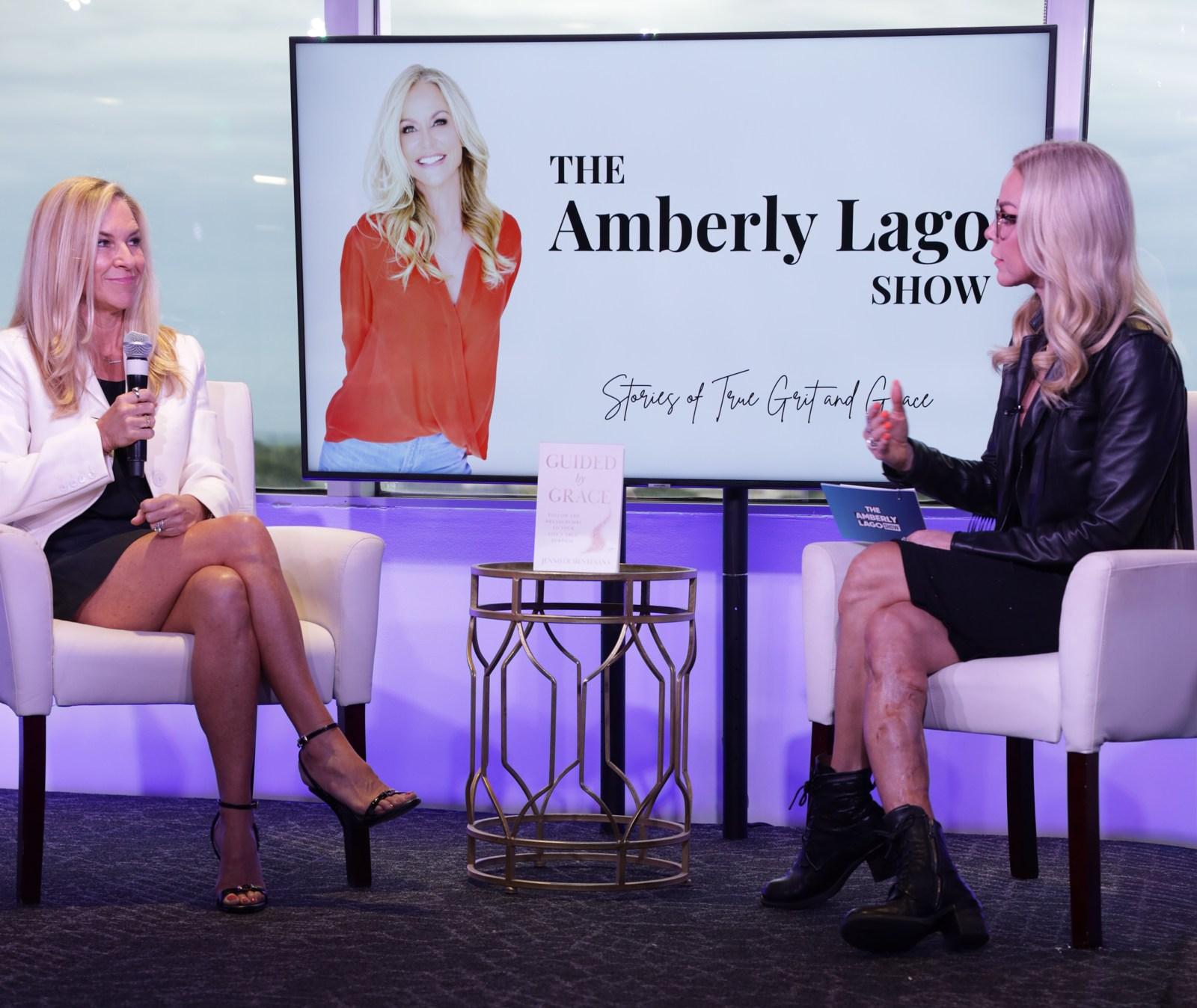
Season 6, Episode 100
How to Turn Your Fear into Your Greatest Strength with Jill Schulman
A conversation with Jill Schulman

Watch This Episode
About This Episode
I think most people assume bravery belongs to someone else. The person who speaks on the big stage. The entrepreneur who takes the risk. Then I sat down with Jill Schulman, former U.S. Marine Corps officer, keynote speaker, TEDx speaker, and author of The Bravery Effect, and she completely challenged that idea!
Jill has spent years studying the science behind bravery, and one of the biggest takeaways from our conversation is that courage isn't something you're born with. It's something you build. If you've been waiting until you feel more confident before making a decision, having a difficult conversation, or taking a chance on yourself, I think this episode is going to encourage you in the best possible way!
Fear Isn't Always Telling You to Stop
One of my favorite parts of our conversation was hearing Jill explain what's actually happening in our brains when fear shows up. She described how the part of our brain, the amygdala is constantly trying to protect us. But it can't always tell the difference between real danger and everyday discomfort. Speaking up in a meeting, starting something new, asking for help, or putting yourself out there can all trigger the same alarm system.
What I appreciated most is that she didn't tell us to ignore fear. Instead, she reminded us that every time we take one small step through it and discover we're okay, our brain begins to learn something new. Little by little, the fear loses its grip.
That perspective feels incredibly hopeful because it means courage isn't about eliminating fear. It's about changing our relationship with it.
The Things We Avoid Don't Usually Stay Small
Jill also shared that when we consistently avoid the things that make us uncomfortable, we might feel relief in the moment, but over time that pattern can actually increase anxiety and keep us feeling stuck.
I know I've experienced that in my own life. Having a difficult conversation or stepping into an opportunity that feels bigger than I feel ready for, avoiding it has never brought me peace. It only made the fear seem larger the next time it showed up. Growth usually asks us to take one small step before we feel completely prepared, and that's something I've had to learn over and over again!
Bravery Looks Different for Everyone
Jill doesn't define bravery by dramatic moments. For one person, bravery might mean walking onto a stage. For someone else, it might mean setting a boundary, making a career change, admitting they need support, or finally taking the first step toward a dream they've been putting off for years.
That reminded me that we spend far too much time comparing our journey to someone else's. Your next brave step doesn't have to look like mine, and mine doesn't have to look like yours. What matters is that we don't let fear make our decisions for us.
If this conversation encouraged you even a little, I hope you'll listen to the full episode. Jill shares practical tools, fascinating neuroscience, and simple ways we can retrain our brains so fear no longer gets the final say. It's one of those conversations that stays with you long after it's over!
We Discuss
• Why fear is often a signpost pointing toward what matters most
• How to tell the difference between protective fear and growth fear
• Using your future self as a guide when making difficult decisions
• Why you should never wait until you feel "ready"
• The importance of preparation and practice when facing fear
• The neuroscience behind bravery and how the brain changes through courageous action
• Why avoiding fear can lead to anxiety and unhappiness
• The surprising truth about stress and why stress can actually be beneficial
• Building confidence by repeatedly doing hard things
• How bravery and happiness are deeply connected
Timestamps
00:00 Introduction to Jill Schulman and The Bravery Effect
03:05 Why bravery and happiness go hand in hand
06:00 How to differentiate between fear that protects you and fear that helps you grow
10:05 Asking your future self for guidance
14:05 Why feeling scared means you're probably on the right path
17:00 The importance of preparation and practice
22:10 Why you should never wait until you feel ready
26:15 The science behind stress and resilience
33:30 How our mindset changes our response to stress
39:40 The neuroscience of bravery and brain adaptation
46:20 Why avoiding fear can increase anxiety and depression
53:00 Fear is a signpost, not a stop sign
57:20 Final thoughts on doing things scared and living courageously
To Connect With Jill Schulman
Instagram https://www.instagram.com/jillschulman/
Website
Book – The Bravery Effect https://www.amazon.com/dp/B0F2BBPR35
TEDx Talk https://youtu.be/G2x63Wk07fE?si=xtIBvxJh29iYJnP6
To Connect With Me
Instagram https://www.instagram.com/amberlylagomotivation/
Coaching Program https://go.amberlylago.com/
Website https://amberlylago.com/
My favorite for gut health & wellness https://plexusworldwide.com/?sponsor=Amberlylago
My MAKE Wellness link https://meet.makewellness.com/?referral=521698
Joy Through the Journey https://amberlylago.com/book/
Listen to The Amberly Lago Show https://amberlylago.com/podcast/
Subscribe so you never miss an episode!
Full Transcript
How do you differentiate, like, between fear that is, like, trying to protect you or fear that's like, I need to run towards this. This is a green light.
You just can ask your future self for guidance. So if you ask yourself in that circumstance, what is your future self maybe five years from now, what does your future self want you to do in this moment? And your future self doesn't say, like, I want you to do this. I don't want you to delay. Have a conversation with your future self. And you're not crazy by talking to yourself. It's a really wise way to differentiate between the fear you should run toward and the fear you should listen to.
What are some steps for somebody to do who is scared? What's the first thing I need to do right now?
So we want to have that balance. We want to do everything we can to prepare ourselves to perform at our best. And you're still going to feel scared. And if you can combine those two things, you're going to be unstoppable.
What is the core takeaway you want the readers to walk away with?
The probably. The key takeaway is for people to realize that they should do things scared or to realize that fear is not a stop sign. Fear is not a warning sign saying run the other way. But fear is a signpost, like, really pointing them to the things that they most need to do. So it's changing the relationship with fear.
Hey there. Thank you so much for tuning in to the Amberly Lago show. I feel like there's a lot of change going on in the world, and some of us. I don't know if you're anything like me. Sometimes I can, especially if I watch the news, you know, get into some fear. I want to be more courageous. I want to be brave. And I've got the perfect person on the show today for this. I am so honored to welcome Jill Schulman. She's a decorated former US Marine Corps officer, leadership expert. She speaks all over the world. In fact, you've got to go check out her TED Talk. It's amazing. And she helps individuals and teams unlock their highest potential by mastering what she calls the science of bravery. So you're going to want to get a pad and pen. I've known Jill for a while, and she shares pure value. I mean, it's amazing. Her book is out. You have to grab her book, the Bravery Effect. Jill, welcome to the show.
Oh, thanks for having me. We've been talking about this a long time. I'm glad we're finally making It a reality. I'm excited to chat.
I am, too. And, you know, we met at John Gordon had an event.
Yes. It was John Gordon and Katherine that introduced us. You were at that event, and. Yeah, I remember that. And you were in the back, and I was just. I hadn't quite launched my book yet, and I was asking a bunch of questions, and you came up and introduced yourself and gave me some pointers and some advice, so. I remember that. Thank you so much. Yes.
And then we ended up going to Kauai together.
Yes. Yes. We'll never forget that.
That was so much fun. Yeah. We got to go. I did a retreat with a couple of other ladies, and. And you joined us for that, and we definitely created some memories. But I have one question for you. Did you were the only people that didn't get sick on the boat?
I think we were. I was gonna say there's two brave things we did. One is snorkeling on that day, because it was so crazy. And I. I loved it. No problem at all. It was great. And then, yeah, that catamaran was, they say, one of the roughest ones. And you and I were in the front just enjoying it. I know.
I think the trick was to stay in the front. But, yeah, I've got a scar on my leg to remember the snorkeling trip because a wave threw me into some, like, I don't know, rock or something. But it was fun. It was fun. So you've been speaking to companies all over the world, speaking about this, and now you have a book, so it really helps. I feel like. Has that gotten you on more podcasts and stages now that you have a book?
I've been on so many podcasts, um, now I'm taking a break from them, unless they're my really good friends, like you, Amberly. But, yes, I mean, I have been speaking, you know, virtually at events, flying all over to speak about this, on podcasts, et cetera, because so many of us, we hesitate. We. We freeze. We. You know, we all have fears that many times control our behavior. And not in a good way. Cause sometimes fear keeps us safe. And. And once in a while, like, I mean, it's very rare, but maybe 10% of the time, we experience fear, and we should listen to it, but 90% of the time, you know, we're waiting until the right time. We're hesitating, and that holds us back from not only being as successful as we can be, but it really. And this is the heart of my research, is it prevents people from living their best life. Because I care about happiness. I'm a happiness scientist. I studied the positive psychology at the University of Pennsylvania under Marty Seligman. So really, the reason I care so much about bravery and people sometimes wonder, how do these two things fit bravery and happiness? Yes. They go hand in hand because when we run away from what we fear, our world gets a little bit smaller and we give more power to that fear and our self confidence and our self efficacy goes down, it leads to anxiety and depression. So bravery isn't just something that helps us be more successful, make more money, and it does that. But what I really care about is what it does for our. Our life satisfaction, the joy we feel in life.
Yeah.
The joy expert.
Yeah. You know, I just got off of a call with one of my clients who were actually going to New York this week to be on the nasdaq, and she messaged me and she was saying, you know, I don't know, I have a lot of fear coming up because what's going on in the world right now? And I said, no, I want to go. I, I want to go. And I know there's a lot going in the world right now, but I want to go. And I have, I want to have some fun with you. So let's do this. But how does somebody differentiate between fear, like face everything and run towards it? Or there's another saying I won't say here, but you know, how do you differentiate, like between fear that is like trying to protect you or a fear that's like, I need to run towards this. This is a green light.
Yeah. The easiest tip I give to my audiences and I'll share it now, is, is you just can ask your future self for guidance. So when you're feeling that fear, ask yourself, what does my future self want me to do in this moment? And your future self will always have the wisdom to know. Is this a fear that you're, you're nervous because you might fail, but you really want to do it or it. So let's use an example just to be practical. Like, if you're wondering if you should take a dare and do five shots of tequila and you ask your future self, should I do it? Your future self is going to say, like, okay, that's just bravado. That's stupid. Don't do it. Or, or, yeah, this is really dangerous to do something, don't do it. But most of the time it is our, it's social fear. We're, we're afraid of failure. We're Afraid of rejection. We're afraid of maybe not being perfect in the end of the very first time. And that's when your future self will. Will guide you correctly. Because what we want to avoid is the fear of regret. Because many times what we want is a self concordant goal. It's. And I'm, I use too many, like, academic things. But self concordant goal is like, what is something that your soul really wants? Like, I want to speak on this stage. I want to get my message out to the world. I want to embark on this new project. And it's something that you really, really want, but you just, you have the fear to get started. So if you ask yourself in that circumstance, what is your future self maybe five years from now, what does your future self want you to do in this moment? And your future self doesn't say, like, I want you to do this. I don't want you to delay. So there's a little, like, psychological trick. We can have a conversation with your future self and you're not crazy by talking to yourself. It's a really wise way to differentiate between the fear you should run toward and the fear you should listen to.
That's so good. Well, I love how you shared when you were doing your TED Talk that you were. You had a little fear. I had a lot of fear. I was scared to death. And I love what you did to go for it and just do, just nail it. What. I remember something that helped me when I was really scared about speaking on the TEDx talk. And I was the only one that wasn't a doctor, the only one that didn't have a bunch of initials behind my name. And I was scared to death. And a client of mine said, amberly, you've made it through 34 surgeries. I think you can go stand on that stage and talk. And I was like, oh, just that little shift in perspective. But I love what you did. You. And when I'm in a hotel room by myself, I can lock in. But you checked yourself into a hotel, put tape on the floor, and you practice, practice. I love that because you're sharing really how you got through it and how you conquered that fear. What are some steps for somebody to do who is scared? And they're like, I don't know if my future self wants me to do this, but I'm scared. I feel stuck. What's the first thing I need to do right now?
Well, like anything, there's like, there's. There's always two sides to this. So one is one Is realizing. And I want your audience to know this is. Sometimes when we feel fear, we think, oh, this means I'm not ready, or this is a sign that I shouldn't do this. So being a little bit nervous or feeling fear, like your heart racing, you're feeling the adrenaline, that is not a sign that there's something wrong. That is actually a sign, usually that it's a signpost pointing you to exactly what you need to do. So if you're feeling that fear, just know that there's nothing wrong with you. That's what's supposed to be happening. When there's something really important, it's actually your body preparing you to perform at your best. In fact, if we look at the. How you feel the emotion of excitement and the emotion of fear, they're almost identical, right? So when your heart is pounding, you feel the adrenaline. That's your body, you know, getting blood to all areas of your. Your body. When your heart is pumping really hard, adrenaline is giving you the energy to perform at your best. And this is our evolutionary psychology. So. So you should feel a little bit fear. And then at the. At the. And also at the same time, you want to do everything you can to make sure you perform at your best. And that's what I experienced when I got to that hotel room a day and a half before my TedX. I kept thinking of this quote, because I got to my hotel room and I'm like, okay, I'm going to practice. I'm going to put away all my notes and just try to do it. And I realized I was not as prepared as I wanted to be, because I think I went on for 25 minutes, and I was saying UMS and I was recording myself. And what came to my mind is that you do not record rise to the occasion. You fall to the level of your training and your preparation. So in that moment, like, I was scared to get on stage, but I don't want to just say, like, well, I'm not prepared. I'm sure I'll be fine. I'm just going to walk out there. No. The way that we can perform at our best at things that matters, we need to do the work, and we need to prepare. And even though I did all of that work and I think I practiced 60 times in my hotel room before I finally went on the stage, I still felt the nerves. So we want to have that balance. We want to do everything we can to prepare ourselves to perform at our best to. And you're still gonna feel scared. And if you can combine those two things. You're gonna be unstoppable. But what some people do is they prepare. They prepare and they still feel nervous, so they feel like, you know, the timing's not right. I'm not ready yet, so I'm gonna put it off. Putting things off. Like, if you wait until you feel perfectly ready, that time is never going to come.
Yeah. And I think I. I would feel like something's wrong with me if I didn't get nervous before I went on stage. I'd be like, what's wrong with me? Am I alive? I was. It makes me feel alive when I'm.
Yes.
You know, I love it.
I love that you said it makes you feel alive. And I want people to. To learn what you just said there. Like, if I'm not a little bit scared, a little bit, like, that's invigorating. Makes me feel alive. If you're not a little bit scared, scared, you're not going for what you really want in life. So we should always be thinking about what do we really want for ourselves? We are born as human beings to strive both physically, which is why we should be going to the gym and striving to get stronger. And we need to do the same thing psychologically. So we should always be just that. Just a little bit scared, a little bit just nervous, because that means that we're on track to try to have a bigger impact in this world.
Yeah. Well, you talk also about stress and saying that what if stress could be a good thing? Can we talk a little more about that?
Yeah, let's talk about stress. You had me at stress. I love talking about stress. The reason I love talking about stress is because people misunderstand stress. And what we see all over media and what people think about stress is that stress is the enemy and stress is horrible for us, so we should avoid it. And we should. We should avoid anything that makes us uncomfortable, that stresses us. And so if we look at the research. And again, I'm your academic nerd, so please just bear with me for a moment. But I think looking at the science is what we need to do here. Your. Your mindset on stress, if you think it's bad or if you think it's good for you, predicts your response to stress, both psychologically and physiologically. So let me expand. This is Aaliyah Crum and her colleagues that have done. They're leading researchers on stress mindset, and what they found is if someone believes that stress is bad for them, and then they encounter stress like every human being in the world, because there's always going to be some stress. They have a negative psychological response because like, oh my gosh, this is stressful. And then their body has a negative physiological response. The inside of their vasculature will constrict, causing blood pressure to go up just because they think stress is horrible. Like this is bad. But if people learn that stress is enhancing, that encountering challenges and stress is what makes them learn and grow and get stronger, then those people have a positive stress response. So when something stressful happens, they're like, all right, bring it. Like, I'm gonna get through this. This is gonna make me stronger. And then the same thing with their body. Their physiological response will stay calm so their blood pressure doesn't go up where someone else it would. People that think stress is enhancing have higher levels of dhea, which is a hormone that is related with, related to resilience. And this has been studied. In fact, Aaliyah Crum and colleagues went into a company, a really high stress company in the finance industry, in ubs, in this company. And when they went into ubs, a really stressful company, the only intervention was showing a three minute video to half of the people saying stress is enhancing. You know, when you feel stress, it's your body preparing you to perform at your best. And that's how you learn and grow. So it's a three minute video, all with evidence saying stress is enhancing, which is, you know, which. So it's all true things. And then they also for the other half the placebo, they gave them a video saying stress is horrible, stress is going to kill you. And there, there is science that also shows that. So they were both three minute videos. Everyone thought they were watching this exact same three, three minute video. Then Amberly, they followed these people and they measured different things. They measured first of all job performance. People who watched a three minute video teaching that stress is enhancing, they perform better in a high stress environment. They also like their job better. And they had a.
They like their job better.
They like their job better because they've been taught stress is enhancing and, and of course their stress in the job. So they had higher job satisfaction and they also looked at the physiological response, their body stayed calm and then than the other groups. So all of it was statistically significant. So our viewpoint, our mindset on stress is going to make a huge impact on your ability to handle the life's ups and downs that we all will encounter. And we'll also predict our body's physiological response. So Kelly McGonagall, another researcher that leads the way in this, in this research, you know, she famously said in her TEDx that this is the difference between someone having a premature heart attack at 52 years old and someone living well into their 90s. So we need to understand the impact of the way we view stress. So.
Well, I would think this reminds me, and this is probably the, you know, former fitness. I was in the fitness industry for 26 years and, and an athlete before that. And when I think of stress, if you think of it on your body, like we go to the gym and we cause stress on our bodies to get stronger. And I'm not looking at that when I'm doing the, you know, leg extension machine or squats or whatever it is, is, this is bad. This is hurting. This is not. I'm looking at it as I'm getting stronger, I'm doing more and more. And so what you're saying, I guess I'm a visual person, that's kind of what it reminds me of. What we do to our bodies physically is we put them under stress to get stronger.
That's exactly right. And that's a great analogy, Amberly. I love that because that is what happens in our brain. And here's the crazy thing. When we look at the neurology of bravery, just like if you stress out your bicep, it will get bigger if you make it. If you lift heavy enough where it hurts and then you're sore the next day, our body remodels and makes the muscles stronger. We actually see changes in the brain. And this is the most exciting part of. I really get jazzed when I. When I'm really diving into the neurology. So we see changes in the prefrontal cortex, the executive functioning part of our brain, when we don't allow our emotional response. So we see changes there. When we do things scared and. And the world does not end. We also see changes in the acc, and specifically the mid singular cortex part of the acc, sometimes known as the courage part of the brain, changes. And then in functional MRIs, when they're actually looking at how the brain is lighting up. So basically, when you do hard things or you do things that
when you
move forward in the presence of fear, then you're doing these little mini workouts for your brain. And these parts of your brain are getting larger, stronger, just like muscles. And then there's more neural pathways that are lighting up between these areas of your brain, so it becomes easier for you to do brave things, moving forward just Like, I just went to the gym yesterday. I had taken a little time off, um, for some little health reasons over the holidays. And I hadn't done a lot of like, really heavy lifting. Right. Um, so I did a, a class, a body pump class yesterday, and I lifted pretty heavy. And I am like sore all over. But when I was doing my body pump classes regularly, like, I'd be a little sore, but you know, like, my body was used to it. It was easier for me to do those loads. So the same thing happens in our brain. So it might be really hard for someone to do that scary thing in the beginning, but if you keep doing it over and over again, your brain adapts. So when I say to people, anyone can be brave, it's a skill to build, I mean it like literally in your brain.
I, I agree. And Jill, you know, even for me, if I am speaking at events back to back to back to back, I'll get nervous, a little nervous, but I feel like I'm on a roll. I feel like I'm just going for it, you know, but like it's been. Well, I'm saying I just spoke at an event two days ago, but it had been like two weeks of I'd spoken at some virtual events, but not an in person on stage event. And I felt like I was a little more nervous, but it's because some time had gone by. So I just need to get regular about speaking on stage all the time. Because then once I get, once I get into it when I'm on stage, like I get through the first few seconds and then I'm like, ground your flow state.
You just get into your flow state because I've been with you, I've seen you. Yeah. Well, the other thing to think, I always want to be responsible from the scientific perspective when I speak on this. Is there a way that you go too far? Can you go too far when it comes to always doing brave things? And the answer would be just like our bodies need to recover after workouts. I mean, if we went in and shredded our muscles every day and we didn't give our body a chance to, to remodel our muscles and get stronger, then we would not be stronger. So it's the same thing. Like, you know, when it comes to bravery, it's personal for each person. So we need to get the workout in and do the hard thing and then we need to rest and recover so that, you know, we can make those adjustments. So, you know, so yes, you can go too far, right? You know, so you don't want to be doing scary things every day, you know. You know, 24 hours a day. But, you know, you. You want to be challenging yourself and doing things that make you a little bit scared. And then, you know, maybe take a day to do things that are more of a rout. Take a day off and then go back at it, just like in the gym. So that analogy of you sharing in the gym is. Works for bravery.
Well, I have to remember to take a break because I'm just the kind of person that I love to go and I love. I actually. Maybe I'm crazy, but like, to do scary stuff. A little bit of a daredevil, and I have to. Like, even yesterday, so I got back in town, I was like, amberly, take. I have to talk to myself. Take a break. You need to recover. You're leaving town again. Like, you have to rest. Because I will just go and go and go. I love. I get all. I geek out on all this brain stuff. And I went to. Have you ever heard of Brain Code Center?
No.
Oh, you would probably love it. So Rachel Lambert is the one who created Brain Code Center. I had her on the podcast, and she. Before I really knew her, I. I heard her speak at an event, and she invited me to come to her center. And they can help with everything from anxiety, depression, bipolar, addiction, all these things. But what was so fascinating is they did the brain scan you. I've had two brain scans done.
Hers.
And at my doctor's office, they did one that was a little bit different. And it is wild to me. She could tell exactly how old I was when I had trauma because it's stored in the brain. But it's also so fascinating because it shows that, like, you were talking about how we can change and the neural pathways can light up in different areas of our brain. It is fascinating how the brain is like. It really is why they call it brain mapping because it tells a story of. They even said, yeah, you have add. And I was like, oh, okay. I kind of figured that. Next brain stand. That's first thing. So, yeah, you've got add. I'm like, oh, is that why I act like that? You know? But I'm fascinated. I am.
It is. It's so. It's so interesting. So for me, too, if I can understand the mechanism of why something happens, then I'm more motivated. So for your audience, you know, when you. So when you're feeling the fear, because I know it's probably hard for you to say, like, oh, just do it. Scared and it's going to get better. Like how do I actually do it? So just for your audience to understand this, so there's a part of our brain called the amygdala and it's the feeling part of our brain. It's where we experience our emotions before we can make like decisions. So our amygdala is commonly described as a, you know, overly enthusiastic, paranoid security guard that is just trying to keep you safe. So anything that's a slight danger is like, they just sound the alarm bells and say like danger, danger, trying to keep you safe. So what happens in the brain is if you take a step, even though you feel the fear, it's called safety learning in the brain. So if you do something, you're a little bit scared and then everything goes okay. Goes okay. And again the sky does not fall and the world does not end. Then the amygdala adjusts and says, oh wait, okay, that actually wasn't as dangerous as I thought it was. So you're, you're training your brain to change the threat assessment. So that is what's happening. And then if I let me leap over. So that's what, what's actually happening in the brain. So you've got this amygdala and you've got to train your amygdala to not freak out over every little thing. And the only way that you do that is you stick your toe in the water and you do something that's a little bit scary. And when it's okay, then your amygdala starts calming down. So that's a little bit of the mechanism why. And then if I just take it to a little bit of evidence of, of like when they study many adults, there's something called experiential avoidance, so which is academic speak for running away from our fears. So when people allow fear to control their behavior and they avoid things that are uncomfortable or scary, researchers followed more than it was like over 2,400 adults over four years. And they wanted to look at the relationship between this experiential avoidance or running away from our fears and what it does to their mental health. And what they found is running away from your fears developed, ended up resulting in the development of anxiety and depression and the sustainment of those conditions. So if we, if we allow fear to control our behavior in the moment, the reason why we avoid the scary thing is because we just want to be happy in the moment. We want to preserve our mental well being by why would we stress ourselves out and do something scary? So That's a very short term, you know, a short sighted way of thinking because each time we avoid that scary thing, right? Our, we feel good in the moment, relief in the moment, but long term it has, it can have a really negative effect. So that's, that's why I'm on this mission. Like I, I feel like, you know, you and I talk about the kids sometime, right? And so I've got an 18 year old, I have a 20 year old daughter and those are my two daughters. And so when I was going back to school and researching, like, I think I sometimes see the world through the lens of my kids and, and I think our younger and they think that the way to live the happiest life is you just, you want to avoid all stress and challenges and you don't want to face your fears. If you just run, if you just stay in a safe environment and there's no challenges and adversity, that leads to a happy life. And that's not the case. Like if that's your mindset and you avoid all the discomfort and the scary things and the challenges and adversity, you run away from it to keep yourself safe. That is a, that is a fast track to living a, a life of unhappiness because you'll, you'll be scared of everything, you'll be anxious and you'll be depressed. So we have some work to do to correct the narrative.
Well, you are definitely getting out there and correcting the narrative. I love that you talk so much, especially in your book. It's resonated. The bravery effect has resonated with so many people. What is the cork takeaway? You want the readers to walk away
with the probably the key takeaway is for people to realize that they should do things scared or to realize that fear is not a stop sign. Fear is not a warning sign saying run the other way. But fear is a signpost, like really pointing them to the things that they most need to do. So it's changing the relationship with fear because like some people say, you know, oh, you're, you're a speaker on bravery, so you want people to be fearless. I'm like, no, no, I want the opposite. I want people to fear more. I want people to realize the secret to living a psychologically rich life, to living your best life, is to think about what you really want. And it's going to be scary to move that way. But I want people to move toward their fear. So do it scared. Do not wait until the fear goes away. So what do you Want in life. Take a step. It'll be scary, but you just keep taking those steps little by little. That's the mission of the book.
I love that. And, yeah, I talked about. I did a post today, and it was all about momentum, and it was all about sometimes, you know, we feel like we're just taking these little steps, and that's okay. As long as we're taking steps forward. That's how we keep the momentum going. So what would you say to somebody like me that is like a daredevil? I like to jump out of planes, and so do you. I was so bummed.
I know. You couldn't jump out of a plane with me. We'll have to do it someday.
I know where I was speaking at another event or something, or you. I was like, I so want to do that with you. It looks like so much fun.
Yeah, it was fun. And now for me, I have always had a fear of jumping out of a plane, so, like, maybe I have. You're at a different level, Amberly, because you just want to do the adrenaline, joggy things for me. I said, when I was in the Marine Corps, there was an opportunity to apply to go to jump school, and everyone thought it was cool. And I'm like, no, thank you. I never want to do that. No, thank you. I said, I will never jump out of a perfectly good plane. But when I started doing the research and I wrote the book, and I'm like, how am I going to celebrate my book launch? I'm gonna jump out of a plane. And because I invited, like, eight friends to do it with me, and I had the local news filming it, like, there's no backing out.
Yeah.
But let's talk about what happened that day. So, like, I mean, being the psychology, you know, expert, like, I was doing all this cognitive reframing. Like, I'm just saying, like, this is. This is not me nervous. This is me excited for something great. And so, like, I was. It worked all the way up until we were at the top, and they opened up the door, and then it was just sheer terror. And we had it planned that I was gonna be the first one out, and I was terrified, but I jumped with a very capable, experienced man on my back that was doing all the work. So this was a tandem jump, but, you know, we. We jump out, and after about three seconds, all of a sudden, it becomes the most serene, calm, beautiful experience. The fear goes away after the first, really three seconds. Right. And so when I. When my. My feet hit the ground down below now Is jumping out of an airplane something that is still a little bit scary? For me? Yeah, I've done it once, but now the fear is so much lower. Like, I mean, it's probably a third of what it was before. And if someone wanted to go jumping again, like, if we're in the same city, I'd be like, let's do it again. And if I did it again, it would be less scary than it was, you know, the first time. And so each time you do these things, you. You. You take the power away from the fear so that your life gets bigger. So where did you jump?
Where? What?
In Oceanside, California. So I live in San Clemente. You know, I got in the Marine Corps from Camp Pendleton. So Camp Pendleton is a little town of San Clemente, which is where I live. So I went down to Oceanside, because when you jump in Oceanside, you basically see mountains on one side, the ocean on the other side. It is, like, the most beautiful place to jump. So at Oceanside, it was great.
Oh, yeah, I jumped. But I think I was in Lake Elsinore.
Oh, yes. I know that site, too. Yeah. And you know what? I need to. I need to jump again, because I was so excited there, that location. But it was. It was a little overcast, so I couldn't. So I gotta jump again because I want to see that ocean as I'm coming down.
Yeah. And you know what? I have done bungee jumping, too. Have you ever done bungee jumping? Not yet.
No.
To me, bungee jumping was a lot. I was a lot more scared doing the bungee jumping than jumping out of the plane. And so I did it three times.
Oh, my gosh.
Yeah.
Because bungee jumping, I was like, wait,
I gotta try this again. Maybe it'll get less.
Did they calculate my weight right? I'd be. Am I gonna, like, crash down? Yeah. And, you know, it's interesting because, like, we're talking about, like, physical bravery. There are some people out there that they will get on a motorcycle, which I had a crotch rocket, like, motorcycle when I was younger. Like, I mean, like, when it comes to the physical things, I mean, that's me. As a United States Marine, I could do a lot of the physical things. There's a lot of people out there that outwardly look really brave. Like, I'm not scared of anything, but they still have fears.
I think we all have fears. Yeah.
Like, fears of. Yeah.
Oh, fear. Mine usually boils down to fear that I'm not enough or not good enough or I want to give it My, you know, and that goes. If you peel the layers on that, that goes from. It started at a real young age. So I think that that's. That your book is going to help so many with those kind of fears. Just kind of rewiring your brain, but also how we speak to ourself.
Yes, yes, yes. I definitely talk about that a little bit as our self talk or even, you know, for you as someone who's such a high achiever and a perfectionist, like sometimes you just feel like I'm just not. I'm not doing enough or I'm not doing it perfect. Right. So that's a common fear people have. But also toward the end of the book, I talk about the fear of being vulnerable and opening up and asking for help.
So that's where it's really scary for me now. I'm not scared to ask for help and be vulnerable, but that was hard for me. I did not want to ask for help.
Yeah. And think about like, if people have goals in life and they're scared to admit they need help, they're. They're delaying their ability to accomplish the goal because they're thinking, oh, I just have to figure it out on my own. And that's the best way to do it. Like it is. There's not as much joy in the journey. And I think it's because I keep looking at your joy book. So I keep using that word, but I love that word as well. You're going to the journey to accomplishing your challenging goal with the fear is going to be so much more enjoyable when you're doing it with others. So that's why you have to learn to ask for help. But you know, asking for help is not a sign of weakness. It's a source of strength. So like on my website I've got a bravery assessment and it looks at like there's kind of this, the general bravery questions and then it's like the cognitive side of bravery and then the behavioral psychology and then the social psychology. So it really helps everyone realize maybe I'm kind of okay in this area. In this area, but I need some work in these areas. So for anyone on your show too, they can take the assessment for free. I've got a free free also bravery blueprint. So they can take some steps today to outline, you know, something that is an opportunity, a fear that might be preventing them or blocking them from living their best life. And the bravery blueprint has everything Evan space and they can immediately apply it. So just go to jillschulman.com and it's all free. I'm just giving it away. I mean, please buy the book. I'd love for you to buy the book, but free things as you can watch my TEDx. Just take the free assessment, take the free bravery blueprint and just share with everyone because I just want people to be their happiest and, and running toward that fear that's in the way of them and their best life is something I want to do for everyone.
Well, thank you so much. And if you're out for a run or driving, don't worry, that link will be in the show notes. Where's the best place to kind of see behind the scenes and follow along your journey? Is that Instagram?
I am. My best presence is on LinkedIn because I mainly speak to corporate audiences and you and I have spoke, have talked about that. So I am really spreading the science of bravery by doing it in large, you know, Fortune 100 companies at their. And then they learn it and then they can take it back to their families and their kids. But I'm also getting out of my comfort zone and now I am doing everything on Instagram and Facebook because I realize if my mission is to get to everyone, I can't do just stay in my comfort zone of just corporate audiences. So, yes, I'm now on Instagram and Facebook so people can follow me there as well.
Yes. Well, I remember when we first met, you were like, oh, no, I'm not really on Instagram very much. And I'm like, you got, we gotta get you on. So we just, I want to see you on. And now you are posting nonstop. It's amazing. So head over to Jill's Instagram, give her a follow. And you know what? If something resonated with you or this helped you to take that next step, will you take a screenshot? Whether you're watching this on YouTube or listening to Spotify, Apple, wherever you're listening. And tag us Amberly Lago, Motivation. And Jill Schulman. And that's spelled S C H U L M A N. And one last question, Jill. If you could give one message of courage to every person listening today, what would it be?
If you want to look back on your life and have pride and look back at your life without the pain of regret, learning to be brave is absolutely crucial. It's critical. What I don't want for people is for people to look back with that pain of regret. There is nothing worse than the pain of regret. So sometimes if we, if we think about the pain of regret in the future. It's exactly what we need to be motivated to be brave today. So I hope that can give just that little spark, you know, that the life that you want is on the other side of hard. So facing your fears is it. It's not. It's not easy. In fact, facing your fears is really, really hard. I know that. But living a life of regret, that's hard, too. It might even be harder. So choose your hard right, you know, and I hope you choose the facing your fear hard because it's going to lead to your most fulfilling life.
Oh, well, thank you so much. It's been like forever trying to get you on the show, and I'm so happy to finally have you on. And thank you so much for tuning in. I know you could be listening to anything or being you could be anywhere, and you chose to be here to listen to the Amberly Lago show, and it's because of you. You have made this a top 1% podcast. So thank you for tuning in and we will see you next week.
Pain to purpose to joy.
Never Miss a Conversation
New episodes drop regularly. Subscribe on your favorite platform and never miss a conversation.