

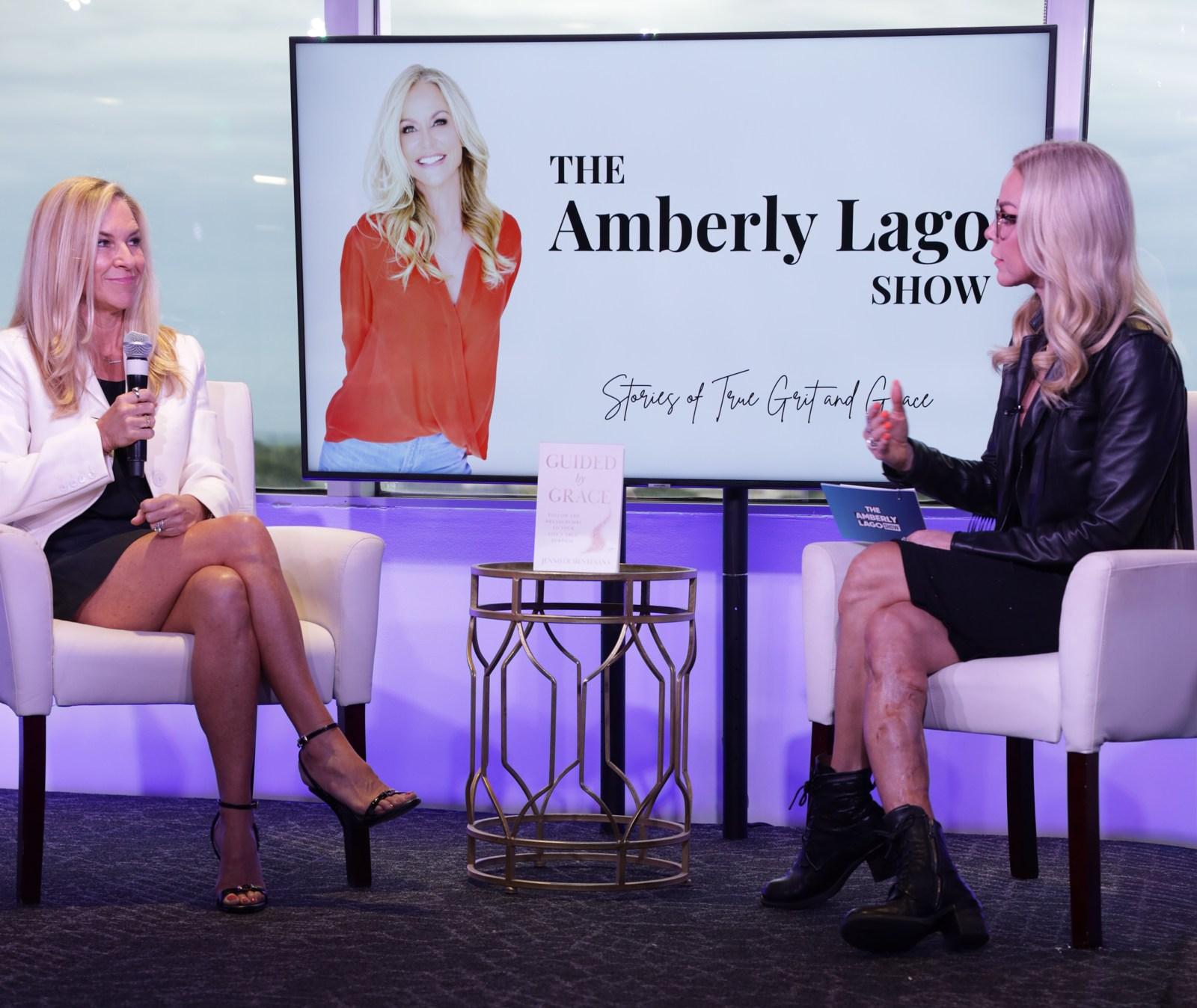
Season 6, Episode 309
From Survival Mode to Truly Living with Cristina P Simmons
A conversation with Cristina P Simmons

About This Episode
Welcome back to another episode of The Amberly Lago Show! Today I'm sitting down with the incredible Cristina Simmons, bestselling author of Eat Your Feelings, TEDx speaker, occupational therapist, and someone who has transformed tremendous pain into purpose.
Cristina's story is one of resilience, trauma recovery, faith, grief, and finding your purpose. She opens up about experiencing the loss of children, challenges in her marriage, cancer, anxiety, depression, panic attacks, and raising an adopted son with autism. For years, Cristina describes feeling disconnected from herself and living life on autopilot until she realized she needed to come home to herself and rebuild her relationship with God.
We talk about what helped Cristina move from simply surviving to actually living again. One of her first steps was surprisingly simple but incredibly difficult: looking herself in the eyes in the mirror. As she began reconnecting with herself and writing her story, she started recognizing not only everything she had survived, but the strength it had taken to keep moving forward.
Cristina also shares her family's experience with autism and sensory processing. After struggling to find the support her son needed, she went back to school and earned her master's degree in occupational therapy so she could better understand his brain and sensory system. That knowledge ultimately changed the way she parented and brought greater grace and understanding into her entire family.
We also dive into the message behind her bestselling book, Eat Your Feelings, and the connection between emotional eating and unprocessed emotions. Cristina shares the moment she found herself standing in the pantry and realized, I'm not hungry. I'm sad. Instead of processing difficult emotions, she had been trying to soothe them with food.
Cristina shares practical ways she began changing those patterns through awareness, breathwork, walking, prayer, meditation, nervous system regulation, and simply learning to sit with uncomfortable feelings instead of immediately trying to escape them.
If you've ever felt like you're living on autopilot, numbing difficult emotions, afraid to share your story, or wondering whether your hardest experiences could ever have a greater purpose, this conversation is a reminder that your pain doesn't have to be the end of your story. Healing can begin with reconnecting with yourself, asking for help, using your voice, and believing that there can still be joy on the other side.
We Discuss
-
Cristina's journey from trauma and survival mode to purpose and confidence
-
Finding the courage to share your story when you're afraid of judgment or failure
-
Rebuilding your relationship with yourself and with God
-
The mirror work that helped Cristina reconnect with herself
-
Grief after losing children and learning to give yourself grace
-
Adoption, motherhood, and raising a child diagnosed with autism
-
Why Cristina became an occupational therapist to better understand her son's needs
-
Autism, sensory overload, and understanding the behavior behind the behavior
-
Marriage struggles, infidelity, forgiveness, and rebuilding together
-
Anxiety, depression, panic attacks, and living in a dysregulated nervous system
-
What it means to live on autopilot or feel disconnected from your life
-
Simple tools for nervous system regulation, including breathwork, nature, movement, and community
-
Emotional eating and recognizing when you're eating feelings rather than physical hunger
-
Sitting with difficult emotions instead of numbing or avoiding them
-
Replacing old coping mechanisms with healthier responses
-
Why Cristina now runs toward difficult things instead of away from them
-
Finding confidence through doing hard things
-
Using your voice and story to help other women feel less alone
Timestamps
00:00 Preview: confidence, overcoming fear, and coming home to yourself
01:00 Introduction to Cristina Simmons and turning pain into purpose
04:00 Cristina's turning point and realizing she was meant for more
07:00 The power of community, connection, and surrounding yourself with big dreamers
10:00 Overcoming fear and finding the confidence to share your story
13:00 Mirror work and rebuilding a relationship with yourself
16:00 Writing Eat Your Feelings and turning your story into a message of hope
19:00 Grief, losing children, adoption, and finding purpose through pain
22:00 Raising a son with autism and becoming an occupational therapist
25:00 Understanding sensory overload, behavior, and giving yourself more grace
27:00 Marriage struggles, trauma, anxiety, depression, and living on autopilot
30:00 Emotional eating, nervous system regulation, healthier coping tools, TEDx, and finding the courage to use your voice
To Connect with Cristina Simmons
Instagram @cristinapsimmons
Website cristinapsimmons.com
Facebook Cristina Simmons on Facebook
To Connect with Me: New and Exciting!!
Every episode, the whole archive is searchable! Look for a moment, or ask a question and get an answer drawn straight from the episodes, with the clips it came from.
Bring Me to Your Next Event
Looking for a keynote speaker who will inspire your audience with practical tools for resilience, joy, and meaningful connection? Learn more about booking Amberly for your next conference, corporate event, or leadership retreat:
Get Your FREE Joy Playbook
Ready to spark more joy in your everyday life? Download Amberly's free Spark More Joy Playbook and discover simple, actionable practices to help you build resilience and embrace more joy, no matter what life brings.
Download Your FREE Gratitude Journal
Start cultivating a daily gratitude practice with Amberly's free downloadable Gratitude Journal.
Download the Gratitude Journal
Let's Connect
LinkedIn: linkedin.com/in/amberlylago Instagram: @amberlylagomotivation
Watch the Podcast on YouTube
Catch full video episodes and exclusive content on YouTube:
Amberly Lago Motivation on YouTube
Read My Books
Discover Joy Through the Journey and True Grit & Grace and find more resources to help you live an unstoppable life:
Join the Waitlist for My Mastermind
Enjoying the Show?
Be sure to subscribe, follow, and leave a review! Your support helps us reach more people who need a little more hope, resilience, joy, and encouragement. Every review makes a difference, and we're so grateful you're part of this community.
Full Transcript
What do you think enables somebody to get the confidence to start sharing their message?
I was the one who was the most scared to show myself or to show people what I was thinking about doing. Because I think it's that accountability. You know, once you say, oh, I'm going to do this big thing, and then what if you don't do it? What if you fail? Then everybody said, oh, well, you know, I knew she couldn't do it anyway. But I think that it really. I needed to come home to me. I needed to find my true self. And that's what I wasn't doing for so long because I was living so disassociated. And so once I found my. Once I became friends with myself, I think that's the best way to put it because I was looking for things in outside relationships and I needed to get back to my relationship with God and then let him show me who I really was and what I was really made to do. And once I got more comfortable with me, I didn't really care what everybody else thought.
Hey, thank you for tuning into the show because I have a really special guest here with us today, someone I have been so excited to bring on because she is a true example of resilience, grit, grace. Her story is incredible. And if you've ever struggled with trauma, challenges, fear, which I think a lot of us have, most of us have. But you felt stuck or turned to something that maybe wasn't as healthy. I've been there too. Whether it's eating your feelings or drinking them away or scrolling through Instagram or any other things that maybe aren't the solution to what is going on in your life. We have somebody here, Christina Simmons, who has overcome so much hardship, trauma, and not only taken what she has learned, she's turned her pain to purpose. She's written a best selling book, eat your feelings. I have it right here. Love this book. I happen to have written the foreword for it too. I believe in it so much. And she's a TEDx speaker. She crushed it at the unstoppable success summit, not just last year, but this year too. She has turned everything that she's learned and she's now helping others to publish their stories with her publishing company. So I can't wait to dive into this episode. Christina, thank you for being here.
I can't believe I'm here. This is. This is incredible. I can't promise you I won't cry today. So we'll. We'll do our best.
Well, you say that because look at how far you've come in the past year, year and a half, almost two years from where you were and when I first met. And the story that you shared from stage about how we met cracked me up, but then you made me cry at the same time. Can you just tell everybody a little bit about the turning point in your life, A little bit about where you were so people understand how you got to. Because people look at you and they're like, oh, wow, she's a TEDx speaker, she's written a best selling book, she's been on, you know, the unstoppable stage and spent speaking at virtual events and events all over the country. But a year and a half ago, you were in a totally different place. What do you think was the turning point for you when you decided there's got to be more to life? I am tired of living and not living my purpose. You know, you were doing things in occupational therapy that helping people, but you knew there was more. You knew you were meant for more. What was a turning point for you when you decided to go, okay, enough is enough. I am going after my dreams?
Well, it's funny because I feel like I had a lot of turning points in my life, but I heard this incredible woman on a podcast with Ed Mylett and her name was Amberly Longo. You might know her. So I've had a really, really good teacher. And I do want to give you credit to that because you have been such a big influence in my life and I love how you lead by example and are so authent. But I think from an early age I felt like I was made to do more. And I always felt like I was struggling or pushing against. I don't know if you want to call it a ceiling or a door or whatever it was. And I always felt like I didn't belong. And I don't think, I don't think that that was the truth. I just think that where I was in my life and the people that I was around was not where I belonged to. And so that's why I talk a lot now about how important it is to have community and connection, which is exactly what you teach, which is why I was so drawn to your mastermind. Because I wanted to be around other women who had big dreams and big goals. And people didn't look at them like they had three heads when they told them those big dreams and goals because those were the circles that I was in before I found you.
Oh, well, thank you. I agree, you know, for I felt the Same, though, Christina. Growing up, I was like, I. I mean, I had some nice people in my life and good friends, but I always felt a little bit different. Always felt like there has just got to be more to life than this. Like, I had big dreams and I had a lot of people saying, you're crazy. Like, that's not possible. But the women that our group, our mastermind, our inner circle, that I'm just so blessed and feel so, so filled with gratitude that we have each other. I really think that when you're just gritting it out all the time, it feels like resistance. It feels like you're on survival mode. But when you have that connection, I really think that's where you get the spark of joy. That's where you find resilience. And so I remember when I met you and you had reached out to me and I missed our first phone call, by the way, and you, you didn't give up on me. And we got on a call and I remember looking at your Instagram and you were kind of hiding, hiding behind quotes. And now I love it. You are on the gram, on social media more than I am. You're showing your workouts, you're showing funny videos with your husband, but you're showing yourself speaking on the TEDx stage and promoting your book. What do you think is a first step for somebody to do? That's like, well, that's great for her to have the confidence to do that, but there is no way in heck I am going to do something like that and share my story. What do you think enables somebody to get the confidence to start sharing their message?
I was the one who was the most scared to show myself or to show people what I was thinking about doing, because I think it's that accountability. You know, once you say, oh, I'm going to do this big thing, and then what if you don't do it? What if you fail? Then everybody said, oh, well, you know, I knew she couldn't do it anyway. But I think that it really. I needed to come home to me. I needed to find my true self. And that's what I wasn't doing for so long, because I was living so disassociated. And so once I found my. Once I became friends with myself, I think that's the best way to put it, because I was looking for things in outside relationships and I needed to get back to my relationship with God and then let him show me who I really was and what I was really made to do. And once I got more Comfortable with me. I didn't really care what everybody else thought. Like, well.
And yeah, that's so good though, because. And also, this is what I noticed. I don't know if you know, well, I know you work out at home, but when I'm at the gym, like, sometimes I like to. People watch and I'm like, nobody. Like, I've had clients when I was in the fitness industry that were intimidated to go work out at the gym. They thought everybody was going to be looking at them and no one is paying attention to anybody else but looking at themselves in the mirror, they're just all about them. They just care about them. And I saw this guy, like, posing, and he was probably. I mean, he. Maybe 100 pounds overweight, but good for him for being in the gym and posing and looking at himself like he was just in love and hadn't seen anything. It was the best thing since sliced bread. And I was like, wow, that is beautiful to see that he has that confidence and he's looking at it, looking at himself like that. You did part of your TED Talk where you started in the mirror. Can you tell us about that a little bit?
Yeah, that's what I was just going to say. That's actually where I really started, was just looking at myself in the eye in the mirror. Because about. It was probably just about three years ago that I realized that I couldn't even look at myself in the mirror and talk to myself. So how could I expect to. To help anybody else or really connect with other people if I couldn't even connect with myself first? So that is really where I started. I just. And at first I couldn't even look at myself for like five seconds in the mirror, in the eye. And, you know, it was so bad that, like, I would go to the bathroom in a public place and, you know, I would check my outfit and I would check my hair and I. But I was never really looking at me. And when I started writing my book was when I really started realizing, like, oh my gosh, I'm a really cool person. Like, I have done some amazing things and I have gotten through some real tragedy, and I'm still here and I'm still smiling. And so I just. I became very proud of myself after reading my whole. My own story and realizing that I had done such big, big things and I needed to. To tell the world, and I needed them to know that they could do it too.
What was your motivation behind writing your book?
I think, you know, I just. I've always had that Little voice in my head, write the book, write the book. For, like, 10 years, I kept hearing, write the book, write the book. And I'm like, you know, I'm kind of talking to God. I'm like, write the book about what? You know. And even my husband, who lived our story with me, he said, why are people going to care about what we went through? What. What is it going to matter? And. But I think that when we tell our story, we don't realize how many other people have been through similar things. And maybe they didn't have the courage like we did to get up the first, second, third, fourth, fifth time you got knocked down. And so we have to build each other up, and we have to let people know that it's okay. You can still have joy on the other side of whatever tragedy it is. And when you tell your story, it helps other people to release shame and guilt and any of those things that they might be carrying and to know that they can move forward to.
Well, you've definitely, you know, lost children, been through struggles in your marriage and have adopted children since, which is. They're so beautiful and such a gift. What would you tell to someone out there that has lost a child and they are still in a place of, you know, I don't know if grief ever leaves. It just gets a little different. What would you suggest for someone who is grieving right now? What's. How can they get through that a little easier, if it is possible.
I mean, time definitely helps. And there was. I mean, I. There was probably a period of 10 years where I still couldn't talk about my babies without crying. And I think you just gotta give yourself some grace. And I. I've done a lot of different therapies over my lifetime, but I remember I had this one counselor that told me that there's no wrong way to grieve, that you just need to do it the way that you need to and don't worry about what everybody else says. And I realized on the other side that there is. There was reason and purpose for. For the loss of my children personally. And don't get me wrong, I question God so many times and why is this happening to me? And why can't I have a baby? And, you know, everybody else is doing it, but my kids that I have now that we adopted, they're my kids. They belong to me and my husband. They were meant to be for us. And I always say that they saved us as much as we saved them. And so I just think that's such A beautiful gift. And I didn't go about motherhood the way that maybe most people did. But I don't like to do things the way that everybody else does. I do like to be a little different, just stand out. And I think it really does make a beautiful story. And it actually strengthened my faith in God because he gave me back everything that I had lost. So I'm grateful for that now.
Well, that's beautiful. And how old are your kids now?
Our twins are 22, and they're girls, and our son is 17.
Is 17. And because of your son, tell us a little bit about your son and how that led you into what the work that you were doing with occupational therapy.
So my. Our girls, our twins, they were born with cocaine in their system, but for all intents and purposes, they were beautiful babies, very healthy. And so when our son came along, I started noticing differences even as a baby. You know, he had no facial expressions. He barely ever smiled. And then when he got to be around 2, he started doing sort of all those little typical things. Once I start saying these things, people are probably going to know what he was diagnosed with. But lining things up, color coding things. He wanted to play by himself all the time. He had a lot of sensory issues. And so by the age of four, he had been kicked out of pretty much every daycare we'd ever had him in. And they were trying to kick him out of pre K as well.
Why were they? So just because he didn't want to play with other kids or.
No, he had very severe behaviors. He would scream for 45 minutes at a time.
Yeah.
Because his sensory system was so overloaded with all of the other kids in the daycare. And he did not understand, as he got older, he didn't understand why babies couldn't move out of the way. You know, he had pushed some kids on the playground. I mean, they were just, you know, his brain didn't work like ours did. And so I feel very like I'm
very similar to him, actually.
Yeah. Didn't have a lot of patience. He's probably a little bit ocd, add, you know, all those things. But at the age of four, he was diagnosed with autism. And I could not find anybody to help us at that time.
Really?
Yeah, no, it's. He's 17 now, so. That was 17 years. Well, I guess that was 13 years ago. Everybody had a wait list as long as your arm to get into a clinic. Nobody would come to your house. All of the clinics were an hour from where we lived, and our Girls were still young, too, you know, they were in elementary school. My husband and I were trying to work full time, and now I've got this special needs child and the school is calling me every single day, and I just didn't know what to do. So I decided that I would just go back to school and get my occupational therapy degree so that I could better raise our son, because I needed to understand how his brain worked so that he could be happy. You know what I mean? Like, it was. And it was really disrupting our entire household. My husband used to. Oh, yeah, yeah. My husband used to say, he runs this household and you let him do whatever he wants. And I'm like, no, it's not that. I just have to choose my battles, you know? Like, I mean, some days I just wanted him to stop screaming. Like, that was my main goal.
Yeah.
I just didn't listen to it anymore. So anyway, I did get my master's degree in occupational therapy and I started working in a pediatric clinic and then later in the school system to help kids on the spectrum like our son. And that is amazing.
That is amazing. And you have the pa. Well, you have, like, this very calming, like, energy about you. Anyway. And so do you think that part of going back to school helped you with your patience and just to be grounded? Because you seem very good in, like, chaos?
I think that. Well, I've. I grew up. My entire life has been in chaos. And I think that's another thing that we have in common. I always. I was always the fixer in my family. You know, even as a child, I would have to, you know, stop fights between my mom and dad or I. I mean, I was the middle. The middle daughter. And so, you know, I would have to stop things between my older sister and my younger sister. I would have to field things between my. My dad and my. My sisters or, you know, I was. I was the protector and I was always trying to fix everybody's problems. And so I think that the same thing carried over with my son. You know, I thought, well, nobody else is helping me. I'm just going to fix this myself. But through schooling and education, what it really gave me was a lot of grace for myself and for him, because once I understood really what he was going through and how his system worked, I was able to be more patient with him because I understood that it was just his sensory system that was overloaded. Not that he was a brat. He wasn't acting that way on purpose.
Yeah.
So that's what. Finally I got my husband to understand as well. And then our whole family dynamic changed.
It does help. Like, I remember thinking, wondering, like, oh, my goodness, why does Johnny go to anger? Like, and when I really learned more that the anger came from fear or the anger came from worry, I was able to give him a little more grace and be a little more patient. And it. It helps so much when you can understand why something is happening, happening, and where it's coming from. And you shared something. Well, your talk at the Unstoppable Success Summit was completely different last year than it was this year. And last year, you shared about the infidelity in your marriage. And I think you could have heard a pin drop in the room. So you've got a beautiful marriage. We all love Donnie. Y' all are amazing. And he is so supportive. How has that been. I'm just curious, how has that been for him? When you share about that and then. Was it hard for you to share about that?
It was hard, but I think what made it easier for both of us is him being unfaithful in our marriage was really the turning point of us coming back together as a couple, because I realized that I was not holding up my end of the bargain in our marriage. And so it turned me inward. To what? To how I could work on myself and what I could do to better support him. And so. And then we walked through that together. You know, we walked forward together instead of being divided and just because of. I mean, losing our children and then the adoption and then a special needs child, and then I got cancer. And, you know, it was like all of these. Yeah, it just forgot to mention that all of these things piled on top of one another. I had severe anxiety. I was severely depressed. At one point, I was having panic attacks, and I was just trying to stay alive. I didn't have the energy for my husband. I didn't have the energy for my kids. You know what I mean? And that was another thing that occupational therapy taught me. My nervous system was so dysregulated that I was, like, checked out of my life. And I don't. I try not to have very many regrets, but that is one regret that I have. And that's why I like to speak to women now, because I don't want another woman to. To go through her life disassociated and miss her kid's childhood or miss years of her marriage or miss the opportunity, you know what I mean? To live out her dreams. And.
And when you say disassociated, explain a little bit for somebody Listening who might be going, well, I don't know if that's me. Can you explain it in a little more detail?
Yeah, like you're living on autopilot. You know, how, you know when, if you drive from home to work and you don't even remember getting there, you're like, I don't even remember driving the car. Like you just happened to be there all of a sudden, like you're just sort of checked out. It's almost like I was watching a movie of my life from the outside and when I was in it, I couldn't recognize it. But now on the other side, I just, I realize how much I missed. And I did the exact same thing. I did a lot of yelling at my kids when they were little, but it was because I was fearful. I was always afraid they were going to get hurt or I was afraid that I was going to lose them. I was probably afraid that my husband was going to leave me, which, you know, almost happened. But. And I think that that's one of those things too that now, I mean, we all, in the space that we're in, we talk about a lot. You know, you got to really be careful what you say out loud because it can come true. So I try now to only look for the good and to say positive things and just believe that God is the one that is, you know, leading my life.
I love that you are both so faith filled. And what do you think somebody could do if they're like, oh my gosh, she's describing my life. I am on autopilot. I feel the same. I just feel like I'm on survival mode. What is one thing that someone can do right now to start changing that and get out of the mundane, but really live life to the fullest?
I, like I said, I started with that mirror work, but also with my breath. Because you've got to, you got to learn the things that work for you to calm your nervous system. And I mean, I always use education because I feel like if I understand things better, then they make more sense to me, obviously. But getting out into nature, just walking, just going for a five minute walk can reset your nervous system and it kind of opens your eyes to the things that are around you. But I also think that community is really important. And so you need to reach out to someone, friend, I mean, it could be a stranger, I mean, but just reach out to somebody and tell them that you need help. And like I said, I've done so many therapies over my life and therapy is not for everybody, but you've got to try things in order to see if they work.
Yeah. And being willing to do that, I think, is so important as well. And I want to talk about eat your feelings. How did you come up with a title, eat your feelings?
So it had a lot to do with my son because I was doing so much education and knowledge on the sensory system. And he had a lot of trouble with food growing up. He still does. He eats very few things because he's so sensory. He just doesn't like the way that things feel in his mouth is really. It's not really the taste. It's the way that they feel in his mouth. And so I was standing in our pantry one day, looking at all of the cookies and the crackers and the chips and the junk in there, and it just hit me. I'm not hungry. I'm sad. And so I went to the pantry to try to cure my sad, and I was like, oh, my gosh, I am eating my feelings. And so then that just kind of made a snowball of looking back at all the times in my life, because I've always struggled with my weight since I was a kid. And so all the times in my life that I was eating things that had nothing to do with being hungry, it was because I was sad or I was angry or I was afraid or I was tired or, you know, any of the feelings that we have. And so it was just like this epiphany standing in my pantry one day that I was eating my feelings instead of processing them.
Well, I think so many of us, or honestly, I think all of us have done that. I mean, I. I'm guilty of that, for sure. And I. I just thought. Now that you're saying this, I was just at my granny's house yesterday and went and opened her fridge. Now, I had already eaten lunch. Why am I even opening her fridge? But it's just like when I go to my mom's or my granny's, that's what I do. I open the fridge. What'd they make? What can I eat? What comfort food can I have? Comfort food?
Yeah, I think. And people make. It's like a joke, you know, and we always talk about comfort food, but that's. You really need to think about, like, why am I really eating this?
Oh, for sure. And so how. Once you had that awareness. And I think that awareness is key, like, just acknowledging. Okay, I think there's something going on here. How did you start to change that?
I just. I really started to Sit with whatever that feeling was. And I know that sounds really uncomfortable. You're thinking, christina, I don't want to do that. But it really is important because. And it doesn't take more than a few seconds. Like, if you really just sit with a feeling, it'll dissipate and it'll pass pretty fast. I mean, if it's something heavier, you know, grief, those kind of things, those take a little bit longer. But I really just started sort of redirecting myself. If I found that I was wanting to eat because I was having an emotion, I would go outside and take a walk or maybe just have some. Like, I don't do coffee, but I do matcha now. So maybe I would have a matcha, or I would just drink some water. One of my friends told me after she read my book, she said that she used to crunch on ice and that she didn't realize that it was when she was nervous, because when I'm anxious, I want, like, crunchy, salty things. That was the association that I made. But, you know, maybe. And crunching on ice isn't good for your teeth, but it's better than eating an entire bag of potato chips, which is what I would used to do. So it's just really redirecting. Sometimes I'll do breath work or I'll do a meditation or just pray. I mean, it's as simple as, you know, just saying a prayer. But you can redirect yourself pretty quick.
Yeah, that's so good. And recovery. So I got sober in 2016, and we say take contrary action. And so I know when I first got sober, you know, going to just take a swig of a drink to try to numb out the pain, and the pain not just physically, but emotionally, and the shame and all that. I would call somebody, I would call my sponsor, and so. And sure enough, that would get me through those few seconds. And. And so I think it is good taking that contrary action. If you can just pause. And I still want to get that pause tattoo. I think I'm going to. Maybe I'll do a pause sign on me before I actually get the tattoo, But I think that's so good, taking contrary action. Then before long, it becomes a habit. You know, I think it takes three months to break a habit and build a new habit, but it's not going to be. It wasn't. It was uncomfortable and easy for me. Not easy at first, but your book has helped so many. It's a bestseller. You just did your TED Talk. Did you ever imagine you would be Doing a TED Talk?
No. And this. It's so funny when people read my bio, because I'm like, who are they talking about? Who is that girl? I don't even know. It's just so. It's still kind of. It's. You know, this is all still new to me in some respects, but I wanted to do a TEDx because I knew it was going to be challenging. And I think that's something that has also been a happy accident in all of this self development, is that now I run towards the hard things. When used to, I would. I would back away. And now I know that I can do hard things and I can do challenging things. And so the more that you do, the more then the easier they become. So I never dreamed that I would be doing a TEDx Nonetheless, in my hometown, where I grew up, which was the coolest thing, because my mama was able to be there and several of my friends, and it was just really special.
Oh, that is incredible. Well, how. What do you think? Why is it so important right now for women to really be using your voice?
Because it helps other women to use their voice, I think. I mean, I. I think we don't realize how many people are craving connection. And, you know, even we just came off of the unstoppable success summit. And I've said so many times, like, this is my happy place with. With this group of women. You know what I mean? Like, this is where I'm feel the most lit up and the most on fire, and, like, I can do everything and anything, and I just want to be around y' all all the time because it. It just fills up my cup so much.
Well, that's how I feel. That's why I'm like, you know, we have our retreat coming up September 4th through 7th, and we're opening and a few. Opening a few spots for that. And I was like, well, we could just. The house is big enough. It sleep 16. We could just move in. Because I'm like, can we just all move in together? Like, we have so much fun. I mean, whether we're out on a boat or at my house retreating or sharing the stage or at the studios recording a podcast or on our zoom calls connecting because we're from all over the country. It is my happy place for sure. And my husband knows. Like, he. I remember the first time I asked, I was like, so can I do a retreat, like, at our house? And he's like, no, absolutely not. And then the very next time, say, he was like, okay, I know how Much. You love these ladies. Okay, you can. And now he's like.
Is the hostess with the mostest.
He is. Now he's like, so when are the ladies coming back over? For sure.
For sure.
Well, what is. What. What is getting in the right rooms or surrounding yourself with the right people changed in your life?
It's changed my entire life and my family's life, you know, And I love that my kids are watching me do all of these things too, because I think it makes them realize that you really can do whatever you want. You can live your dreams. And I. I don't know how many times in the past, like, six months I've said, I'm living my best life. When somebody asks how I'm doing, I'm like, I am living my best life. You know, I. I quit my. I quit my 9 to 5 job.
I remember when you called and told me, so I quit my 9 to 5 job. I'm like, good, that's. But you know what? Sometimes that pain pushes you until your purpose pulls you. And it can be that you were comfortable there. You knew it was easy for you, and then it was like, okay, I'm getting into my next level, but sometimes you gotta jump off and just go for it. And you did well.
But I'll tell you, quitting that 9 to 5 job, that lowered my stress level so much, because back then, I was tracking my hrv and it was terrible. My HRV was terrible. And when I quit that job, it skyrocketed. My hrv.
Oh.
My ability to recover because. And, you know, even with the stresses of not having a job and, you know, not knowing what was coming next, I was so much less stressed than I had been with that stability of, you know, a paycheck every two weeks and knowing what was coming in. So that was my biggest, like, aha. Moment. Like, I'm so much less stressed, and I don't have any idea what's coming next, and I am here for it.
Well, you're now helping other people write their books. You started a publishing company because you're like, wow, writing a book is cathartic. Especially when you're writing about the loss of your children, infidelity, overcoming cancer. And now tell us a little bit about what you're doing to help others get their stories out there.
Yeah, I love. I've always written poetry and journaled, and I. You know, I've done that all my life. And so it really was.
And you wrote me a poem.
I did write you a poem. My most favorite poem I Love it.
It's. It's on my Instagram, if y' all want to go check it out. Yes, but. Sorry, I just. I've never had anybody write a poem for me, so I would just had to give you a shout out there.
Well, I'm honored to be the first. I meant every word of it. But. So, I mean, it just followed suit that I would, you know, become an author and a writer and then. But I. I noticed that there was some disconnect in the writing process because my. My story was really heavy, and so I felt a little bit alone in the process. You know what I mean? And so I. I started saying. And of course, you know, we were on. I think. I think we were on a group call when I started talking about, you know, I think that I want to be a developmental editor, and then I can help people write their story, and then I can just refer them, you know, to my publisher. And my coach, Amberly says, christina, why don't you just start your own publishing company? And I went, oh, I know.
I know exactly what we. I know where we were. I was speaking at the Billy Cox event, and we were. You had gone to help me. And that's one thing I love, when you ladies will come and hang out with me backstage and get to meet everybody at events and just kind of get the behind the scenes. And we were outside waiting at ballet, and you were telling me about this, and I said, well, just start. Yeah, get a logo, get a website, start your own company. That'd be great. And so you're like, okay. And so you went from occupational therapy doing that. You were good at it, but it wasn't like that's. You were doing good for people, but you're like, I want more. Now you are helping people. People make an even bigger impact than walking them through that journey, because it can be lonely. I mean, really lonely, writing. So you coach them every step of the way. And I want somebody like you who has been through that process that can say, oh, that's totally normal to feel that way. Keep going.
I think, yeah. I think that what makes my publishing company different is that I do bring the clinical side and my personal experience, because, I mean, I am a therapist, so I have a lot of tools in my tool belt for regulating your nervous system and just, you know, working through some of the mental aspects for it. Because that's why what I loved about occupational therapy, it's so holistic. You can do. You can work with so many populations of people in occupational therapy. And so we look at the whole person. And that's the biggest thing that I loved about it. And so I'm helping these ladies move through some really tough stuff and things that they've been, that they had pushed down and maybe even suppressed that have come out in writing some of these books. And I mean, it's helping them heal in the process. And that's, that's what I love the most.
I love that so much. Well, how can people, because there are 81% of people who want to write a book, 1% actually do it. How can people. What's the best way for them to find you? To just jump on the call and see if, you know, you can help them get their book out in the world?
Yeah, I would love that. I'm all over Instagram. Christina P. Simmons. And then I'm on Facebook too. It's. It's Christina Borges Simmons because that's my maiden name because that's how people used to find you on Facebook. But I'm on LinkedIn as Christina P. Simmons. My website is christinap.simmons.com and just remember, Christina is with no H, C, R I S T I N A. But I'm sure you'll have all that in the show notes. But yeah, send me an email. Send me a DM on Instagram. It's really me answering. So I would love to talk with you.
Yeah, that's awesome. And you know what? If you're out for a run or you're driving around right now, don't worry. That's all that is in the show notes for you. And now just a few rapid fire questions just for fun. Okay. What's the best advice you've ever received?
The best advice I've ever received. There's no wrong way to grieve. I'll. I'll just say that again. That is the best advice I ever received.
That is powerful. Coffee or tea matcha? Okay. I like it salty. Salty or sweet?
Salty.
Gab me tea. Me too. Morning routine. Must have my workout. I see you working out, girl, and your ziya outfits. And then one thing you do when you feel stuck.
I pray. I know that's cliche, but that is the truth. I. I do pray about it. And then it works out.
I love that. And then what is your definition of resilience?
Oh, just being scared and doing it anyway. And then being so proud of yourself. Looking back and seeing how far you've come.
I love that. Well, Christina, you're amazing. It has been like, I am so blessed to be on this journey with you. And it's been such a joy to have you a part of the mastermind for two years now. And I just texted you yesterday. I said, oh, you're never getting rid of me.
You're never getting rid of me either. I love you to pieces.
I love you. And we're doing at least we're doing our retreat in Florida this next time, and so it'll be closer to you. So that'll be fun. But this has just been a powerful conversation, y'. All. Check out her book, eat your feelings. Please share this episode with someone who needs a little inspiration to give themselves some grace and to get unstuck. And all the show notes will have all Christina's information. If you found value in this episode, which I am sure you did, just take a screenshot and share it on your social Tag me at amberly lago Motivation. Tag Christina at christinap Simmons and I just appreciate you tuning in. Christina, thank you so much for being here and being a blessing in my life and in this world.
Thank you. I'm the same to you. I will love you forever.
Thank you. And y', all, thank you so much for tuning in. I know you can be anywhere right now, so I appreciate you tuning into the show and we will see you next week.
Pain to purpose to joy.
Never Miss a Conversation
New episodes drop regularly. Subscribe on your favorite platform and never miss a conversation.