
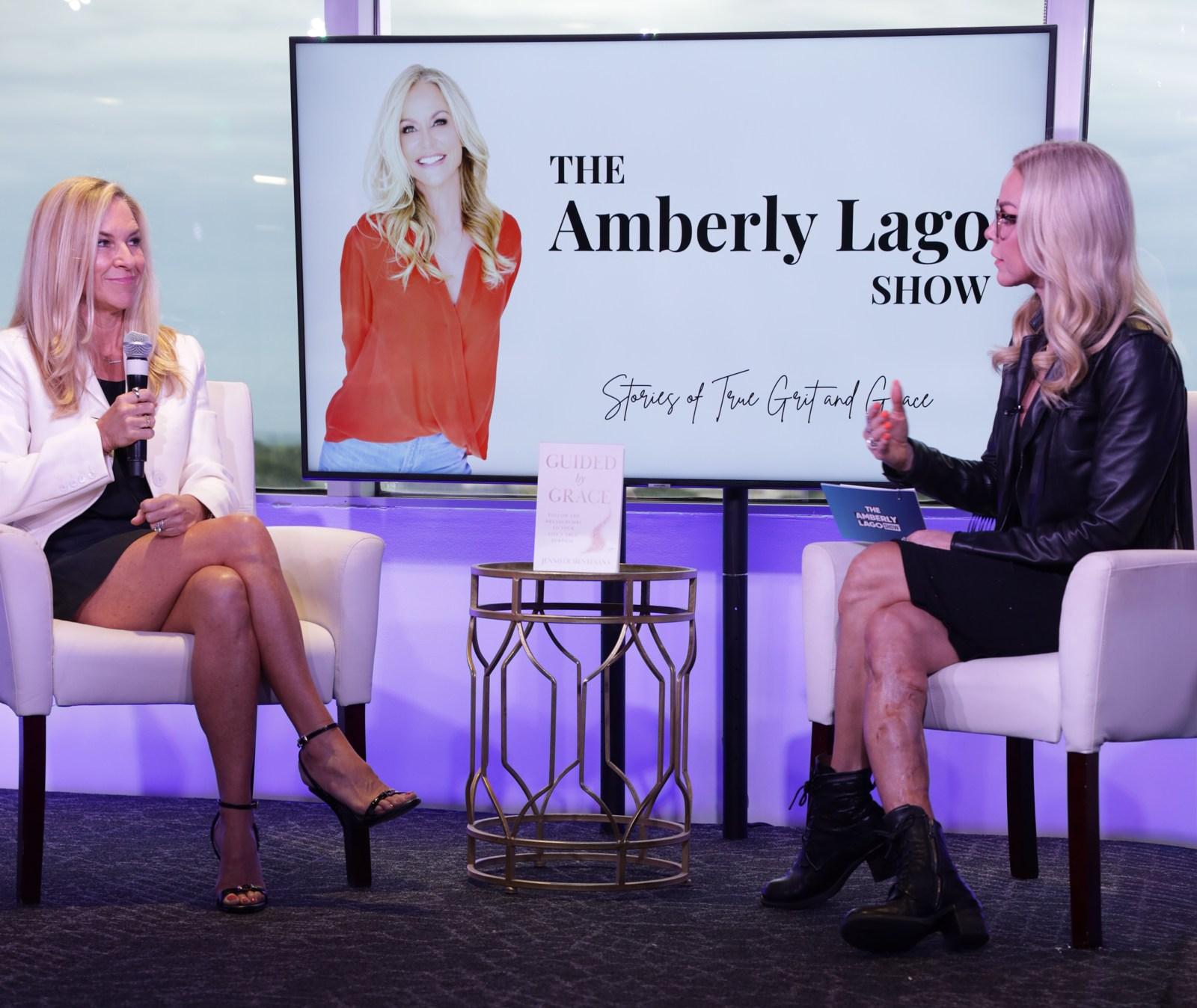
Season 2, Episode 84
From Shattered by Suicide to Rising with Strength and Voice with Tiffaney Childers
A conversation with Strength and Voice with Tiffaney Childers

About This Episode
I have to tell you, this episode of The Amberly Lago Show is one that I know is going to land in the hearts of so many of you. My incredible friend Tiffaney Childers joined me for one of the most raw, real, and deeply powerful conversations I have had on this show. Tiffaney is the bestselling author of The Rise Back, a suicide loss advocate, speaker, and a fellow CRPS warrior who has walked through fire and come out the other side with a story that will stop you in your tracks.
Tiffaney lost both of her parents to suicide within a year and five days of each other. She spent nearly two decades suppressing that grief, raising her kids, pushing forward, and holding it all together from the outside. And then her body said enough. A hip surgery led to a CRPS diagnosis, the mask came off, and everything she had buried came rushing to the surface all at once. What she did with that pain, physical and emotional, is nothing short of extraordinary.
Here are three powerful takeaways from our conversation.
Your Body Will Always Tell the Truth
Tiffaney described it perfectly: she had shoved her grief down so far for so many years that it eventually came out in her physical body. Her CRPS diagnosis became the turning point that forced her to stop running and finally face everything she had buried. I believe this with everything I have. Pain demands to be felt and if we do not feel it, it will find a way to speak. Whether it shows up as chronic illness, burnout, addiction, or emotional shutdown, suppressed trauma always finds a way out. The healing truly does begin when we stop pretending we are okay and get honest about what is really going on inside.
The Power of Saying "I Am Not Okay"
One of the most moving moments in our conversation was when Tiffaney talked about the night she looked at her husband and said those four words: I am not okay. Not "I'm fine." Not "I'm just tired." She told him the full truth. And that was the beginning of everything changing. Those words take courage. But I truly believe there is a gift in desperation, and sometimes hitting that wall is exactly what sets us free. If you have been white-knuckling it and telling everybody you are fine while you are crumbling on the inside, this episode is your permission slip to tell the truth. You do not have to have it all figured out. You just have to be willing to say it out loud.
The Rise Up Method: Small Steps That Lead to a Big Life
Tiffaney walks through her Rise Up acronym in this episode and it is so good! R is for reach out before you shut down. I is for ink it out, get it on paper and out of your body. S is for sit with it, which she says was the hardest and the most necessary. E is for embrace who you are becoming. U is for unlearn the lies your brain has been feeding you. And P is for protect your peace, because not everyone deserves access to your healing. These are not giant leaps. They are small, intentional steps that anyone can take no matter where they are in their journey. And sometimes that is exactly what we need, not a big overhaul, just one tiny step forward.
If you have ever loved someone who struggled with mental health, if you have experienced loss that you have never fully processed, if you are living with chronic pain and wondering how you are going to keep going, this episode was made for you. Tiffaney's story proves that our darkest moments do not have the final word. From the rubble of unimaginable loss, she has built something beautiful and she is using it to light the way for others.
Tune in now and let Tiffaney's story remind you that the rise back is always possible.
We Discuss
• Tiffaney's journey through suicide loss and suppressed grief
• The connection between unresolved trauma and physical illness
• Living with CRPS and chronic pain after hip surgery
• Why silence around suicide loss can delay healing
• The power of journaling as a healing tool
• How community and support groups can change everything
• The importance of reaching out before shutting down
• How faith helped transform pain into purpose
Timestamps
00:00 Introduction to Tiffaney Lindsey Childers
03:10 Living with CRPS and chronic pain
09:45 The impact of losing both parents to suicide
16:20 Suppressed grief and emotional survival
22:40 When trauma begins to surface physically
28:15 The moment healing truly began
35:05 Journaling and writing The Rise Back
42:30 The importance of community and support groups
48:55 Advice for someone struggling with grief
54:20 Turning pain into purpose and advocacy
To Connect With Tiffaney Lindsey Childers
Instagram https://www.instagram.com/tiffaneychilders/
The Rise Back: Reclaiming Life After Suicide Loss, Pain, and Silence: https://shorturl.at/qagLy
To Connect With Me
Instagram https://www.instagram.com/amberlylagomotivation/
Coaching Program https://go.amberlylago.com/
Website https://amberlylago.com/
My favorite for gut health & wellness https://plexusworldwide.com/?sponsor=Amberlylago
My MAKE Wellness link https://meet.makewellness.com/?referral=521698
Unstoppable Success Summit 2026 https://www.eventbrite.com/e/unstoppable-success-summit-2026-breaking-chains-building-dreams-tickets-1968268162057?aff=oddtdtcreator
Become a sponsor https://go.amberlylago.com/uss2026-sponsors/
Full Transcript
What do you think some misconceptions people have about grief or suicide loss that you hope the book helps to break
A lot of people and I'm probably going to go back to actual suicide. Like a lot of people think if somebody talks about it then they're not going to do it and they're just talking about it and they're never ever going to take steps to do it. And that is so, so, so false. If somebody cries out that they are going to do this, you take them very, very seriously and take steps to. I always call it the two step method. Number one, are you okay? And number two, do you know that if you're not okay that you can talk to me? My hip surgery was unsuccessful, so I've still got to deal with that and I've still got a lot of inflammation in my hip. So I walk and I walk and I walk and I walk up to five miles a day now and I at least get 10,000 steps. That is non negotiable.
Well, are there things that people can do to reach out for support if they can't afford a therapist?
And I'm assuming that you're meaning if they have a suicide loss. If you can look up and see if you have a loss team in your area, which is LO S S and that stands for local outreach to suicide survivors and they. You can go on lossteam.com and see if there's one in your area. And they have so many resources and they'll find you resources in your area, whether it's a support group. And I think that's what saved me is it's a peer led support group. So it's peer led by someone who's lost someone to suicide like me.
I really believe you have to be your own advocate.
Medication hits everybody different. It does. I mean, I can take some balta and then you can take it and we'll have two totally different reactions to it. What's good for one cannot be good for all.
Hey, I am so glad that you're here. Thank you for tuning in. I have a real treat for you today. I have Tiffany Childers with us today, y'. All. She doesn't just talk about healing. She has lived it. She's clawed her way through and now walks beside survivors as they navigate their loss. After losing both of her parents to suicide and living through just years of suppressed crisis, grief and emotional survival, she knows what it means to unravel and what it takes to rebuild. Not only that, she is my sister. I guess I should Say CRPS warrior so we can relate on a whole different level. She's a good friend. She's the author of the Rise Back book. I have it right here. If you're looking on YouTube, you will see this beautiful book cover you. It's a best selling book. It is making waves. She's a speaker, she's a suicide loss advocate, and she stands with hoes who have been shattered by suicide loss and helps them reclaim their voice, power and identity. Tiffany, I love you. Thank you for being here. Welcome to the show.
I love you too. Thank you for having me.
Oh, my gosh, so much to talk about. And we, we met and it was like, I feel like instant connection because we have so much in common. And I just have to tell everybody right now, I have talked about you, not just because the person you are, but just how you showed up for me. I just recently spoke at the national RSDSA conference and I was struggling. The pain was real. And after I got off stage, you were there and we were sitting at my book signing table and you're like, you know what, we need to get you out of here. Let's get you out of here. Come on. And your son and daughter were there and your husband was there and they like took my suitcases for me and like rolled out of there with me. And that means more to me than you know. But I know you can relate on a deep level what that pain is. But you have gone through pain physically from CRPs and still do, but also from the suicide loss. Before we get into the suicide and the backstory, I just wonder, do you feel like suppressed trauma and suppressed emotions triggered the CRPS after your hip surgery?
1,000%. Absolutely.
You do.
I had shoved down for years. Came out physically in my body.
Yep. I think pain demands to be heard and it will come out some way somehow. And if it doesn't come out physically, it will come out in the way that we lead, in the way that we love. How long ago was your hip surgery and you were diagnosed with crps?
It was just a little over a year ago, last October of 2024. So I'm still very new. You are experienced at this, but I'm still very new in navigating this.
Yeah, well, I didn't realize it was that only that long ago. Wow. So when you were diagnosed, like the pain just wasn't getting. Getting any better and you were diagnosed, what were you were at that moment? Were you like in denial, like, this can't be, or were you relieved because I've talked to some people who. They get a diagnosis, and they're like, oh, finally. You know, I.
There's.
There's an answer for me. Whereas for me, I was like, oh, hell no. This cannot be true. So I went to another doctor and another doctor, and I was in denial for a long time. How did you handle it when you were diagnosed?
I wasn't diagnosed for a long time. Everybody just kept. I kept going to doctor to doctor to doctor, and nobody knew what was going on. And it kept. You know, one of my surgeon said, well, maybe we put you in your booties for too long during the surgery, you know, because they put you in the booties and put you in traction, and maybe it caused some nerve damage. And I kept thinking, but you do this 20 times a day. I mean, I. It wasn't making any sense, and the pain wasn't making any sense. So I had gone to the pain doctor, and he's the one that diagnosed me. And that. Yeah, I was like you. I was like, oh, hell no. No. So I ended up going to Dallas, and then another orthopedic surgeon diagnosed me as well.
Yeah.
The weekend that I went to your event.
What now?
The weekend that I went to your event. Event last April. I had gone that morning to the. Near. To an orthopedic in Dallas.
Oh, my goodness.
Wow.
So what did he tell you to do?
He was very honest, and he just kept apologizing and saying, I'm so sorry. I'm so sorry. There. It's incurable. The only thing I can recommend is a spinal cord stimulator, but I don't think that'll even work because he didn't really go into it. But the. The pain is in my foot, and it's so far from the spinal cord stimulator that it might not reach my foot.
That's a. It's really hard to get because mine. The worst of mine is in the right part of my foot is where it's even at the worst. And it's really hard to get the nerves that reach all the way there. That's exactly right. For those of you that don't know what CRPS is, describe what CRPS is to you, Tiffany. What does it feel like and what is it?
You know, And I've done all this research on my own because, you know, none of the doctors could really tell me, but it stands for Chronic Regional Pain Syndrome, which I think is such. Is such. It's the dumbest word ever. I call it hell. I don't know.
Yeah.
But anyways, it is your, your. It's like there's a fire in your body and their alarms are going off, but there's no fire anymore. So it's basically the central nervous system is what I have read is sending pain signals to the rest of your nerves saying that hey, we have pain, we have pain, we have pain. And it's really hard to shut off at what doesn't ever shut off. I have pain every single day and flare ups and it's somewhat manageable now. And when I say manageable, I can get through about half of a day manageable and then it just progressively gets worse into the evening, through the night.
What are some of the treatments that you've done for complex regional pain syndrome?
I have done.
What was it called?
The epidural. I've done the nerve block.
Thousand.
No, not for 30 seconds, no, neither of those. Did thousands of supplements. And I know that you and I have talked about that and I mean thousands. And I had gone to this holistic doctor who I spent quite a bit of money on all of these supplements and nothing helped. I tried. I don't even know what it's called, but it's where you wear these goggles and then you put little vibration things on your ears and then you listen, put headphones on and you listen to things. That's supposed to rewire your brain. So I did that every day for 30 days and it was very expensive plus very time consuming by the time I drove over there, did that for 30 minutes, drove back to work and it didn't help at all. I ended up going to the chiropractor and he had just got a new unit and it's kind of like a tens unit, but it's like a nerve regenerator.
Yeah.
So you put the pads on your feet and then your lower back and then you sit on that thing for 30 minutes. And that was when that. A little bit of relief. A little bit. And then I think I finally gave up. I just gave up. And I mean I gave up on searching for anything. Number one, I had to replenish my cash flow because it's so very expensive. And number two, I had to quit chasing. I had to quit chasing the end of this because there was going to be no end. And I think that's when maybe my brain kind of settled down just a little bit. Like, okay, let's take a little while to revamp, replenish our cash flow, chill out for a little bit and move on.
Well, thank you for sharing that. And you know what? I'd forgotten that I did the same thing with the pads.
Yeah.
That you put on your back and your leg. And it was. Oh. And then I ended up buying a machine which was thousands of dollars, because I was driving 45 minutes, three away, three days a week to go do this treatment. I mean, I've flown out of the country for treatments, and. And I think you and I. But I did this for years. I mean, even up until just this year with my second spinal cord stimulator. And I'm to the point where I'm, like, done. I'm done. Don't even tell me another thing to try, because I'm done. I mean, if I have to hear about one.
And, you know, people call me all the time, have you heard about this patch? There's this new patch out the. The. Yeah. And I'm just like, I can't. I can't.
Oh, I have to tell you this. You're gonna. Okay. I have somebody, bless their heart, they really were trying to help, and they sent me some patches, and she got. Gets on the call. Actually, I met her at one of the events that. You went with me to the next level event that I was speaking at, and you and Christina went and somebody that I had met there, and she sends me these patches, and she's so sweet, and she's talking me through, and she's like, well, just put these patches on. Okay. Do you feel relief? And I'm like, not yet. Well, try moving them over now. Do you feel relief? And I'm like, I don't think you quite understand.
Yeah, well.
So it's like, yes, I get hard to explain. No, I feel like I spend half the time trying to explain it and half the time trying to pretend like I don't have it. So.
Me too.
When we met, and I'm like, we could talk. And you're like, yeah, you get it. Like, I. Yep, I get it. So thank you for saving me and getting me out of there so I could go sit down for a little bit before my next event. And I did make it to that next event, by the way. Yeah. But I think it's very interesting that you say that. Yeah, absolutely. You think that this came about because you were pretty much running from pain. Basically, that's what I did. I ran from pain and kept myself busy. What did your life look like before your hip surgery and before CRPs? You've lost both your parents. What did life look like then that you weren't maybe processing your feelings? And. And I always say we Heal what we reveal. What did life look like when it was kind of chaotic for you?
Well, like, yeah, you said, I lost my mom to suicide. This has been 18 years ago. And then a year and five days later, I lost my dad. And they weren't married. They hadn't been married in years, so it was pretty close together. You know, my mom had left me and my brother and my sister notes, and they had taken those into evidence. So we were still trying to get those notes out of evidence by the time my dad took his life, which. And then both were just shocking. Just. I can't even explain the shock. And, you know, I had no frame of reference back then. I had no support groups, no nobody like I do on the lost team coming to the house, saying, okay, here's all the resources we have. Here's how to write an obituary. We just had nothing. No frame of reference for anything. So I did the only thing I knew to do, and I just shoved everything down. I had young kids. There were four and six. You just keep going. Yeah.
How did they take it? Did they understand what had happened or how did you talk to them about.
No, and I talk. I have almost a half a chapter in my book about this. We did not ever mention the word suicide. That was a no. No. In our house. My husband and I never talked about it. We never told them. I mean, and bless their hearts, they didn't know anything. They just knew Mama was gone, and we went to a funeral, and then Pawpaw was gone, and we went to a funeral, but they knew nothing. And I think the only way I can describe why we didn't say anything, because, number one, they were too young. And then we didn't even talk to them about it when they got older, because I didn't want them to think that this was a way out when things got tough. I didn't want them to think that that was acceptable. And that's so wrong in thinking that, because they're going to come up with their own story.
Mm.
I was.
I was just gonna ask you, do you. Do you wish you would have handled things differently about talking with them?
Absolutely.
You do?
Absolutely. Oh, yes, I do. Because they're going to create their own story. And so I think my son was about 15 years old, and that was when Robin Williams took his life. And it was all over the news. And he asked me. He was like, mom, is that what Mama and Papa did? And I was like, how did you know?
Kids know.
And they know. They know. I mean, they hear us talk Even when we think we're talking in private, they hear things. And so I so wish I would have said something. And you know, it always needs to be age appropriate. And like I said, I talk about that in my book. You know, you don't have to go into the deep, dark details of everything, but just age appropriate words to let a child know. Because they're the. They're the hidden grievers of the family.
Yeah.
And you think they don't grieve and they do.
They do. And they know everything that's going on. They sense things. And sometimes you're like, how did you even know that? You know what I mean? What? They watch everything. And they also are watching how we handle situations.
Oh, absolutely. They're watching everything. And I'm telling you, I didn't handle things very well for about 18 years. You know, I did, but I didn't, you know, I just had no frame of reference.
Exactly. And I see the kind of mom you are, and I've met your kids and you have the most amazing kids who love you so much. And so we do the best. You know, I made some awful mistakes, let me tell you. Both my kids remind me and my husband remind me of. And especially my oldest daughter, she loves to remind me of what Kind of like how many times I messed up as a mom, you know.
But it only came with a manual. I know Owner's Eye will.
Well, I feel like the Rise Back is a manual for people who have experienced loss. And I'm actually passing your book on to my mom and my dad because I lost my stepmother from suicide. I still wear her ring every day. She too left notes and they were pretty, pretty intense, the notes that she left. And then as you know, my little brother, we just lost him. Gosh, I guess it's been about three months ago from to suicide. And so my mom really needs the Rise back.
I really hope that you give that to her.
I don't feel like she's dealing.
Sorry, Mom. This is a whole different beast. It's not. It doesn't. You know, that grief doesn't come wrapped in a pretty little bow. It's very heavy. It's very shameful, I know that. I was so ashamed for how my parents took their life for so, so, so long. I was embarrassed. And once I started talking about it, that's when I started healing because I thought, you know, I stayed silent for so long only because people don't know what to say and they don't know what to do, so they just don't do anything at all. So I thought, well, I better just not say anything either, because nobody else was. So I thought, well, I just better not say anything and stay silent. And. Until it started affecting my health. And, yeah, no more. No more. I will shout it from the rooftop. I mean, the mental health issue right now, it's a crisis. It is an absolute crisis.
It really is. And the shocking thing is, like, with Robin Williams, even no one. And so often it's your strong friends that you have no idea. They put on a brave face. They don't complain, and you have no idea that they're having these thoughts. And so with going through this, what it. Well, first of all, I want to know, like, what was it that the first thing you started to do to heal because you stuffed it down and stuffed it down. So many people do, and they feel stuck and they're unhappy. What was it that set you on your healing journey?
You know, I had shoved it down so far that I made people think that I was okay for so many years. That's how far I've shoved everything down. My healing started after my hip surgery, when I was in such chronic pain. And this is a pain like I had never felt before. And, you know, when the. When the kids left the house, when they went to college and we started being empty nesters, you know, my husband was so excited. He's like, yes, we did it. They're out of the house. So I just started having this little feeling in my heart. I was like, oh, something hurts. It just hurts right there. And I thought, oh, my gosh. That is grief coming to the surface. That is grief in years and years and years of shoving down trauma. And then my kids leaving, they. I didn't have them to entertain me.
And it was like a good distraction. You could put all your attention.
Oh.
On them instead of you.
Yes, yes. You know, and I'm not gonna lie, too. I did the drinking. Helped me just numb myself. I mean, that's what I started doing, especially after the kids left the house. It just helped me numb myself. And then once I had that surgery, of course I quit drinking because the pain was so bad, and the mask came off and all that was there was just little old me thinking, what hurts? Why does this hurt in here? I think my heart hurt more than my foot hurt. Well, I don't know. But that pain was extreme, excruciating from crps. Like, I can't even tell you. I couldn't even think. I couldn't. I couldn't walk. I couldn't wear shoes. I couldn't do anything. And I looked at myself in the mirror one morning after vomiting from the pain and I thought, I don't even recognize myself. I didn't even know who I was anymore. And I remember just crying and crying and crying and crying and thinking, okay, we got to do something. You know, I've been blown off by every doctor. Nothing I've tried is working. So I've just got to do something. So I really started desensitizing my foot and to just so I could get shoes on. I would just wear house shoes that were like three sizes too big because I just could. I still can't wear socks, but I had to get a size shoot too big and start desensitizing my foot so I could wear a shoe to work. I didn't even want to go back to work. I didn't even know if I could go back to work. I think fear of the future was so real for me. Like, am I going to be able to work 8 to 5? I can't even think from 8 to 9 o' clock in the morning. So it was just little things. And I started getting very, very intentional with my healing and what was going on with this hurting and my heart hurting. I started journaling and pretty much journaled into writing a book. And I never before journaled in my life. I always thought it was for little girls with glitter pins and puff pens and never ever, ever, ever journaled and changing. It was life changing for me. And I journaled my cake into a book.
Yeah, writing book is cathartic. I remember you messaging me going, yeah, telling me how you were feeling, like it's normal, it's totally normal. But keep going, it's normal, just keep going.
Yep, keep going. And you know, I started walking. I couldn't walk from my front door to my mailbox and. And finally just walk in just a little bit. And that's pretty much still all I can do. My hip surgery was unsuccessful so I still got to deal with that. And I've still got a lot of inflammation in my hip. So I walk and I walk and I walk and I walk up to five miles a day now and I at least get 10,000 steps. That is non negotiable. It'll be nine o' clock at night and I'll be like, oh, I need another thousand and I'll just walk, walk, walk, walk, walk, even if it's dark. But you know, just the little things, walking, getting out in the sunshine. I always, I use my Rise up method in my Rs. You need to reach out before you shut down. And I think that is so, so, so, so important, you know, because I even tried to hide my pain even from my husband. And I remember telling him, I'm like, I'm not okay. Like, I'm not okay. And he was just like, what? Well, I know you hurt, but what do you mean? And I'm like, I'm not okay. Nothing was okay. My soul was tired, my heart hurt, my foot hurt. So everything all at once came to the surface.
Well, you. It was like you could not bear the weight of everything anymore. And I think Alex, hurts are powerful. I am not okay. Like, to admit that, it's almost like I feel like there's a gift in desperation because it took you getting to that point and we're going to get to your rise up method also. But I really feel like it took you getting to that point of I am not okay and that gifted desperation for. For you to even admit that to your husband. And did you go seek a therapist? Who did you reach out to for somebody who is like struggling like, well, I'm not okay, but I don't know who to reach out to. What would you suggest for them to do?
I would, yeah. Reach out to a safe friend, reach out to a spouse, reach out to a parent. I didn't reach out to a therapist right away only because I work with a lot of therapists and you know, especially with the loss team and stuff. So I kind of like, I knew all this. I knew all this mental health, you know, CPR in my mind. I knew every single thing to do. I just couldn't do it. I just couldn't put that into play with myself. So, yeah, I didn't right away seek a therapist yet. Years ago I went to a therapist and it was just didn't line itself out very well. So I never went back.
I think I've been that were not great. And I think you and I remember finding one that was so good. Yeah.
And when you find one, you find a good one. Yeah.
Yeah. But you're lucky if insurance covers them. And this one wasn't covered by insurance. It was after my motorcycle accident and he was like $600 an hour. Worth every penny, I'm sure. But I was like, yeah, well, yeah,
you have to replenish your cash flow.
Yeah.
I was like, insurance, I think paid, pays for like six sessions and that's it. And it's like, oh, well, are there
things that people can do to reach out for Support if they can't afford a therapist.
Oh, absolutely. You can look in your area. And so. And, and I'm assuming that you're meaning if they, if they have a suicide loss. If you can look up and see if you have a loss team in your area, which is loss, and that stands for local outreach to suicide survivors. And they. You can go on lostteam.com and see if there's one in your area. And they have so many resources and they'll find you resources in your area, whether it's a support group. And I think that's what saved me is it's a peer led support group. So it's peer led by someone who's lost someone to suicide like me. It's not led by a therapist. It's.
That's great.
Yeah. And it is people in there that have been there, they have done that. It is the most amazing thing that you will ever sit it through. People just like me that have been there, that have done that and you feel like you're part of a community that is incredible. Support groups. If you don't have one in your area, start one. Go find, figure out where your public library is. See if you can borrow their room and start one. Plaster signs everywhere that you're going to start a support group. Start one online. I think that was the greatest thing for me is finding people that have been through a loss themselves and kind of like you with CRPs that you get it, you understand it. We don't have to explain it to each other. Yeah.
We can just look at each other's eyes. Oh, my gosh. Okay. I. I know what's going on right now.
Yeah. And I spend the same way. He can look at my eyes and he'd be like, okay, you don't feel good, do you? I'm like, yep, yep, yep.
Your eyes are the window to your soul. Try to hide it. It's like, it's there, it shows, it's. So would you say community has been a big part of your healing journey?
Huge part. Huge, huge part. Yes.
Yeah.
Me becoming a part of the Lost team and just, you know, I finally felt accepted and finally felt like, okay, so this is normal that I feel this way because, you know, I was around people that had lost someone too.
Yeah. Yeah. And then how has faith played a part in your healing journey?
Yes. You know, I think that God positioned every single tragedy in my life for me to heal and to walk beside others. But I didn't realize that for a long time. For a long, long time. I think we. For a long time I thought, God, did you forget about me? You know, wow.
God doesn't waste pain.
Oh, my gosh, no. And when I came to the realization that he has used every tragedy to set me up to heal and walk with others. Wow. Wow.
Yeah. I always think, you know, what happens next? Well, we heal, we grow, and then we go help others.
That's exactly right. Yeah, exactly right. That's why I always want people to share their story. You never know if you could be somebody's lifeline.
That's. And I feel like this book is going to help so many people who feel a little lost right now. What do you think some misconceptions people have about grief or suicide loss that you hope the book helps to break?
I think the misconceptions of, you know, there's a lot of suicide myths, a lot of people. And I'm probably going to go back to actual suicide. Like, a lot of people think if somebody talks about it, then they're not going to do it and they're just talking about it and they're never, ever going to take steps to do it. And that is so, so, so false. If somebody cries out that they are going to do this, you take them very, very seriously and take steps to. I always call it the two step method. Number one, are you okay? And number two, do you know that if you're not okay that you can talk to me? Because that second one is so very important to let somebody know you can talk to me without judgment, without any shame. I will never. It will never go further than here, you know, instead of just, are you okay? Because your typical answer is going to be, yes, I'm fine.
You're. You're so right. You're so right. I think so often people just need to know that someone is there for, for us. But I know for me, like, looking back with my stepmom, I can see, like there was a time when she took too much medication, it was a mistake. But looking back, I'm like, was that a mistake or was she trying to do it back then? You know what I mean? But she never complained. She smiled. She didn't ever go too deep.
Every.
Everything was kind of surface level. And that's what I had a lot of guilt as a daughter thinking if I could have just done more, if I would have called more, if, you know, I just wasn't there for her. Did you ever have guilt?
Oh, gosh, the what ifs the wise. What if I'd have gone over there a Little bit sooner. What if I would have pulled what if the what ifs and the wise will eat you alive. And the thing is, we don't ever have a crystal ball to what anybody is going to do. And I mean, that's the beauty of it. What if we did have a crystal ball and we knew all these things? No, we can only do what we can do when we know what that we need to do it. You know, my mother took pills as well. And I think all the pills from her hip surgeries and back surgeries and every. You know, they. They lined her up with an arsenal of pills. And that was back when hydrocodones were coming out. Oxycodones were coming out. Xanax was huge. And I think that it rewired her brain to think I'm a burden and I shouldn't be here anymore. Yeah, and it just. Just rewire your brain as, you know, and. And the government didn't regulate them back then. Boy, she had a standing prescription at the pharmacy. If she ran out in three days, you're gonna get another full bottle. You know, now the government regulates it to. You can take, you know, only the certain amount that you're supposed to take. But back then she was, well, now
they've really come down. I remember I. When I had my accident 15 years ago, I came home from the hospital with 11 prescription medications. They were refilling my. I had like oxy and Lyrica and all these other things. They were refilling it. I. I mean, this is. I could have been a drug dealer. I was like, I didn't want to take anything. I had a nurse yelling at me because she was changing the bandages on my leg. And she goes, have you taken your medication? And I was like, I had tears running down my face. And I was like, no. She's like, why? Because I didn't want to take medication. But if you take medication the right way, it can help to heal.
That's exactly right.
But yeah, they.
They rear right way and you take it as prescribed. And, you know, I think have people have such a fear of being addicted. And, you know, later on in my book, I. I talk about this about, like, really coming to terms with what my mother went through, because here I am in chronic pain and I'm being handed pills right and left. You know, it was pretty much overdosed by my pain doctor and I lost consciousness. And I wake up and I thought, what in the world happened? I mean, I just was on the floor and I thought, okay, this is it. Like I can't do this. I will go down the same path as my mother went down. And it really gave me a new appreciation for her because, oh, I was so angry at her for so many years. And I finally got to release that anger because I thought, now I know she was just doing what the doctors told her. And, I mean, how many times do we do what the doctors tell us? We trust them. We absolutely trust them. And then we get into deep. And so, yeah, talk about coming full circle to what my mother went through. And I thought, I can't do this. I cannot do this. I could end up in the same position as her. And that was an eye opener.
That is eye opening, for sure.
Yeah.
I think you really, really, really. And I should probably talk about this more about how you. I feel you really have to be your own advocate. But, you know, when I moved to Texas from California, I had to find all new doctors. And I remember going into my pain specialist, and he was just standing there saying, oh, let's give her this, this, this, this, and this. And I'm like, excuse me, what is that you're trying to give me? Yeah. He's like, well, I said, oh, is that generic for Cymbalta?
Yeah.
And he's like, well, yeah. How'd you know? I said, because I can't take that. And he goes, what do you mean? He goes, well, you know, doctors, like in. In a lot of psychiatrists use this for depression, but doctors like us use it because it helps with pain. Now, I know what you use it for, and I'm not taking it, you know, And I. And I told him, I said, I am probably your worst nightmare of a patient, because I will question everything. I will, like, try to think outside the box. But I really believe you have to be your own advocate.
You do, because only everybody's medication hits everybody different. It does. I mean, I can take Cymbalta, and then you can take it, and we'll have two totally different reactions to it.
You're exactly right.
It depends on body chemistry and hormone levels and every kind of level and cellular level, and it can hit people different. So what's good for one cannot be good for all.
I remember there was one time I had a. An ankle surgery, and it was. It was intense. And they had a wire that went in the side of my leg, and I wore, like, a fanny pack that was supposed to block. So the pain, like, numb my leg completely, so I couldn't walk or anything. But it was gonna numb my leg for a few days in order to try to not flare up the CRPs. Well, I look down and I can see the solution running out of my leg instead of into my leg. And I. And the pain started getting more and more and more. And in the middle of the night, I was like. I was crying. I. It was so bad. I called the emergency hotline, and I'm like, what do I do? I can't. The pain is so bad. Like, I. I needed to, like, bite on a stick or something. Yeah. Or a towel, like.
Yeah.
I don't know. And he said, well, take your pain meds. Just don't overdose.
Oh, the great idea. That is a great idea.
Seriously. That was like, if you were telling me that for the shock effect of it, like, no, that. That was shocking. But it's like, man, you can't mess around life, can it? Life is. Is not. I mean, I always thought, you know, especially when I was younger, oh, I'm invincible. I can do this and that. You know what? We're pretty fragile, actually.
Oh, I spent years thinking I was so strong, so tough.
Well, you know what?
If I cry at the drop of a hat, this pain thing, I swear I throw up. And I'm like, I don't need to throw up.
Oh, maybe I'll feel better if I throw up. I know. Oh, bad.
You talk about making me drop to my knees very quick. Yeah.
Oh, yeah. Pain's been my biggest teacher. Yeah. Actually, I didn't tell you this, Tiffany, but that day of that conference, as I was waiting, you know, I was waiting for my Uber,
I got sick.
I went to that. I was sick, and I went to the store and bought a water bottle and got a plastic bag just in case I had to throw up in the Uber. Like. But that's the thing I was planning, like, okay, I have my electrolytes with me. I've got my little protein bar with me. Whatever I can stomach down. I'm grabbing the water, I got the plastic bag. Just get me home, you know? But I've just learned.
Yeah.
And, you know, you said something, Tiffany. You said, I used to think I was so strong. Actually, I. You are strong because I know the pain that you go through. You are strong. And, girl, you have got some grit. You have got some grit. I mean, number one, to get through all that you get through, not just physically, but the grief that you've gone through from losing both parents, but also to write a book. 81% of people want to write a book. 1% actually do it. And it was hard. There were moments that you shared that you had never talked about or written about. And it's emotionally and vulnerable.
Being vulnerable. I remember going to bed every night thinking, nope, I'm calling the publisher. We're not doing this. I'm calling him in the morning. And then I'd wake up in the morning. Yeah. And then I'd wake up in the morning, and I'm telling you, I'd have a fire in my soul, like, I've got to get this out. And it was just a cycle. Every night I'd be like, nope, not doing it. Every morning I'd wake up and say, yeah, come on, we're doing it.
That's all.
And with. You are like, yes, you're doing it.
Oh, and look, we have our matching network. We're unstoppable. Well, okay, okay. I could get. I get easily sidetracked with you because I love so much sacrifice. Talk about everything with you. But I want to talk about, first of all, can you go through. You have this acronym, and I am a sucker for acronyms. I love acronyms because they're easy to remember. Can you talk us through your Rise up acronym?
Absolutely. And these are itty, itty, itty, itty bitty steps that anybody can take if they are in pain, if they are grieving, if they are having some kind of identity crisis. And I'm talking itty bitty because I remember people were giving me like, breathe, do breathing. Go do this, go do that. And I'm like, wait, I can't even. I got to do some little things. So it's called my rise up method. And the R is reach out. Before you shut down, I think I talked a little bit about that, which is so, so, so important. Reach out to somebody safe. A friend, a family member, a pastor, a teacher, anything. And then the eye is ink it out. And I've talked about this too. You're going to journal, and we got to ink it out. Because your thoughts have to have somewhere to go besides your body. Because I promise you, your body will somehow feel it and it will scream and it will say, no more. And the S is sit with it. Sit with it. And I think that this was the absolute hardest for me. You know, whenever I kind of stopped drinking and the pain hit and all of this, and I feel the mask off and sat with myself. That is a lonely, lonely place to be. But it was so necessary for my transformation. The E is embrace who you're becoming, because you're not going to be who you used to be. Not after a suicide loss not after a chronic pain, you know, diagnosis that is going to absolutely change your life. So you're not going to be who you used to be. And you are actually going to be better and stronger. You have to the you is unlearn the lies. I don't know how many lies. And we talked about this too. That your brain tells you after a suicide loss, you know what? If I'd have done this. Well, you weren't enough. You didn't do enough. Yeah. The lies are just brutal. Brutal. And the pay the p is protect your peace. And I'm so, so, so, so big into this. Like, not everybody deserves access to your healing. I had to cut a lot of things off and a lot of people off and start healing. And not everybody has to have access to that. You have to protect in your energy.
That's so good. And I love that because not everybody have gets to have access to you. Because I think too, when you're going through something like you're. You are dealing with so much pain.
Yeah.
And life is heavy work. Stuff is like things are piling up and piling up and piling up. And you've got people pulling at you and pulling at you and pulling at you. You can only take so much. And then it becomes very evident what you need to cut out, who you need to cut out. Like, because you're exactly right. Energy is everything and everything is energy. And when it takes every ounce of energy that you have every day just to get through the day living with so much pain, you don't you start. I don't know. Do you? For me, I notice the people who are energy vampires in my life that I'm like, oh, I can't be around that person.
Yes.
Do you.
And I'd never noticed it before ever, ever, ever, until I started healing. And because I was such a people pleaser and I was just such a. Yes, I'll do that. Yes, let me do that. Yes, I will absolutely do that. Give me two seconds, I'll be right there. I will do that. I was such a people pleaser. And I don't know where that came from. I don't. I have no idea. But now I'm like, no, I'm so sorry, I can't.
Well, I think it's happened, you know, to not have. But say I'm sorry, but just know that's not possible. Yeah, no, that's. No, no, not gonna happen.
And I think we don't realize that until we're older. You know, when we're younger and we're raising kids and. And stuff. We just are just a. Yes. Yes, of course. Yes, I'll do that. And just the utter chaos. Complete chaos.
I don't know. I feel like you might be like this as a mom too. I see like your. How much you do for your kids and how much love being a mama. And like there are times where I catch myself doing things and I'm like, wait a minute. Amberly. What. What are you doing? Like, I just. You just had surgery. What are you doing? Making a surprise snack for Ruby. She needs to be making a surprise snack for me. You know what I mean? Like, or I'm saying yes or I'm doing this or I'm doing that. And it's like, I don't know. Whoa, wait a minute. Stop. Pause. There's power in the pause. And I love your tattoos. I've thought about getting a pause button tattoo on my arm to remind me to push that paws bone and was.
That's a good one because you are
a go getter too. You. You are. Well, I am just so excited about your book. I feel honored that I got to read it. One of the first people to get to read it because I got to run forward in it and it just really everything that you write, the person you are, the person that you are, have become, are becoming. Because I feel like this is just the beginning. I mean, you're a best selling author. You're speaking on stage at the Unstoppable Success Summit, April 30th. I cannot equal 30th. Y' all come see Tiffany rock the stage.
Yeah.
Are you ready for that?
I'm ready. I'm already starting my speech.
Oh, I love it. I love it. You know what?
I was gonna say one thing about the book. You know, if. If somebody thinks that it's just for suicide, boss, it is not. It is for any kind of lost. Any kind of grief. You know, it does mainly touch on suicide, but any kind of grief, you can take the steps in there and you know, just help get through any kind of grief. It's just. I hope it gets out to the whole world.
Well, I do too. I feel like it's a ripple effect because so many of us are touched in some way or another by suicide. But for sure to. I love that you have places to write in your book and I also love that you have big quotes. Well, you can't see. Oh, there we go.
There we go.
I. That's actually. Do you know, I wanted to do that in my book and then it Got to the deadline and I was like, oh, we don't have time to do that. So I love that you have this in your book and I know that this is going to be something that will be, will touch people for years and years and years to come. You've definitely, you're, you're helping so many people and advocating for so many people and now sharing your message from stages and through magazines and you know, your best selling book. So what's next for you?
Oh gosh, this is just the beginning. Like you said, this is just the beginning of speaking on stages, just helping people. I think that I just want to be the person that I needed so many years ago. You know, from our darkest moments our transformation comes and I just want people to know that and help, help spread that and speak it all over the world.
I love that. And you have one quote in your book. Healing involves discomfort, but so does refusing to heal over time, refusing to heal is always more painful. And it reminds me of, you know, there's a saying, when you do the easy thing first, life gets harder. When you do the hard thing first, life gets easier. And I feel like you are to a place now where you are just on your way. Life is. You're so much in alignment with your calling and in flow for what you're doing and just share so much love and goodness. And so thank you for writing the Rise Back book. Where is the best place for people to connect with you, for coaching, for speaking, inquiries. To get your book and all the
things, you can go to my website, which is risavage.com or you can find me on Instagram and remember my name has a weird E in it. T I F F A N E Y.
That's a spiritual thing.
It is special, I guess a special
aid me a bonus E. A bonus
E. And you can find me on Instagram and Facebook and I would love to connect with anyone.
Well, you know what? I think that we should. Y' all take a screenshot. Whether you're listening to this on Spotify, Apple, watching it on YouTube, take a screenshot and tag me at Amberly Lago motivation and Tiffany at Tiffany Childers. And I love when I see that, that you're listening and I always like your input as well. So you can DM me or email me ever. All that information is right there in the show notes and let me know what who you want to hear on the show next, what topics you want to hear and maybe what was your takeaway from today's show with Tiffany? So thank you again, Tiffany, for being on the show. Thank you for this book. You're amazing.
It was an honor. Thank you so much.
And thank you all for tuning in. I really appreciate you being here. I mean, it's because of you, you've made this Show a top 1% podcast. So thank you for being here, and we will see you next week.
Pain to purpose to joy.
Never Miss a Conversation
New episodes drop regularly. Subscribe on your favorite platform and never miss a conversation.