

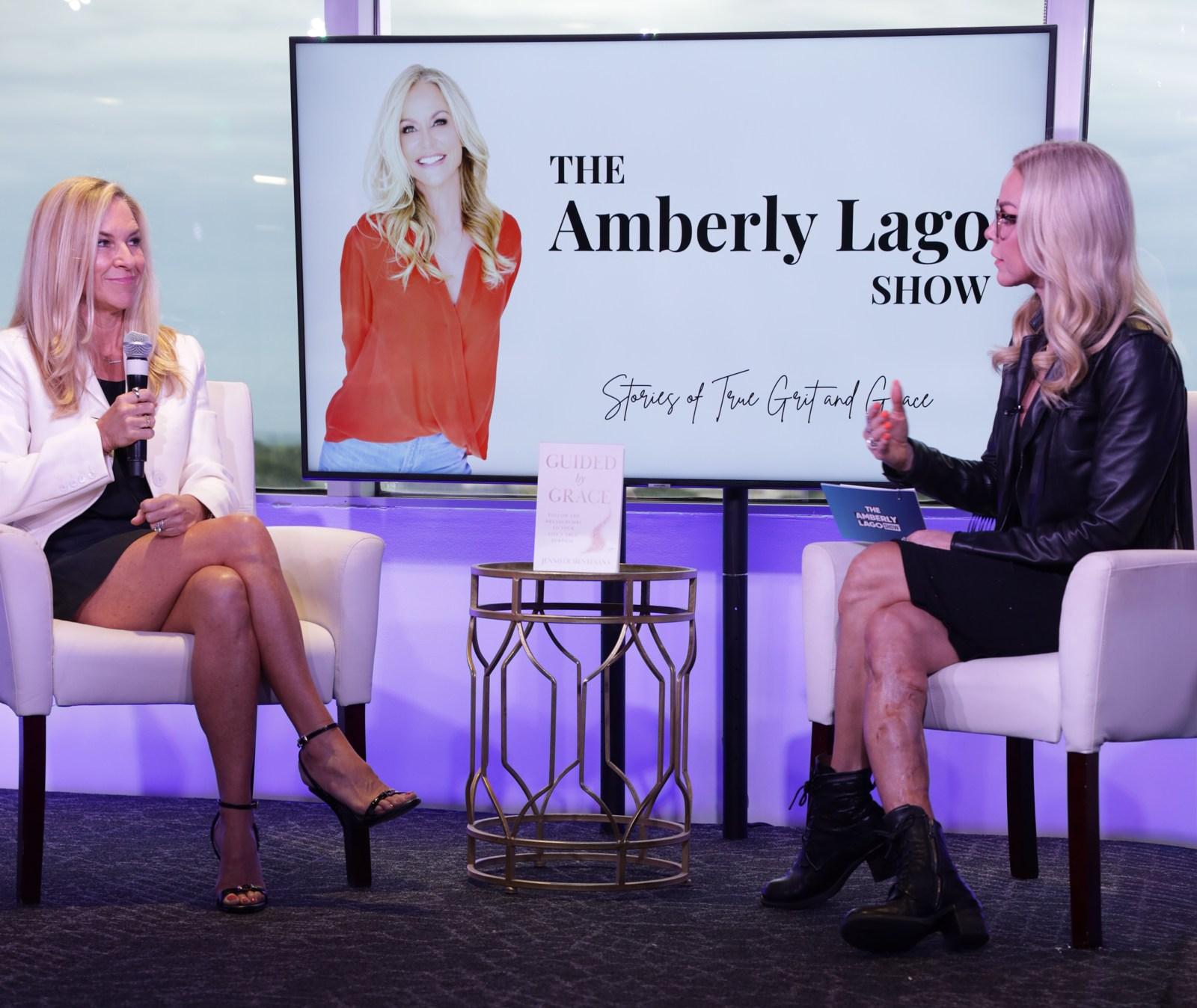
Season 6, Episode 240
The Art of Storytelling: Impactful Techniques from Rene Rodriguez

About This Episode
In this episode of The Amberly Lago Show: Stories of True Grit and Grace, host Amberly Lago sits down with the incredible Rene Rodriguez to dive deep into the realms of presence, resilience, and the power of authentic communication. Rene shares his influential journey from handling an unexpected speaking role for his mother to becoming an authoritative figure in leadership and influence. They explore the emotional aftermath of trauma, the rewarding struggle of personal growth, and the significance of storytelling in breaking through emotional barriers. Additionally, they touch on the role of body language in public speaking and how mastering it can bolster confidence and engagement. Join Amberly and Rene as they discuss the importance of vulnerability, the neuroscience behind resilience, and the value of navigating life's challenges with grace and authenticity in this captivating and heartfelt conversation.
If you are ready to leave your mark by discovering your message and sharing it with the world, you've come to the right place!! Let's work together to build your influence, your impact, and your income! Join the tribe you have been waiting for to activate your highest potential and live the life you deserve! Join the "Unstoppable Life Mastermind!" and let us know you are ready for greatness! Read the "True Grit and Grace" book here and learn how you can turn tragedy into triumph! Thank you for joining us on The Amberly Lago Show: Stories of True Grit and Grace! If you find value in today's episode, don't forget to share the show with your friends and tap that subscribe button so you don't miss an episode! You can also head over to amberlylago.com to join my newsletter and access free downloadable resources that can help you elevate your life, business, and relationships! Want to see the behind-the-scenes and keep the conversation going? Head over to Instagram @amberlylagomotivation! Audible @True-Grit-and-Grace-Audiobook Website @amberlylago.com Instagram @amberlylagomotivation Facebook @AmberlyLagoSpeaker
Full Transcript
Welcome to the Amberly Lago show. Stories of true grit and grace. Thank you so much for tuning in to the Amberly Lago show. If you're ready to amplify your influence and transform how you communicate and how you lead, you're going to want to go get a note and pen and take a lot of notes because I have a real treat for you today. I have the one and only Renee Rodriguez here with us. Actually, he is the author of amplify your influence. Not only that, he. He's the leading authority of leadership and influence. He speaks all over the world. In fact, he has an event coming up right here in my hometown in Dallas, and I'm so honored. I get to speak at AMCON. Mark your calendars for August 15th and 16th because this is an event. It's an event like no other. I went last year and I was blown away. I still look at the notes I took from that. You guys. He is an exper. Neuroscience. He's a CEO of multiple companies. He's been featured in Forbes and Men's Journal and Maxim and so, so much more. So, Renee, thank you so much for being on the show, for being here.
It is my pleasure. Emberly, thank you so much. It's. We're excited to have you there and. And it's an honor to be here.
Oh, my goodness. That event was incredible. And I feel so honored that I get to be there with you at the event. And. And I've. You're somebody that I admire, I respect, I look love and I love that you're so authentic and so real. But one thing that you have is when you. Somebody meets you, you have this gift of making them feel seen, heard and understood, like they are the only person in the room. And when you're on stage, you have this command presence about you, and it's powerful. Yet there's so much grace about how you speak, too. You have people sitting on the edge of your seat. Now, we have a lot of people that listen to the. That they want to become a speaker or maybe they want to be better in sales or a better leader. And you really have systems. I mean, I've got so many notes in your book. You guys, if you want to learn how to be an effective communicator, I really highly suggest you get his book and come to the event and learn from Renee. I. I would just wanted to know though, how did you get into speaking?
Well, one, thank you for all those kind words. That is very sweet. How did I get into speaking? It was Honestly, an accident in the fact that when I, I think at 17 years old, I saw my mother speak for the first time. And I was embarrassed that she was going to be speaking in this group. And these people before her were so good. And I, I told her, I said, I want to be like that guy. His name was Bill Shepherd. And she's like, well, I'm next. And I'm thinking, oh my God, my mom's going to speak after that. And I watched her go up there and own the room in such a magical way that was. I was 17 and I was in tears thinking, okay, so the person I want to be like is my mom. And it was just. It was weird, but it was amazing. And I literally just followed her and. But I never spoke. I was always way too shy. I had massive social anxiety. I was not somebody that was confident on that stage. I was not even just the thought of a stage. My whole world would close in, you know, like, literally my periphery would go away. And the amount of anxiety around it was just. Was too much. And so I, I never did it. Selling cookware door to door through college was helpful because it got me presenting to people. But I never really started speaking until after 9 11. And after 9 11, my. My mother in our company actually lost a big client. And so she had two strokes or four strokes, actually four different places, and was kind of taken off the, the docket for a little bit. And in her recovery and so the fact that I had to go out there and sort of do her introductions and do things, it started with five minutes and you know, then I would move on to 10 minutes and then 15 minutes. And then she'd say something that, you know, her past clients understood but new clients didn't understand. So I would reamped it by, you know, doing a little session, two, three minutes on which I know she's going to talk about, then she talk about things that I didn't prepare for. So then I'd have to add another four or five minutes. And then that just kept going. And Now I'm at 45 minutes in an hour. And people were saying, hey, can you just continue? And it was sort of this process of sort of needing to get into it by force and then, but being surrounded by people that did it very differently. And so our work back then was really based on getting, you know, we had typically a keynote speaker can go on stage while people leave and get on a plane and go home. Then I held accountable to any result. When you're a consultant and you're doing it this way, you actually have to stay for the result and you're fired if you don't get it. And so I'm glad that I started from that perspective so that I could bring that level of accountability to the stage, because I do feel like I need to create a change when I'm up there.
Well, you definitely create a change. And actually that video that you showed at your event last year had me in tear. Actually, you had me in tears when you were speaking. You're so real and you just connect with people, people in the audience. But the video that you played at the beginning of your event inspired me to do a video before my own event because you, I just like, wow, that really touched me. And you talk so much about the art of storytelling and how you can be so much more remember, you know, memorable and get connected with your audience by storytelling. What would you suggest for somebody who wants to learn how to do this? The art of storytelling? Where should they start?
Well, versus to realize we're doing it already. Everybody's telling stories and this. And so we, I think we, we could sort of psych ourselves out when it comes to storytelling. But a storytelling is a narrative. A narrative is a beginning, a middle, and an end. And so narratives in our life play a very significant role, starting between ages three and four. And that's where we realize that life is sort of as a narrative. And we use narrative and story to make sense and to bucket what we learn and also to. To create a sense of reality. And so, you know, we watch dad is hungry. There's the beginning of the story. He walks to the fridge and consumes something. He opens it, consumes something. There's the middle of the story. He's not hungry anymore. There's the end. Ah, so when hungry, do what dad did. Dad is stressed out. He reaches over to this glass cabinet, pulls out this drink and pours it into this glass bottle. Dad seems to be happy for a little bit. Okay, so then when stressed, go drink that stuff. So there's. There's a narrative that is always being played out. And you know, as we get older, that narrative begins to be driven by values. You know, Johnny, for some reason, my neighbor Johnny was over, over Sunday nights. Well, I come to find out that Johnny's mom wasn't home. Her parents weren't home Sunday, so he didn't eat. So our parent, you know, your mom, decided that that was their job. So when a kid, when kid is hungry, then when Johnny's hungry, invite him over to your family by age 21, we realize that those values are, are applied not just in specific situations, but everything. When anyone's hungry, invite them into their house. House. And so we are already telling stories. If you go to listen to anybody at happy hour, what happened? Any recap of the day is a narrative. It's a story. And so then when you get into business storytelling, it's a little bit different. There has to be a payoff. There has to be a reason for the, the story. At happy hour, there's no, you know, the payoff might be humor, it might be fun, it might be entertaining. But in business, the payoff has. Payoff has to be some sort of message. It has to be a message of value, something delivered. Otherwise, we're just storytelling for the sake of storytelling. Yeah, and so. Yeah, and so it's, it's. People say, well, you know, the difference between somebody who's a really good storyteller and someone who loves to tell stories, there's a really big difference between those two. And the one who is really good storyteller uses a story to deliver a message of value. Somebody who loves to tell stories, uses our time just to tell us a story. So there's a difference there.
There is a difference. And when I put together a keynote, I always think about. And even when I'm teaching people in my own mastermind how to even post something on social media, I was like, you need to add value. And, you know, you can share the obstacle, share the, the solution, the story, the solution. But what's the benefit? I was like, people want to know what's in it for them. And if they apply these things in this story, that it's going to benefit them in this way. And that's why they should do that. And so, yeah, I think that is a huge difference. And I know you've worked with Brad Lee just praises you for all that you do. And, and, and said even on your book that you have made him go from like a talker to like a really, an effective storyteller. That, and he is, he is so funny.
He's. He's got. Brad is. Brad was great before me. I mean, he's, he's got so many good stories. And I think what he wanted those. What can I do with the stories? And that's where we sort of got into the strategy behind how can he tie those down and use those stories to deliver a very specific message. And so somebody as talented as him is. It's a, It's a really deadly skill set to put Them together.
Yeah. Well, you. I love that you also talk about neuroscience. You are an expert in neuroscience. Can you explain exactly what neuroscience is and how it helps you as a leader?
Yeah. So When I was 17, I asked my mom, or my mom asked me a question. What does everybody have in common in this room and this big room of people? I was trying to figure it out, and I couldn't figure it out. And he said, renee, they all have a brain, and if you understand how the brain works, life becomes easier. And so I. I took that to heart and said, okay, I'm gonna study everything I can. And I didn't like school at all. But I remember in high school or psychology class, our psychology teacher brought in a magician to talk about sensation and perceptual illusion. And I was so intrigued. For finally, I, like, I. I was. Somebody captured my attention, and it was like, okay, this is. I want to feel this way. If this. If school can be as fun as this, I'm in. And so I. I devoured everything that I could. I went to school for behavioral neuroscience, which is really a lot of. Really mostly statistics. In a lot of ways, people realize that psychology is cool, but it's 75 stats. And the reason it's there is because you're using psychology to find tests of truth. You're trying to find and navigate to understand behavior. You're trying to understand why we do things, the origin of things, how brains can be broken, you know, from any sort of, you know, anxiety, depression, add, autism, things that are sort of divergent in the brain. But the problem, though, in the past was and. And one of my favorite psychologists, Dr. Martin Seligman, he's the founder of Positive Psychology. He was asked in a talk to, he was going to do an interview, and they go, we're going to give you one word. And they said, Dr. Siligman, what's the state of psychology today? And he said, good. And then they kind of say, okay, you know what? Actually, let's give them two words. Let's get a little bit more of a, you know, deeper answer here. And so, you know, let's go give it two words. Now, Dr. Sligman, what's the. How would you describe the state of psychology today? He said, not good. Okay, hold on a second. All right, three words. Let's go. Last time. Let's get. Let's nail it here. All right, Dr. Sligman, tell us the state of psychology today. And he said, not good enough. And it was such a cool way of looking at it, because it was the same frustration that I had with psychology. It was always about a broken brain. What was broken, about us. How do we study what's broken? There's lesions in the brain, there's epilepsy. There's all of these things that. That we don't understand, from schizophrenia to anything, sociopaths. But nothing was really being done on the potentiality and on what's potential and how can we use this knowledge to increase our performance? To be better parents, to be better salespeople, better communicators, better influencers, speakers, you name it. We have to use this thing between our ears and the psychology to be able to perform in life. And for me, I was always driven to what's possible. And if I could use this data and this information, I would always be like, what does that mean to me? To help me close a deal? What does that mean to me? To help me build trust faster? Can I fast forward the trust process? Can I show somebody that I care about? How about body language? Okay. What's the psychology of that? I was always asking those questions around application. And so I moved away from the research side and more and really dove into application. So applied science, how do we apply this knowledge? I had to know how to read the abstracts, understand the study, understand the research, and have enough of the brain map and understand the neuroscience of what function was happening and neurotransmitters. But then to go through the next layer of saying, so what does that mean to us, the layperson, the business professional, the school teacher, the parent, the kid? How do we apply this stuff? And so to me, neuroscience is about understanding the essence of the engine that drives us and all of the pieces that really give us insight into who we are, why we do what we do, and how we can affect our performance to be better.
Well, it's fascinating to me. So I met Rachel Lambert at your event, and she was on my podcast, and I actually went to the brain code centers, her center, and did the brain mapping. And it was wild.
I was fascinating, right?
I said, rachel, are you a psychic? This is. This is wild. Yeah, she. It was like she didn't really know me, and she knew all about me by looking at my brain. And it was just fascinating with me. But what is more fascinating is that you have the ability to, like, level up your brain. You can change. You can be more resilient. You can.
Yeah.
What do you think it is that allows somebody like yourself to be that? You jump out of your comfort zone. You are resilient. You've got grit do you think that that can be learned, or do you think it's something that you're born with, or do you think it's everything that you've been through that makes you a little more gritty?
Yes.
Yes.
Okay, let's have more words to all of it. So the, the answer is yes to all of it. And so there's a lot of new research done right now on obviously, the, the. I'll give you a couple different answers to this. How many. I always tell people, you know, how many people are frustrated with the. The current or some of the more recent generations in their work ethic. And now I know that that's sort of a triggering question because it's, it's not a fair question. But you get a lot of, you know, Gen Xers raising their hand and boomers raising their hand because they perceive it as not the same work ethic. And, you know, there are some entitlement in certain places that has happened. And people say, yeah, we don't understand it. Like, it's frustrating. I said, well, who raised them? And the same people that were frustrated also have to raise their hand, me included. And I said, okay, so we're at fault for this. But why? Because I always want to know why. Well, how many of us grew up with a difficult childhood? They all same people raised their hands. I said, how many people vowed that they would be so successful that their kids would never have to suffer the way we did? And they all raised their hand proudly. I say, that's where we messed up. We robbed them of struggle. We robbed our kids sacrifices. So if there are kids that aren't that way, it's because they were robbed of the ability and the beautiful gift of suffering, of pushing through something. I mean, you know this better than anyone of what your suffering and your journey brought up and revealed inside of you. Remove those suffering moments in those times of trial. We are not the same person. And so there is a part of our brain that I've known about for a long time. Dr. Excuse me. Andrew Huberman talks about it a lot. It's called the anterior mid singular cortex. And it's a really fascinating part of the brain because it's found to be much larger in athletes and military leaders. And people who have overcome, like you would have a very large anterior meticulous cortex or an amcc, because based on what you've overcome in the grit. And so people that have done difficult things have a much larger one. It's found to be much smaller in people who are obese. But when the obese person decides to go on a diet, that part of the brain begins to grow.
That is fascinating.
Oh, it's so fascinating because what it's saying is that if you do things that you don't like, there's a part of the brain that you're growing that muscle. It's becoming stronger. So. Stronger for what? Your capacity for tenacity. So you're growing tenaciousness by choosing to do difficult things. So now this resonates with David Goggins message within my let's message with everybody talking about doing the hard things. Now the science is showing. When you choose to do something difficult and, or you overcome a difficult challenge, the part of you that needs to be tenacious, that, that, that quit level starts to change. You know, some people quit sooner. The tenacity makes you quit later, or if, if not quit at all. But you can choose to grow it by choosing to do difficult things. Now people say, you know, cold plunging, there you go. That's if you hate cold plunging and you do that. Yeah, you grow that part of your brain. But some people say, I love it getting in there. Well, then it's not growing. Then you need to go colder or you need to step out, shiver for a couple minutes and then go back in again. It's not about, there's not an ego involved. It's about what you choose. Like, so I am so sensitive to cold water.
Me too.
I am such a baby when it comes to it. But yet I love the effects of cold plunging afterwards after the suffering. Yeah.
And it's the same with the gym. Like, there are days that I pull up to the gym and I'm like, oh, I don't know, my legs hurting so bad. I don't really need to work out. Maybe I'll just go rest. And then I talk to myself and say, amberly, you are going to go in there and do that. And I never met anybody who doesn't regret that they worked out or feel better.
Never been a regret after a gym.
Exactly. And it's just like going to the gym and pushing ourselves through a hard workout. It. You feel better in every way. I do it mainly. I mean, yeah, I want to have some muscle, but I do it because of the way it makes me feel.
Yeah. You know, well, you have the ability to remember that. And so like, you know that choice when you don't want to go in the gym, but you go anywhere, the AMCC grows when you choose and you give into it, it gets smaller. And so then what Happens is, is that the energy, the choice begets the next choice. The more you choose hard things, the easier life becomes, ironically, because your ability to deal with life's curveballs and the realities that life is going to throw at you, your capacity to deal with it is much higher. And so you perceive life to be easier, but the more we avoid it, the harder and the bigger lifts, the smaller things become.
Oh, yes, I totally agree. I always think if you do the easy thing now, then the harder your life is going to be. But if you do the hard thing now, the easier life is going to get.
That's why you and Maddie get along, because she always says, my wife, she's like, do. Do the hard thing first.
Yes, that's what she is.
She's.
I love your wife. She is beautiful on the inside and out. You guys. You know what? Well, first of all, you have go follow Renee at Learn with Renee on Instagram. But also you're gonna want to. And you'll see his gorgeous wife Maddie, who is like, she's universe. And then you will want to binge Renee's YouTube, especially your shorts, because every single short that you do is like, value. And you're going to learn so much. I want to go back to the speaking a little bit because there are so many people that listen to the show that they want to be on stage, they want to get booked, they want to be an effective speaker. And you say there are four elements an audience considers when it comes to influence. Can you go over those? The things that, like when they're sitting in the audience, what they are thinking about as a speaker, what you need to be aware of about your audience.
Are you referring to ethos, pathos, logos? Which pieces are you referring to?
I am safe.
Oh, you're talking about. Okay. Yeah. So we're talking about the. The specific journey of how we decide. Yeah. So that. That chapter in the book was really interesting because I've studied that research for, oh, just over 30 years. Wow. It's been a long time. So this will be my 30th year when I was introduced to it. And what was difficult was when I was writing the book, I wanted to talk about it, but I had to go back and realize that a lot of that research was debunked. There was a theory called the triune brain theory. So when we talk about the lizard brain or the croc brain or the reptilian brain, it's a. It's a quote unquote debunked theory from Dr. Paul McLean from the, he was the director of the National Institute of Mental Health. And what he said was that we have these three different brain systems that dictate our behavior depending on how much, depending on how much stress we're under. And so you have the reptilian brain, which is the basal ganglia, the core of the brain. And then above that, as a brain develops, it develops into the limbic system, which they call the mammalian brain. So it has different characteristics as a reptile, reptilian brain, as all the reptilian aspects, like cold blooded, it doesn't, it doesn't have verbal centers, it doesn't bond. So anything that you would categorize or characterize as a reptile would be the same in that part of the brain. And then you get into the mammalian brain where you have values, emotion, gateway to long term memory or connection happens. And that's where the amygdala is. And there are 35, 000 times more neurons that come from that part of the brain than when we make logical decisions in the next part of the brain, the human brain, called the neocortex. And as a part of the neocortex in the front you have this thing called the prefrontal lobe. Now that whole theory is in essence debunked. And so I, I, but I wanted to find a way to use the idea because I called my neuroscientist friends and mentors and they said, Rene, of course it's debunked, but it's a great metaphor. And so I go, so how do I use this metaphor? And then I found this phrase that just really made sense, which was some things are literally inaccurate, but metaphorically accurate. And so from a metaphor standpoint, we follow those parts of the brain, of the how things evolve and the way the brain sort of evolves too to really understand things. And we know that the first when something enters the brain in terms of our perceptual awareness, that reptilian brain idea, or there's a defensive part of us that's really designed to keep us alive is asking this question, first of am I safe? And so if I'm presenting something to you and you don't feel safe, and we would call it psychologically safe, it doesn't matter what my value proposition is, nor my price. I don't trust you. And so you can have the best idea. If I don't trust you, none of what you're saying matters. So it is the ultimate deal breaker. And so we know that the first step is we have to create Safety with people, make them feel psychologically safe. And how do we do that? Structure, order, Predictability. Predictability. Letting them know that they're not going to get ridiculed for, for responding in a meeting. Letting them know that they're, we're not going to pitch them something and they're, they're safe to listen and there's value going to be delivered. Let them know that they're physically safe too. But when we create that safety, now the next part of the brain is asking this question of say great, I feel safe, but do you care about me? Do you value me? And if I, if I know that I'm safe, but I know that you don't have my best interest at heart, the deal's kind of over. Whatever it is, I don't want to listen to you anymore. If I feel that you're pompous and all about you, I just, it's become a discredit. I don't really follow. And if I know that you don't care, then I, that reptilian brain comes out as sort of the bodyguard and protector, security guard to say, no, we're good, we're going away. And it can hijack the entire brain. And we talk about emotional hijacks, we talk about being flooded, that fight, flight, freeze response, all of that happens at that really core level. And the way that it's triggered is through the way we perceive stress. So for me, I'm not allergic to bees, but I have a phobia of bees. So when a bee comes around, I respond as if I'm going to die, even though I'm not, I do too.
I'm allergic to bees.
And they, well, that's a logical thing by the way. So that's logical. I'm not. So it's illogical, but it still functions the same. Another example is speaking on stage will not kill you, but yet it's one of the highest rated fears known to man and woman. And so, but they're not going to die, but yet the perception is, is that they're going to be at that level 10. And so it shuts the brain down and we don't remember. That's one of the reasons that you, we go blank on stage is because the stress level is so high that our sugar begins to metabolize at a much lower level, bypassing the long access to long term memory in the limbic system. And so we sit there and we just don't remember. But if you breathe and learn to really get the oxygen back in the brain and do that correctly, you will literally open up that doorway to the memory again. And, and so that's like, that's that piece of it. So am I, you know, am I safe? Do you care about me? But notice the difference there. Am I safe? The first thing that we are very selfish. It's about me. Am I safe? I'm not asking about you. Reptiles are selfish. Now do you care? Now it's about us. So I moved to a different sort of sophistication, evolution of understanding beyond just me now into this concept of us. And so reptiles don't understand us, but horses and dogs do. So mammals do. They can buy, they can bre. They can bond together. You can pet a dog and it smiles at you. You pet an alligator, it's just going to bite your hand off. And so it's, it's, it's. It's not because it's a jerk. It's just doesn't have the limbic system. And so now am I safe? Do you care? Now we move into the third part, the human brain, which talks about it. Is it interesting? So now it's an idea outside of us. And now most animals can't think outside of themselves into this idea that's considered really advanced thinking. To think creatively and to think of something that hasn't been invented and. Or even just to ask to say, I'm not interested in this, I move on to something else. And so we move from me to us to it and then to the prefrontal lobe, which really asks the question of, is this inspiring for me to us to it, to where are we going and how am I using this? And what's the vision of this, that future action and the way that that future action is decided? Inspiration is decided of whether my actions are in alignment with my values. So that prefrontal lobe is very well connected to the limbic system.
See, that's why I could listen to you all day, because you explain complicated things in a simple way that I can understand them. So thank you for that. So I have a question for you. I was speaking to all the captains of. And like the head of the firefighters of California, and there were 300 firefighters. I was going. And they were all like the big wigs, commanders. And my husband was like, those aren't. Those aren't your people. I'm like, these are my people. I was going to be a firefighter. Firefighter saved my life. Like, these are my people. And my husband was a lieutenant commander for the highway patrol. And he goes, no, they're not your people. Well, it was the toughest crowd that I've ever had, because imagine speaking in a room of about. It was about 350 firefighters, all with handlebar mustaches, mullets, and tattoos. And they wanted me to speak on emotional resilience. And all had their arms crossed, and I was like, what would you do? Well, see, they would. I think, because you're, like, this big, like, you're tall, you're muscular, you're tough, and you've got, you know, the. The facial hair, they would probably listen to you more. But they most certainly didn't want to hear about emotional resilience and raise their hand to ask questions, I think, because they didn't want to look weak. I understand that. They don't want to look like they're asking for help. They got to be tough. What would you do? What could I have done differently to make them feel safe? And that I really tried to let them know by opening up with a story about how I care. What. What. What could I have done differently? Because I was the toughest crowd.
Oh, I. And I feel you. And here's. I could make a case that they'd much rather listen to a female that. Than me so that you can make a case for anything. But your. Your assessment's right. When you're dealing in a group that maybe doesn't feel safe to talk about emotions. And so the first question is, how do you make them feel safe? And that's not. Especially in a rough and tough environment where any sense of weakness could mean death, it's really hard to talk about emotional resilience. And so I think that one is honoring the group in there. One is, I'm in a room of people that are heroes, and I know you don't feel that way, but, you know, you guys are the ones that saved my life. And I would immediately just tell your story and your story. Vulnerability cuts through all of that. And then, because I'm assuming, who saved your life? First responders, right?
Yeah. I mean, first responders, for sure. I could have bled out. My femoral artery was severed. They saved my life. They were. They came running towards me before they even got the call. They were at a coffee bean. They heard and saw the accident. So, yeah.
So if you think about it, you come in and you tell that story of who you are, and you say, so why am I so honored to be here is because I'm in a room full of people who saved my life and either have or will be saving someone else's. And so, but here's why I really want to share with you. My journey through that event really began afterwards. Probably a lot of the journey that a lot of you don't see, and maybe the journey that you guys are going through yourselves that you can't talk to, talk to people about, which is how do we now navigate life afterwards? And unfortunately, it's not a logical process. If you've seen tragedy, if you've been through trauma, you've been through something horrific, Post traumatic stress for a war vet is not a logical piece. It is a 100% emotional response to what's going on. And so you see where I'm. Where almost you can your story honoring so good.
You are so good. You are so good.
But if you think about it like you're the, the, the concept is one is your story is so compelling that it, it just pierces through any of that armor. And when somebody pierces through the armor, their people respect them more. But then people make the mistake of taking that respect and running or ethos and running. But when you turn around, you say, but the reason why I'm sharing that story is because I wouldn't be here without you guys. And I know talking about emotional resilience is, can be, can be lame and boring. I said, but you guys make it possible for us to even have a chance for our next piece. So there's this honoring of who's in that room and through that story, and you'll cut through whatever perceived machismo or mass, you know, overly masculine stuff that you might be facing in that moment.
Yeah. And the, the event planner, she. Or the head, she came up and said, well, that was exactly what we wanted. She goes, I know they didn't raise their hand with a lot of questions. She goes, but you wait, they're going to come up to you one by one and want to ask.
I was going to say, I think you affected them a lot more than you realize.
And you know what? They did come up to me one by one afterwards, so. But I was like, oh, that was tough. And I know we only have a few more minutes left. And so I wanted to ask you just. Do you have time for a couple more, Two more questions?
Yeah, absolutely. Let's go.
As you can see, I've got. If you can see, if you are
watching this, we're gonna have to have part two. You know that, right? Well, you have to have part two. We're just gonna have to.
I know we're gonna have to have a part two because I Love how in your book, you have exercises, and I've got them marked. I've got, like, sticky notes in here. Because you talk about body language and presence, and. And also, if y' all look on his YouTube, he gives examples. Or on your Instagram, you give examples of just how your body language speaks more. And I think when you walk out on stage, people judge you right away by even the way you're standing, the way you're dressed. And so many people get on stage and they are nerv as heck. And they get up there and say, I'm so excited to be here. And you're like, you don't look excited. You look scared to death. So talk about body language. For someone who is going to speak in front of a lot of people, what is something they can work on and take away a tip that they can start doing today to be a better speaker on stage?
Well, one is understanding a few different things. One is people aren't looking for polish. I think that a lot of people make the mistake that you have to be this perfectly polished speaker. Like, if I was holding a glass and you saw me shaking, could I be influential with, you know, giving a toast with a shaking glass? And people typically say, no. Well, if I do it this way, and I'm you visibly shaking, and I say, hey, everybody, I'm super excited to be here. And, wow, what a great event. So my words are saying, I'm excited to be here. What a great event. But my body language is screaming that I am nervous. So what we're picking up on is incongruency. Oh, yeah, Your words are saying one thing, your body's saying something else. But if I were just to align them and still be shaking and say, guys, speaking in front of a group like, this has always been really hard for me. It's scary and. But I wanted to do it because this means a lot. This event means a lot to me. And now all of a sudden, I've acknowledged the fact that I am nervous. I gave it no power. People can see it, so I can't hide it. So there's a sense of congruency and authenticity that is so raw in that moment that what people realize that they like you because and now they're cheering for you, but there's congruency. And so, like you said, people that come out and you can tell that they're panicked or there's something else, or they're like, I'm really excited to be here. So there's an incongruency in that so then you got to show excitement in the voice, in the body. But the reality is, as you mentioned, light travels faster than sound. And so we see people, we see you before we hear you. And so your brain is automatically making judgments based on this part of the brain called system one. Really quick judgments and sizing people up. Can I trust you? And so really, what we're. The body's giving away for four different sort of contrasts. First one is, What is it? Oh, it's. Why am I forgetting this? It's. It's crazy. I'm gonna go through the other.
I'm glad I'm not the only one.
Well, no, just like, I literally just had them here. But it's one of those moments. But do I like you? Liking. It's really, am I interested in what's going on? Right? Or am I disinterested? Do I like you? Do I dislike you? Am I, like, attracted to what's happening, or am I repelled by it? And the last one would be truth versus deception. And so all of those things are being spoken through the face, through the eyes, through the posture, all of those different elements. So we're picking that stuff up, but we're also giving it off. And so learning how to stand and how to walk is so critical. And what's also fascinating to me is that we know that the brain affects the body. And so if we're sad, we can look sad, right? We see it in our body. Our posture goes down, our shoulders hunch. But the question was, well, can our bodies change our brain? And so, well, the answer is yes. What's crazy?
I'm over here shaking my head yes, right?
You stand differently. And the brain says, wait a minute, I thought we were. I guess we're confident. Hold on, guys. Secrete different neurotransmitters. And so it starts changing the chemistry of the brain based on how you stand. And Amy Cuddy did a lot of research on this in her book Presence. It's one of the best TED talks out there on. I think it was on.
Oh, I know. She's amazing. She's actually gonna be on my show.
No way. Good call. That's gonna be a great one. I'll tune in for that. But yeah, so she, she's done a lot of research on that piece. But your body is something that you can control. You can control your thoughts and you control your posture. And so those pieces are pieces that we want, really. The low hanging fruit of learning how to walk with your shoulders up and your chin just slightly elevated. Slight smile, opening up the curtains. We call the curtains eyebrows. Right. You know, a lot of people don't realize they close their curtains. Try to smile with closed curtains. Doesn't make any sense. Right. So you want to open your eyes. There's lots of things that you realize, that the Presence is a science that influences a science, and you can learn it just by breaking down those little elements.
That is so great. Yeah. And I know you've got to run, and I have so many more questions. I love that you talk about values so much. You talk about authenticity so much. Because as my husband says, who I can't wait for him to meet you, Renee. He's Cuban like you and.
Oh, cool.
Your. Your VIP night for your event is his actual birthday. And I was like, honey, you're coming with me.
He doesn't sing to him.
He doesn't like going to events. And I'm like, but Renee is Cuban. You're going to love him. And he goes, oh, okay, okay, I'll go. So yeah, it's his birthday, but we'll have to have a part two and have you back on because you teach so much about the importance of values and authenticity. And my husband always says there's so much BS in your industry, Amberly. And so he has retired a while ago and I've made him my BS detector because he is so good about saying if somebody's real or genuine or he just, he's so good at it. And so I want people to get to know you more. You guys follow him on Instagram, learn with Renee, go follow his YouTube, listen to his podcast, grab his book, amplify your influence. It's a Wall Street Journal best selling book. And Renee, are you going to work on another book? We were talking about that before. Are you going to write another one?
We just. Yeah, the publisher wants us to do another one. And so we're in the process of making a final decision on which topic, but we've got two that we're looking at.
I just turned my manuscript in a month early. Yes, I got it early.
That's crazy. That's not easy to do.
It's not. I was getting up at 4:30 in the mornings to write, so I'm just glad it's done. And a month early. Now I can have some of that pressure off. What is the best way for people to reach you? I want people to come to your event in Dallas, August 15th and 16th, y'. All. You. This is an event like no other and you're going to fall in love with Renee and you're going to learn so much and get so much value because that's what he does. He's amazing. What's the best way for people to reach you and grab their ticket? It.
Thank you. You would go to meetrenae.com m e e t renee r e n e.com and up at the top and the banner is our amp con piece there. And so it'll be right there. We'd love to see you there. And if you're there, please come say hello.
Yes. Please check out his website. Your website, by the way, and your media kit is amazing. It's inspired me to update mine, by the way. Thank you. Renee. I just. You're amazing. I just have so much admiration for you and all that you do. And thank you for taking the time to be on the show. I know you're going to bless so many people when they hear you. And you guys, all the links for the show, like his. His show, his book, his social media and the event here in Dallas August 15th and 16th is in the show notes. And if you found value in this, take a screenshot and tag me at Amberly lagomotivation and learn with Renee. And when I see that you've shared the episode with a friend or on your social media, it makes my heart sing. So thank you for tuning in to the Amberly Lago show and we will see you next week.
Pain to purpose to joy.
Never Miss a Conversation
New episodes drop regularly. Subscribe on your favorite platform and never miss a conversation.