

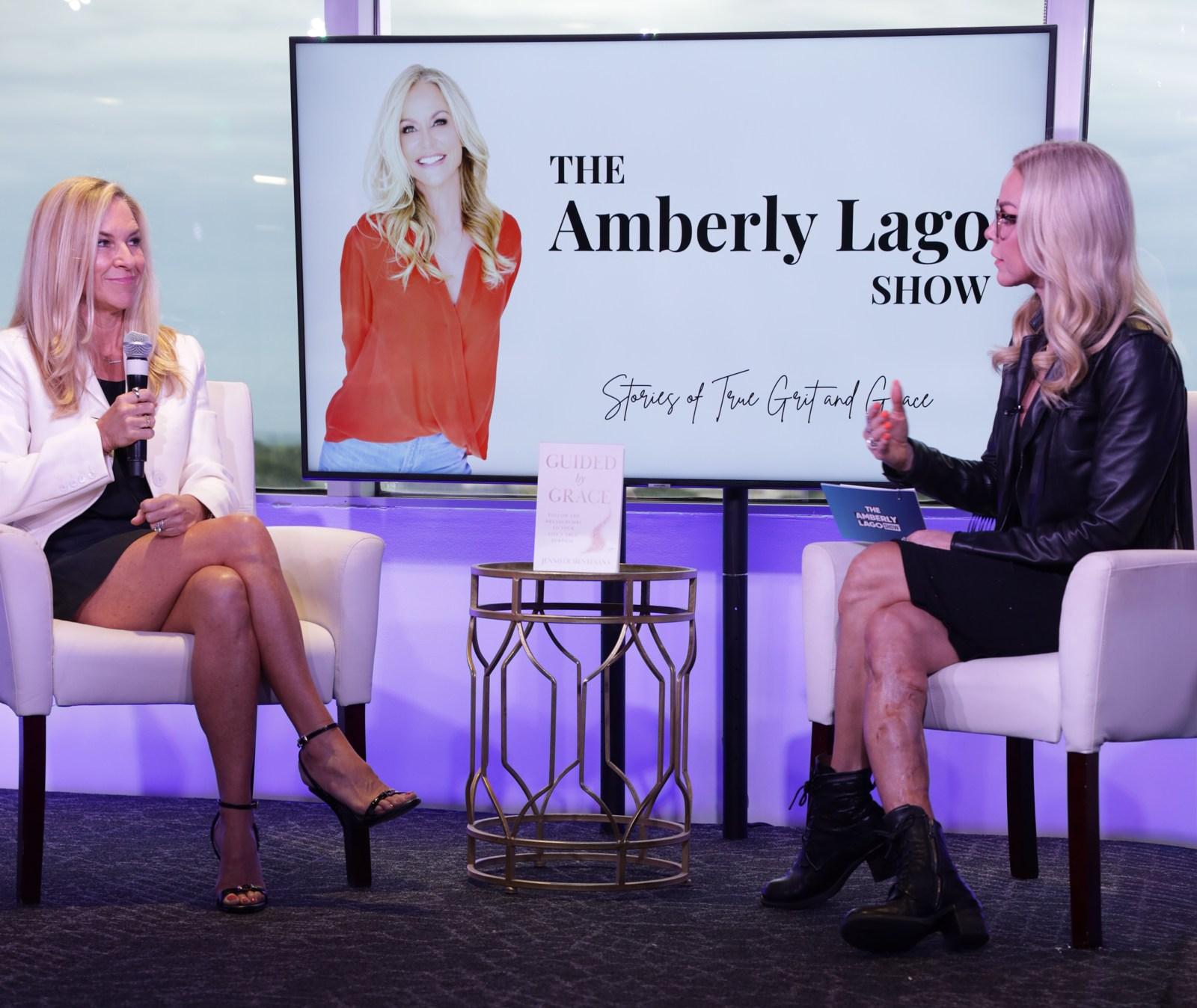
Season 2, Episode 86
Standing on the Front Lines of Human Trafficking with Becky Rasmussen
A conversation with Becky Rasmussen

About This Episode
I have to tell you, this episode of The Amberly Lago Show is one that I believe every single person needs to hear. I sat down with my incredible friend Becky Rasmussen, the CEO of Call to Freedom, a nationally recognized nonprofit that is on the absolute front lines of the fight against human trafficking. And I walked away from this conversation with goosebumps, a full heart, and a fire to do more.
Becky and I met at an event in Sioux Falls and from the moment I heard what she was doing in the world, I knew we had to collaborate. The Unstoppable Success Summit is proudly partnering with Call to Freedom, and a portion of proceeds from the event will go directly toward supporting survivors. This partnership felt divine from the very beginning and after you hear this episode, I think you will understand exactly why.
Here are three powerful takeaways from our conversation.
One Encounter Can Change Everything
Becky's story begins with a young girl named Marissa. At a Sturgis Rally in 2015, Becky felt God nudging her to walk up to a girl who seemed out of place. They had a ten minute conversation. The next day Becky was handed a book of 117 missing girls ages 14 to 17, and Marissa's face was in it. That moment became the foundation of everything. Becky quit her job, worked two jobs as a single mom, and launched Call to Freedom in 2016 with nothing but faith and a calling. Today, Call to Freedom has served nearly 1,900 individuals, operates Marissa's House, housing 36 mothers and their children, receives referrals from every corner of the country and even internationally, and is certified as a gold standard safe house. When God calls you to something, you answer. And Becky answered with everything she had.
The Signs Are Hiding in Plain Sight
One of the most eye opening parts of our conversation was when Becky walked through what human trafficking actually looks like in real life. It rarely looks like the movies. It looks like a troubled kid. A runaway. A child who seems to have a lot of issues. It looks like grooming that happens over months, sometimes by someone the family already knows and trusts. Becky shared that traffickers are masters at finding vulnerabilities, especially online, and that sextortion targeting boys ages 14 to 17 is one of the most rapidly growing and underreported threats right now. Boys are being blackmailed and because we have not created safe spaces for them to speak up, they are suffering in silence. Becky's message is clear: trust your gut, know who your kids are talking to online, never let them exchange pictures with strangers, and if you see something, report it. Do not intervene, but do not stay silent either.
We All Have a Role to Play
This is not just a Call to Freedom issue. Call to Freedom trains guidance counselors, teachers, law enforcement, first responders, and community members from kindergarten through 12th grade across entire states. They have over 250 volunteers. They run Keeping Kids Safe Online events, hidden in plain sight awareness programs, and a continuum of care model built directly from the journeys of survivors themselves. Becky reminded me that alone we can do so little, but together we can do so much. Whether you can donate, volunteer, attend an event, or simply start a conversation with your kids tonight, there is a place for you in this fight.
This episode lit something in me and I know it will do the same for you. The work that Becky and the entire Call to Freedom team are doing is changing lives, reuniting families, and giving survivors a real path forward. I am so honored to have her as a partner for the Unstoppable Success Summit and even more honored to call her my friend.
Please listen to this episode. Share it. And then get involved.
We Discuss
- The divine encounter that launched Call to Freedom
- What human trafficking actually looks like in everyday communities
- Warning signs parents, teachers, and community members need to know
- Online victimization and how bad actors target children through social media
- The alarming rise of sextortion targeting boys ages 14 to 17
- Familial trafficking and what it means for the youngest victims
- How Call to Freedom trains schools, law enforcement, and first responders
- Marissa's House and the continuum of care model built for survivors
- How faith has guided Becky through the most dangerous moments
- How you can get involved, donate, or volunteer today
Timestamps
00:00 Introduction to Becky Rasmussen and Call to Freedom
03:40 How a prayer in 2015 started it all
05:30 Meeting Marissa at the Sturgis Rally
08:00 Building Call to Freedom on faith alone
09:20 Marissa's House and serving survivors nationwide
10:35 Survivors as young as two and as old as 75
13:00 How Call to Freedom navigates complex trafficking cases
14:45 Signs to look for as an everyday person
17:00 What grooming and trafficking really look like
19:10 Sextortion and the targeting of young boys
21:00 How to get involved in prevention in your community
23:00 Community events and 250 volunteers across the state
26:50 How schools and parents can help stop exploitation
30:35 The courage it takes to do this work every day
32:00 How to donate, volunteer, and connect
34:30 The continuum of care model built from survivors' journeys
40:00 Closing encouragement and how to take action today
Connect With Becky Rasmussen and Call to Freedom
Website: https://calltofreedom.org
Instagram: https://www.instagram.com/calltofreedomsd
Connect With Me
Instagram: https://www.instagram.com/amberlylagomotivation/
Coaching Program: https://go.amberlylago.com/
Website: https://amberlylago.com/
My favorite for gut health and wellness: https://plexusworldwide.com/?sponsor=Amberlylago
My MAKE Wellness link: https://meet.makewellness.com/?referral=521698
Unstoppable Success Summit 2026: https://www.eventbrite.com/e/unstoppable-success-summit-2026-breaking-chains-building-dreams-tickets-1968268162057?aff=oddtdtcreator
Become a sponsor: https://go.amberlylago.com/uss2026-sponsors/
Full Transcript
Where did you get started? How did you start this back in 2016? Was it 2016?
Yeah. So I had in my heart that God was going to call me to do something, but I didn't know what it looked like. And it was really may of 2015 in prayer that I felt like the Lord said, get involved with anti human trafficking.
What role do schools, parents, and local communities play in preventing exploitation before it starts? Starts. What can they do?
We do a lot of training, prevention trainings, kindergarten through 12th grade in the school systems, as well as the after school juvenile detention centers, as well as residential programs. And what we find is that to get educated and understand what's happening, a lot of kids will be look like they're troubled kids that they, you know, are runaways, they might be homeless. They look like on the outside that they have a lot of issues. There's always a reason behind those issues.
As young as 2 and as old as 75, I think are seeing with
the Epstein files that a lot of times victims don't come out because some of the backlash you're seeing nationally, as well as a lot of things that they have to endure in their victimization. And when we talk about those older demographics, we're talking about people who realized I was trafficked years ago. And so familial trafficking is where it's actually mothers and fathers trafficking their own children to meet needs or they've learned that way of life.
Thank you for tuning into the show today. I have a really good friend of mine, Becky Simmons, here. She is the chief executive officer of Call to Freedom, nationally recognized nonprofit that is on the front lines in the fight against human trafficking. And Becky and I met at an event that I was speaking at in Sioux Falls, and I was like, who is this amazing lady? And someone said, you've got to meet her. And I met her and I was like, we've got to do something together. And so we have stayed in communication. The work that she is doing in the world, God is just like moving mountains for this call to freedom and for her to help so many women. And she is actually a part of the Unstoppable Success Summit. And as you know, you've heard me talk about the Unstoppable Success Summit a lot lately. And Call to Freedom is who we decided to partner with and donate proceeds to to help other women who are survivors of the human trafficking. And we were starting to talk, and I was like, oh, my gosh, I got to hit record. So, Becky, thank you so much.
Thank you for having us On I, I looked at the title and the Unstoppable Success Conference is Breaking Chains and Building Dreams. And I think this partnership was divine. When we met in Sioux Falls. I. I love who you are, Amber Lee, and what you stand for, the resilience that you had and the things that you have overcome. A lot of those that we serve who walk through the doors of Call to Freedom need that story and they need that resilience because of the awful things they've been through.
Well, we were just talking before we started recording about how it is so needed and women are starting to use their voices more. And your help and what you do with Call to Freedom is going to. I can see it really, really just expanding and growing because more women are having the courage to come out. But where did you get started? How did you start this back in 2016? Was it 2016?
Yeah. So I had had in my heart that God was going to call me to do something, but I didn't know what it looked like. And it was really may of 2015 in prayer that I felt like the Lord said, get involved with anti human trafficking. And so I found the foundation that was laid. I found my mentor here in this area and who was doing some of this work but had retired, ended up in our Sturgis rally, if you're not familiar with that, in South Dakota, it is the largest biker rally. It's about a seven day event that happens here in South Dakota and over 500,000 people come to that event every year from all over the United States. And we were doing outreach and just starting to talk about if you're buying an individual, that person may not be consenting to that activity and understanding what human trafficking was. And I just felt I met this young girl, I had made eye contact with her. If you looked at her, she dressed like she would be in the life. Maybe not from the area based on what she was wearing, how she was acting. So it seemed really odd to me. But I felt like the Lord said, go meet her. And so I walked up to her and I do what everybody does. I introduced myself, I said, hi, I'm Becky. And she said, hi, my name is Marissa. And we had about a 10 minute conversation. If you've ever learned about human trafficking, a lot of victims will not make eye contact. They will have limited words. They may be fearful, dismissive, might have hit all those indicators. I just talked about not looking like she's from the area. And her last words were to me were, you have no idea what kind of day I'VE had. You have no idea. And she left. She ran off the next day. I got connected to Free International that was in the area to do what they call search and rescue. And essentially what they would do is they go to pga, they've been to super bowl this year. They were at the Sturgis rally in 2015. And they do a search for missing kids. And long story short, they handed me a book of 117 girls age 14 to 17. And I felt like the Lord said, look for the girl you met the day before. And so I start flipping through the book and. And the girl that I met the day before, her picture was in the book. Her name is Marissa. She actually gave me her correct name, which doesn't typically happen, you know, because of trust and a violation of trust to those that have been victimized by human trafficking. And long story short, so this was August of 2015. On their research, she had been found October of 2014, went missing again in May of 2015. And they told me that she's highly suspected that she is a victim of trafficking because of re recruitment that happens that there weren't enough services to help those that were coming out of trafficking situations. And so they were highly vulnerable coming out of those situations and re recruited by organized crime or organized fronts. And they had suspected that that was the case with Marissa. And I knew that, you know, there's a quote and I'm going to say, I'm going to read it from Margaret Mead, that I can sit there and do something. I can know what I know or I can do something about what I know. And I just felt like at that point in time, the Lord said, you know, I'm calling to you to this. And so in that car ride home, which was a little interesting in the conversation part of the vision that you see today with Calder, Freedom was downloaded, not the full vision. I think that's the grace of God in our situations. But started nonprofit and formulated as 2016 in January, we got our acceptance, opened our new office in March of 2016 and worked two jobs. And so I was a single mom at the time and knew that God had put this on my heart. My daughter was in high school and so she was along for the ride. Was starting Call to Freedom. We didn't have a paycheck. And so essentially I worked two jobs until November of February of 2017, where I stepped out in faith and started Call to Freedom. And fast forward to today. We have a home that's named after Marissa's and it's called Marissa's home, and it houses 36 mothers with their children that have been impacted by human trafficking. We got our first referral from the Netherlands, from Europe that is living with us now. And so we impact every state in the United States. We've gotten calls from except for nine. And we've gotten international calls where we're housing mothers with their children. And we started that in 2016 and really saw that this women had a deep desire to be reunified with their children. And that birthed our build of the numerous house, which launched in April 1st of 2022. And we've been serving women and their children and moms together and reunifying families since then. And along with that, we also have additional case managers. We just opened a rapid city office where we're offering services on the western side of the state as well as we're going into Iowa and equipping 19 of their advocates to do better responses. So I have a training team, prevention team. Our. Our curriculum is really set into prevention, intervention, and restoration. And we have bilingual case managers. And currently we're serving individuals as young as two and as old as 75, as well as men.
Wow. So as young as two and as old as seventy five.
Yeah. As we are seeing with the Epstein files, that a lot of times victims don't come out because some of the backlash you're seeing nationally, as well as a lot of things that they have to endure in their victimization. And a lot of times they're told by their trafficker they'll never be believed. So when we talk about those older demographics, we're talking about people who realize I was trafficked years ago, or maybe I'm coming out of trafficking at that age, because these organized fronts will either use their Social Security numbers for llc, forced labor, it could be sex trafficking. There's so much in that organized. We've had forced marriages that we've worked with as cases as well to as young as two. Within South Dakota, we have five of the poorest counties in the United States located here in South Dakota with our tribal nations. And so familial trafficking is where it's actually mothers and fathers trafficking their own children to meet needs or they've learned that way of life. And so our youngest is a familial case, and it was a parent that had introduced their child to that life.
Oh, my goodness. It's just heartbreaking. I've seen that on tv. And to think that that really happens is just heartbreaking, especially when I think of, you know, my youngest daughter is 17. I can never imagine that. But I think people, and you know, I was sexually abused as a child and I know the shame and the pain. And I was told, you know, you know, no one's going to believe you, or if you tell anyone, I'll kill your mother. I mean, the awful things that were said. And when you're young, you kind, you start to believe those things. And how do people, how does someone find you and get the help that they need?
As I started entering this work, one of the things that I challenge my team is we need to be innovative. We need to get into the circles that you're talking about. Maybe child protection services, it may be some of those law enforcement responders, it might be an emergency department where they're going in for medical care. We need to train every first responder to better identify those that are impacted by human trafficking. Because a lot of the times those that are victimized don't know that they're a victim of sexual assault or human trafficking because the person they trust the most introduces them to that lifestyle. And so it's really important for us to be integrated into those systems to be able to better identify and build responses for child protection services. We train them every year. Law enforcement, what is a response to a familial case where it might be a third party case? We are developing those responses and being very innovative in that and getting into those circles. Nationally, we're known our Marissa's House is just one component of our programming, but it's one of 2% in the nation that's offering those services. And we've been certified through Safe House Project as gold standard. So we get referrals from them from all over the United States because housing is one of the first things that need to be met for safety and basic needs. And so I think people realize, if they don't realize, a trafficker controls every aspect of your life. It controls who you, this individual controls what you eat, who you talk to, your personal identification, where you live. And so when somebody controls every aspect of your life, you as a service provider have to be able to provide those services for them to feel like they can safely leave that situation. And so housing is a big component of that. And safe housing, we've navigated where we've had people identify here in Sioux Falls, South Dakota, and we've moved them nine states away because Sioux Falls is not as safe place for them because of the organized gangs and organized fronts. Whereas that happens as well nationally and through the states. Is that a lot of people refer to us based on safety and whatever state they're in. So we get referrals from all first responders, other anti human trafficking groups, FBI, hsi. I worked a case with a homeland security where they were going to do a raid on a restaurant that was labor trafficking, where they identified as potential labor trafficking. And they came to us and they said, you need to house 10 to 15 undocumented survivors, mostly men. So if you've ever done that, that's really hard because, you know, in order to get a lease and to be able to get into a home, you actually have to be able to prove that you're a citizen and legal. And these people were being victimized. They were brought in on false promises, sponsored by their parents, a variety of different networks that they were, they were victims of labor trafficking. And so how old are they? These are adults. These were of the 10 that we ended. Out of the 15, we had three women and seven men. And they were anywhere from age 20 to age 35.
Wow. Wow.
And so we get creative and we get referrals from everywhere.
Well, what are some of the signs to look for for the everyday person? If you think something doesn't seem right, like you just happened to look over at Marissa and you were like, something's not quite right. What are some signs that we could look for?
Absolutely. Trust your gut. If you feel like something isn't right, there probably is something that's not right. You know, one of the things that we haven't talked about is online victimization. And I really want to say, say here's some signs that kids are getting approached online. And now we have these tools that can be really great from AI to online, but they're also used by bad actors to victimize. And so I would say for your kids and knowing online, never exchange pictures. If somebody asks you to do something you're not comfortable with, do not do it. We have worked cases where those pictures have gone out on the black web in videos. Two pictures that have gone on the black web and you can never get those back. We do have the take it down where we talk about, you know, getting those down, but we can never fully get those pictures or those images back. And they can use them in AI as well. So I would say to parents, get educated. Know where your kids are, what they're involved with, know who their friends are. It's okay to put boundaries on social media and access to your phone, because if you don't, there are bad actors out there that will be looking for vulnerabilities with your kids on social media, their Instagrams, and they are masters in knowing how to communicate with those kids. Reel them in, find out what their vulnerability is and be the answer to that. If you have somebody that's face to face and it's fearful, they will not make eye contact, they may be dressed inappropriately, they may look malnutritious, there may be some physical. I've seen seeing a lot of this kind of change from physical abuse to more coercion and mental abuse and control versus some of the physical because that's easier to prove. So traffickers have advanced this business in the way that they facilitate this business. People are like, it looks like trapped. It looks like, you know, some of those movies online, taken. And it is very rarely kidnapping. These people will spend time, they will get to know their individuals that they are grooming. And we call it manipulation and grooming. And they will take. I've had up to six months where a young girl met the parents and ended up in a trip to Chicago and ended up police intervening on that case. And she was trafficked in Chicago, but he had met the family. And so know who your kids are involved with, know their background, and if you see something, say something, do not intervene. A lot of times people want to go and rescue, they say rescue. Actually, survivors do not like that term because they feel like that means that they owe that person something in return. And so it's very interesting. But if there is a high risk situation, you should have a local law enforcement you can call. There should be a reporting site where you can actually report. You know, we have our attorney generals. The National Human Trafficking Hotline is a good way to report. And what you find is sometimes there's cases that are outstanding and the more you report, don't intervene. But the more you report, the more they can kind of line up those cases and find that illegal activity happening.
Wow, that's so good to know. And I'm surprised that I feel like my youngest daughter probably knows more about all of this than I even do. So you are educating me. And I say that because she is so smart. She's very street smart and she's fascinated with stuff like learning about, you know, the Epstein files and grooming. I remember when I didn't even know what grooming meant, you know, and she's the one that brought that to my attention. But I think it's really good to know. And we've definitely had a talk with her about this. Taking pictures or even taking a picture on Snapchat one we're like, once you put something out, there, it is out there, you know, and the. The.
The. The incredibly disturbing part of what we call sextortion and sextortion is the blackmailing. So it'd be financial sextortion or traditional financial means. They blackmail you for money. You know, traditional means, they ask for more pictures, and they hold that against you is that they're targeting young boys. And I want to talk about that today. That we talk a lot about children and women, but in this extortion from age 14 to 17, it has been a highly targeted young boys. And you know why they do that? Because it's proven that they boys will pay the ransom or the black male faster than girls.
Really?
Yeah. Isn't that sad? And. And as a culture, we have not created safe places for boys to disclose. I mean, how many men talk about shame and guilt and. And they keep it inside? Well, we haven't created safe places for these young boys to disclose, and we've seen in a tremendous increase in suicides following the sextortion, especially with young boys. So I would say get in. Get into a prevention education training. We do a Keeping kids safe online here with our HSI agents. Like them or not, they're really good guys here. But they really talk about cases and how perpetrators have identified, targeted, and infiltrated some of the tactics we're talking about today. So I would encourage you to get involved in your local community, find out whatever education is happening within that community and get connected to it.
That's amazing. And I don't know if I told you. Did you know that my husband was a cop?
Oh, really?
Yeah.
We love our law enforcement. We wish they'd move faster, but, you know, we. We love our law enforcement.
Yeah, he was. Yeah, he looked good in a uniform. He was a lieutenant commander when I met him. He was a sergeant. He rode motors. And he always says, yeah, you married me for my insurance. And I'm like, no, I married you because you look good in the uniform now.
That's amazing. And what is he doing today? What is.
Well, I wish he was doing more with Call to Freedom and helping out with that sort of thing. Well, I'm gonna plant a little there. But, no, he's retired. He loves being retired. And he says that he officially works for me, and I. This was my first year. He actually got a 1099, and he's got a bit of credit card, so. Yeah, that's amazing. I told him, so we're going to New York, and he's going On a work trip with me. He doesn't usually go with me. And he's like, well, now I need extra leg room. And now I want this the nicest hotel. I'm like, you are high maintenance, mister. Like, when I go somewhere, I don't care. Just get me on the plane and get me. There you go. Yeah. So it's. It's very funny. So maybe he will. You will see him at the event. I'm excited for him to meet you. You can't miss him. He's a character for sure.
I tell you, our law enforcement are so important to this and training for our law enforcement, so important to be able to recognize what's happening in. A lot of this has cross intersections because it looks like addiction, it looks like mental health. It looks like they're forced criminality where they might be taking a drug run for their trafficker or they may take a gun run. And there's usually something more happening with those, what we call mules behind the scenes. And so we so appreciate our law enforcement and We've seen since 2016 an increase of identification of victims. The more education that we've gotten out there for all first responders.
Oh, well, thank you for all that, the work that you do. So you do you have ongoing programs to help with youth and community, like education programs, or are those planned out? Are they a yearly things? I know you host huge events. Like, your events are thousands.
That's like, God's been so good to us. Like, I think, you know, there's another quote. Alone we can do so little. Together we can do much. And I remember when the Lord called me to this, one of the other instructions he gave is united community. And I couldn't wrap my head around that because I didn't know what that looked like. And we just started talking and God started getting a hold of this community. And we have over 250 volunteers that take our pull tabs across the state, or they're mentors to our clients, or they come and clean apartments when we're in transition. And so we. We do a lot of different events. We just held one with a chada dance. And they actually travel all over the world and recreate trafficking survivors of trafficking stories into dance. And so Mary, who is here.
Yeah, it was beautiful.
And they were here just two weeks ago, and they actually asked me, is there a survivor on that you would like to feature? And Mary, who works with us at Call to Freedom and shared her story of cartel trafficking and how she survived. And now that travels there in Brazil, Peru. Her story is going all over the
world in dance Goosebumps.
It no it was such a divine. Her story needs to be told because cartel trafficking is more prevalent than people know. When we talk about the Epstein cases, those conversations that are starting to finally happen because survivors were brave enough, encouraged and had the courage to come forward and talk about it and us getting behind them and believing that this isn't a call to freedom issue, this is a community issue and we need our community come behind it. So we do our big fundraising event which started out with 210 people in 2016 and we have over 1200 people that attend that event every year. Two, we've had almost 1900 individuals walk through the doors of college. The freedom to get services in that short amount of time too. Where we do keeping kids safe online, where we bring in parents and a lot of times they have questions. They know something in their gut is off and their child is doing or maybe feeling that there's something not right. Well, we bring in agents and we talk through and bring resources to them as well as we've done where we've done what we call hidden in plain sight where individuals that have lived, experience, experience share their story from men to young ladies, from pornography to individuals that were gang related, cartel trafficking to familial trafficking. To really allow people to understand what this issue is about and to get behind it. And when you hear a survivor like Mary that shares her story and is helping others out of something that she shouldn't have lived out of, there's nothing like that. And that's why we do what we do.
Oh, and you know, it's such a beautiful thing. And I am so. It makes me so happy to have so many people that I think want to come to Unstoppable because they're like, oh, that's so cool. Call to freedom is going to be there. What proceeds are going. Yeah, they people want to get on board and help. I really think that they do.
They just don't know how.
And even I introduced you to Ashley Holt and she has been wanting to help and do something and I connected y' all and she's. I don't know what exactly is up her sleeve and how she's going to help, but I know that y' all are both beautiful souls and I know something is going to come amazing is going to come out of it. What do, what role do schools, parents and local communities play play in preventing exploitation before it starts? What can they do?
Yeah, we, we do a lot of training Prevention trainings, kindergarten through 12th grade in the school systems, as well as the after school juvenile detention centers, as well as residential programs. And what we find is that to get educated and understand what's happening, a lot of kids will be. Look like they're troubled kids that they, you know, are runaways, they might be homeless. They look like on the outside that they have a lot of issues. There's always a reason behind those issues. And retraining our staff, from our guidance counselors to our teachers, to be able to identify what those indicators are and how best to respond. And so we have a youth navigator that travels the state, as well as a specialized trainer here in town that does that within churches, youth groups, as well as we're in the after school programs. We do a lot of rural communities. And we first train the staff to know the responses and to better identify this. And then we go and do prevention with the kids because it never fails. Every time I do an event, somebody comes forward and somebody says, oh, that's me. Or I identify with that, or I know somebody and I know it. I just. We set it out there every event and we say, if this is something that resonates with you and you need help, we're here to help you. And the tears, the families, that's how referrals have come as well, is all of a sudden then even in this prevention training, a young kid goes, that's me. Like, I didn't know that's what my mom was doing or my dad was doing to me. And then we begin to do the intervention piece where we intervene on something that's created, currently happening within the homes. And then we have to help navigate those first responders on how do we best protect this kiddo in these situations and how do we navigate them out? I did a navigation with a family where their daughter was 18. So legally and jurisdictionally, there's a lot of complications there to getting out an individual. And it took us nine months and she's out and she's safe, and her traffickers are now being held accountable in federal court.
Wow. Nine months.
Nine months. It took the hand of God a lot of prayer because Jurist. It's such a complicated. It's just a complicated issue, especially if you're 18 or older and you're making in your own eyes, your own choices. But yet people don't understand manipulation and coercion. And in order to navigate somebody out of that situation, you have to work the family, you have to talk the family through it. You got to give them direction. On how best to approach every situation, because they can trigger each other, as well as navigating the law enforcement piece, to say, okay, there was just a seizure of drugs at this house. Can we link it to the Iowa case that, you know, they were arrested in a casino in Iowa. And there's just so many intricates to prosecuting these cases, but also to getting somebody out. So for us, prevention is huge. We never wanna see or have a family call us where their daughter is in the midst of it, and they didn't get the prevention or the guidance they needed before that.
Wow, that is unbelievable. It sounds like you really have to have a lot of bravery yourself to do the work that you do. Cause it sounds like it could be, in some situations, pretty dangerous.
Yeah, we've had one where the law enforcement said, move her out of town because this cartel, they'll kill her. And, you know, these are highly organized fronts. Majority of them. You also have the familial cases and, you know, maybe onesie 2z boyfriend, pimp type of situation. But majority of these are organized crime. And so, you know, God has us with. We know that we're very safe in what we do. We work very closely with our partners, but we're never going to not say we're going to help somebody walk through the doors. And I've seen God anytime. I don't have the answer. I don't know how to navigate it. He shows up and he does something. And that's the one thing I can promise people. Sorry. Is that I know my God, and I know that he brought you here for a reason. And we're going to lift it up, and they'll call me and say, guess what just happened? Or, you know, this was amazing. And I just can't believe, like, there's a sting operation. How did this happen? And I've just seen it over and over again. And I tell my teams, a girl may leave, but she will always come back. Or a boy may leave, but they will always come back to Calder Freedom. And they do. And God has been faithful to that call. And I would not do that without him.
Oh, that is so beautiful. And I think this is just what everybody needs right now, is a dose of your hope and love and inspiration. I mean, it's beautiful. And I. I can't wait to see. Just see this grow and grow and grow. How can people get involved to support? Whether it's volunteer or whether it's donating? What is the best way for them to do that? I mean, of course they can Come to the Unstoppable event.
Yes, come to the Unstoppable conference. You can meet me in person. I will be there. I'm so excited to connect with you again and your women. But I, you know, you can go to call to freedom.org under our get involved page and you can donate to Call to Freedom as well as volunteer opportunities. And you know, we have advocates, we have 80 volunteers that take our pull tabs across the state. We will find a place for you. We will. That is one thing. I had a promise to the Lord. If somebody wants to get involved, how do we figure out to make that happen? And so you can go to call to freedom.org you can donate. We always need more resources. We look to expand our services into not just South Dakota, but the other states. And hopefully this continuum of care model that we have developed through the journey of survivors could be used in other states to help other people. And so we need you in the fight. If you are not in this area, you can find a local anti human trafficking group in your area and get involved, plug in and have conversations.
Oh, that's beautiful. So, Becky, with your continuum of care, is that something they can find right there on your website?
You can go into our website under our services and our continuum of care model was developed. We have an outreach center, which we just had two benefactors come alongside, where we actually do have showers on site. We have boutique on site for clothing. We have a food area. We have a respite area. That continuum of care model was developed and continues to be developed from every survivor's journey. And if we didn't meet a need, we figure out and we add it to our continuum of care model. And that's what I think. People that have been victimized in this deserve to have a holistic, full approach to having every opportunity to get out of that, that situation successfully.
Oh, that is amazing. And do y' all see why I was like, I want you to come to unstop. What can I do? And you know what, Becky, I can't wait for you to meet Renee at the event. She's the one that's doing the live art. And what she does is she says, you know what? I just listen. God just gives me, tells me what to paint. And last year she did scripture on the, the paintings and then painted over it. And I'll have to show, I'll have to show you. They're beautiful. But yeah, so it's just. I got goosebumps again. I think that all the ladies and you and Renee and the emcee and I have a gospel singer. At the beginning, I mean, yeah, I wanted a whole fire.
We have no idea.
You.
You have a very special group of people that I've just met a few of them. And what you have. Poor Amberly. I'm going to turn this back to you, what you've poured into their lives and many lives other. That's what we do together, right? Mine is anti human trafficking. Yours is empowering other people to step in their fullness. And our world needs hope right now. It needs a voice that brings hope. And, you know, you do that. So thank you for blessing us and allowing us. We're very humbled to be a part and look forward to divine connections and more time with you.
I know. I can only imagine the connections that are going to be made in that room. And that's really the thing is. So I went to Sioux Falls. I had never been to. I was like, where is Sioux Sue Falls? I. I mean, and I really think that Mike took a chance on me. I was their first ever female keynote speaker, and I was the first person ever that wasn't a part of the Catholic Church. And do you know that after I gave that keynote, we went and had dinner in a separate room. That's me and a bunch of guys sitting around the table. They all go around and say, well, what was the highlight of the event for you? What highlight? And they get to this one guy, and he looks at me and says, well, I have to say, I really thought that having you as our keynote speaker was going to be a big mistake. He goes, but when I saw you in mass this morning, I knew we had the right person. And I was like, oh, that's a.
That's a top crowd. I mean, it is a lot of male driven, you know, driven speakers. But you. You did amazing. And you brought an energy and a love and a faith healing. And your story is. Can inspire so many people for so many years to come. And it's not just when you're here.
You. I'm just grateful. And at that event, it's pretty, like, straight laced, you know, and I show up in a butterfly suit.
You did.
I did. And then one of the guys was sharing a story about, well, I bought some. I brought some flowers from my garden because I was going to talk about butterflies. And I walk in, and the first person I see is you. And, you know, I wasn't even going to wear that. I had something I was going to wear that was totally different. And I was like, no, I need to wear the butterfly suit. But I did not realize. Just it was pretty serious, but it was. Everybody was at a highlight.
I just had dinner with Julie and Mike and I invited them to come. They are going to Europe and so they have a trip to Europe, two weeks. But I just am so grateful for that connection. And they love you dearly. Mike speaks nothing but highly about you and Julie as well. And so you made an impact. That's forever.
I mean, just like you never know who you're going to meet. And I met him in the hallway when I was speaking at another Fit Body boot camp event. And we stayed in contact for a couple of years and then he referred me for this, where I got to meet you. And now so many people are going to get to meet you at the unstoppable event. Sometimes you think you're going to an event for one thing and you realize you come out of it with new friends or a new collaboration or a new opportunity or you meet somebody that you can help or that can help you. So it's just a beautiful thing. And I'm just so glad that he's like, I really want you to meet Becky. And I was like, I'm so glad he did. So I'm just excited for all the amazing things that we are going to do together. This is just the beginning. And thank you so much for taking the time to be on the show. Thank you so much for saying yes. Thank you to being a part of this summit. And I just want to help as many people as we can through call to freedom. So you guys go look all the links for her social media and her website so you can start to get involved. It's all going to be there in the show notes. And Becky, just so much love for you. Thank you so much.
Thank you so much and thank you for giving this a voice. One of the things that I've learned over the years is that doing this for 10 years is that there wasn't a voice for so many people. And they need you and they need all of us to come together. So thank you for inviting us. Thank you for allowing us to be a part.
Thank you and thank you for giving a voice to so many and helping so many. And thank y' all for tuning in to the show. I hope to see you in Dallas April 30th. Well, the VIP starts the 29th. April 30th, we're having the big day and I've got. I'm going to announce a surprise at the event. So it's going to. We're going to have all kinds of surprises, but. Yeah, Marker calendars. Come see us in Irving, Texas. It'll be in the show notes. And thank you again. Becky and I will see y' all next week.
Pain to purpose to joy.
Never Miss a Conversation
New episodes drop regularly. Subscribe on your favorite platform and never miss a conversation.