

Season 7, Episode 70
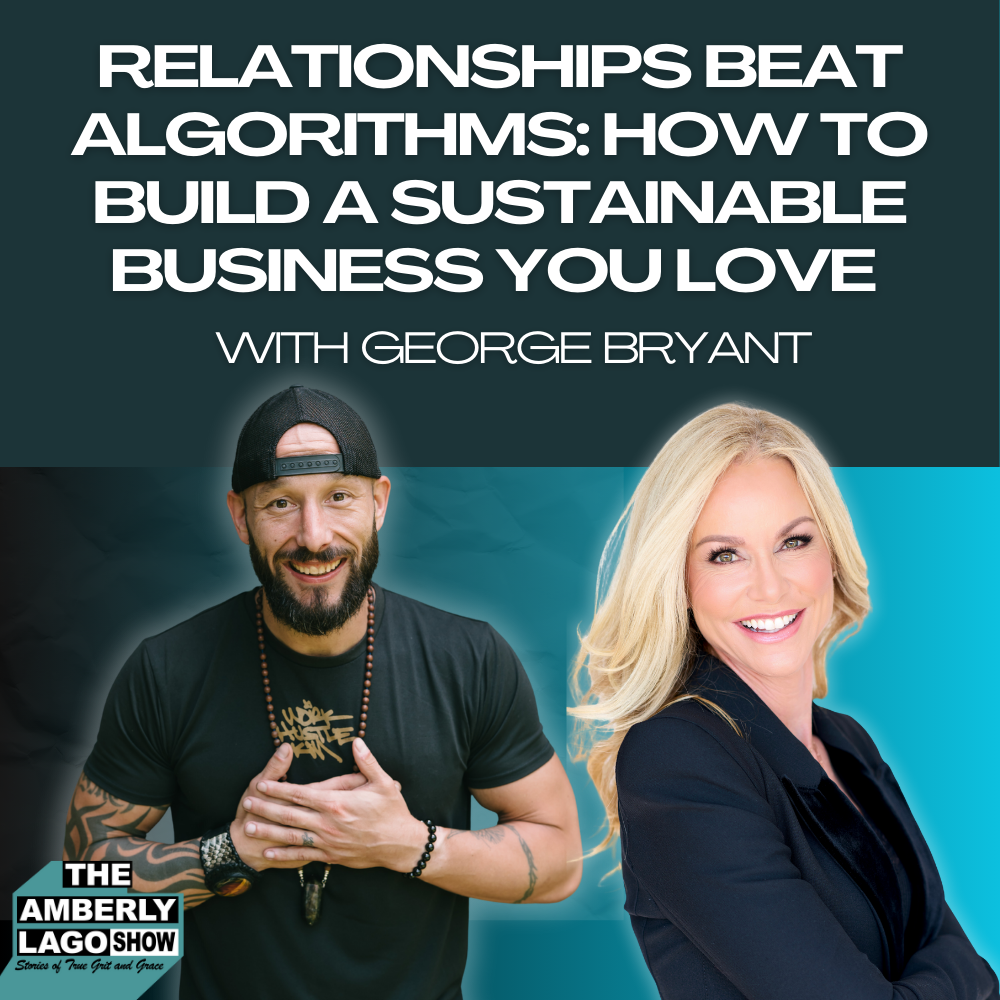
Relationships Beat Algorithms: How To Build A Sustainable Business You Love With George Bryant
A conversation with George Bryant
About This Episode
Do you want to know the secrets to Sustainable Success & Business Growth? In this inspiring episode of The Amberly Lago Show, Amberly welcomes renowned entrepreneur and mindset coach George Bryant. They go deep into George's powerful journey, from overcoming childhood trauma and military challenges to building multiple 7-figure businesses and helping hundreds of others scale authentically.
Discover how to create unstoppable growth through grit, grace, and the power of genuine relationships. George Bryant shares actionable strategies for business owners and aspiring entrepreneurs alike, covering topics such as sustainable business growth, resilient mindsets, and why "relationships beat algorithms" in today's noisy digital world. Learn the difference between marketing and true connection, scaling the unscalable, conquering fear, and the importance of adding real value in every step of your business journey.
If you're seeking motivation, practical business tips, or wisdom on overcoming adversity and building a brand with authenticity, this episode is your blueprint for lasting impact and fulfillment. Don't miss the secrets to thriving as an entrepreneur while nurturing meaningful connections!
They Discuss:
Overcoming trauma and adversity
Power of authentic relationships in business
Sustainable growth versus burnout
Value of adding value first
Scaling through genuine connection
Importance of loving the process
Faith and mindset in entrepreneurship
Timestamps
00:00 Overcoming Hardship and Finding Connection
08:01 "Proving Everything Through Challenges"
14:59 "Marine Corps: Disconnect and Change"
18:44 "Proving Publisher Wrong"
21:38 "Faith, Growth, and Opportunity"
29:25 "Evaluating Evidence and Belief"
31:50 "Success and the Pressure to Deliver"
38:44 Coaching Courage Over Fear
46:19 "Creating Connection, Reducing Resistance"
48:44 Passion, Delegation, and Connection
55:29 Trust Yourself: You Know Enough
59:36 Play the Hand You're Dealt
#MindsetCoach #AmberlyLagoShow #GeorgeBryant
About George Bryant:
George Bryant is a visionary entrepreneur, New York Times bestselling author, and host of a top-ranked podcast that inspires millions to scale with soul. From his roots as an Active Duty United States Marine for 13 years to a celebrated food blogger and marketing genius, George has turned his raw, authentic journey into a global movement, touching millions through his storytelling, social media, and the #1 health app of 2015 (Apple).
To Connect With George
Website
To Connect With Amberly
Website
Amberly's favorite for gut health & wellness
Unstoppable Success Summit 2026
Listen to "The Amberly Lago Show"
Subscribe so you never miss an episode!
Full Transcript
Welcome to the Amberly Lago show, where grit, grace, and joy connect you to unstoppable success. Hey, there. Welcome back to the Amberly Lago Show. If you are a business owner, if you're thinking about starting a business or you want to scale your business, or if you are a business owner and you're maybe facing some burnout, you are definitely in the right place. I have my friend Jim, George Bryant with us today, y'. All. He is an incredible. I mean, incredibly successful entrepreneur. He is an author. He is a veteran. Oh, my goodness. A consultant, a mindset coach. He is the man behind the mind of George, and he has overcome trauma, some very dark times, and really forged something very powerful out of it. And he's going to share with us what it really means to build a business, how relationships beat algorithms, and how to have sustainable growth. Every time I get this amazing man on the phone, we just. I could talk to him all day. So. I am so grateful that you are here, George. Thank you so much for being here on the show.
It's an honor, girl. I feel the same about you. Instantly. I was like, kindred spirit. Like, that's my soul sister right there. So, like, I'm. I'm so honored to be here.
Well, I. Was it Brian Bogart that introduced me.
Brian.
I love Brian, and I know when he introduces to me, me to someone, I'm going to love them. But, man, you and I got on, and I was like, oh, my gosh, we just connected. And the more that I learn about you, the more I'm like, oh, no wonder we connected. I mean, your story starting out from. I didn't want to share it in the intro. I want it to be, you know, yours to tell because you speak so powerfully, but you have overcome so, so much, and even from a young age, and there are a lot of people out there that they want to do big things or start a business. But I think trauma, past abuse, past hardships, addiction, things like that keep them stuck or held, hold them back. Can you share a little bit of kind of where you were and how you made it through some of the darkest challenges of your life?
I sure can. And, you know, since we're not making a Netflix docu series for everybody, I'm going to keep this somewhat a high level, and I'll let you. I'll let you dive in. And. And, you know, before I even start, I want to frame this for everybody listening. Like, if I could say there's one thing that I want you to leave this entire Podcast with whether you leave in the beginning, the middle, the end, or you stick around is that you can build whatever you want to build as long as you believe it to, but it can't be everybody else's way. It's gonna have to be in alignment with your soul and where you are in that current phase of your life. And I think this is an invitation and a permission slip for everybody to honor that journey, because I don't think any of us are done. And, you know, I. I joke. Now, as a man of faith who loves Jesus with all my heart, I look at my story now not as something that I overcame, but more so something that God gave me to build my character. And beautiful. I have it written on a sticky note in front of me, but I said I often prayed for things that I didn't have the character and scars to maintain. And I look at life and this gift that we're given, and we're given an invitation to steward whatever we're issued, whatever hand that we're dealt. And all too often, I allowed my flesh or my mind to say, well, this isn't what it looks like. What I prayed for, well, I wasn't specific enough. But if I look back in reflection, everything I've ever prayed for, I've gotten and become a better man in the process. And this wasn't somewhere that I landed overnight. Like, this is somewhere in the last three to four years of, like, really deepening my relationship with Christ and reflecting all the way back to, like, my earliest memory and realizing that God had his hand on my shoulder the entire time. I just was looking down instead of looking up. And so if you go back, it's, you know, childhood trauma of, you know, physical abuse, sexual abuse, not from my family, but from other people, emotional abuse, neglect. My parents had a lot of trauma in their life, and they did incredible. Like, the fact that they even got me out and, and got me somewhat sustained, given what they face. But there were social services involved, potential emancipations like welfare checks from cops, two to three times a day, and that I was bullied on top of it. I had my nose broken twice and my front teeth knocked out I think four times by the time I was in ninth grade.
Wow.
And so I just never felt like I fit in. And in that process, I became a chameleon. I did everything in my power to try to get people to like me as a survival mechanism. And so at a very early age, I started working because if I couldn't support myself, I wasn't going to get Anything. So I was, you know, 12 and lying about my age to get my first job at a skating rink, and then working two to three jobs while trying to navigate high school, living in my car that I had bought or a friend's basement and like kind of floating around until I realized that I wasn't gonna make it if I stuck around. And. And I had this. Now what I consider God on my heart the whole time. I'd never wanted to be in the military. You know, my dad was in the army, but we never talked about it. Never even heard of the Marines. And one day it hit me like a ton of bricks. I saw a recruiter and I was like, that's what I have to do. And I was like, that's the hardest thing I can do. And a part of me did it because I think I had the desire to prove to myself that I could do something. And so when I was 17, I forged my parents signature and I joined the United States marine Corps at 17. 17. Yep, 17. And then by the blessing of God, my teachers, I. I missed, I think, over a hundred days of high school my senior year because I was working. And it was like, well, I have to choose between school and feeding myself. And so I would choose that and. And I didn't graduate. My teachers passed me. They were like my mentors. I still talk to them to this day. Some of them listen to my podcast, which is like mind blowing to me. And I was like, they took a chance on me, and because of that, I have, you know, a chance in this world and life. And so I left.
You think they knew that you were. Did you tell them that you were working?
And that's why they knew everything. They, they were, they were like my safe place. So like, I would like Mrs. Thompson, the nurse. I was in her. I was in her nurse's office four hours a day.
Wow.
My math teacher, Mrs. DeLuca, Kathy DeLuca. Like, I remember them all. Peter Boucher, my gym teacher. I remember every one of them because it was before school, during school, I only did sports, so I had some mentorship. And I would cry to them and tell them what I was facing. And they all knew. They knew the family, the cops had come to the school, social services, obviously, when it gets involved, everybody knows if you're a. If you're a student. Right. So guidance counselors knew, teachers knew, principals knew. And my family grew up where I was from. So they all went to school with my parents, they knew my family. And so it was just this, like, really interesting hodgepodge very contrasting because I lived in like suburbia Massachusetts, right where the Patriot stadium was. So there was this contrast that I lived in. And so, you know, that was my childhood and blessing in disguise. It gave me that survival mechanism, right, where I'm like, I, I tell everybody if you ever watched Goodwill Hunting, I was Matt Damon. That was it. Right? But I was never like, book smart. I never understood school. Like, I really struggled with it, but I understood people because it was the only way I could survive. I had to get relate to people, I had to communicate with people. I had to get things.
But also, don't you think that when you grow up with abuse or any kind of abuse, I think it gives you this special spidey sense where you have to be able to see, is this person safe, is this situation safe? Am I walking into a room where I'm about to get the crap beat out of me or is it okay?
Everything, Everything. It's like, it's so interesting because I thought growing up in that I had hyper vigilance until I joined the Marine Corps and I got real hyper vigilance, right? You do a couple combat deployments, you, you know, things like that. So, so that led me and, and truthfully, what it created in me was the Napoleon complex, right? And that turned into a kind of a hidden benefit because when I went into the Marine Corps, I didn't really have anything to lose, but I felt like from this insecurity, I had everything to prove. And so, you know, I went to boot camp, graduated honor graduate out of 1400 recruits, went to Marine Combat Training, graduated first out of like 2, 000 people, went to my job training school, graduated first and got to choose where I was, you know, stationed, and then was 20. I ended up in North Carolina. And that hoorah, like, I'm going to prove everything to the world got me on my first deployment. And I ended up deploying to Somalia in 2004 for 13 months. And that's where a lot of my life started to really change. So when I was in Somalia, I, I had an injury to my legs. Wasn't. It didn't happen in combat. It happened like training to go out on a mission. And I almost lost both my legs.
Yeah, you had compartment syndrome.
I had bilateral. So both legs at the same time.
Did they slit your leg down, the surgeries?
Yeah, six surgeries. So I had that too.
And I've got any doctor that I've met that have just seen me and seen my scars are like, oh, wow. You had Compartment syndrome.
Because what happened to me, I. You're actually the first person I've ever met besides me. It's not a very common thing, but it happened in Somalia on my 21st birthday. And then they misdiagnosed me as having shin splints.
You're kidding.
And so I stayed in country for six more months. And when I flew home, I had blood clots. I made it home without dying. I'm so blessed by God. And when I got home doing my post deployment physical, that's the first thing they make you do, is you go to medical, you do all this. I was on the operating table within eight hours of landing back from Somalia. Like it was that bad. And they did a partial. It didn't work. So they told me they were going to have to amputate my legs because it was so bad. And because it didn't work, I got the benefit of asking for a second opinion. And I asked the military to refer me to a sports doctor. And they did. And he's like, listen, I can save your legs, but you're never going to run again, you're never going to walk again. You're going to do this surgery, these surgeries, and then you're going to get discharged out and you have to figure out what you do in your life. And I was like, okay, cool, whatever you say. And so over the next 12 months, they proceeded to do five more fasciotomies. Um, so don't Google this, by the way. If you have a weak stomach, I don't recommend looking at it. But the fasciotomies, they happen. So they would do one side of one leg, they would heal it, debride it, close it, then they would do the other ones. So over the course of like four months, I was in a wheelchair, I gained like a hundred pounds and went through all.
Gained a hundred pounds.
Yeah. So the part that I didn't, I didn't tell everybody is that because of the abuse as a child, I started coping. And I became bulimic at 15. And so my coping mechanism was food. And so I had the surgeries. I had a PCA pump in, so I had unlimited morphine every six minutes. And then I would just binge eat, binge eat, binge eat, binge eat. And so, you know, I'm only 57 and at the heaviest I was 270 pounds and I was just non functional. And so they did all the surgeries. And then I had an incredible physical therapist. She was mean, like a drill instructor. And because I was in the Marine Corps, it wasn't an option. It became my job. But they're like, you need to do this recovery, and then we're going to separate you. And I realized in that moment, if they separated me, I had nowhere to go. I didn't have a family to go back to. I didn't have a home to go back to. My parents divorce was still happening over, like, nine years. Criminal charges, they were going to jail, suing each other. Like, it was. It was gnarly. And so it scared me enough that I was like, I need to get better. And I kind of made it my mission. I learned fitness, I learned food. And I spent the next seven months fully rehabilitating myself. Not because the Marine Corps wanted me. They're like, we're going to kick you out. But I was like, if I need to stay, I need to be able to perform at the level of everybody else. I just don't have feeling in my legs now. And so I had to work two, three times as hard. And so right near the end, within, like, 30 days of me being done, I was able to pass a physical fitness test.
Wow.
And it bought me time. And then that's where kind of fitness became this, like, new obsession of mine, because I'm like, if I don't use them, I lose them, and if I lose them, I'm out, and I don't have a backup plan. So I ended up making a full recovery.
There's no plan B.
You're like, no, there's. There's no plan B work, you know,
And I love that, man. When I. I. When I moved to California, I was like, there's no plan B. It has to work. I have to make it in Hollywood because there's no plan B. And when you put that pressure on you, it's like, okay, whatever it takes to make it work, I'm going to make it work 100%.
It was like, who do I have to become? Like, let's go. And then it turned out to be a benefit because that catapulted into my career, and I was an incredible Marine, got promoted really fast. Was the best fitness test, the best combat test, the best shooter, the best martial arts instructor, the best everything. And so that continued until 2009, when I was deployed to Afghanistan. And then in the. In the span of like, a year and a half, I got seven traumatic brain injuries.
I didn't know that.
I didn't know training accidents, combat accidents. And then, truthfully, I was blessed that, you know, like, compared to some of my friends who were Special Forces and Navy seals. Like, I had a really easy life on deployment, but there's no easy life on deployment. You see everything that you are not designed to see, and the death, the destruction, the people leaving and not coming back. And, you know, witnessing all that stuff, like, really took a toll. And the PTSD spiraled out of control. And so when I came back from Afghanistan, the brain injuries were really, really bad. I would just pass out randomly. I. I'd not be able to leave a dark room for four days. Like, I had vertigo, I was dizzy, I had bleeding on my brain, swelling on my brain. And in that process, my dad was diagnosed with cancer. The Marine Corps sent me on a humanitarian transfer to go take care of him. And so I cared for him for the end of his life. And then my brother was 17 and had nowhere to go. So I adopted my brother, took him with me. And so I'm 24 years old, 25 years old, like, barely made it out. He's five years younger. I took care of my dad, was left with this insurmountable debt and no family support. Then my brother comes with me, and I'm still in the Marine Corps. So I'm navigating, like, all of this before I go to Afghanistan. And then when I came back, it was kind of like the first catalystic moment where I had to face everything I had faced and, you know, military trauma. All it did was unlock my childhood trauma because I never coped with it, right? Like the Marine Corps using food to,
like, stuff down the pain.
The Marine Corps replaced my having to deal with my childhood because the more disconnected I was, the better I performed and the more they rewarded me. Like, I don't have feelings, I don't have emotions. These things don't matter. And so it was in Afghanistan that, like, my world really shifted because my dad died right before I went to Afghanistan. And I witnessed so much death. And I had some really close near death experiences that really, really shifted me. And I realized that, like, something had to change in my life, my life. And so I decided, like, anything that, like, to your point, I was like, I'm not going to be sick anymore, but I'm afraid to ask for help. I can't tell anybody this. I'll be weak, right? I can't have mental health issues. And so I made it my mission to make myself better. And so I started teaching myself how to cook. Found out I had celiac disease. This is 2010. And so when I came home from Afghanistan, I just started Teaching myself how to cook and documented on the Internet as accountability. Well, fast forward about a year later. I was blogging every day before I even knew what a blog was. And the Marine Corps is like, hey, we're really medically separating you this time, and there's no backup plan. And because of my previous injuries, they were like, the paperwork's already in process. You got maybe six months. And so what I had spent 13 years doing, which, like, oh, I'm going to do 20 years. I'm going to retire. All of a sudden, it was off the table, and they're like, no, no, no. Like, you're out. Like, you have less than six months, and you are no longer a Marine. No benefits. Like, by. And so entrepreneurship was this thing that was presented to me because I had been blogging and creating content. And so as soon as that happened, I immediately set my focus, and I'm like, I'm going to be the best paleo food blogger in the world. And sure as crap, I get out of the Marine Corps. And, you know, within a year, I'd made my first million dollars as a food blogger and then went on to
write, how did you make a million dollars as a food blogger? I'm sure there are people right now listening, going, a million dollars. Well, I'm blogging today.
I made a million dollars in 30, 35 days. But it wasn't just the 35 days. What I had done is because I had documented my journey and I didn't know anything about business. I spent two years, a year and a half, creating a recipe every day and then telling people a story and just adding value. And after about a year and a half, someone emailed me. I'm. I joking off this. The craziest story emailed me. And it's like, dude, I really wish you had all your recipes in one place. I'm like, I do. They're on my website. And he's like, no, no, no. Like, in, like, an ebook. And I'm like, what's an ebook? And he's like, you take them and you save them all. And, like, you give it to me in one document. And so I spent the whole weekend making an ebook of every recipe I'd ever made. And I emailed it to him, and he's like, why'd you send it to me? And I'm like, because you asked. And he's like, no, no, no, I want to pay you for this. I'm like, why would you pay me? They're all on my website. He's like, yeah, but they're not in one place. You should upload it to this website called clickbank and then tell everybody that you made this. We'll support you. Charge like $37 for it. And I crap you not. Amberly. I did exactly what he said. I emailed the like, 1100 people I had on my email list and I did a blog post about it. And the first two to three days, I thought something was broken because ClickBank was saying I was making $80,000 a day.
Oh, my God. $80,000 a day when you had 1100 people on your email list?
Yeah, because I posted it, then I did a blog post. And because I had added so much value and I'd never asked for anything from anybody, they all started sharing it. And then they're like, look at these recipes. Look at xyz. And so that first ever digital product went on to make a million dollars. And it's actually what kickstarted my career. Because after that, someone's like, george, you should write a cookbook. And I'm like, well, how the heck do you write a cookbook? So I go straight to Google University. And I'm like, cool, what do you need to do? What do you need to figure out? They're like, you need a publisher. So I was at an event speaking, and I saw a publisher. I was like, hey, I need to introduce myself. And he's like, why? Like, well, since you're publishing my next book, I figure you should know who I am. And he's like, your audience isn't big enough for me to publish a book. And I was like, I don't need it in advance. I'll prove you wrong. And he fought me nail and tooth, and I had to fight and fight and fight and fight. And finally he's like, okay, you can do the book, but I'm not supporting you, xyz.
Well, that publisher was that.
I'm not gonna just for. Let's just leave that where it is. I'm like, what publisher was There's Jesus in my heart. There's Jesus in my heart. So. And he wasn't wrong. That's the craziest part. He wasn't wrong on paper, there was no good ROI on me, none. I didn't have the numbers. I didn't have the audience size. I didn't have any of it. But what he didn't know is no one else had my heart. Nobody. And so published that book June 10th of 2014 and went on to become a 22 week New York Times bestselling cookbook in the paleo space. And so I hit the advice how to list. I sold a couple hundred thousand copies because all I did was connect with people, add value, ask for support, connect, add value, ask for support. Which then led to an app. Sounds like you should make an app. And I'm like, I don't know how to do that either. Found it out, found an app developer, made an app, launched it. Apple featured it as the top health app of 2015.
That's amazing. It's like along the way, you were following the breadcrumbs in the right came into your life with the right suggestions. But I love that you have said this over and over and over. Add value, add value, add value. And you know, when I wrote my very first book, I knew I had one year to try to figure things out. One year. So I started my Instagram. I didn't know how to work Instagram, and I knew I had one year before my book was coming out. So for one year, I was like, how can I add as much value as possible so I can build community? And I did. I made so many free things, downloads, and was just pouring into people for a year. And then I was like, hey, the year now my book's out. It's 1695.
Yep.
Would you come to my book signing and give me a hug? I didn't even ask them, will you come buy my book at my book signing? I was like, just come to my book signing. I don't want to be there alone. Just give me a hug.
Yep.
And they did. And it. But I love that you said over and over, add value, add value. And so I didn't know that you had had an app. Do you still have that app?
Well, the app still exists. I looked it up a couple weeks ago. I don't use it. We haven't updated it in years. But we were the first recipe app that integrated with Apple health and macros and your Apple watch. And so we combined kind of everything together in that health space.
And now there are so many.
There's so many. But back then, like, we were kind of early, and I think there's a couple points that I really want to hit that you said, number one is that I followed the breadcrumbs, which means I was obedient to the opportunities. Not because there was evidence that I would be able to achieve them, but I owed it to myself and God to follow the path. Like, even biblically, it doesn't say, I'm going to light your next 20 steps. It says, I'm going to be a lamp post to your feet for the next step. And that's where faith is right. But it's faith in believing and becoming that person. Because now I spend all my time helping 6, 7, 8, 9 figure entrepreneurs scale. And the one thing I start with all of them is the reason you don't have the business you want is because you haven't become the person to have it yet. It's not because you're lacking a tool or a strategy or a tactic. If the playbook is the same for all of us, it's our perspective of the playbook that dictates our results. And all too often we think there's a finish line in the game of entrepreneurship, but that's the death trap. That finish line does not exist because it means you've stopped growing. That's huge. Number point, number one. Number two is I have a friend who's been on my podcast. He's an incredible, incredible author. Bob Berg and David Mann, they wrote a book called the Go Giver.
And oh yeah, I've, I've heard of great book.
And it's like literally it's a one hour read. It should be required for every entrepreneur who has values and believes in business. Because what we have to remember about business, and you nailed this with what you were talking about, people don't buy products or services. They invest in relationships with people who own products and services.
Do you know, I just got off, so I did a three month coaching program called Profit in your purpose. This was the topic that we just discussed was I said, you are your brand. There are a million life coaches. There are a million people out there with podcasts. There are a million speakers out there. People want you because they know you, you're your brand and they want to know who you are authentically you. Because I think you can smell inauthenticity. And yeah, I didn't say that.
Right, you nailed it. But you, but you nailed it. And people forget, right? Every. Every decision a human being makes. This is a business lesson for everybody. But we're all the best consumers of business. Every decision we make as a human is an emotional based decision. Logic doesn't make you feel safe. Authenticity gives you evidence to feel safe, right? So everyone's like, yeah, that's not true. I'm like, great. Have you ever recommended a restaurant to a friend that had subpar food but quality service? And everyone's like, yep. And I'm like, have you ever not recommended a restaurant to your friend that had great food? But subpar for service. And they're like, yep. And I'm like, that's my point.
That's so true. That's a good way to look at it.
That's how business is done. And when we understand human behavior, which is what we're all doing, business in its essence is an extreme exchange of value to be mutually beneficial. It's not that I'm selling you a bridge. It's that I'm going to help you walk over this bridge to achieve the thing on the other side. But what's required is that people know who they're learning from. They know who they're consuming, they know who they're building. A relationship was even faceless brands, people build relationships with the essence of the brand, the values of the brand.
Yeah. With how it makes you feel.
That's the point. And how it makes you feel.
And I always think about this. Like if there's a commercial for American Airlines, they're not showing you the airplane. And look at these seats and look at this airplane and the windows and that. No, they're. They're making you feel like this is the vehicle to get you to the destination, to where you want to go. And, you know, the freedom to travel, you know, 100%.
And an even more tangible example for everybody is think about iPhone and Android. How Does Apple own 99% of the market share with only 1% of the actual market? And Android owns like 90 plus percent of the market, but less than 1% of the market share.
You're kidding.
If you look at Apple commercials, they're showing people in the experience and what it unlocks for them. If you look at Android commercials, it shows people the features and benefits of the phone.
Oh, that's good, right?
You go back to like when you and I grew up pre Internet. Right? Every commercial had every dude convinced that if he drank a Coors Light, he'd have a sports car and a hot chick. Right. No substance, no value. Right. But it was like painting this picture. And so it's really, really, really important. And I. You made an important point that I want everybody to really, really understand when you think about the world that we're in now, because all I do is coach entrepreneurs. So I see this across the board. Everybody is so over inundated with noise that the only thing that actually separates any of us is our identity. And the people who win are the ones that are willing to share it. And the people who lose are the ones who are hiding it from everybody else. Because what's the difference between my podcast and your podcast, or hiring me as a coach, or hiring you as a coach, it's actually their relationship with us. Well, in order for people to build a relationship. Right. Entrepreneurship at every level is leadership. And it's not that I have it all figured out that I've done all this before. It's that, like, hey, I'm on this journey with you. Let me share what I've learned and invite you to take it with me. But I can't do this for you. But I'll show you what I've learned. I'll show you what I've experienced, because I'm still committed to this growth. It's a really, really important point. And even going back to your Instagram point of how businesses are done, like, I've heard it for years. Like, people told me, they're like, dude, you could never succeed with a Facebook page. They're dead. Well, they told me that. And then I built 350,000 fans in 18 months. And they're like, how are you doing this? And I was like, the same way I would do anything else. Just like, someone's like, well, I could never launch a podcast. It's so saturated. I was like, but you are not out there. You're the unique factor. But we all too often hide behind our businesses, right? Our businesses are not our identity. Our businesses are just a playground for us to share our identity with the world. And I think that.
I'm sorry to interrupt, but I just. I. I have this. This just came up, and I think it's important and that you're going to be able to answer it. So I have people that are just. They're. They're living in fear. They have this big idea. They have this, you know, big business that I've got. This is it. I'm gonna do it. But then they're scared to do a post. They're scared to even update. Their profile Picture is from 65. You know, and I'm like, it's scary putting yourself out there. But what do you suggest? Or if this comes up with the entrepreneurs that you coach, what do you suggest for them to do to get through the fear and do it anyway?
It's such a great question. And I'm going to give two answers. I'm going to give the easy answer and then the deeper philosophical, theological answer, right? The first thing is that all too often, we don't ask ourselves what we're really afraid of, right? And so, like, your human brain is designed for survival. Your limbic system is designed to keep you comfortable facing growth has discomfort associated. So what we'll do is we'll negotiate with ourselves, but we'll just mentally ruminate over and over and over again. And I asked this in my clients sometimes when they're facing fears, and I'm like, all right, what are you afraid of? Like, what's the worst that could happen? And they'll list them all out. And I'm like, amazing. Now what's the best that could happen? And then I'll make them list them on a piece of paper in front of me. And I was like, cool. Now, let's be honest. Given the last 30 days of our life, I want you to make a tally mark for every piece of evidence that you have that proves either side of these. And then I'll look at them and I'll be like, look at that list of things that you're afraid of. And I was like, would you be willing to put your life on the line to a jury of your peers to prove beyond a reasonable doubt that this is true? None of them say yes. But then I'll look at it and I'll be like, would you be willing to make a case for this side? And they're like, 100% I would. And I was like, because you have nothing but evidence to support this. But we have to believe it. We have to actually look at the evidence in front of us, right? It's no different than like the first ever keynote I gave. I was convinced people were going to leave, they weren't going to listen to me. I'm going to be judged, I'm going to do. And the exact opposite happened. Right? And as cheesy as it sounds is fear is false evidence appearing real. But what that is, is we're bumping up against our growth ceiling. Right? It's like you worked so hard to run a 10 minute mile and then you literally can't go faster than 10 minutes. Well, to break through that barrier, you have to change your training or change your habits or change your behaviors. But it's scary because it's not comfortable, it's not known. So it requires a little bit of discomfort. The interesting thing about entrepreneurs, though, is if we all go back to when we started, we faced this every day, but we didn't have a bias associated because we didn't have success. So you and I starting Instagram, if a post didn't do well, we didn't delete it. You know what we did? We made another post.
Exactly. And you know what? I still keep my crappy post up from when I first started so people know I didn't know what I was doing. Well, well, I still don't. I'm just still trying to figure it out. But I leave them up. And I remember being so excited when I got double digit likes. I was like, oh my gosh, 10 actually liked this post.
Yep.
You know, but yeah, you're right. I was like, well, that I gonna do another post because I, I was committed. I made a commitment that I was going to post at a certain time every day. And I was, you know, people thought, oh, social media, you're messing around, you're wasting your time. I was like, no, it's a business strategy for me and I made a commitment to do it. Yeah. And so. Yeah, exactly. I think sometimes I was just talking to a friend of mine. So I was speaking on a panel at an event in Dallas this weekend and there was a lady on the panel and she's got 5 million followers across all platforms and she was talking to me and confiding in me that she wanted to have an event but she was so nervous like that people wouldn't show up or they had these expectations that it would be great. And I was like, yeah, I was like, we all have fears of, of happening, like who's gonna come? What if they don't like it? What if you know it? But, and I said, but sometimes I think the more success that you have, the more pressure you put on yourself, that it has to be a certain way or you know, it has to be a sold out room instead of just having fun and doing what you love and being in your element and you know, going and being in the purpose that you're called to be in. And so, but she had a point that, you know, I think that when we do achieve success that maybe it is a little harder. Have you felt that as an entrepreneur because you've achieved loop success? Have you ever felt that pressure of oh, what you're posting or what you're saying or anything like that?
The pressure comes if you allow it. She's spot on. Right. There's, there's this, everyone thinks like as you get more successful, the imposter syndrome goes away. No, no, no. The volume gets louder.
Uh huh.
What you learn is how to silence it. That's what capacity is. That's where practice comes in. Right. Just like no different. Right. I'm so simple as a, as a creature when it comes to coaching and entreprene. But like it's like if you're a parent and your job is to cook dinner for the family, right? And you make dinner and you accidentally add salt instead of sugar. You might take a bite of it and be like, we can't eat this. Are you never not gonna cook again? No, because it demands you make another recipe. So you learn from it, you make an adjustment, and then you put another recipe in the oven to feed everybody, even if it's just ordering pizza until the next time. But everybody gets fed, right? It's not the result we're after. It's the process. It's that everybody gets fed over time. What tends to happen is we fall into this, like, comfort zone or this bias of, like, well, this is what it looks like, except we don't really look at the game. Just because I spent a majority of my life getting really good at running a marathon, if I change disciplines and go to Olympic weightlifting, as much as I'm a professional athlete over here, I'm a kindergartner over here. And I have to remember not what it was like at the finish line, but what it was like at starting line, except I'm going to progress faster because of my perspective and the lessons I've learned and my ability and capacity to navigate those challenges, right? So I have a lot of clients that are billionaires or, you know, have. Have made it. And we all joke the same time. They've all been on my podcast. They're like, the only reason I'm successful is because I failed more often and faster than you. He's like, because what you see as failure, I see as opportunity. I don't let it dictate my identity. I'm like, what worked, what didn't work, and what am I doing differently, as fast as possible so that I can learn from this experience. Right? And so the second part of my answer before, with, like me as a man of faith, when these fears become real, my Bible tells me all day that I should fear nothing because I have everything that God gave me. And the thing that I tell myself all the time, like, like, they're not going to respond. They're not going to like it. No one's going to like. What I have to say is, unlike, I'm not interested in the opinion of a world who crucified a perfect man. I'm interested in being obedient and following what God put on my heart. I'm not looking for your approval. I'm looking for the approval of my father and being obedient to what he asked me to do, because there's a lot of People that are told they're crazy. We can all go back and look at Elon Musk, whatever your opinion is on him. Everyone's like, tesla's going under. It's gonna fail. And he's like, no, it's not. And nobody believed him. And then a lot of wealthy people were created who did because it didn't fail. And then they became the number one auto manufacturer and, like, take over the world. But, like, I think that's the barometer that knows you're in the right direction if you're afraid of doing something. I call it the tickle test. It's me bumping up against my ceiling. If my entire day was full of like, oh, I'm gonna do this. This is so easy. There's nothing in here, there's nothing for me to benefit. Just like if you and I were at the gym together and every day we went to the gym, we're like, oh, this is so fun. This doesn't hurt. I'm not even sore. We'd be like, why are we going? We're not getting stronger. Entrepreneurship is the greatest gym for life growth that ever exists because we're constantly bumping up against that ceiling. And so it's up to us to reframe that perspective. If you're going to commit to a three mile run and a mile two, you want to stop running, but you convince yourself to keep going because you're like, oh, this hurt is good. This is making me stronger. Well, when we bump up against those fears in business, in posting on social and running an event, we have to say, oh, this is making me stronger. The more I practice this and work this out, the better my results will come. Because it really is a simple equation. We just have to be willing to see it for what it is.
Yeah, well, I always say, well, first of all, I don't know, maybe I'm a little weirdo, but I like when I'm sore because I might do you do? I'm like, oh, yeah, good. My legs are sore. You know, like, I'm getting stronger. And it's funny, I just have to share that I had a client, you know, years ago because I used to be a fitness trainer. For 26 years I was a trainer and, and I had this one client, she used to be in the industry, this is in la, and she was a professional model. And we worked out. And afterwards I'd called to check on her. She's like, yeah, I think I have the flu. I am like, I'm just hurting all over. She had Never been sore. She was sore from working out. It was the first time in her life that she had ever been sore from working out. And I was just like, wow, I was just blown away by that. But I also. And I was just sharing this in my coaching community earlier today, that I used to always tell my. My clients, do something that scares you every day because it's going to strengthen your resilience. It's going to strengthen your confidence, your grit. But I always say fear means to run. Like. Like, it's a. It's a green light. When I. When I'm scared about something, I'm like, this must mean it's important and that I need to do this.
Yes. And, like, think about this, too. For every parent listening, how many of us would have our child, like, my son's eight and a half. My daughter's 20, right? But if my son at eight and a half came home from school today and he's like, dad, I was gonna ask the teacher something, but I was afraid what parent would be like, you know what? You're right. Don't ever ask the teacher anything again. Never in our right mind would we ever say that. We'd be like, well, what were you afraid of? What's a way that you could do it differently? Is there a way that you could start this conversation and we would start to literally coach them on finding the evidence, but at some degree as adults and, you know, the why doesn't matter so much. But we live in a world that doesn't accelerate progress, humanity, or authenticity because of this, like, social media life, or we have it all together, except we don't. Like, even for me, a success. Like, my favorite thing in the world is running my events. Like I told you about them, right? My first event looked like I booked it in the projects. I grabbed the first hotel that was the cheapest price, and I had six people show up, and I had to work so hard to get those six people. But then over the next, like, five, six years, I started having hundreds of people come, and I was like, look, God, I made it. Like, this is what you want me doing? Big events. I'm speaking, I'm doing all this.
And.
And like, two years ago, I booked a hotel in Dallas, of all places. And I was like, all right, we're selling event tickets. The last one sold out. The previous one sold out. Six weeks, Amberly, and not one ticket sold on a 700 ticket. And I'm talking thousands of people told. And I'm crying, I'm praying, I'm Doing all of it. And so I had this moment with God, and I was like, God, what do I do? And he's like, like, cancel the hotel. And I was like, what do I do? And the only thing that hit my intuition was four walls and feelings. I call my CEO and I was like, ashley, I need you to call the hotel. Cancel the contract. Get us out. We can't pay for this. It's like, 25 grand. No, no, no. And she's like, craziest thing, George, is I never booked the hotel. And I was like, what?
What?
Come again? She's like, it just didn't feel right. I never booked it. She's also a woman of faith. And I was like, okay, listen, this came to me. Four walls and feelings. And she's like, oh, we need to get an Airbnb. Remember, that's when you started all of these. We, Amberly, I crap you not. We book the Airbnb in Dallas. And I'm like, hey, guys, God told me, four walls and feelings. We're doing this. But it's capped at 25 people. The next day, the tickets sold out.
Wow.
I, to this day, still only do them in an Airbnb. And I cap them at 25 people. Because that's the season I'm in. So it doesn't matter that I've spoken to stages of 10,000 people or 15,000 people, that season has passed. That's not the workout I'm in right now. The one that I'm currently in is like, this is the way that I'm being obedient, and this is how I'm having the biggest impact.
And so we have so much in common. Like, I did events for the past five years, and after this last event, and of course, this last event was amazing. And afterwards, I was like, oh, but this was so, like, trans God was in the room, and maybe I just need to do one more, you know? And then I was like, no. I said I was going to change this up, and I'm doing it differently. I'm not going to be selling tickets. I'm not going to be. I'm doing a stage and I'm putting my Mastermind members on stage and they're getting video and pictures, but I'm just doing it different. But what you're sharing, it actually makes me feel better because I had so many people reaching out, saying, I didn't get to come to your event this year, but I'm going to come next year. And I'm like, oh, no, we're not doing it the same next year. You know, it's different. And there's that little part of me, that small part of me that has like this, oh, maybe I should do it again, you know, But I'm like, the stress of, of having an event and I keep it real on the podcast and I share everything I'm going through. But let me tell you, doing a book launch and an event at the same time, it was really hard. Not just like physically, mentally, emotionally, but like, financially. My accountant is like, you cannot do these events anymore. Like, you're in the red every single time. And he's like, I know you love to do it and you've got this, you know, heart of being of service, but like, it's costing you thousands and thousands of dollars. Like, yes. So I, I would need some advice from you before I did another event like that, 100%.
And this is the best part. We could FaceTime every day. But here's, here's one of my rules for all of my clients and entrepreneurships. I, and you said this earlier, I've helped scale two companies to a billion. I've helped hundreds scale seven, eight, nine figures. I've built three of my own companies to eight figures and lost them. And now everything I do is value driven. But here's the two biggest lessons that I can leave everybody with. Like, just as, like, write these down, fortune cookie these, stare at them in front of you. Okay, lesson number one. You have to earn the right to complicate it. You have to earn the right to complicate it. If I threw you some ingredients and I said, go make me dinner, there's two ways you could do it. You could get me food in 30 minutes. Do it easy. Or you could complicate it. Go to the store, buy pans, buy knives, do all these things that don't matter, and yet the food on the plate is still going to taste the same. You have to earn the right to complicate it. Because we can speak fitness and everybody understands this doesn't matter what you do, what modality, do weightlifting, Pilates, training, bodybuilding, running. I'm going to give you the equation you want the best body of your dreams. Move more than you eat, sleep, drink water, and measure what you intake. The rest of it doesn't matter. You can go to the gym for three hours a day, take every supplement in the world, but if you don't sleep, drink enough water, and you eat more than you burn, it's not going to matter.
Exactly. That's my language.
That's what yeah, that is the greatest, greatest thing that we all have to understand. And entrepreneurship, what happens is we have something that works. And this is point number two. Whatever worked in the beginning is the thing that's guaranteed to work until the end. We just forget about it. So for example, I have a lot of most of my clients are females, like 95% of them. A lot of them work online. They have multiple hundred thousand dollar a month businesses or we help get them there, right? And they're like, okay. They'll look at their business like, okay, I don't have time to do this anymore. I can't do all these connection calls. I can't go live on Instagram. I need to build a product process, right? And they'll remove themselves from that equation. And then three months later, business dries up. And like, I don't understand, I'm scaling. And I was like, no, no, no, you scaled yourself out of the thing that was pumping the blood in your business in the first place. The goal is to remove all the things except that thing. And sure as crap, I'm like, no, no, here's what I need to do. Take that off your plate. Take that off your plate. Take that off your plate. Go back to doing Instagram lives once a week and respond to dms and all of a sudden they add six figures of revenue. We fall into this trap of consumerism and entrepreneurship. Well, this is what they're doing and this is why they do it. But at the end of the day, our businesses are really simple. We have somebody who can benefit from what we have to offer. So we have to create a connection with them, have the least amount of resistance possible for them to experience that connection or possibility, and then have a way to get them in and fulfill it. You don't need all the noise. Just like, if I'm going to open a restaurant, the first thing I'm going to do is I'm going to invite all my friends over for dinner at my house and have them taste the items and get feedback on it. And I'm like, dude, this is great. Can we do this again? I'm like, actually, next week I'm going to do this again. But can all of you bring like three or four friends so they can taste them too? And then I'll have 20 people at dinner and like, dude, we wish we could do this a couple times a week. I'm like, great, I'm going to open a food truck because that's low cost, low overhead. So let's just get the food out because it's not about the restaurants, not about the walls, it's not about how big the building, it's about the food. And then if that demand is breaking, then I'm like, oh, maybe we should move into a restaurant. But we have to go through the phases. And so the two things that I want everybody to remember is, number one, you have to earn the right to complicate it. Before you tell me that you're going to go do this two hour a day workout program, I'd rather you show me that you're consistently walking for 30 minutes a day and sleeping every night. Because that's the only thing that's going to build the foundation. And the second thing is that whatever works is gonna work in two years, in four years and six years, as long as you protect it. And those are the two most valuable lessons. Because I coach more people through this than anything I've ever done. And at the end of the day, when things get hard in my own business, in my coaching with my clients business, 10 out of 10 times we can find the three things that we used to do that we stopped doing. And when we go back to doing them, they work again.
Oh, that's so good. That's so good. And I love how you use these analogies, especially with having friends over and then moving to a food truck that's scaling it up. Because that's how I started with my mastermind and it's how I started with events. My very first event, I had 45 people and I rented a small little hotel room, you know, like it was very small. And then it got bigger and then it got bigger. And then think in the process too. You have to ask yourself, like, do you love what you're doing? I feel like if you love what you're doing and you love it, then it is going to work. If you love the people, if you love your people, if you love the people that are coming and you just love it, I feel like it is there. You will have that drive, you will have that grit, that persistence to get it done. But I think it is like taking the time to take a look at your business and see the things that maybe you can pull yourself out of. What can you delegate and the things that only you can do, then stick to that. The only, you know, like you were telling me about your client going on Instagram Live, like delegating the things, the behind the scenes, like maybe you need to hire somebody to help you with newsletters or maybe, you know, and people are always shocked that I tell them that I still do my social media, and they're like, you do your social media? I'm like, yeah, because I feel the connection and I listen to my audience to learn what is resonating with them, what do they want more of. And so I felt kind of a disconnection when I don't check my messages or I go see, you know, and I always respond, or I do my best anyway to respond to a comment and then go to their page and see what they've posted, because it's more about connection for me. And I love that you are so much about connection. In fact, you also say you never have a marketing problem. You have a relationship problem. So how can somebody today who is like, well, I need to scale, like, how do I start building these relationships instead of focusing on my marketing? What do I do? What's the first step that they could do starting today? That should change.
That's a great question. Yeah. Because here's the craziest part. This is the paradox of scaling. Effective scaling comes from scaling the unscalable, right? Marketing. Effective scaling comes from scaling the unscalable. That's it. Right. So when we think about effective marketing, effective marketing is monogamous relationship building at scale. That's all it is. And the only way to honor those relationships is to either you maintain them or you bring somebody else in that can maintain them the same way, or you create a process that allows you to maintain them. So, like, if we all go to our favorite restaurant and we love going in because they talk to us and they ask us about our morning, and then one day we walked in and the hostess was replaced with a robot kiosk. We'd stop going back because we lost that personal connection. Right. Or where we buy something at a store and they're like, here's your receipt. Get out of the store. We would never come back to that. Right. That's the human element that's inside of all of it.
I think we're missing a lot of that is. And that's the power, too, of. And I wish everybody knew this. So listening today, I want you to hear this. Like there is something magical, transformational when you actually get in a room and get to be around the energy of other entrepreneurs, people that are go getters, trailblazers, doing the same things as you. There is something. It can be life changing getting in the room. I think it's so important.
Yeah. And so to answer your question as well, I agree with you wholeheartedly, which is why I do the events, it's, it's an. A complete pattern interrupt, right? It gives you space, it shifts your perspective. And then you get to absorb from other people their ideas, their energy, their confidence, and it unlocks possibility. Because. Because as entrepreneurs, I'll tell you the place, you don't scale. You don't scale locked behind your laptop, grinding away because you're just operating in this one bias of convergent thinking. It's not an effort thing, it's a perspective thing, right? I say this to my clients all the time. Our perspective is the difference between our prison and our power, right? So if I take a client or somebody listening to this episode right now that is doing, you know, five figures a month in their business, and I'm like, what are the challenges in your business? Oh, this is keeping me up at night. I can't solve this. I can't solve this, this. And I grab one of my clients who's doing eight figures a year, and I put them in that same seat. They see opportunity, but the person in the business sees obstacles. The information's the same. It's just their perspective, right? And so we have to understand the nature of business. Like, I relate it so much to working out, right? Like, I worked so hard for my 40th birthday to have the first six pack of my life. Newsflash. If you don't keep working at it, it doesn't stick around, right? If I go down the chocolate cake roll, if I go down, I'm not doing steps anymore, I'm not sleeping, all that work that I worked for goes away. Entrepreneurship in business is no different. Just like our relationships, you can work really, really hard to go from dating to engage to married. But then everybody in a long term relationship will tell you this. You work harder to keep that spark alive because it's worth it than if you just stopped doing everything. That relationship would end. Entrepreneurship is no different.
Different.
And I think importantly, what everybody has to understand is a lot of the things that people complain about or are obstacles in their business are just what we would consider inconveniences. But if you remember that on the other side of that inconvenience, those are the people paying your bills, they're the ones that are funding your lifestyle. They're the ones that are telling their friends about you. And if they were all in a room asking you all these questions, you'd never be like, oh my God, I don't want to answer your question. How dare you DM me me. A lot of the times we pray for things or like, we want this business. We want these results. Well, that comes with the responsibility to steward them. And so first is, like, shifting your perspective. Like, what a blessing to be like, oh, my God. My biggest challenge is I have too many dms and not enough time to get back to them.
Yeah, it is a blessing. I think it's a blessing. You know, the other day, I was. I've written a lot of forwards for books. Books. Y. Oh, dozens. And I had somebody ask me to write another forward, and my husband was like, I thought you were done with that. Like, you're going to write another forward. Oh, when are you going to have time for that? And I'm like, honey, this person is in my mastermind. And he goes, oh, okay, okay. Well, yeah, yeah, yeah, you got to do that. Because he knows I love these women. And, yeah, I. It's a blessing for me.
It is.
I feel blessed that they ask me to ride a forward, you know, a hundred percent.
And when I look at these situations that people get stuck up against because I'm. I'm. It's really hard. It's not hard for me, but I'm. Be really honest with everybody listening. Everybody wants the shortcut.
Yep.
There isn't one. And the best coaches in the world don't tell you something you don't have. They ask you questions and give you the confidence to follow the thing that you already know to be true through. I promise you right now, if any of you are stuck of, like, how am I going to manage this? How am I going to handle this? You already know the answer. But seeking that answer is providing a distraction from facing that fear or facing that ceiling. I can't, no matter what I do. Could I give you the best strategies and tactics in the world? Yeah. But you know what's going to happen in 30 days? You're going to look for another one because you didn't become the person to realize, like, this is what's required. Right. Just like me as a single dad navigating a divorce and custody. My time with my son is very different now. But when I have him, that requires parts of me as a father and a man that I don't have yet. But I also don't give myself the option, like, no, I'm not going to take you to the park. No, I'm not going to come pick you up. I'm like, yes, I am. And what do I have to shift in my perspective and my habits and my priorities to allow me to do that?
That.
That's what entrepreneurship is at A very, very big level that we all forget about. And these businesses, the things that we do. What tends to happen is we tend to, like, want to scale, so we remove the things that made us successful. But that's like me being like, hey, Amberly, I need you to go work out for me so that I can have the apps.
Yeah, that's not how it works. Exactly. You got to do the work.
You gotta. You gotta do the work, and entrepreneurship is the work. Right? We agree to not work 9 to 5 for somebody else so we can work 9 to 9 for ourselves. But with that comes this responsibility that we face these ceilings, we face these walls, and that we keep pushing through them. We reinvent, we change our habits, we challenge our perspective. Right? Because all too often we're like, oh, we made it. I'm like, says who? Then you put yourself in a room with somebody else, or I don't feel
like I've ever made it.
Like, a different perspective. And then all of a sudden, you have a very different perspective, and those are the things that are exciting. You're like, wow, wow, look at all this room. I have to grow. Like, I can be a better entrepreneur. I can be a better mother. I can be a better partner. I can be a better friend. I can do business better. I can do social better. It's falling in love with the process over and over and over again. And you nailed this earlier. Typically, you can't stay consistent with a process that you don't love. If you don't love the process or the result on the other side of the process, you're always going to be inconsistent with the process. But if you love the result that you create, if you love the difference that it makes, like, for me, you and I share this in common. If I could have my dream 9 to 5, Monday through Friday, I would walk into a room full of people waiting for me, and I would facilitate 10 hours a day, five days a week, and do nothing else. There is something.
I love it. They're addicted. Yeah.
And for me, that's my magic. Coaching people is something that I love and desire. Well, I don't have that luxury, so there's jobs that I get to do, like promoting the event and organizing the event and getting it together so that I have the opportunity to bask in that reward which is serving people. And so for me, it's really, really easy. Just like last night, I wanted a ribeye for dinner, so I had to open the grill and get it ready. And I wanted potatoes and asparagus and I had to put the effort in to have the reward on my plate. And was it worth every bite? A hundred percent. Would I have loved it if a private chef made it for me? Sure. Not really. I just had to refall in love with that process to have that result. And so I think a lot of us just have to keep in perspective, like, what a blessing it is that we have a business. Because I, I, I, I remind people often we're currently sitting in a previous version's vision board of our life. Like there was some point in our life where we didn't think we could even achieve what we have now. Now we're living in a previous dream and we're treating it like it's an inconvenience. What a blessing.
Yeah.
If you've made one sale, if you've had one DM conversation, if you've made a difference for one person, you are different than literally 200 other million people that are checking a box in a 9 to 5 that don't have the freedom that you have, that don't have the path to explore. What you get to explore, and I think to tell all the way back to the beginning of this, is when we face these moments or these hardships or these trials or big T and little T trauma that either we create or are done. To us, the question is simple. If the hand has been dealt in front of us, are we going to fold it or are we going to play it? And I would submit it's never worth folding. It's better to play it and lose the hand than never give yourself the chance, chance of even winning the hand. And if you fall in love with that process over and over, it starts to turn you into the person that can have all of these things that we desire. Right. And a really cheesy example. Everybody sees this all the time. What happens to most lottery winners when they win the lottery? Five to 10 years later, they have none of the money left. It's not because they didn't have the money, it's that they weren't the person who could maintain it because they never learned those lessons.
Lessons.
Entrepreneurship is like the game of hard knocks and invitation. It exposes our weak points, it shows us the areas of opportunity, and it's a big mirror for us. But what a gift, like, what a gift to be surrounded by like, man, I am not good at public speaking. Okay, cool. Well, I'm just going to keep speaking and then I'm going to get better and then I'm going to end up doing this or giving a TED Talk or writing a talk on overcoming fear or writing a book or launching a podcast. Like we don't get to skip the process but I would invite everybody is to be excited about the process.
That's such a great way of looking at it too. And what a blessing you are. I could literally talk to you all day and like I said, I had three pages of questions for you. I didn't really look down at the questions once. I think I'll have to have you back on because have more questions.
But we can even do rapid fire.
Yeah, we, yeah, but, but, but we're like so out of time and I just thank you for your time and it's an honor your wisdom and all that you share. And I want to know what so what is the best way for people to reach you so they can go to one of your events or start to coach with you to scale their business or become the person that they know they desire to be so they can scale the, the, the, the business? What's the best way to reach you?
My favorite color is pink. So if you want to see the pinkest website from a very masculine man you'll ever see, go to my website. It's mindofgeorge.com I literally pink is my favorite color. But you know, for anybody listening, my website is the best place. My website has my podcast, it has a contact form. I would love to get a cup of coffee virtually with any of you. There's a open calendar link on my website on the application where you tell me about your business. I'll get a couple cup of coffee with you. Everything's linked there. Our retreat, which I don't know by the time this airs but it's in Montana in October 23rd, 24th, 25th.
I so wanted to do that.
You know, I we're going to get you the next one. We're going to get you the next one.
Yeah. I'm traveling non stop in October and I so wanted you told me about it and I wanted to go so what is your website again?
So the website is mind of george.com mind of george.com and I, I'll share this as well. Just like you, Amberly. I do all my own socials, I do all my own everything. If I can help you in any way, if you want to share anything with me, if you have a question about what I share, just shoot me a DM on Instagram. It's linked on my website but it's also, it's George Bryant the it's is included. So it's. It's George Bryant, but DM me, I will personally respond. I will help you any way that I can. And let me be really, really clear. My mission is to help you. That's it. So no pressure. You don't owe me anything. But if you have a question, I think the silliest thing you could do is not ask. And I would love the opportunity to pour into you. So if I can help you with customer journey, mindset, any of it, just please reach out and give me the opportunity to pour into you. It would mean the world to me.
You are so generous. And seriously, take him up on that. Go to his website. And you know what? Also, if you got value out of this episode, please take a screenshot wherever you're listening or if you're watching on YouTube and tag me. It's George Bryant and Amberly Lago. Motivation. I love when I see that. And give us some feedback, but really reach out. I mean, he's offering to get on a call and have some coffee with you. Thank you for your generosity.
There's nothing that makes me happier. Like, I genuinely mean it. It's like the. The best part of my day is I walk into a calendar, I'm like, I get to meet people, I get to help, I get to answer questions. It's. It's. God made me this way and gave me this 20 years of experience so that I could give it away. That's the whole point. And that's how we all want win. It's right. Like, you pour into everybody else and then your cup overflows and those things just start dripping downstream. And I think that that's the invitation for all of us. Because the thing that I will close with for everybody is that I coach a lot of entrepreneurs. 2025, 2026. It's the reinvention of connection. People are craving relationships. They're craving authenticity. And it's really going to be the only way to win in business. And so the more we all collaborate, great. There's enough for all of us. So pour into each other. Support each other. Because I hate to say this, but I've yet to find any situation where helping somebody hurts anybody. So that's the invitation for all of us. Collaborate over, compete, and then same thing, support Amberly. Listen to this show. Tell your friend about the episode. If you think I'm crazy, tell me. I'm open to all the feedback, but I'm here to help anyway I can.
Oh, well, thank you. And I will talk to you again. Soon.
You will.
Thanks for having me every day, but thank you for just pouring into the show, show and in me all the time. Like, every time I get to talk with you. And thank you for listening to the Amber Leo Show. I appreciate you being here. It's because of you that the show is a top 1% podcast. Couldn't do it without you tuning in, downloading the episode, and, of course, sharing it. So thank you so much. Thank you so much. George and I will see y' all next week. Ra.
Pain to purpose to joy.
Never Miss a Conversation
New episodes drop regularly. Subscribe on your favorite platform and never miss a conversation.