

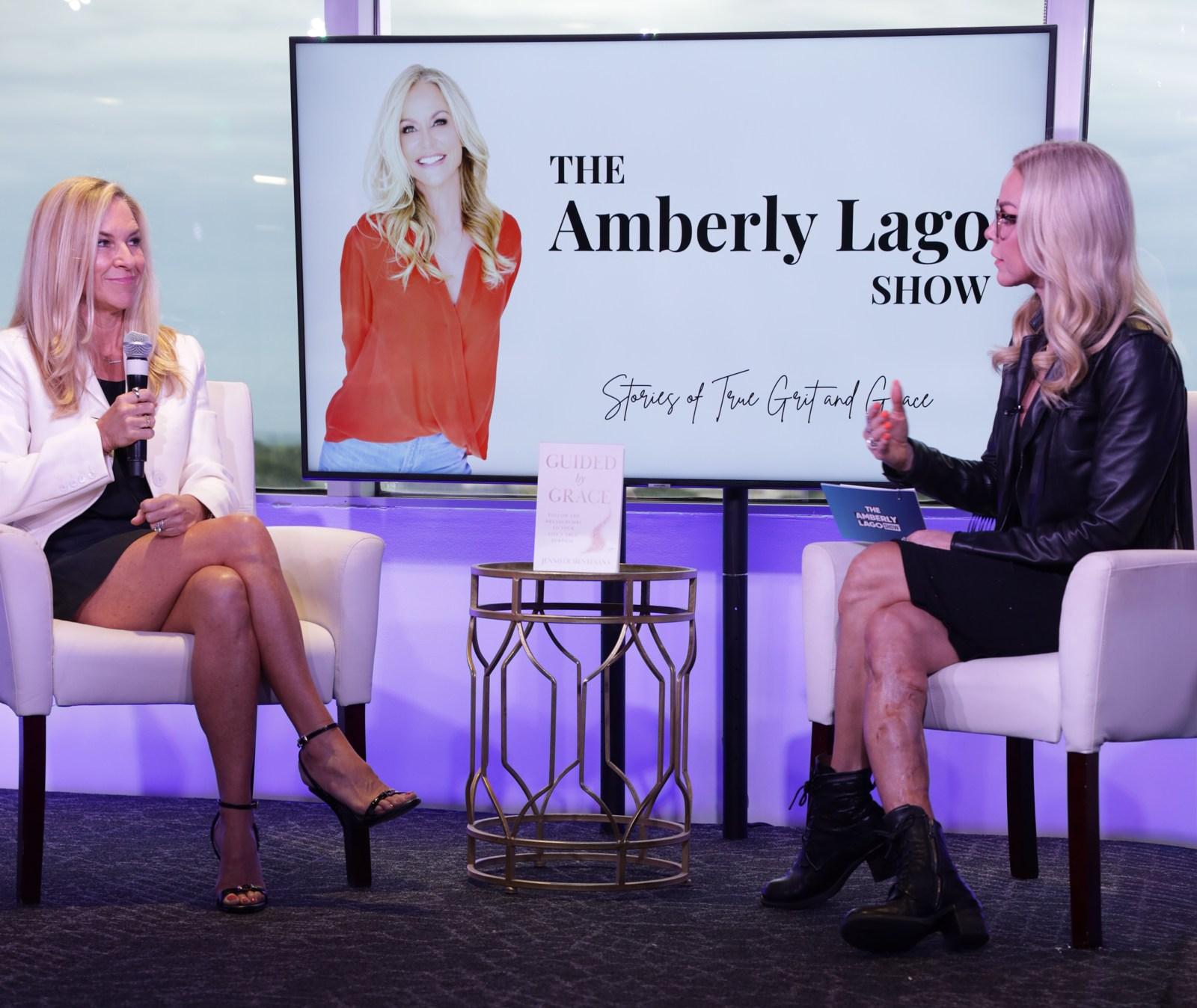
Season 5, Episode 212
Finding Purpose and Healing with Kimberly Shannon Murphy
A conversation with Kimberly Shannon Murphy

About This Episode
"I think forgiveness is is a great thing. And I've forgiven a lot of people in my life. But I also think that there are some things that are not forgivable."
In this episode of True Grit and Grace, host Amberly interviews Kimberly Shannon Murphy, an award-winning stunt woman and author of the book "Glimmer." Kimberly shares her inspiring story of survival, hope, and healing, discussing her experiences as a stunt double for Hollywood stars like Angelina Jolie and Cameron Diaz. The conversation dives into the cathartic nature of writing about past abuse and the ongoing journey of self-healing. Tune in to hear Kimberly's powerful story and the positive impact she is making in the world.
Kimberly Shannon Murphy is Hollywood's go to Stunt Double for Premier Silver Screen actresses.
Notes:
- [00:02:01] Triggers and healing progress.
- [00:04:16] Dysfunctional family dynamics.
- [00:13:40] The importance of speaking out.
- [00:22:02] Healing through trauma work.
- [00:34:36] Self-harm and seeking help.
Links mentioned in this episode:
- Glimmer the book
Follow Kimberly
If you are ready to leave your mark by discovering your message and sharing it with the world, you've come to the right place!! Let's work together to build your influence, your impact, and your income! Join the tribe you have been waiting for to activate your highest potential and live the life you deserve! Join the "Unstoppable Life Mastermind!" and let us know you are ready for greatness! Read the "True Grit and Grace" book here and learn how you can turn tragedy into triumph! Thank you for joining us on the True, Grit, & Grace Podcast! If you find value in today's episode, don't forget to share the show with your friends and tap that subscribe button so you don't miss an episode! You can also head over to amberlylago.com to join my newsletter and access free downloadable resources that can help you elevate your life, business, and relationships! Want to see the behind-the-scenes and keep the conversation going? Head over to Instagram @amberlylagomotivation! Audible @True-Grit-and-Grace-Audiobook Website @amberlylago.com Instagram @amberlylagomotivation Facebook @AmberlyLagoSpeaker
Full Transcript
Hey there. I'm so excited to announce the Unstoppable Success summit is back, y'. All. We are going to be in Dallas April 19th and 20th, and I want to see you there. Don't miss out on this opportunity to gain valuable insights and make valuable connections and leave with actionable takeaways so you can implement all of these things into your career and level up your life and your business. I've got Ben Newman, Rachel Luna, John Gordon, Rudy Rickstein. I've got a panel of speakers that specialize on publishing, pr, branding, podcasting, and TED talks. And so if you are ready to level up, if you're like, I've got a message to share and I really want to increase my influence. It's time to kick the limiting beliefs to the curb. It's time to move forward past your fear. It's time for you to invest in you to bet on yourself. So I want to see you in Dallas. It's my hometown and I'm gonna make it, y'.
All.
I'm planning some big stuff. Okay? It's gonna be fun. My event planner keeps saying, amberly, you need to reel it in. I'm like, no. In. In Texas, we say go big or go home. So go to go.amberly lago.com that link will also be in the show notes to grab your early bird ticket. The early bird tickets will only last for a certain time and There are only 100, so these tickets will go fast. You're the first to know about it. I want to see in Dallas, so hopefully I will see you there to hug your neck and let's be unstoppable together. Okay, now on to the show. Thank you for tuning in to the True Grit and Grace podcast. I'm Amberly Lago and I'll be sharing inspirational stories of resilience and empowering ideas to elevate your business and your life, ignite your passion, and fuel your purpose. Hey, it's Amberly. Thank you so much for tuning in to True Grit and Grace. I have Incredible lady, an inspiring story. I have her book right here. It's called Glimmer. It's a a story of survival, hope, and healing. It's Kimberly. Shannon Murphy is with us, y'. All. If you've seen any, like, big time Hollywood movies, you've probably seen Kimberly because she is an award winning stunt woman. She's like, been a stunt. I think you filled in for Angelina Jolie, Cameron Diaz, who's one of your good friends and who wrote the forward for your book. But so many TV shows. Over a hundred TV shows and films. And today we're going to talk about her survival story and what she's doing to really change the world in such a positive way. So, Kimberly, thank you so much for being on the show.
Thank you for having me.
Oh, I. Your book was incredible. So I just. Thank you for sending your book and the paintbrush.
I love that, too.
Your book really touched me because as we were talking right before we started recording, because I was sexually abused, too, and it was very cathartic for me to write about it. I thought I'd done all the healing. You know, I'm like, okay, I'm. I've done the therapy. I've healed from this. Did you find that you healed even more, that your book was cathartic when you wrote about the abuse?
Pretty much the same thing you're saying. I felt like, you know, my book was kind of like my crescendo because I had healed and I had spent my whole life doing the therapy. And then when I started writing, I was like, oh, gosh, I have so much more work to do on myself. So I feel like it, as cathartic as it was, it also brought up so much more that I needed to work on for me.
Yeah, it did for me, too. I was like, wow. And I wanted to ask you this before I would. Look, I'm going to get into questions so our listeners can kind of understand the why you wrote the book and what you went through and all the healing work you've done. But I wanted to ask something like, I'm always surprised sometimes when I get triggered and I'm like, dang it, what. What is wrong with me? You know, I thought I healed. I thought I did the work and something happens and I get triggered. Do you still sometimes get triggered with things or you. Is that pretty much gone?
No. I'd say at least a few times a week, if not sometimes. Every day, depending. I think the difference now is that I recognize it.
Yeah.
Where before, it was just something that I would get. You know, you get triggered and you get angry or you get upset or whatever the feeling is that comes with that trigger where now I can step back and recognize, okay, Kim, you're being triggered. What about this situation triggered you. So I'm dissecting it in a different way instead of just reacting, which I guess is a good thing. But it's a. It's a. I think when you've had the level of trauma that I have, and. And when you have had sexual abuse, in your life, especially when it's a family member. I, I think it's something that you're just going to be dealing with forever in different ways, in different planes, on different levels. But I don't think it's something that just goes away.
And you know what? Just by you sharing that, I mean, makes me feel better knowing that I'm not alone in that. In your book, you were, you know, you wrote about. Or maybe it was one of your interviews. I've been stalking you, by the way. Just. But, but you had said, you had said that as you were going through the abuse, you felt like you were the only one that no one under could ever understand or had. You feel like you're the only one very alone. And I felt that way, too. So can you take us back to the time when the abuse started, which I am just blown away when I read this in the book?
Yeah, I was, I, I think about three. That's when my earliest memory was, and it was my mother's father, my maternal grandfather. And, you know, we sort of lived in this bubble of dysfunction. I would say on the highest degree. My grandfather was extremely successful, he made good money, and my family was all affected by him in some way, shape or form. And my grandmother was a complete narcissist and.
Wait, your grandmother?
My grandmother. His wife, yes.
And your dad, too, right?
And my dad. Yes, my dad. I think they all kind of find each other, you know, all the dysfunctions sort of find each other. And my grandmother knew what was happening and a lot of adults knew what was going on and no one did anything about it. And I think when you are in that family dynamic and you're so young, it's just what you think is normal, but you also know it's wrong. And I just felt like this was my normal, but I also felt like there is no way that this is the normal, but that was my normal, if that makes sense. So. So it made me feel lonely in the sense of. I didn't think any other family was operating this way. And, you know, most families aren't. So, yes, it is very. It's a very lonely thing. And especially when your abuser, you know, you're terrified of them because you're so young. I was terrified of him. He was very scary, and I felt like I couldn't talk to anybody. And it. That's a very scary place to be.
Well, that. And, you know, you look, when you're, when you're that young, you look to adults for, for safety, for security, that you can trust them, that they're going to protect you. And did you ever feel safe in your home?
No. No.
Where did your grandfather live? Did y' all all live together, or did he live somewhere else? And you just saw him for the holidays.
He lived, like, 15 minutes away. We probably saw them three to four times a week. He was in our life. My mother was very close to him. But, you know, he also abused her her whole life. So it was a very. It was a very painful childhood. Very confusing, Very painful. I. Sometimes I'm like, I can't believe I got out or just even got to the other side of all of it, you know, and have a normal, somewhat normal life. Because when you really look at everything that happened, it is. It is kind of amazing. I feel like there's a certain type of person that's able to pull themselves out of that, and I don't think it's many people. I think a lot of people, when they've had this type of trauma, just, you know, go down the wrong road, of course, because, you know, you're trying to do something with all this pain you have.
What do you think it was in you that. Because I. I totally agree here. My brothers and I, we were raised in the same household. I have a somewhat, I guess, normal life. I've kind of come out of the other side. Not that I don't have. It's not perfect by any means. And I still struggle sometimes a lot. But, you know, my brother sits on death row in Texas and he never. Yeah, it's.
It's.
You can easily go into addiction or binge eating or all kinds of bad stuff. What do you think it was in you that you had that glimmer? And you always had that glimmer of hope of just getting through the other side. What do you think? Where do you think that came from?
I don't know. But I will say that from a young age, I felt always that there was something inside of me that always felt like I was meant for something and I was going to do something with everything that had happened to me. And I always had that, like, inside of me. I think also, being a dancer and being an athlete saved me in a major way. It is an Extremely. And Dr. Perry, I don't know if you're familiar with his work. He's not really, like, in the social media realm, but he wrote a book called what happened to you with Oprah Winfrey.
I haven't read that. I've got to read that.
Yeah, he's incredible. And he endorsed my book. And I had many conversations with him before it was published. And his. His thing that he said to me was, you. You were using positive coping mechanisms through your childhood and your early adulthood, probably without even realizing it, you know, like, you know, dance and movement. And so I think I just went to a positive route, thank God. But then also, as you read in the book, I did have negative coping mechanisms that I was doing as well, like cutting and bulimia, which, you know, are not good, but they're also not, you know, heroin. So, yeah, I think, like walking the line, you know what I mean? Without crossing over completely to the dark side, I would say.
Yeah, I mean, I completely agree that, you know, I think dance and athleticism is what pulled me through. And I. I was like, and I am out of here. As soon as I graduate from high school, I'm out of here. I am going to go to LA and make something of my life. And that was hard. When you don't have support or you don't have help or you don't feel protected or, you know, and I want to. Speaking of that. So your grandmother knew she didn't do anything about it. Your mom then walks in on what is going on and walked out.
Yeah.
How did you confront your mom about that? How old were you? Tell us how old you were when that happened.
I would say six.
Oh, my gosh. Now, let me tell you. I would be in. I'd be in jail probably. I'm sure I'd be in jail. If I. If I walked in and saw somebody hurting my child, I probably would. I would be in jail a hundred percent.
You know, that's a memory that I didn't have, ironically, until recently. And so it's not in the book. But I have spoken about it in interviews because I. And the reason I spoke about it is because I think that it tells you a lot about the power of grooming and the power that somebody can have over you. And my grandfather had that power over so many people. And I do feel like my mom had been disconnecting from her body for so long, from the time she was young and he was abusing her, that it was just another instance of her just disconnecting when that happened. It's not an excuse. And I've. You know, right now I'm honestly taking a very large break from my family. It's just been a really difficult time for me in that aspect, as I'm sure, you know, it's really hard to sort of try to look at everything for what it was and then be in relationship with the people that allowed it to occur. It's really. It's a really kind of like, whoa. It's. It's a hard. It's a hard one.
Now, were your sisters abused as well, or do they not talk about it?
We. I don't really. You know, I have three sisters. They're not all in the book, and they don't. It's not something that they're comfortable with me speaking about. And so I don't ever want to tell anybody else's story.
Yeah, that's hard, though. You know, like, when my stepfather. I was 23, when my mom found out that he sexually abused me. And I think it does change the whole. He didn't deny it, by the way, which was crazy. I thought all this time he would, but. But it was. It was hard. I don't know. You know, it's my. My half sister. It's her real dad. And it's been hard on the relationship, on the whole family dynamic, and it was really hard to write about it in my book. And it's just a small portion of my book, but it's in there. And I think out of all that I've written, it's one of the things that people have come up to me and said, thank you the most about. About writing, that they. They're like, I haven't ever told anybody about this. And I appreciate you sharing that because I've been walking around in shame. Have you had, for the most part, with people who have read your book, A lot of people who have come out and said, thank you for writing this book. You're telling my story. This is exactly what happened to me. Or everybody.
Yeah, everybody. And, you know, it's so interesting that you say that, because through the years, I was always very open about speaking about my abuse before I even wrote the book. And I would say, probably if I'm just going to do a ratio, If I had 10 people that I told, eight of them said to me, oh, my gosh, my neighbor, my brother, my cousin, my father, my mother. I never told anybody. You're the first person I'm telling because they felt safe that I shared my story with them. So it happens so much more than people talk about. And. Yeah, and I think that just having the conversation is so important for people that do feel exactly like you're saying that they've been walking around and holding this secret. And you can't start to heal it until you talk about it, until you vocalize it. I Mean, that's the first step, right? Is saying it out loud. And that can really have a huge effect on you for a long time, just dealing with the fact that you vocalized it, especially with abuse survivors, because part of the abuse is. Is. Is stifling our voice and keeping us quiet when we do say it. There's so much that, you know, we physically feel, mentally feel when we finally express the words.
Yeah. How old were you when you started to talk about it?
15.
15. Who was the first person you told about it?
My mom.
Your mom? And what happened when you told her?
She, you know, sort of ran out of the room. I just said, mom, I'm feeling like I'm having, like, flashbacks or I'm. I'm having these pictures. It was like, for me, like, pictures in my head of these horrific moments. And she ran out of the room, and she came back and she said, you're not going to school tomorrow. I'm taking you to my therapist. And I was like, you have a therapist? I didn't even know she was dealing with her memories and her things with her father at that time as well. And I had no idea. So I. You know, she said the same thing happened to me. And I said, who was it? Who was it? Because in the beginning, for me, I didn't really have a face to the person. I was very confused around that. And then I finally said to her, was it your dad? And she said, yes. And then that just kind of like, started the whole. The whole thing.
Did she hug you or say she was sorry, or was she very affectionate?
No.
No. Was she upset when you told her you were writing a book?
No, she was very supportive of it. And. And, you know, matter of fact, she's one of the first people, I think, in my acknowledgments. But I. I was shamed when I. I. You know, once I got my book deal, I started telling my family one by one, and I felt like I needed to, you know, state my case sort of for everyone. Like, I'm doing this. This is why. And I had to kind of be careful with how I spoke to everybody. And that was a really painful process for me. One of my sisters said, you're hurting me, and you're going to ruin all of our children's lives by what you're doing.
You are saving lives.
That's. That's how I've always felt. So, you know, when you're the one who's out there telling the truth, and you're the one who's standing up. And you're the one who has the strength to do so. It's amazing what people will do or say to keep that away and to
keep the truth and knock you down, knock you down, try to stop you, try to shut your mouth. I mean, and enough you're like, I am breaking this cycle. It's gone on for way too long. And now you have a daughter. She's eight years old. Is she eight?
Yeah. She's nine. Yeah.
And I. I think it was another interview that I listened to that you did, and you had a talk with her. You told her kind of what happened and why the. You weren't. You know, the family didn't. You aren't talking to the family and stuff. And I love that. She said, did he hurt your heart or did he hurt you with his hands or something like that?
Yeah, she said, did. Did he hurt your heart or did he hurt you with his hands? Is what she said. And I said, both. And it was just really in that moment that I realized we had a situation that happened, that she was excluded out of something with her cousins. And it was a moment that broke my heart for her because she was beside herself and crying and just putting it all on her. Like, what did I do, Mommy? I love them. Like, why would they not include me? And, you know, I had to just let her know that this is something that's been in my family for way before she was here. It has nothing to do with her. And that's really hard for her to rationalize in her brain because she just sees the situation and sees that she wasn't invited. And for her, she's just like, it must be me. They must not like me. It must. You know, when I kind of said to her, in the best way possible with my husband, it was just so beautiful just to see how her brain just kind of, you know, took it in. And. And she just hugged me and said she was so sorry, and she loved me, and that was it, and we just kind of moved on. And it's funny, she said to me the other night when I was putting her to bed, she said, mommy, I know that it's hard for you with your family right now. And she said, but she said, mommy, you know that. And I've never said the word generation, like generations to her. She said, but, Mommy, I'm the new generation. Oh, she's very connected. And I said, yes, Capri, you are. And she said, and this is what you're supposed to do.
Wow. She's an old soul.
She's an old soul. Yeah.
Yeah. And I love that you have been an example for her to speak her truth. And in fact, you said the truth is so easy. Why don't we say it more?
Yes.
Which. Why do you feel like it's so hard for people to say the truth sometimes? Is it fear?
I think it's fear. I think it's shame. I think a lot of people think that if I go there or if I. If I. If I speak the truth and I sort of am living in that way, I'll never come back from it. When they don't realize that they've already been through the worst and that the other side and living in your truth is. Is so healing and so necessary if you don't want to live in your triggers. Like, I. I see it with people all the time. It's like when you don't heal your trauma, especially when you're a parent, then you're just living in your triggers so you're not able to recognize. Like you were saying before, if you get triggered, you can, you know, oh, go, gosh, where is this coming from? And you can look at it and deal with it instead of just, you know, getting triggered and then just letting it sort of take you into this whole, like, abyss of anger or fear or shame. And then you're taking it out on your kids and you're letting them, you know, take that. Those feelings that have nothing to do with them.
Yeah. Well, what are some of the things that. When you decided, okay, enough is enough, you were 15 years old, you told your mom you went to therapy. Did that therapist help you?
No, no, it was my mom's therapist. So I then soon left her and went to my own therapist. And she was very helpful to me. She definitely got me through high school and just. It was just somewhere where I can go and talk. And that was very helpful.
Yeah, that's just to. To be heard and invalidated and seen. I mean, I think that's. We all want to be seen, heard, and understood. So I'm glad you, the therapist. Are there books that you read that helped you as well?
I feel like I didn't really start doing that work until, I will say, until I met Gabor, you know, through my writing of the book. And being able to get connected with all of those trauma therapists for me was life changing. I've done so much work with internal family systems, which was incredible for me, and I did a lot of psychedelic work, which really. Other level of healing for me, which was terrifying. And I wasn't going to actually do it. And it's changed my life. Like, it's completely rewired my brain.
That is wild. I have heard of that before, but, yeah, that is wild. But it rewired your brain, huh?
Completely, yes.
Wow.
It made me look at things for what they actually were instead of trying to protect myself from looking at those things. So I think the biggest piece for my healing was that I needed to look at my entire family for my whole life. I just looked at my grandfather and I obviously hated him, blamed him for everything that happened to me because he is to blame for everything that happened to me. But I wasn't looking at all of the adults in my life that stood by and didn't. And a lot of had a lot of information about my grandfather. Like, he had done things through the year, of course, because he was who he was, that were major red flags that nobody spoke out about. And if they did, it would have changed my life, you know, so it really made me look at everybody and the participation that each person had in my abuse.
Yeah, you have a. I love your Instagram, by the way, all the quotes that you have and everything. And he says, one of your quotes says, addiction doesn't run in family, trauma does. And you were really. Your life could have been changed if one adult would have just said, seen what was going on, like, taking the blinders off, acknowledged, hey, something is not right because this abuse happened. It wasn't like, I mean, it happened right underneath their nose. It would happen at a holiday. Or. I just. There's. When you talk about the abuse, you're in your beautiful white dress and your cross around your neck and your grandfather's there, and it's like that happened. Do you ever think, why didn't anybody do anything or say. And did they see it and not say, well, I know your mom obviously did, but do you think there were other adults? Like, do you think your dad knew and didn't do anything?
I think that being oblivious to something like that and knowing something like that is happening is just equally as bad to me. There's no way that I would be at a Christmas function and not know where my daughter is for any period of time, ever.
Especially for, like, more than a couple of minutes to use the bathroom or something.
Never. It just wouldn't happen. I know where she is at all times. So there were people through the years that I've spoken, spoke to my aunt's partner. She then told me one Christmas, my grandfather, they were staying there over the weekend, and my Grandfather tried to get in the shower with her. And, you know, my question to her was like, why? Why didn't you say anything to anybody? I mean, how are there this many adults around? Because my. A big family, and so we were all, you know, celebrating together always. It wasn't so. So it's still. It's still beyond me how so many adults were around and nobody knew what was going on. So it makes me just think that either they were just drinking and completely oblivious or knew that something was going on with my grandfather and chose not to look at it because there is no other answer.
Yeah. And so you have really just broken that cycle. You had a lot of people comment and kind of disagree, and you had some life coaches disagree because you had written that you don't need to forgive to heal.
Yeah.
Did. Were people saying to you that. That you have to forgive in order to heal? Is that what it was?
Well, I did a podcast early on and I, you know, it's funny and I'm sure you feel this way too. Like you'll watch your interviews back sometimes and you're like, you know, I'm like, oh, geez, Kim, you're so angry. You like, that's coming again. Like you're triggered. And it came from such an angry space. And it was one of my first podcasts and it was a bigger one. And I said. I actually said, I think forgiveness is a crock of shit. Which wasn't probably the best way for me to articulate myself. Well, I like it.
We keep it real here. So I like that.
I was like, oh, gosh, Kim. And then, you know, they take the clip and they put it out there, and it's just that, you know, 15 second clip. And then you, you look like I looked really angry. And so I wasn't very happy with the whole situation. And yes, then I got flooded with, you need to forgive. You need. And. And you know, it's interesting that people put judgment or shame around the forgiveness thing. I think forgiveness is. Is a great thing, and I've forgiven a lot of people in my life, but I also think that there are some things that are not forgivable. And I think when we put the shame around it for people that have had severe trauma, it just adds another unnecessary layer to it. I don't need to forgive my grandfather. There is nothing that he contributed to my life that was anything positive or loving at any time. And matter of fact, Dr. Imani, who I spoke to about this as well, she has a book coming out, and I think it's called. It's not you. And there is, like, actual science to the whole forgiveness thing, which made me feel better. And it's basically that if you keep forgiving somebody who is causing you pain, it's actually bad for your mental health. And if you think about it, it makes perfect sense. Like, if someone's hurting you over and over, and you keep saying, that's okay, that's okay. You're not protecting yourself. You're just allowing that to continue in your life. So I think we need to look at forgiveness a little bit, like, clearer and especially know that it's not like somebody, you know, crashed my car or, you know, did something very minimal that you, of course, can forgive someone for. We're talking about something much deeper and darker than that. And I don't. I don't think that I need to forgive him to. To heal, because I'm healing, and I haven't. I don't plan on ever forgiving him for it.
Yeah. Tell me how you felt when he passed away.
That's when my eating disorder started.
Really? How old were you?
I was 11.
You were 11 when he passed, and then you start. Did you. Were. Did you become bulimic or anorexic eating?
I stopped eating.
Wow.
I don't think I ate for a week after he died. I'm sure I did, like, here and there, but I remember, like, starving my body, and I remember feeling really good. Like, it felt like for the first time, I had control over something.
Wow. Because that's what that is. Like anorexia. Bulimia is when you want to be in control. Like, you're. You're feeling out of control, and you want to grasp some sort of control. So did your mom, dad, sisters, anybody go, oh, my goodness, like, Kimberly, you are. You're withering away. You're so thin. Did they notice that you weren't eating?
I was so skinny. In just my life in general, I was really, really skinny. So it wasn't like. I think I stopped eating for about a week, and then I started eating again. It was it for me. My eating disorder came and went. It wasn't anything that I ever did for food, meaning I didn't do it because I thought I was heavy. Ever. When it carried on into my 20s and I was more bulimic than. I just did it as a control thing, so I wasn't doing it every day, but I would binge and purge mostly when I would have a memory because I would get, like, physically ill. And so that I did to Just, like, get it out of me. So it was more, like I said, a control thing and more. It's like I had a memory. I would just eat a ton and just puke. So it wasn't like it ever was a weight thing for me.
Yeah, it was almost like you wanted to stuff it down and then purge it out.
Exactly.
And now how did you heal from the eating disorders?
I think they still sort of live in my brain. I don't know that you ever fully get through that. I don't throw up anymore. Matter of fact, interestingly enough, I said to my husband, for years, every Christmas, every Easter, every Thanksgiving, I would puke. And I think it was more just attached to me being around my family, to be honest. And then the last two years, I've gone holidays without seeing my family, and they're the first two years of my life that I haven't grown up.
Wow. Now, do they live in Los Angeles as well?
No, some of them live in California. Some live in New York.
And I think it's, you know, to create those boundaries and to not see the people who you're. Like, they might be your family, but that doesn't mean that. That you're gonna have to see them. What would you do? You ever plan on seeing them again or doing family holidays with them?
No. Definitely. I mean, we're just not speaking to each other anymore. I think the truth. I think the idea of the book, for the people that were supportive of it, was. Was great. I was going to write this book, and then I think as the interview started spilling out, it got harder and harder for people, and everyone has slowly just fallen off, you know, for other. For other reasons. But I know that that's the actual root reason. And if, you know, if I, you know, feel like if they ever get to a space where they're doing the work and are wanting to really look at things, absolutely. I. I would never write anybody off in that way. I'm a very loving person, and. But just right now, for me, it's just not healthy. Yeah.
Well, I. In the beginning of your book, you talk about being hurt. I mean, as a stunt person, a stunt woman you like with your stunt double for Angelina Jolie, Cameron Diaz, you do some crazy stuff, bust through glass, fight scenes, all kinds of stuff. And even. Did you end up riding the motorcycle for that one movie?
Yes.
Yeah. That's so cool. But you got hurt. You had, like, glass stuck in your face, and it was some sort of validation that people could see that you were hurt on the outside. When you had been trying to get validation for hurting so badly on the inside.
Yes.
Was that like a red flag? Like, oh, something's got to change. I got. Maybe I need to get some therapy?
Yes. Hugely. And I realized, too, in that moment or now I realize that, you know, I was a cutter. And a lot of people, I think that our cutters will cut where no one can see. They do it for themselves. For me, I did it on my face.
You did it on your face?
Yeah. And I didn't do, like, really severe cuts. I did very, like, on the surface, and I would use, like, a razor. And it was just because I wanted my mom to notice that I cut my face. Like, I just wanted to be like, kim, are you okay? And I did that through high school.
And I ever notice. Did anybody ever notice that you had cuts on your face?
No.
Oh, my gosh.
Like, I said, they. I would do it over my eyebrow. They were very, you know, nothing. Like, I never. I never, like, went deep or anything, but they were enough to, like, scab over. And I was just doing all these things to cry out. Like, even when I would throw up at home, I never closed the door.
No way.
Yeah. It was like I was doing everything
for just anyone screaming for help.
Yeah.
Oh, my goodness. You know, it takes so much courage to finally share what you're. What you're going through. Did your dad believe you when he found out?
Not when I first told him. He'll tell you that he did, which is why we have a really difficult time. He'll say, I've always believed you. But he didn't. And he. You know, I think he couldn't. He couldn't look at that, because if he did, he would have to look at the fact that he completely failed his parent. But my mom, you know, I told him, kim, Kim's having these memories. And he was like, no way. This couldn't have happened to her. She must have read one of your books, is what he said. And it wasn't until I was in my 20s where other people started coming forward about my grandfather, where he. His. He had written a confession letter as well, my grandfather. So when that all came out, then my father believed me.
Wow. And now that you have a book, and now that you have. You won so many awards as a stunt woman and all these things, did they kind of go, oh, I always knew you'd make something of yourself, or I always. Because I always knew you'd be somebody. Have your parents ever said they were proud of you for all you're done. You've done.
My mom was always proud of me, and she was always my biggest fan, for sure. My father put me down every step of the way, of my dance career, of my. You know, like, then I was breakdancing and I was in a company, and then I was doing acrobatics, and he always put me down. Like, you're ne. That's. You're never going to be able to support yourself. Like, this is no way to live your life kind of thing. Until I was on television,
I totally understand that. I'll never forget that people, friends and stuff would be like, oh, you, good luck. You think you're going to be a professional dancer. And then a month later, they saw me in an MC Hammer video, and they're like, I always knew you could do it. I'd always knew you could make it. You know what I mean? But, yeah, crazy.
And. And, you know, all of my dad's friends would say, he's so proud of you. He's. So I said, well, where was he when I was, like, knuckling my way to the top, so to speak? And that it wasn't accepted until it's like, oh, there's my daughter on television, or here's my daughter doubling this person or this person. So, you know, it's. I don't feel very like, I don't really accept that because you're just proud of me when I've made it in your eyes, which doesn't really work for me.
Yeah. Well, how did you get into doing stunts? I almost did. There was some shark movie that I was going to be a stunt double for, but then I read it and I had to strip down to, like, my underwear and bra. And I was like, oh, I can't do that. Oh, my gosh, no way. I can't do that. And, like, it would have looked like a bathing suit. Like, I should have done it. It would have probably been fun. You know, I saw the movie after,
I was like, well, yeah, I could
have done that, you know, but how did you get into stunts from dance into stunts?
A lot of my friends, because we were. I was an acropat at the time, and we were kind of traveling the world and with a company called Anti Gravity, which was similar to Cirque du Soleil. So I did silk and all of that, and a lot of my friends were getting into stunts, and they were like, you should send your stuff to the coordinators in New York. And I didn't really know what it was. And I had sent My stuff to George Aguilar, who at that time was not. Still is one of the biggest coordinators in New York. And he called me like, a week later.
Wow. Because how tall are you?
I'm 59.
You're five' nine.
So tall too, right?
Yeah, I'm five' ten. I used to be five' eleven, but I shrunk. I gotta start sitting up taller. But you're, like, perfect stunt double for Angelina Jolie and Cameron Diaz. And now did you meet Cameron on set or before that?
Yes, I met her on what Happens in Vegas in 2007. I think we did that film. Yeah.
Yeah. And what's the hardest stunt you've ever done?
I mean, every, like, big thing I have done has been a challenge in its own way, you know, so. Yeah.
Do you ever get scared?
No, because we really rehearse everything really well. It's not like we show up to work and we're doing this crazy thing, and they're like, okay, get up there. Three, two, one, action. It's like, when we do the bigger things, they're really well rehearsed. So of course, things can go wrong, like in the first scene of the book. And there are those situations, but they don't happen often. And so, no, I don't really get scared. If there's something I'm scared of, I wouldn't do it, because I think that when you're scared, going into a stunt is when you do actually get hurt.
I couldn't agree more. I just played in this celebrity softball tournament to support veterans, to raise money for veterans, and I do not know how to play softball. I was there to, like, support. They had me on second base, and I was like, oh, my gosh. These. With pro players, like, I mean, the pitcher for the Rangers was there a Dallas Cowboy, These huge athletes that take it very seriously. And I was like, you're putting me on second base? I was terrified. And I went to the coach and I was like, hey, think we better rethink this? I said, I think you should. I. I appreciate your confidence in me, but we need to get one of these professional athletes the second base. Not me. I said, I'll go up to bat, but that is it. Because I do think if you're in a lot of fear about something, that that is when something could go wrong. So I completely agree about that. So are you still doing stunts?
We're on strike right now, but.
Oh, it's still on strike, huh?
On strike. I know it's crazy, but, yeah, I'll still Do things. And yeah, I'll still. My husband directs now, so I'll work for him a lot. But, yeah, I still work. Yeah.
That's awesome. That. Because you can understand each other. Like, what that whole world. You know what I mean? Do you know the Cadientes I used to train? You do? Yeah, Yeah, I used to train Terry Catiente. She was.
Oh, my God.
And I would get her ready for. Because I was a fitness trainer for 26 years, and I would get her ready for her, like, next TV show or film where she was a stunt double. Haven't seen her in years. But they were. I know they were really big in the industry. Yeah, yeah. For stunts. So right now you're on strike. Were you working on anything in the middle of anything when they. You went on strike?
Well, the book kind of has take. You know, the book came out in May, and so I've been just doing promotions for that. And my husband was doing Twisters too. They're doing a second Twisters. So I was out there a little bit, and then my daughter's in it. So that was just really. She has a small role, but. Yes.
That is so cool. She must think that you are like a superhero. I mean.
No, not. Not impressed by me at all. No, she's not. She's like, I. I double Taylor Swift quite a few times. So for her, that's like the thing that makes me cool. But that's it.
That is hilarious. That's how my daughter is like. I will just get off the stage, speaking at this huge event in front of thousands, and you just like, you're on top of the world. You're like, oh, my gosh. That was, like, amazing to get to be able to do that. And I've gotten off stage before, and my husband will be like, yeah, you need to get home because the dog is not eating. And, oh, by the way, she pooped in your office or, you know, whatever.
It's like.
Like, they don't care about any of that. You know, they're just like, yeah, get home. Like, when are you coming home? And, yeah, I did your laundry for you. You know what I mean?
You're welcome.
Yeah, yeah. Well, so what is next for you?
I really. I want to make this book a film. That's my next.
Oh, yeah. That is good. That is good. And you have the connections there and Hollywood to do that.
Yeah, yeah. Fingers crossed. There is a producer who's interested in it. So, yeah, we have to write the screenplay and then. Yeah, so that's what I'm crossing my fingers and I'm, you know, manifesting right now.
Yeah, I love that one part of the book. I mean, I've highlighted so many parts in the book. But y' all get this book. Especially if you want that glimmer of hope and you want to. You want to thrive, you want to heal, get glimmer. It's the story of survival, hope, and healing. Let me hold it up one more time. If you're watching on YouTube, you can see it and go ahead. And you know what? Tag me at Amberly Lago Motivation. And Kimberly, yours is Kimberly Shannon Murphy on Instagram Stunts.
Yes. Like the longest handler on the planet.
But you know what? You just. You just, like, look up Kimberly Shannon Murphy and it comes up. So, like, take a screenshot. Whether you're listening on Apple or Spotify or. Or YouTube, take a screenshot and tag us at Kimberly Shannon Murphy stunts and Amberly Logo Motivation. When I see that, I share that in my story. And tell us where the easiest place for people to grab your book.
The easiest is Amazon. Really. I mean, because everyone's just. You can do two clicks and it's at your house the next day. So.
Yeah, yeah, for sure. And then tell everybody the. The best place to find you any upcoming events or any upcoming TV shows that we can look for. Would that be your website?
Honestly, my Instagram is where I sort of do everything, so that's the best space for it. And we're doing a book signing on December 11th in Santa Monica. My first one, so, yeah.
Oh, it's your first one?
I haven't done, like, a signing. No, because I've been doing so many interviews and so many podcasts, so I haven't. I wanted the book to gain some traction before I did a signing because I'm not, you know, known to write books, so I wanted it to get some traction first. Yeah.
So where is it in Santa Monica?
It's at Zibby's bookstore. Okay.
I think I saw that on your social media.
Yeah, yeah, yeah. So it's on my social media and I'll post closer to the date.
So, yeah, that's so cool. If I. I'm going to be in Costa Rica at that time, or else I would go, yeah, I'm gonna go. I'm gonna. I'm gonna do it. My husband thinks I'm kind of crazy for doing it, but I'm trying stem cell, so we'll see. Oh, good for you.
In your life.
Yeah, in my leg. I'm going to see if it helps with the crps.
I heard it does.
Really? Wow. Well, I'm crossing my fingers, but I'm just so. Thank you so much for taking the time to be on the show. I've so been looking forward to having you on, and I love everything that you share on your social media. You have such great quotes, y'.
All.
Check her out at. Again, Kimberly. Shannon Murphy, stunts. And thank you again for being on. Thank y' all for tuning in. And go ahead, subscribe to the show so you don't miss next week's episode. But, Kimberly, thank you again. And thank y' all for listening. I'll see you next week.
Pain to purpose to joy.
Never Miss a Conversation
New episodes drop regularly. Subscribe on your favorite platform and never miss a conversation.