

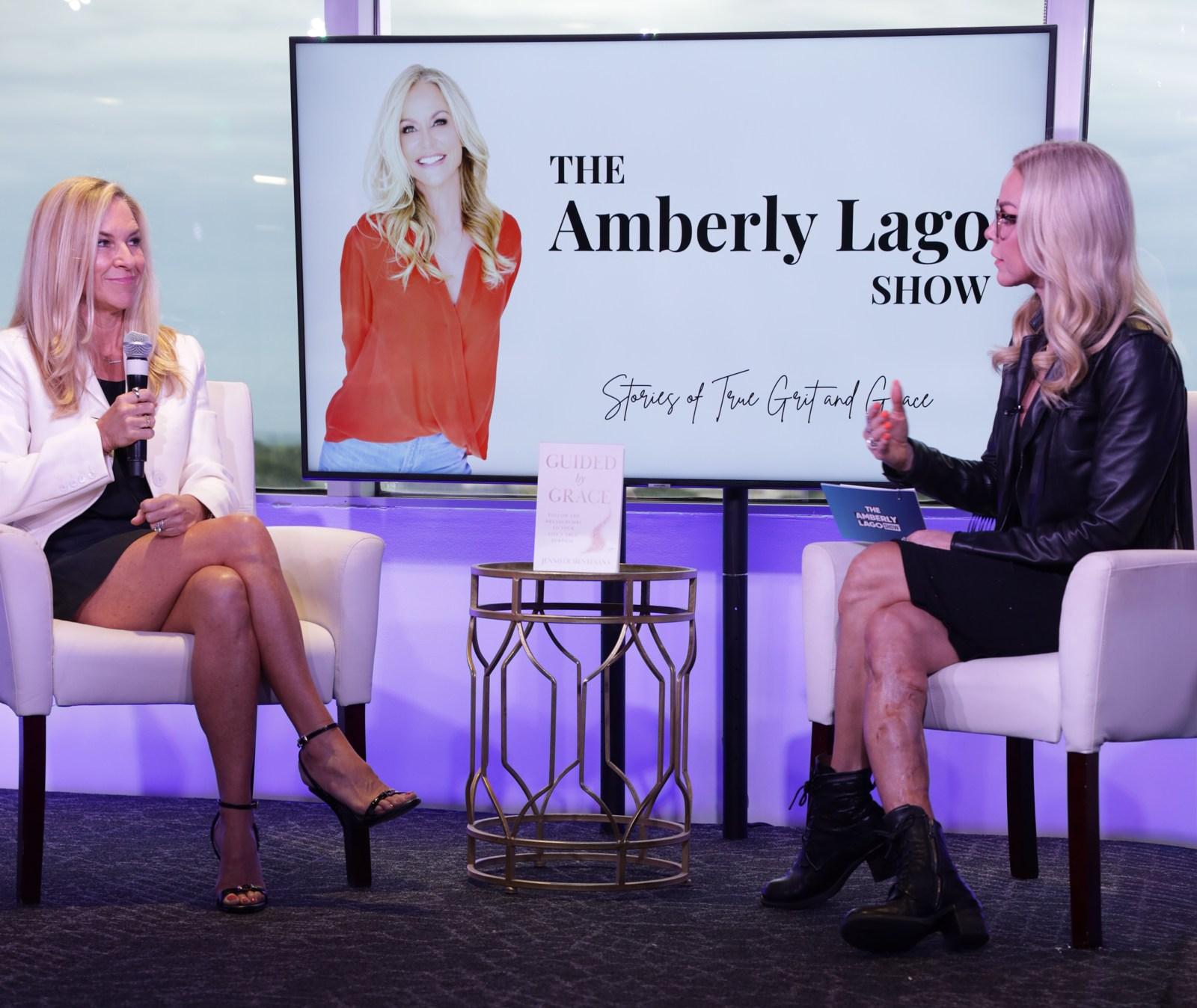
Season 2, Episode 110
Claim Your Calling and Abundance with Cathy Heller
A conversation with Cathy Heller

About This Episode
"If you're reading this, I DARE you to dedicate the next 6 months to just doing you. Choose authenticity vs being liked by everyone. Try more ease, more fun & more rest. You'll increase your productivity and your revenue by 200%." If you're ready to build your own business or want to expand the one you already have, I can't wait for you to listen to this week's episode with legendary Cathy Heller!
Cathy Heller is an abundance expert and intuitive coach who specializes in helping women create wealth and next level happiness. She has grown an 8 figure business and hosts a top-ranking podcast with over 25 million downloads where she has interviewed incredible souls like Matthew McConaughey, Seth Godin, Gay Hendricks, and more. As the creator and host of "Don't Keep Your Day Job," she is growing one of the biggest, most engaged audiences in podcasting. Prior to her podcast, Cathy handcrafted a career as a songwriter, licensing her music to film/TV and advertising. She is now showing others how they can finally manifest more of what they truly desire through her courses, retreats, and her "Lit Up" community.
Here's what you will learn:
- How Cathy began pursuing her dreams in LA at age 23 and how writing music has fulfilled her (2:32)
- How to step into the energetic of abundance and start thriving in your life and business(10:21)
- How to use Cathy's passion finder quiz to find yourself and your purpose (19:21)
- The importance of feedback in building out your idea (26:34)
- What we can do to get out of the dips and low points in our lives (34:57)
- How being authentically you is your superpower (42:15)
- Normalizing women making millions (48:37)
Screenshot your favorite part and post to your IG story and tag me @amberlylagomotivation and @cathy.heller so we can see and repost to our stories!
Follow Cathy
Links mentioned in this episode:
If you are ready to leave your mark by discovering your message and sharing it with the world, you've come to the right place!! Let's work together to build your influence, your impact, and your income! Join the tribe you have been waiting for to activate your highest potential and live the life you deserve! Another Your Unstoppable Life Mastermind is starting soon!!! Early bird countdown starts now! JOIN NOW and let us know you are ready for greatness!
Read the "True Grit and Grace" book here and learn how you can turn tragedy into triumph!
Thank you for joining us on the True, Grit, & Grace Podcast! If you find value in today's episode, don't forget to share the show with your friends and tap that subscribe button so you don't miss an episode!
You can also head over to amberlylago.com to join my newsletter and access free downloadable resources that can help you elevate your life, business, and relationships!
Want to see the behind the scenes and keep the conversation going? Head over to Instagram @amberlylagomotivation!
Audible @True-Grit-and-Grace-Audiobook
Full Transcript
Welcome to True Grit and Grace, a podcast designed to empower you to claim your resilience and thrive through life's challenges. I am Amberly Lago, a mindset coach, fitness expert, and best selling author. Each week, I'll dive deep with the world's brightest leaders and elite performers to share tangible tools and practical advice to inspire you to keep your eyes on the prize and forge ahead. So get ready to conquer your fears, heal any trauma, lead with your heart, and elevate your life with grit and grace.
Hello and thank y' all for tuning in. I have a guest on the show today who we have been so seriously trying to make this happen for like a year. And so I'm so excited to have Kathy Heller with us here today. She is a brilliant businesswoman and entrepreneur. She's the author of don't keep your day job. How to turn your passion into your career. She's got a podcast. Oh, there's that book if y' all are watching on YouTube, y'. All. She's got a podcast called Don't Keep youp Day Job and It's got over 22 million downloads. She's brilliant at what she does, but I love her because she's authentic. It shows that she cares. She wants to make a difference. She's really on a mission to help people find their dream path and find what lights their soul up and get paid for it. So, Kathy, thank you for being here. I'm so excited to see you. How are you?
I'm great. And you're so loving and welcoming and it's so fun to have these conversations. And I love that you've created this amazing community of people who really want to show up and take that next step. And that already says a lot if you're listening to this show because this is not the easy conversation to have. Right. A lot of times people just want to distract themselves and scroll their Instagram and bury their head in the sand. But you know that there's a reason you listen, because there's something inside of you that, you know you were made for more. And you're like, okay, so what is that? And I'm not going to look away anymore. I'm going to show up and figure it out and wake up to a life that feels so much more like me.
Yeah, well, you know, I loved digging deep into, like, some of your story and what you've accomplished and what you've done. And you had this. This passion and this drive. You're a singer, songwriter. Can you tell us, take us back A little bit so you can explain to people how you got to where you are. Because I think your story and your journey is so inspiring and it's so thinking out of the box. And some people give up on their dreams or they think, oh, well, I didn't get that job or I got fired or, and that's the end. So I'm just going to go back to my 9 to 5 and keep working. But you didn't do that. You moved to la. Well, you'll be back here soon and we'll have to meet in person and get coffee, I hope. But how old were you when you moved to LA and tell us about how you were pursuing your dreams here in LA.
Yeah, I moved there when I was 23. And I think a lot of people, we each have such courageous stories, right? Like, I think, you know, if you're listening to this, raise your hand if by the age of 11, you survived so much. You know, I think the answer is most people have an amazing story, we just don't all see it. And so everyone is podcast worthy. First of all, my story is, I think, also one of those stories that deserves to be told too, where I wanted something different than the life that I was being raised in. Growing up, my parents were not the model of happy people. They were unhappily married, they were unhappy in their own professions. There's a lot of anxiety, a lot of arguing. My dad was having an affair and eventually he left. And my mom completely hit rock bottom when that happened. They were both really, really unfulfilled. So that was something I just didn't want to be me. And the one thing I knew, we all are given these sort of like Hansel and Gretel breadcrumbs. And the one little breadcrumb was, oh, I don't know. When I'm a kid, the one thing that makes me happy is going in my room and writing songs or singing along with Carole King and doing a musical, a play, after school stay and doing a play. So I loved being on stage, I loved performing, I loved to sing. And so I was like, okay, I guess one day I'll get far from here and I'll get a record deal. And I came out to LA and I found out that those are not things that people are just giving away on the street corners. And the truth is that my music was okay. I don't think it was amazing. I think it was mediocre and I had to write better music. But the music eventually got better and then it got even Better. And that was a whole journey, right? Showing up at co writing sessions with songwriters who I knew were better than me, me and feeling so inept, but then sticking it out and then over time, writing better and better songs was such a rite of passage. And eventually, lo and behold, while I had all the day jobs after work, I was singing in clubs and trying to get myself into meetings. And I did, in fact, get a record deal. I got signed to Interscope. I was with Ron Fair at Sunset Sounds. Lady Gaga was recording Paparazzi, and I was like, oh, my gosh, this is actually happening. And about six weeks later, I was driving in my little blue Saab. I had this little Saab car. I don't even think they make Saabs anymore. And Ron calls me and he's like, are you driving? It sounds like you're in the car. Can you call me when you get home? And so I pulled over and got off the freeway and said, what's going on? And he said, jimmy Iovine isn't sure that we're going to sell these records, so we're going to drop you from the record label. And at that moment I thought, okay, so this is when I'm going to give everything up, because I'm. I'm everything people said that I was. I'm being impractical, I'm being irrational. I'm not being a realistic person, and I need to give up my dream and go get a real, quote, unquote, real job. And so There I was, 27, you know, at this point, I was like, oh, okay, gonna go get a real job. And so I tried everything. I worked in a real estate office, I worked in a casting office. I worked in an interior design firm. I worked for an oncologist doing his, like, philanthropy work.
That must have been miserable, though, for you. I say that because being a dancer and that was. I feel like you're almost describing kind of how I grew up too, and I had dancing as an outlet and I came to LA to pursue my career as a dancer. And I cannot imagine having a job where I was in an office. I would want to, like, shoot myself.
Seriously? Yeah, I just didn't feel like myself. And it's really kind of you to have that empathy, because it really is. Is a horrible feeling when you feel that there is something unique and special about you, but it's something you're going to have to put away. And especially when you get that close and you have enough of a validation in that moment to know that you really were onto Something. But maybe you're not, as, you know, maybe it wasn't Beyonce or nothing, though. That's what I kept thinking, like, why is it Taylor Swift or, you can't do anything you love, you got to go work in an office. It was like, why do we have that? As an idea of, that's the only model. Either you're a superstar Olympian or you better go sell insurance. That can't be the way. So after a couple years, I was walking to the elevator and I looked at myself in the mirror doors. And I just burst into tears. I was like, why am I wearing a pantsuit? Why do I have high heels on? I can't stand who I am. I don't like who I'm dating. I don't want to live this life. I don't want this life. Like, this is not why I came to la. And why am I in LA doing this? I don't need to sell commercial real estate.
I don't need paying the prices of how much it costs to live in LA to sell insurance. You can do it anywhere.
Exactly. And so I was working at a commercial real estate firm when I finally quit, and I asked a new question. Is there any other way for me to do what I love? And the truth is that there are so many other ways for us to do what we love. Well, I wound up reading an article talking about songwriters who were licensing their music to film and tv. Songwriters who had their songs on Grey's Anatomy, Pretty Little Liars, Switched at Birth, One Tree Hill. I was like, licensing your music? What does that mean? In any case, I decided to put all my energy into that. And what I realized is that business is radical empathy. Business is making a connection with someone. And the difference between a hobby and a business is that if it's a business, somebody's going to pay you for it, which means they need it or they want it. So I started to ask those kinds of questions, like, what songs do you need for this show? What stories are you telling? What music do you want? And lo and behold, every conversation I had where I asked those questions, the person would say to me, gosh, no. Other songwriters ask us. That's so refreshing. Well, as a matter of fact, we are writing a. You know, the movie we're writing is all about sisters. Could you write a sister song? Absolutely. Be right back. You know, Kath, we're doing an ad for Coca Cola, and we need a song about going for what you really want. Can you write a song about that? Absolutely. Be right back. So I Started to write songs for people who were willing to pay me because I was now part of a bigger vision. And my friend Jeff Goins wrote this book called Real Artists Don't Starve. And it's about how throughout the ages, artists and people who are creative were actually not starving. They were the wealthiest people in society. Mozart, Michelangelo. But Michelangelo was commissioned to paint the Sistine Chapel. He was asked to paint it. He was told where to paint and what to paint. They said, we want you to depict the first few scenes of the Bible. We want you to use these paints. Does it make it any less beautiful? Absolutely not. He had a buyer. He had an investor. And so I started to learn that the way that I was raised, it was either you get lucky enough to do whatever the heck you want and you make millions and millions of dollars and you're a star, or you do nothing you like, you sell out, you make just enough to survive, and you work for someone else. It's like no business is you get to figure out an ikigai. An ikigai is the combination of three things. What you love, what you're good at, and what the world wants. And the truth is that what I learned is that what we actually crave is to touch other people with our gifts, is to contribute to other people. So actually, it felt really good. And sure enough, I started making 2, 3, $400,000 a year, using the thing I loved as a business, writing music. I remember days in the studio writing songs for Target, writing songs for Coca Cola, writing songs for Pretty Little Liars. And I used to think to myself, this is better than Disneyland. And if that was my last day on earth, it was the best, funnest day in the world. I just got paid $74,000 to take Shakers out and sing a song and talk about things that I love to talk about. And people are paying me to do this. Why doesn't anyone know that? So then I started to talk to all of my songwriter friends, and I was shaking them. I was like, what are you doing to get well? I sleep till 11. I play six shows a week. I'm a barista. Nobody likes my music. No record labels are signing me. And I said, but you can make money? Well, how do I do that? Touring makes no money. Playing, you know, putting a hat out on the subway makes no money. I'm like, where are the investors for your dream? How do you turn your hobby into a passion? So I started, would you believe, teaching songwriters, that was my first step into helping other people, is I Started a class called Six Figure Songwriting while I was still a songwriter. And here I was, I did a webinar without a single slideshow. I don't know anything from slideshow. So no slides, just me talking to camera.
I heard you, I heard you share this in another podcast that I heard you interviewed on. And I was like, oh, that's so refreshing to hear that that's how you started. Because I didn't even own a computer five years ago and all of a sudden I was speaking, I didn't know how to do a slide. I barely knew how to work a computer or do any of that. Yeah, barely knew how to attach. But you just asked a lot of the right questions. You led with your passion and you were like, well, let me help others.
Yeah.
And just do this. And so how long ago was that when you did Your first webinar?
Five years ago.
It was five years ago.
Yeah. So up until five years ago, I was making multi six figures songwriting, writing about 20 to 30 songs for film, TV and ads every year. Five years ago I said, what if I taught this to other people, having no clue how big of a business this was going to be and what it would lead to and lead to and lead to. And the truth is, yeah, I didn't know the first thing about marketing or anything like that, but I knew that intimacy is everything and authenticity works. And so instead of being overly curated, I was not at all. I just was who I was. I went live, did a webinar, had never done one before. It was me straight to camera talking about what I had done as a songwriter and how I the conviction I had for wanting to help other songwriters to figure out how to write music for film and tv. And I offered a class that was a thousand bucks. I said, It's $1,000. You can join here. And at the end of that night, $147,000 came into my PayPal because 147 people took the class there. I launched it again. We had 441 people take it the next time. Then while I.
So wait, what did you think when all of a sudden you see that much money in your PayPal account? Were you like.
It was as. Because at that point I was making multi six figures, but it was taking me a year and it was taking me having to fly to Minnesota and meet with Target, having to fly up to San Francisco, flying to New York, pitching music every single day for every song that I pitched, you know, 1 in 20 would they say yes to. So all of a sudden I felt like this is like, you know, like a fountain of youth. This is amazing. And then what happened is when I was. This is the way that the world works. The Hansel and Gretel breadcrumbs. You just keep saying yes and yes. And one of my students in my songwriting program, Amy Loftus, she says to me, you should start a podcast, because what you're teaching us as songwriters can be applied to shoemakers, sculptors, song, you know, script screenwriters, people who want to open a cookie store. I was like, you're right. I mean, there was so much of the bones of starting the business. So I started a podcast called Don't Keep youp Day Job. I started it four years ago. We're at 23 million downloads in four years. Not one drip of advertising. Because, again, words from the heart speak to the heart. It hit on a pain point. People want to quit their jobs. I really wanted to urge people to do that, and I just said, let's just see what happens. And then from there, I started teaching a program to my podcast listeners called Made to Do this, where they come through a program, and in 12 weeks, they figure out idea to income. What was I made to do? How can I leave my job and start doing what I'm actually made to do? And so the program helps them choose their path, validate the offer, scale their offer, get customers, serve their customers, and learn how to sell without selling, because you're literally being of service, and so people know and like and trust you. And so the group grew, and I started making $3 million a launch every time we would launch that class. And then from there, I wrote two books, and the second one will come out next year.
Wow. What's the second one called?
So the second book, I won't tell you the name yet, but the second book is the same thing I'm working on with a TV show. And it's all about. I have this thing right now called the Quitters Club, and it's all revolving around quitting. And it's about quit pleasing, quit working a job you hate, quit saying yes when you want to say no. I think we need a generation of quitters. I think that the ugly pandemic created one beautiful thing, which is a moment to pause. And in the pause, it's like, what do I really want? Where do I really want to work? Who do I really want to live with? These are important questions. And the number one thing we know from hospice nurses is that the biggest regret of the dying is I didn't live life on My terms, we have to quit doing the things that don't feel like us so that we can get to the end of our life and say, that was me. That was the way that it was supposed to go.
You know, this morning, I did a post on Instagram that reminds me of exactly what you're talking about. I was saying, there's power in the pause and make sure that before you get on this hamster wheel of life and you're on autopilot that you really know what are the things that you love, what brings you joy, what do you want to do with your life? And. And I love that you have a quiz that people can take. I took your quiz, by the way.
What was your answer? Do you remember?
Well, yeah, I was a little surprised because I was like, okay, am I the teacher or the curator? Because I love bringing together people. Like, my favorite thing or one of my favorite things is to do the mastermind that I do where I get to work with entrepreneurs. It just. It fills my heart. It just energizes you. You know, it's something I really look forward to. But I've loved to teach. I started teaching dance when I was 13, and I went from. And I asked myself the question, like, when I knew I wanted to be done with my dance career at a young age, I knew I had this thing in my head where when I'm 25, I'm going to retire while I'm, like, at the top because I don't want to be one of those bitter, broken dancers, you know? And so I thought, but what can I do that I love? What can I do? And so that's when I got into fitness training. So I love. I love to teach, but can you kind of talk about the four different things in your quiz and you guys head over, where can they take that quiz? Is the best place to go to.
Kathyheller.com There is a place where you can take the Passion Finder quiz. And essentially, we curated a quiz to help you know a little bit more about yourself and what is the role you're supposed to play in the world? Because when it comes to why we're here, I do believe we're all here to serve. And when it comes to a business, at the end of the day, people get paid to solve a problem. So you could solve the problem of a better cup of coffee. You could solve the problem of nice shoes. You could solve the problem of, like, really cool throw pillows. You could solve the problem of organizing people's closets. But a business is solving a problem. So the quiz helps you figure out what kinds of problems you solve best. And so there are actually five potential answers. You can turn out to be a maker, a teacher, a curator, an investigator, or you are a service provider. Like, you provide some kind of a service. So what does that mean? Well, makers make things. Makers make candles. Makers might write the song. Makers might quilt. They might sew the quilt. Teachers might teach people how to sew. Teachers might teach people how to podcast. Teachers might teach people how to do marketing, teach people how to organize. Then there are the people who like to do sort of like the curating, like you were just saying. Well, curator might be the person who says, I don't want to be the photographer. I don't want to teach someone how to do photography, but I would love to get a whole show together of female photographers. Or, I don't want to make the food, and I don't want to teach people how to make food. But I'm such a foodie that I would love to pull together sort of a big evening where local foodies get to show off what they do. And so that's an interesting path to take, right? Because a lot of times we are just. We reach for the highest branches we can see. And so, as I said before in my life growing up, well, all I knew was you get a job you hate that pays the bills, or you get lucky to do something you love and you are so, so famous, but there's nothing in between. And here it's like some people think, well, I could make something. I guess I could teach something. But wait, what if I don't want to make something or teach something? What if I just have an affinity for something? It's like, yeah, you could be a curator. Like, just because you have really good taste and you don't want to make clothes, you could probably do a lot with your fashion sense and be driving traffic to different things or pulling together some kind of a. Maybe you don't want to teach people entrepreneurship, but you pull together these events and you bring all these female entrepreneurs together. It's like, that's a curator. So we have maker, teacher, curator. Then we have investigators. Investigators are the people who are really curious about conversations and topics. And so they might want to sit down and start a podcast. They might want to sit down and start a blog. And they might be somebody like Malcolm Gladwell. A lot of people listening to this. You probably think Malcolm Gladwell is a psychologist because he writes these books about human behavior. He wrote Blink. He wrote Outliers Tipping Point. He's actually a journalist. He's actually somebody who loves to research things and pull all of the information he finds together in books. And now he has podcasts. So Ira Glass, he's a podcaster. He has a show called this American Life. It's so successful. That's investigating. Gretchen Rubin is a ex lawyer who was really unhappy who wanted to sit down and investigate the topic of happiness. She's not somebody who is saying to the world, I know everything about happiness. She's a self proclaimed, I was unhappy trying to be happier. So she wrote all these books called the Happiness Project and looking at how to be happier. She's investigating a topic and therefore that's a whole business now. And the last thing is somebody who's in a service based business, somebody who says, I don't want to teach organizing, I want to go do it for someone. I want them to pay me to go to their house and okay, great. So those are the different paths and sometimes that's helpful. Now can you be more than one? Of course.
That's what my next question was. Is it important to just stick to one? Because I kind of like a couple
of those or I do three of those things. I have a podcast, I teach courses, I also write music. I do think what needs to happen is in order for you to build an empire, you need to start with something and get it off the ground and then you can have that one thing. It's like when you're making food on the stove. You know, you get this one pot to simmer, get it going, then go to the next pot, then you can come back. Now you can check on both. Now you can add a third thing. But you do need to get the oil on. The flame needs to be right and that it's got to start in order for you to walk away from it for a second and do something else.
So I think such a great analogy to use because I mean, I wouldn't be able to do my mastermind had I not over the last five years built amazing relationships with other people and spoken at their masterminds and been able to pull people in to teach for my mastermind. I wouldn't be able to have probably the credibility if I didn't have, you know, some of the things that I've done already where people go, oh, she actually has spoken on that stage. Oh, she did a TED talk.
Oh, that makes sense.
She's written a book so maybe she can help get me there too. So it's been a journey of taking all these little steps to get to where I am. And some people think, oh, it just happens overnight. And. And it's like, it's such a journey of. Of keeping the pots going 100%.
Yeah.
And to have a few of the pots going, I think is so important. I think a lot of people learned that during COVID You know, I was lucky that all my. I had a lot of speaking gigs that completely got canceled, but at least I had my coaching so I had that pot. I could make sure I was adding some good ingredients to it and stirring it around.
Yep.
But for a lot of people out there that are thinking, well, gosh, I have. I think I know my passion, but I'm not sure. Do you have people that go, I don't know what the difference is between my passion and my calling. How do I figure that out and how do I, you know, go for it?
Yeah. I mean, the bottom line is this, like, what's your priorities? So there are moments when people are just looking for a hobby. Right. They just want right now something that's going to make them happy. And that is one thing. There's another thing when someone's like, I really want to do something that makes money that I really enjoy. So if something is going to make you money and you're trying to figure out which of these things is going to be a calling, which of these things is going to be a business? In order to pick the one that's going to be a business, we have to get proof of concept. We have to know that people are going to pay for it. Right. Because the difference between a hobby and a business is there's something that has to do with money changing hands.
And too, I think that you have to feel worthy to be paid for that something. And I think, do you find that that comes up a lot and people that you have worked with or that take your webinars where they don't feel worthy to get paid for that thing that they love doing.
Yeah. I think part of it, there's two reasons why. One, they have imposter syndrome because they haven't really done it. Most people are literally sitting in a 20,000 ton perfectionism suit, so they don't even get started. And so part of the reason they have imposter syndrome is because they actually, they haven't done it. So they don't feel confident around it. So that's part of why they don't feel worthy to accept money for it, because they need to go do it and they need to Realize that every person who started doing anything wasn't already the expert of that thing. However, when you're starting out, one of the reasons why you might be better for somebody to do their photography or make their wedding cake is because you are so invested in them having a good result. And so that is a gift. Whereas if somebody makes thousands of cakes a month and they've got 14,000 Yelp reviews, they might not care as much. They might not be as collaborative, right? But there might be other benefits, and they also might be more expensive. So. So I say to people, we got to get started, right? And part of it is you don't begin by making money. The very first thing you do is you do what every business, whether you're Nike or Coke or the woman who just started her coffee shop down the street, you bring people in with a free offer. That's how you start. You start by feeling really good about just making deposits. In business, we know, just like in life, for every seven deposits you make, then you can make a withdrawal. The reason people, people tend to jump from the first step to the last step, right? We overestimate what's needed, we underestimate what we can do, and then we just give up as opposed to taking the next step, right? You would never be standing at the bottom of the staircase and try to just jump to the top staircase. You would take the next step and the next step and the next step. So if you were to go to the ATM, but you had not deposited anything in there and you tried to withdraw $700, that would be insane. There's nothing in there. You didn't put money in, you didn't deposit any money. So you can't take anything out. When it comes to business, it's actually not scary when you know what every upstanding business has ever done. You begin with, I have this idea. I like making cake pops. The first thing I'm going to do before I try to go sell them for $15 a bunch, I'm going to think of three people I know who might want to try these cake pops. And I'm going to say, hey, Marissa, I'd love to get your feedback. I know you're gluten free. I make gluten free cake pops. I want to know what you think. Marissa is going to taste it. You're going to say, what did you think? And you're going to get her feedback. Would you pay for this? What? Would you pay for this? What flavor did you like? I gave you a caramel one and I Gave you a maple bacon one. Which one did you like better? Oh, I for sure like this. This one. The texture I didn't love. Great feedback. Fail forward. That's a good thing. That's like an answer key. Now you go back. Now you ask her again. Now once she goes, oh, my God, I love these, you can say, okay, cool. Well, that was my free sample. If you want, I'm doing a whole membership where every month there's a cookie of the month, there's a flavor of the month, or I'm doing a whole nother bouquet. If you want it, your first order, I can give it to you, actually, also at a discount. It's 15 bucks. It's 20 bucks. Now you are starting down the path. So the very first thing people have to do is they have to create a focus group. They have to beta test it. Once you get feedback, that's the thing, you know, turns into a business. What most people do is they never even try that part. They decide that they're going to guess on behalf of the world that nobody wants their. Whatever their, their offer is. I had someone recently say, well, I help. I'm a doula for people who are dying. I work with people in hospice care. I know nobody wants that. That's so stupid. Like, how do you know nobody wants that? Have you put that out there? No, it's just so weird. But that's what I've done for friends and family. Well, why don't you put it out there? Sure enough, puts it out there and it starts to work. And your first few clients, you say, I'm going to offer this to you in exchange for the experience, in exchange for a testimonial. And what might happen is you realize it doesn't work great. Well, Elon Musk, last time I checked, has tried 17 businesses. Right. You go back then and you go, well, this is the other thing I was thinking, or, oh, I'm so glad I tried that because it led me to. Now try this. The biggest problem is that we are not allowing ourselves to be messy. And so if we are not going to give ourselves permission to be in a creative process, it is completely impossible.
Yeah. And you know what? You said so much good stuff there. The first thing is doing, like having a beta group or test. Well, I, you know, listen, I've had somebody say, how did you sell out of that course you did in the first week? I'm like, well, I really listened to my audience and all the questions that they ask me. Everything that I get asked over and over and over about advice on. I took a course that put all that information together, and I'm like, here you go. I. I love talking to people, but I didn't have, you know, I don't have time to have coffee with every single person, unfortunately. But here's a course that I put together, and it's the next best thing to where we can get you all the answers or what. So I think it's really important. And you can do that as easy as, like, on Instagram, taking a poll on your story, that has really helped me. I actually had a poll the other day where I was like, do you want to learn more about how I stay sober or how I stay married? Do you want to learn more about mindset or health and wellness and fitness tips? You know, just so you get an idea and you get a poll of what people, what really resonates? And I think it's also great feedback when you look at insights on your Instagram. What are people saving? What are people sharing? What are people clicking your website on? What kind of posts, how many people, new followers do you get for? And to take all that information instead of just throwing spaghetti on the wall and hoping something sticks. Really doing your research now? I have to say, my very first course that I did, complete failure. Not one signup. I was like, oh, my gosh, did I get this so wrong?
I want to tell you a story about that, because recently I had this guy named Wayne Fetterman on my podcast who's a comedy writer, and he was talking about a book he just wrote on the history of standup. And he told me a story that Dave Chappelle told to him. And Dave Chappelle told him that his very first time going out to do an open mic, he went to the Apollo. And the Apollo is famous for being extremely difficult for comics. Like, they literally tap dance you off the stage. They literally heckle you for the audience. It's really fun, right? Because they let you know how they feel. So Dave Chappelle goes in there, and he's like a young kid, and he does his Chappelle Y stuff, and people hate him. They were booing him, they were heckling him, and he was literally thrown off the stage in the middle of his act. And the story he tells is that he walks outside, he looks around, and he goes, well, that was like, the hardest thing I've been told. And I survived it. My friends are here. We're gonna go get some dinner. I think I actually can continue on, because if I could, if I can, like, handle that. I'll be fine. And that was really a gift because he could have easily been like, you see, it's never going to work. And instead, he took it as a positive. Then he was like, let's go do the next set and the next set and the next set. And of course, he became one of the most prolific comics that there's ever been. So I think that the biggest problem when people email me, because we get so many letters from the audience, and I say, you don't have a business problem. You have a courage problem. And my mentor, Seth Godin wrote a bunch of books, but one of his books is called the Dip. And it's a small little book. It's like 80 pages. He said that his publisher was not going to publish it. They said, this is not a book. And he's like, yes, it is. So this book is about how there will be a dip. There will be and successful people. As we know from Carol Dweck's work and Angela Duckworth's work, they have what's called grit. And so what we have to do is we have to look ahead and anticipate the dip. We have to say for sure there's going to be a dip. And then for anyone listening right now, you should write down, what do you know about yourself already? Where. Where does the dip show up? Is it every time you get rejected, you're. You become hopeless? Is it if things take too long and you have no patience, like, know ahead of time, where's the dip? Where is the dip? And then I want you to, ahead of time, say, here's what I am proactively committing to do when I hit the dip. So I just hit the dip. What am I going to do about it? Right? It's like, you know, when somebody is a diabetic, they go into their day and they know what's coming and they know what they're going to do about it. So it's not a big surprise, like, oh, my God. It's like, no, no, no. This is what I'm doing about this. We get so easily tripped up. We are so much more. We think we're so much more fragile than we are. And the truth is that the magic that is available to us when we can keep the vibration, keep flowing it like, that was actually a gift that didn't work. Which means this is what's going to work. That was a gift. That was a gift. If you look for the magic, you will find that there is a gift. There are clues everywhere. That has to become the mantra. And the biggest thing that I see is people think they need more strategy. People think now strategy is a good thing.
I'm terrible at strategy. I'm one of those people that it's like, this is what I want to do. This sounds like so much fun. I'm just going to go for it. I don't really know how to work kajabi very well, but I'm going to build this course and I'm going to do a little thing, you know. But I learn, and I learned a lot of the lessons that I've learned along the way is now those I've made some big mistakes. I've lost a lot of money on things. I now teach that to other people. Don't do this, because this will cost you a lot of money.
You know, such a gift that you do that.
So it's been able to help me help others and teach them. Okay, this was a roadblock. This is what I did about it. So they can get this to point A to point B faster. But, yeah, and you know, I love that I'm going to remember that about the dips, because just this morning I realized one of my dips when you were saying that. So I don't know. Are you on Clubhouse at all?
A little bit. Yeah.
I'm on a little. Not much. Hadn't been on in a long time. And so I was invited to be on this panel today. And I'm speaking at this event, and I'm on this panel. I'm like, hmm. Well, I'm the only one. They didn't make me a moderator. My inner critic starts going, well, I guess I'm just not good enough. Maybe I'm, you know, I thought I was one of the keynote speakers, but maybe, I guess maybe they don't like me. Like, all these thoughts came up just because they didn't make me moderator and asked me to speak after an hour. And then I'm like, okay, that's one of my dips. Because afterwards I was like, oh, I'm just not good enough. I feel kind of crappy. And then I thought, nope, I just need to stay humble, stay hungry, and make sure I am on top of my game. So when I show up to that event, I deliver 110%. And, you know, I've. I've. I've been kind of the underdog in my life, and I've had. Not had a lot of people, you know, saying I wanted to move to LA to be a dancer. People thought I was crazy. Saying I wanted to be a fitness trainer. That's not a real job. Saying I wanted to write a book, whatever. You don't own a computer. So all those things, I realize I can hit a little dip, but I realize what, you know, I think it's important to realize what you can do to get out of that dip. And I love the comparison. You talk about the diabetic. Diabetic knows. This is what I need to do to take care of that. So what are some of the things that you suggest to people that are like, they are in the dip and they feel stuck and they feel like they can't get out of that dip?
Yeah, I mean, one really big thing, just the more that I've studied meditation, mindfulness, and the science behind the way that our brain is actually wired, it's really important that we understand what's happening. Like, we know more about our own car and what gas it needs than the gas that we need as a human being. But essentially, your brain, all of our brains are wired to protect us, okay? So they're constantly scanning for danger. So we have a. There's a negativity bias that we walk around with. And our brains, when we wake up in the morning, they are an artifact. Your brain is spitting out 70,000 thoughts a day, and they are all based on what you've already experienced. And really, they're hardwired to look for the danger of what you went through from zero to eight years old. So if somebody is walking in a room and somebody sees that person as this or that or someone else sees it net neutral, you see that person as similar to this person who wronged you, similar to this person who.
So that's zero to eight. Is that the most informative? Years zero to eight, our brains are
in a certain form called theta, where, like, when you're in theta, it's kind of like you're a sponge, right? So things sink in, and then you run a program. From then on, your brain runs a program. So essentially, what they found out is when you look at a deer in the woods and there's a hunter nearby, and the deer hears a gunshot, the deer goes into fight or flight. When they do studies, they understand that when a person is in fight or flight, our hearts race, our pupils dilate, and all of our extremities are filled with cortisol, we go into stress hormone. When we're in that state, we are not in that magnet. We're not pulling down a divine download. We're not in a flow state. We're not in a reparative place. We're not in a restorative place. We are just in stress mode. That's not the time where we are going to feel safe enough and bold enough to send the right email to someone to publish our podcast. That's when we're going to be in fight or flight. What's really scary is that they've come to find out that a normal, average human being lives in fight or flight 75% of the time and 75% believe it.
I believe that because, I mean, I have complex regional pain syndrome, which leaves me in pain a lot. And it's basically telling, you know, when you're in pain, if somebody steps on your foot really hard, it puts you in fight or flight. So I have to really work on ways to get out of fight or flight because it's draining.
Yeah. But what we've come to understand in the science is that every thought that we have creates. It creates a chemical response in the brain. And so certain thoughts give you dopamine and serotonin. Certain thoughts give you cortisol, which is a stress hormone. And then what happens is your body literally builds receptor sites on the cells that it wants it craves. It's literally addicted to the stress hormone of the cortisol. Just like your body can get addicted to nicotine, your body gets addicted to stress and wants it and craves it. So just like someone trying to get sober, if you stop giving yourself cortisol, your body goes into withdrawal and it will actually try to get you into a negative place because you crossing the river into something positive is denying your body actual cortisol, which is a chemical that your body is now dependent on. So that's why it's so hard to change. It's not so hard to change just because thinking positively is really hard. It really is. It's because your actual body is part of the fight now. Your body wants that cortisol. So what we have to do is fully be aware that our health is a result of the biology that gets created when we think certain thoughts. And so if we were to change the way we think, we would change the chemicals we produce, which would change the way that we act. And so when people say, I can't get this business off the ground, I can't get this relationship off the ground, it's like, okay, well, do you believe that your thoughts affect it? No, I don't know that they do. Okay, then let's do this. Your thoughts create your feelings, which create the actions you take. True or false? Yeah, I guess that's true. Now, what if you're in a certain amount of thoughts and feelings for an hour? What would you call that? A mood? Yeah, it's a mood. Well, what if your mood lasts all day? What if your thoughts and feelings and that mood sort of hang around for a month and you're sort of thinking the same thing about the world or people, which makes you feel the same way? Oh, I see what you mean. Oh, well, that's a personality. Okay, so then you think your personality, which is your thoughts and your feelings and your actions, impacts your results of your life, your reality. Oh, yeah. Yes, it does. Great. Okay, so now when we're talking about goals you want to set, you want to get sober, you want to lose weight, you want to start a business, it is completely dependent upon the things that you're thinking, the things that you're feeling, and the things that you're doing about what you think and feel. So what I know to be true is that we've done almost 500 episodes of my podcast. Every single person on that show, including myself, is involved in personal development so that we can meditate, so that we can walk, so that we can get ourselves into that magnet, so that we can actually start to come out of that state that pulls us into the negative thinking. Because when you, as much as you want to start a. A business, if what you think all day long is, I'm not good enough, nobody likes me. No one's going to buy this. No one's going to buy. The world is filled with scarcity. Why would you ever take action? But if you can start to say, wait, there's abundance all around me. There's a customer, there's a buyer for every price, for everything. If they don't buy from me today, they're going to buy from someone else, hey, you know, there's evidence of 15 other people I know today who just got sober. Hey, there's 20 people I just heard of in this group who have better marriages, who overcame this thing. It's like, let me start feeding myself more positive understandings of things, proactively feed that to myself. What a difference in the action I will take.
Right.
If I start to see that, though,
like, when you see people, I love that you say there's proof that it can be done. Yeah. Now that's. That's exactly how the program works for sobriety. Like, you see somebody who has one day sober, two day sober, three a year, 25 years, it gives you hope that you can stay Sober, too. And it's like that with anybody who I love, supporting authors that have books, because I know it's like birthing a child. So, you know, I get. I have such a big collection of books, and I shout it out because I'm like, more people need to write books and get their message out there. But when I was writing my book, I was like, well, if they can write a book, well, then why not me? I can write a book, too. When I've seen big speakers on stage, I remember going, I'm going to be on stage one day and share my message. And so a lot of times people get caught up in a comparison trap and they think, oh, well, I'm just not good enough to do that. But to me, I think that when you see somebody who's done it before you. It should. You can look at that as inspiration as, oh, my gosh, Kathy has 23 million downloads on her podcast. There's hope for me, too. I can build up my podcast to that level. I can have that type of success. And I think that's important. I think social media has created a lot of people to get caught in that comparison. And they, you know, they start thinking, oh, I'm just not good enough, or they're looking at somebody's highlight reel. One of the things I like about your social media is that you keep it very real. You have a good message that you share, but you keep it real. You get on there and you're. You. You're like, I am just in my robe today, chilling out, and I'm just going to talk to you about this one thing. And I think that comes across as people can. It's relatable.
Yeah.
And people can relate. Relate to it.
And the thing is about comparing ourselves to other people. It can be so depressing when we do that. But at the end of the day, we know our assignment. And my assignment is not your assignment, meaning not only am I not supposed to be you, right. God created every person unique and different. But even if you didn't believe that, when I say I know my assignment, it means if there is something you know, you need to go and do, like, you need to say this thing to this person, or you need to drink less, or you need whatever your thing is, you know what that thing is. And so you're only racing against you, and the part of you that. That wants to sort of, like, bury its head in the sand. So when you're going for the goal, when you're chasing this thing, it's not Even about the satisfaction that you get isn't a box. You check to be able to say, I have a podcast or I have this many downloads.
It's a journey.
We have these upper limits of like, who am I to do this? And then let's say you go ahead and you actually record of something that's scary, or you send the email to someone, or you offer someone your product. The fact that you did that, that's the satisfaction. You go to sleep at night. That's the sense of self. So what we're really chasing, we want to grow. We as human beings, we want progress. A really good analogy for this is if you look at water, if you look at water that's sitting stagnant, it's not moving, doesn't move. It's like a pond, right? There's green algae. It can be like really still water. And still water becomes poisonous, right? You don't want to drink it. But if you look at water that's moving like it's in the Colorado river and it just goes and goes and goes and goes and goes. It's literally electricity. It literally is life giving, right? You want to just be in it, you want to be near it, you want to look at it. We know at the end of the day, it's not relevant what this person is doing, what your neighbor is doing. What's relevant is, you know, you're playing small. We started this by saying, you know, you're made for more. You know, you have a story to tell, you know that you've crossed over mountains and other people still wish that they could just even get one inch further. And it's your mission. When people say, who am I to do this? I'm not this one, I'm not that one. It's like, listen, you know that if you're here, there's a reason for it and you're needed. And so who are you to opt out and say, oh, I don't have to show up and serve. I don't have to help. I don't have to offer whatever it is I can. When we stop thinking about ourselves, when we stop thinking about how pretty we are, how famous we are, how popular we are, and we think about someone else and say, could I affect three people today? Could I go live and is there one message that somebody would need? Could I go talk to my neighbor? Could I go offer to do this thing for this person for free and therefore help this person and also learn how I can help more people? We get so bottlenecked because we Just make it about us. I'm not this enough. It's like, stop thinking about yourself, get out there and serve. And when you do, you will be disproportionately rewarded. But even more than the reward, you will feel a sense of satisfaction and fulfillment because you stop sitting on the bench.
Amen, girl. That is powerful. It makes me think of some of the best advice my dad ever gave me when I was really nervous and he said, you remember, Amberly, this isn't about you. This is about the people you serve. And that always helps me. It gets me out of my ego. You know, ego is edging God out. So it's important to get out of that ego and remember to serve and do the things you love. I just. I know. I just have a couple more questions. Do you have time for a couple more questions?
Yeah.
Okay. Oh, well, first of all, is your daughter a horseback rider?
She loves to horseback ride. Yeah.
Well, my daughter's an equestrian. When you get back to la, we'll have to have you and your daughter come to the barn. My daughter's a hunter jumper. And I saw something, I think it was one of your post or something, talking about so awesome, your daughter and the lessons that she's learned from, you know, cleaning the horse. And it is, it's such a great, great experience for my daughter. You know, everybody at the barn had these really expensive, fancy horses. And we bought our daughter a horse that had been sent out to pasture that was all scarred up. He was recovering from an injury and a lot of the girls made fun of her. Like, that is the ugliest horse that.
Let me show you what he scarred up.
And you know, and she cried. She's like, mom, everybody's making fun of my horse, saying, I'm never going to win anything on that horse. And I said, ruby, let me tell you, you. It's teamwork. You are going to work with this horse. You're going to. It's good. Y' all are going to get stronger together. Well, the first time she gets on him, she gets thrown over a four foot wall. And I'm thinking, what have I done? Anyway, she kept getting on. She practiced more than any kid at the barn. And she had her first competition at school. She got first place out of 54 kids. She still to this day spends more time at the barn than any other kid. She does everything with her horse, from massaging it, doing, giving it a horse pedicure, hoof cure, whatever it's called. I'm like, I don't even have A manicure. And so it's been such a great lesson that, you know, hard, hard work, you know, really puts you where your blessings can find you. And so it's been such a great blessing. So, yeah, y' all definitely have to come to the barn. And I wanted to ask you really quick. We've talked a lot about, you know, finding your purpose, taking the quiz. Y' all go to kathyheller.com to take the quiz, and you can also find her book there and find her podcast. I wanted to ask you really quick about social media. How important do you think it is when you're building a brand and you want to do that thing to focus on your social media?
Yeah, I think it's really important. You know, social media is about being social, right? And so we have this incredible tool where if you were going to be in the regular world, not on social media, how many people could you really talk to in one day? Maybe you could drive around town, maybe you could meet 8 people, 12 people, 24 people. But on social media, you can get something out there and you can interact with 4,000 people in a day, right? So it's an incredible tool that we use to design, not have. I do, however, feel like people jump the ship because you should start with your one to one offer. You should start in your space. Just you can use email to ask the person or you can text somebody. But before you scale, right, it's more important. People often say, I can't start a business till I have 10,000 followers. No, I would say it's the opposite. I would think that was very dangerous. Actually, before I started trying to get 10,000 people, I would make sure that this thing that I'm building an audience around, whether it's quilting or cereal or the fact that I want to produce this podcast, it's like, is there even a market for it? Do people even like this? And so everything I started, I started in my living room first. You know, I started coaching songwriters in my living room first. I started writing songs one to one and getting business that way first. You know, I'd sell a song to Netflix. I'd sell it. And then I started to scale it. Same thing with the podcast. I was having this conversation about quitting your day job with Uber drivers, with. With my friend friends and family. And I was like, you know what? I think that there's a market for this. So yes, it's great. And then I would say, when you have a social media following, it is so much more important that you have amazing Engagement. Because my friend Elise Darma, who teaches Instagram, will tell you that she has clients who have less than a thousand followers. But the engagement is so high, and those are the people who are able to make $10,000 a month. You don't need to keep looking over your shoulder for more and more and more followers. You need superfans. You need people who are connected to you, who like you, who know you. So you have to figure out how to interact with people, engage them, ask them questions, and focus on the people who are there and give them so much that they can't help but tell their friends and family because they feel so served.
See, I love that idea. I started with nothing. I mean, from the ground up. I did not. I only had an Instagram account so I could basically stalk my oldest daughter. I didn't even know how to really work it. And then when I had my book, they said, we don't do any marketing or publishing for you. So if you want to get this book out there, you're going to have to market it and brand it yourself. So I started on social media, and I purposely leave my crappy posts there that I first started with. They were so bad. But along the way, I have really learned about my audience and everything about that. So I love that you share that. Thank you. What is the best way that people can join your club? The Quitters Club.
You're so sweet to even ask. The Quitters Club is awesome. It is a place where people can start to raise their hand, get excited, and get some of the tools and workshops you need in order to figure out how will you be able to build the Runway and quit responsibly so you don't freak out? And it's exciting. If you go to kathyheller.com quitter you can find out all about that, and we are just seeing it everywhere. They're calling this moment in time the great Resignation. So many Americans are not wanting to go back to work after the pandemic. They would rather make less money. They'd rather work from home. They'd rather figure it out. So I'm excited to help people know that there is that possibility.
Yeah. Well, so, you guys. I know there was so much wisdom shared in this episode. Please, you know, take a screenshot of it and tag me at Amberly Lago Motivation and Kathy underscore Heller on Instagram. It's Underscore Heller, Right?
It's just dot Cathy dot.
Okay. See? Glad I got that right. I don't know. I just. Well, if you Just pull up her name. It come. It comes right up. She's a. She's a badass. So she comes right.
You're so generous.
You're. No, you are amazing. And everything you do, you're helping so many people really live incredibly, you know, go after their dreams and live a fulfilled life by doing what they love. And so I'm just so grateful to have this.
So generous.
No, this seriously might be the best episode I've ever recorded. I hung on your every word, so thank you.
I just appreciate you. I. You know what? I'm just a kid whose mom was really, really depressed when I was growing up, and I feel like I've always seen people and I think that people tend to feel invisible and I just can't sit back when people walk around with such gifts and such heart. And we live in a time where there's such an empathy deficit. And I really believe that you don't need to be perfect. You just need to show up. And if you show up and you care and you're present and you want to do something really cool and you have enthusiasm and empathy, God, does that go a long way. And so I don't want to say
you're going to make me cry right now. I'm welling up. Seriously?
Yeah.
Oh, well, thank you. Thank you for seeing so many people. It's just been a joy to have you on the show and I thank you for your time and your wisdom shared. It's been just an absolute pleasure.
You're really good at what you do. Thank you so much for this space and you're so genuine that I'm not surprised that you're so successful. So, guys, if you like this episode, come say hello. I have a feeling if you guys are fans of this show, that we would probably be good friends. So come say hi.
Thank you.
Thank you. Thanks so much for joining us this week on True Britain Grace Podcast. If you like it, please rate it or share it with your friends.
That would help, too.
If you're not yet on the newsletter list, come over to Amberly Lago.com and
just jump on it.
While you're there, you can grab a free downloadable gratitude journal. And you might just want to check out my book or even check out my monthly motivational membership. Thanks again for tuning in and we'll see you next week.
Pain to purpose to joy.
Never Miss a Conversation
New episodes drop regularly. Subscribe on your favorite platform and never miss a conversation.