

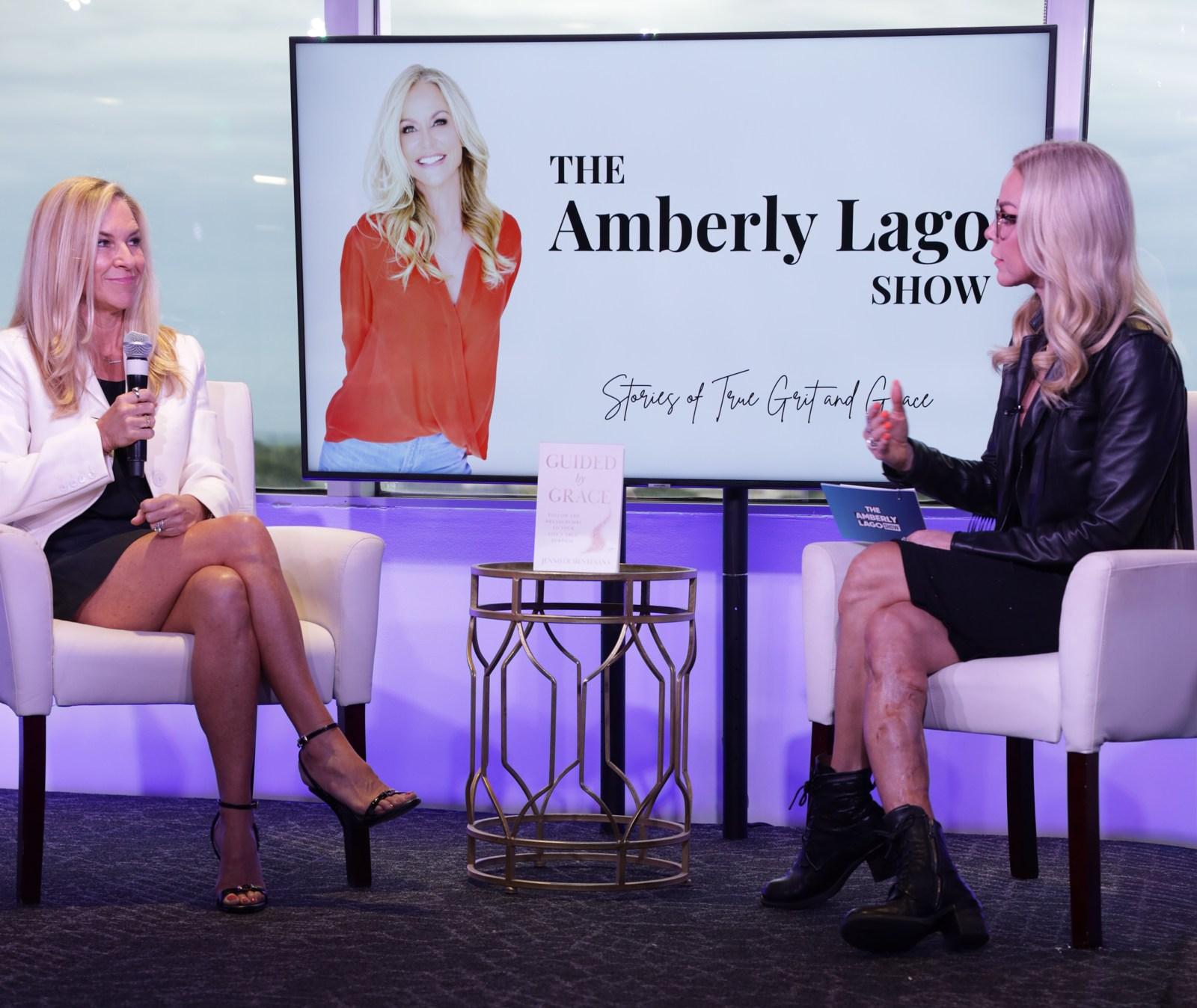
Season 5, Episode 197
Charting Your Course in a Chaotic World with Mark Black
A conversation with Mark Black

About This Episode
"If you have something that you want to accomplish and it matters to you enough, you'll find a way."
In this episode of The Amberly Lago Show, host Amberly Lago interviews Mark Black. The author of "Live Life from the Heart," Mark has travelled the globe as an author, speaker, and coach, sharing strategies and tactics for building resilience. His story has impacted more than 150,000 people at more than 700 organizations including ExxonMobil, AstraZeneca, and Mercedes-Benz.
In this episode, Mark shares his story of overcoming adversity and provides valuable insights on breaking through limitations in today's chaotic world. Amberly finds Mark's journey inspiring and encourages listeners to apply his wisdom to elevate their own lives.
Tune in to hear about Mark's new book, "The Resilience Roadmap," a book about the theory & practice of resilience...from someone who has lived it. Mark has taught this framework to thousands of people in audiences across the continent. Now he's sharing it with YOU.
Key takeaways from this episode include:
- Mark's Resilience in the Face of Health Challenges (6:33)
- Embracing Positivity Amidst Life's Struggles (14:21)
- Finding Motivation and Success through Running (23:10)
- The Power of Adaptation: Taking Ownership and Time Management (35:29)
- Community: A Crucial Support System in Times of Adversity (43:51)
Follow Mark
If you are ready to leave your mark by discovering your message and sharing it with the world, you've come to the right place!! Let's work together to build your influence, your impact, and your income! Join the tribe you have been waiting for to activate your highest potential and live the life you deserve! Join the "Unstoppable Life Mastermind!" and let us know you are ready for greatness! Read the "True Grit and Grace" book here and learn how you can turn tragedy into triumph! Thank you for joining us on the True, Grit, & Grace Podcast! If you find value in today's episode, don't forget to share the show with your friends and tap that subscribe button so you don't miss an episode! You can also head over to amberlylago.com to join my newsletter and access free downloadable resources that can help you elevate your life, business, and relationships! Want to see the behind-the-scenes and keep the conversation going? Head over to Instagram @amberlylagomotivation! Audible @True-Grit-and-Grace-Audiobook Website @amberlylago.com Instagram @amberlylagomotivation Facebook @AmberlyLagoSpeaker
Full Transcript
Thank you for tuning in to the True Grit and Grace podcast. I'm Amberly Lago, and I'll be sharing inspirational stories of resilience and empowering ideas to elevate your business and your life, ignite your passion, and fuel your purpose. Hey, thank y' all so much for tuning in to True Grit and Grace. I'm Amberly Lago, and I have a new friend on the show today. Oh, my gosh. His story is amazing. He's amazing. All that he's overcome. I. I really feel like I wanted to do this podcast to share stories like his, although I don't think there's any story out there that is quite like his. He's going to help you break through limitations. He's going to help you break through your comfort zone, break through adversity so you can level up your life. He is a resilient speaker. He is a coach. He's an author. In fact, he's got a new book that came out. It's called the Resilience Roadmap. Seven guide posts for charting your course in a chaotic world. And I am so excited to share his wisdom, his story, and have you meet this amazing man, Mark Black. Thank you so much for being here, and I'm just so happy to get to talk with you. Thank you.
Thanks, Amberly. Thanks for having me. It's a pleasure to be here.
Oh, my goodness. Well, just watching your. Your TED Talk, although we've been through different challenges, what you did to overcome just, you know, to. To develop that resilient mindset and the resilience to keep moving forward. I did a lot of the same things as I was in the hospital. Now, I wasn't in the hospital near as long as you were, but I love that you have a quote on your social media, on your Instagram, and y'.
All.
His Instagram is. I am Mark Black, Right? That's your.
That's correct. Yeah.
Y. I love a quote that you wrote. It says, we don't admire people for what they have achieved, but for what they have overcome to achieve it. And you have most definitely achieved so much, but I think that so many people are drawn to you because of what you've overcome. Could you just share a little bit? I didn't want to give away your. Your. Your whole story in the introduction. I want you to be able to tell that. But I would love. I mean, you started developing resilience at a very young age. You had surgeries before you even were one year old. Can you take us back to. I Guess. When you were a kid, do you remember struggling physically or anything like that, like with surgeries? Or did you have that surgery before you were one and then you didn't have to have another surgery for a while?
Yeah, I actually was very fortunate. So I had two surgeries and one at a day old, one at a year old, and doctors said he'll probably need more before he starts school. And I was really fortunate that that next surgery didn't happen until I was 24. So there weren't surgeries, but there were regular. I mean, I, you know, I saw a cardiologist every six months, and there were regular tests, and there were lots of little kind of bumps along the way. I was always the smallest kid in my class. And so there were a number of indicators, I guess, that I was not, you know, quote unquote, a normal kid, and that I had these challenges that maybe other kids didn't have at the same time. I think one of the blessings of my childhood is, is that that happened so young. And so even though intellectually I knew I was different, this was my reality. I didn't know anything else. Like, going to a cardiologist was what you did. I was probably six before I realized that everybody didn't have what I call the zipper, the. The scar down my chest from my open heart surgery when I was a year old. I was like, oh, wait a minute. Everybody else doesn't have one of those. So, you know, one of the blessings of whatever we're born into is that that's our frame of reference. Right. And so for me, much was normalized that otherwise would not be normal.
You were in college when all of a sudden your hands and feet were swelling, you were losing weight, and you were just like, well, you know, life is hard, and this is college, and I've got exams to study for, and it's stre stressful, and I just have to keep moving forward. But it was when sometimes we don't realize, like, what our reality is until we see the look on someone's face. And I remember getting off the plane, coming back home to Texas to visit my mom, and I guess I had lost so much weight, and I was like, yellow. And she was like, oh, my God, what happened to my little girl? Like, I was a shell of myself. And your mom, you got off the plane, you went to go see your mom, visited her story.
Yeah.
And the look on her face was like, oh, my gosh, are you okay? And you're like, yeah, I'm fine. But she took you to the doctor. And you were what, 20, 23 at that time?
I was 23. I was. So I had done. And I had finished my undergrad. I was going to do a second degree. I was going to be a teacher. My mom, my parents are both teachers. That was my career plan. So I was halfway through that second degree, got home in May, very similar story. And I got to the door and mom was like, oh, my God, what happened to you? You've lost a ton of weight, you look horrible. And, you know, again, 23, male, stubborn, like all of, all of that stuff, right? I just thought, it'll. It'll work itself out. It'll be fine. And I did not have an appreciation for how serious the situation was. And then I, she, she. The first thing she did is like, go away yourself right now.
Okay?
And I was £80. Now, look, I'm a small guy. I'm a small guy, but I'm. I'm like 125 pounds today. And I'm not overweight. So 80 pounds is scary small. When I look at the pictures now, in retrospect, it's like, how did I not notice? But I didn't. Anyway, so she saw that and said, okay, we're going to the doctor. And the, the long story short is I ended up being taken by ambulance to the cardiology team that had been following me for years. I stayed there for a month while they stabilized everything that was happening and then said, okay, so we've done everything we can do. Your long term survival now depends on a heart lung transplant. Like, you've got about a year to live unless we can get you a transplant.
Oh, my gosh, that just gave me chills when you said that. What was your first thought when they said, okay, you need lungs and a heart, and it's not likely that you're gonna live much longer if this doesn't happen. What were your first thought when they told you that?
I mean, scared, obviously. As a family, we knew for a while that a transplant was in my future. That was something that, like, was sort of talked about as down the road, but it was never that imminent. And the idea was like, well, we're gonna have mourning, right? And all of a sudden it's like, okay, it's happening now. And the other, the other thing he said was, the chances of us getting you on a list in the condition you're in right now are virtually zero. So, like, we can try, but quite honestly, you're probably not strong enough. And so I don't know if anybody's going to take you on the list. So you might want to think about option number two. And I'm like, well, wait a minute. You just told me I have a year to live if I don't get this, like, what the heck is option number two? And he says, well, option number two is try and live some life with whatever time you have left. And I'm 23, right? Like, wait, I'm gonna go home and like take some things off a bucket list. Like, no, I, I think like, let's do what we need to do and see if we can get on a list. And like grace of God just or dumb luck, I don't know. But that was the other thing. We had three options. So in Canada at that time, there were only four centers in the country that do heart lungs. There are lots of, lots of places do hearts lungs are a lot more specialized and a lot newer. And so a heart lung transplant is only performed in, in a couple of centers. And so we chose Toronto, the Toronto General Hospital, which is about a thousand miles from where I live. And that, so that required moving. If we were even going to be put on the list. We had to move. And so they sent the file to Toronto. I later learned from the head of the transplant team there said, I remember, I remember when we discussed your case. He said once a month we gathered all the cases together. We discussed whoever's on the, on the applications for being accepted. He said, I remember your case. And you were, you were coin toss, you were a 50. 50. I said, well, I don't know what I called, but I'm glad I landed on heads or tails or whatever it was supposed to land on then because I was accepted on the list in October of 2001. And we moved, we moved to Toronto then to start waiting for the transplant. My we, my dad and I moved and left my mom and three younger brothers at home in New Brunswick, where I live to try and, you know, normalize their life. And dad and I, well, how, when
you were going through this, there's one thing that I love that you say at the end of your TED Talk, you say God bless. And the reason I think I love that so much is because I, well, I have faith. But when I did my TED Talk, they were like, okay, don't talk about your accident too much and don't talk about God. And I was like, but that accident was the biggest life changing moment of my life. And God is the biggest part of my journey and how I got through so much. So I love that you said, God bless. Did you have a lot of faith? Were you praying to help you get through each day?
Whether or not I survived physically, I never would have survived mentally and emotionally without my faith. For sure. Yeah. No, it was fundamental to finding some level of hope in an otherwise hopeless situation, because the odds, the odds, the statistics that we were given were very, very bleak.
Do you feel like everything that you went through as a child, even the operations and then going to the doctor every six months to get your heart checked, and do you think that helped build your mindset and your resilience and prepare you for this surgery?
100. 100. I mean, so I, I. When we moved to Toronto, I waited outside of the hospital. My dad's cousin, amazingly, just said, look, come and look. Come live with us. Which was. Was huge, right? Because mom and dad have a mortgage to pay at home. So to have a second mortgage in a metropolitan center that was much more expensive would have been a huge burden. Obviously, they were willing to do it, but. So we went and lived with him for three or four months. I got sicker. They moved me into the hospital, and I stayed as an inpatient in the hospital for six months while I waited for the transplant.
Oh. And, I mean, I was in the hospital for three and a half months the first time. And it was. I begged, I kept begging, when can I go home? When can I go home? And when I learned that you were in there six months waiting, what are some of the things, mentally, that you did to help yourself? Like, just to get through those days where maybe worry could take over or fear could take over, or you felt like maybe giving up. What were some of the things you did mentally to get through that time?
The biggest thing was, and it's part of the formula in the book is what I call accept and adapt. So it's to the seven steps. And the acceptance piece was the most fundamental and the most difficult. And what I mean by accept is, and we all face this every area of our life. It's figuring out, okay, what aspects of this situation are in my control, which aspects of the situation are not in my control. And I think, you know, as people who live in North America in 2023, we have this illusion that we control more than we actually do. And sometimes it takes something like this to make you realize how. I don't want to say powerless, because we all have the ability to do some, but we're fragile beings, right? And things can happen, and you don't have as much control as you'd like to Think you do. And so is. And in the hospital, that becomes very stark and very real, as you know, right? Because it's like you can. You don't control your schedule. You don't control what you eat. Like, every aspect of your daily life is controlled by this routine of what happens in a hospital that makes the hospital work. And so I had to. I sat there frustrated and angry and bitter about that for months. A couple of months, probably. And it was my mom who was like, look, you got to figure out if you're going to sit here and be bitter and angry or if you're going to focus on what you control instead of what you don't and what you have to be grateful for instead of what you've lost. And, you know, I'm 23 and that's my mom, so whatever. But after a while, I was like, well, you know, like, that's. In fairness, I'd like to say I absorbed her advice, but the reality is I decided it was my idea, and then it was a good idea. But. But I had this epiphany that I couldn't control the schedules. I couldn't control if or when a donor was going to be found. I couldn't control if or when my heart was going to give out. What could I control? Like, worrying about those things was just causing stress, anxiety, frustration, worry, and. And diminishing my energy and. And like, there were nothing good was coming from that. So what can I put my attention and focus on? A, just to distract me, but B, to maybe make some positive progress. And that shift completely transformed my experience of the same reality. I always say to people, the reality didn't change. Like, it's not that we're like moving mountains and changing the world, but our experience of a reality completely transform when we make that shift.
And so 100%, I feel like gratitude is the quickest and easiest way to shift your perspective. For sure. It really helped me. Did you write a gratitude list every day, or did you just focus on the gratitude? Did you express it?
How.
How did you go about, like, getting grateful? Because this is the question I get a lot of times from people is, well, you say, practice gratitude and be grateful, but it's really hard to be grateful when you don't have anything to be grateful for. And I'm like, but there's always something to be grateful for. So what would you say to someone who's like, yeah, yeah, that's great, but I don't. I don't know what to focus on. I don't Know what to be grateful for? What's a piece of advice that you could give them?
Wow. Yeah. So I did, I did not formally journal. Although I think that's a brilliant idea. I did. I. Sorry, I did journal. I didn't formally gratitude Journal. So gratitude would have been in there a lot, but not, not as an intention, although I think that's a brilliant idea. And at first it really took people around me reminding me what I had to be grateful for because I was again, I was, I was that person. I was like, well, look, look at, look at this situation. Like, I. What do you want me to be grateful about? And mom would say, well, you haven't sat here for a single day by yourself, mom or dad or a friend or one of my brothers. Every single day took time out of their schedule at their lives, in some cases making major sacrifices because I'm in a two provinces away, you know, to make sure that I was not alone. And there were lots of people. I look around that hospital and there are people next door and they're two doors down dealing with their stuff mostly by themselves because their family members just can't be there or they don't have family or whatever the case is. Okay, so there's that, hey, I live in like, I won the birth lottery. I happen to be born in Canada or the US or like some of these countries where we have the resources available to us. Look there, there are place many countries around the world where doctors would have said, look, we've read about this thing called transplant, but we don't have the operating rooms and the surgeons and the medications and the like. So to have the fortune to even be waiting on that list, now, that's not something that I even hit me before. I was like, well, I need a transplant, let's get one. Right? But in many places that would not have even been an option. So as you start to shift and you start to look, yeah, I would challenge any. First of all, if you can say to me, I have nothing to be grateful for while you can speak, there are people who can't speak, right. Like, it doesn't take much effort to really think for a second and realize, okay, I've, I've. If you're watching this, you have access to the Internet, you have some device that you're watching this on. There are lots of people who do not have those things. So start from there. And it's not that gratitude means all your problems go away, but all of a sudden they become a lot easier to start to cope with. Because you realize you have resources to deal with them.
Yeah. And now I. I love that you have such a positive mindset. What's a piece of advice that you could offer just for someone who struggles with staying positive? And it's not like I really focus on trying to shift my mindset to one to be positive because I can slip into negativity and. And be hard on myself. What would you say to someone who has trouble focusing on positive and they're struggling, like their mindset is just one of the glasses half empty instead of the glasses half full? What would you say?
There are lots of things. Right. So, I mean, gratitude is definitely a part of that. And first of all, let me say, like, I get negative too. I don't think anybody doesn't. If, you know, the most positive person, you know, either, has gotten really good at practicing this. But this. This misconception that some of us are just born this way, I don't think is. It's not fair to the people who have worked hard to get this way. And it's also not fair to you if you're not that way, because it makes you think you can't do it. So, look, we all have a baseline personality, and some of us have to work at it more than others. Maybe. But to be positive, you got to work at it. And. And I think one key is to understand it's about seeing the good in reality, not pretending the reality isn't there. So I think some people kind of dismiss it immediately because they think it means living in a fantasy world where there are no problems. Right. It's like, no, like, I'm not. I'm. I managed with work to be positive while acknowledging that I'm sitting in a hospital room and I could die literally at any second. So it's. It's not pretending that reality isn't there. It's finding the good wherever it is. And I would challenge you that there's good everywhere. Gratitude is part of that. If you're able to exercise, moving your body in some way, just going for a walk, you don't have to go, you know, work out like a crazy person. You can if you want to, but moving your body creates those chemicals in your brain, right? Which helps you to. To do that. Taking little steps. So when I'm challenged and feeling in a funk, we all have a need to make progress, right? And. And sometimes we get overwhelmed because what we want to do is so big or where we are is so far from where we want to be. But if we just make Small little steps. Make that phone call to fill in that application. Like, whatever that step is, there's positive emotions and positive neurochemicals that start to develop when you start to feel like you're moving in the direction of where you're, even if you're not there yet. So I'd say take those little steps. Take care of yourself. Like, there's a lot of different things that we can do to help ourselves to. It's an intention, but it's also creating the scaffolding or the framework to help you do it more often.
Oh, I love that. And I want to go back to the hospital where they finally tell you, you get to have this surgery. You get to. And you get through that. And I saw a picture of what you looked like after you were out of the hospital with the staples and the scars, and you decide that you're going to do a marathon. And what I love about this is everything that you just shared about the gratitude, about focusing on the right things, what you can control, about taking baby steps. You say, look, a marathon, you can do a marathon. It's just putting one foot in front of the other. And eventually it took you like, two and a half years to be able to run it. Now you've ran, what, three or four?
Four.
And you're the first person using someone else's lungs and heart to ever complete a marathon.
As far as we know. If anybody out there can find the Google, we Google search pretty hard. And I feel comfortable making that. If there's somebody out there, please come and correct me. Yeah. Yeah.
That's incredible. And what did you do every day to make sure that you reached that goal?
Well, I mean, it begins with the intention, right? It begins with the mindset. So one of the things I talk about in the book is the power of an aspiration, a clear and compelling vision of where you want to go. So people who say, I struggle with motivation. Yeah, look, we all do. But it's not that you're unmotivated or undisciplined. It's that either you don't have a goal or the goal that you do have doesn't matter to you at a deep level. So if you have something that you want to accomplish and it matters to you enough, you'll find a way. And the example that I usually use for folks is think about somebody that you love. If your parent, think about your child. If you're a partner, think about your spouse or your partner. If that person needed you to do something to. For them to survive. What would you not do? What. Where would be the line where you would say, well, I'm too tired or I don't have. No, you'd climb over broken glass, right? You'd figure out a way. And so as long as we have a clear and compelling vision of a future that's better than today and it matters deeply to us, then there are very few things that you can't do. Look, I'm a motivational speaker, and motivational speakers love like, you can do anything. I think that's not fair and not real. There are limits, but few of us will ever come close to reaching our limits because we push ourselves enough. And so part of running a marathon was just to see if I could. It was just going like, if I. If I can do that, then I'll feel like I can handle, like, anything. Because to me, prior to my transplant with heart and lung issues, I couldn't climb one flight of stairs without getting out of breath. Right? So a marathon to me represented like, the impossible kind of. But I also knew now I have this new heart and new lungs that work. It's definitely not impossible anymore. It's incredibly difficult, but it's not impossible. So I set that intention and then I set about the work of preparing to do that. And that meant, like, it began with walking on a treadmill for three minutes and lifting two pound weights in a hospital gym during the initial phases of. Of post surgery rehab, and eventually to jogging and eventually to doing a 5k and then a 10k and then a half marathon. Like a lot of slow, steady progress over a long period of time, which is a great metaphor for the marathon because that's all I'm here for. And it's too, as you alluded to, it's like the gun goes off and you put one foot in front of the other until you get there. And I always say to people, the person that finishes in five hours and 16 minutes, which is how long it took me to do the first one, and the person who WINS in like 2 hours and 45 minutes gets exactly the same medal again. It's the metaphor for me, it was like, if I can do that, then whatever other things I want to accomplish in my life are going to seem pretty easy in comparison.
Wow. I just think it's just so inspiring. I had a lot of misconceptions about grit and resilience, and I was very stubborn, and I confused stubbornness for strength and would just push and push and push until sometimes I would end up in the er. How do you Learn to push past where you thought you could go and then give yourself the gift of grace and listen to your body. Are you more in tune with really listening to your body now more than you were, you know, when you found out you were going to have to have a transplant when you were 23, or is that something that you still kind of struggle with? Just, you know, be stubborn and push hard and do more.
That's a powerful insight on your part and something I'm probably still working on. I'm much better at it at 45 than I was at 25. Yeah, we have to figure out what that line is for each of us and in different contexts. Right. Because I think it exists in different places. It's. It depends on the context of the situation. So, yeah, I believe in pushing past our comfort zone. I believe in, in trying things. Even though we're not sure we're going to succeed in pushing the limits of what we think we can do, but also when we fail, which is inevitable, that that's okay. And in fact, that's not a sign that things are going wrong necessarily. That's a sign that we're trying things that are difficult and you're going to fail and that's okay. And if it comes to your health, then, yeah, we got to listen to our body and we've got to. You know, I had to realize that I'm not in the same shape, nor am I just the same physiology, the same human being. I was at 25 as I am at 45 with three kids. So I haven't not run a marathon. In fact, I haven't run further than 10k in like 10 years. The story is I, I was going out for a training run for my fourth marathon and I was waving goodbye to my wife as I'm about to run for three and a half hours and she's holding a newborn and there's a three year old running around. And I'm saying, I'm gonna go run for four hours. And then by the way, when I'm back, I'm gonna be pretty much exhausted for the rest of the day, so I'm gonna be kind of useless the rest of the day too. And I'm thinking, this isn't fair. Like, this is a pretty selfish thing that I'm doing right now. And my wife never complained. But I realized this, you know, this context of our lives have changed and my priorities need to shift. And this isn't about me like ticking a box to run another marathon. And so that was the last one And. And maybe someday, when the kids are growing up, if I'm still able to, I'll try and do another one. But, yeah, I think we have to balance pushing and trying to get the most out of ourselves with the realities that. That we live in. And it's hard to know sometimes what's a legitimate reason versus what's an excuse that I'm making for myself.
Yeah, that is. Right.
It's really challenging. And so that's when it's helpful to have a coach or a mentor or a group of colleagues or somebody in your life who will. Who will call you on your stuff. And who you can ask, hey, this is how I see this. How do you see this? Generally speaking, my experience is that's not your partner or your family members, because generally speaking, they're just going to let you off the hook no matter what. But so I have a few people who I can kind of reach out to to be like, okay, this is. I'm seeing this this way. What would you. You know, how do you see this?
Oh, it's so helpful when you have somebody that you can trust, a mentor, a coach. I think it's so important. Or to be involved in a mastermind with other people who are doing the same thing, who can, like, call you out on stuff. But it was actually my husband who. I'd had another surgery, and I was in the gym. This is back when I kept trying to get back. Back to training clients. I was in the fitness industry, and it was him that one day I had had another surgery, and I was. My leg, it was bleeding out. The stitches had come open, and I was bleeding across the gym floor. And he was like, what are you doing? Just go home. Go home. Get off your leg. You know, and it. I had to take a good, hard look at, like, what I was doing. Like, I wasn't serving my clients in the best way. I wasn't serving my family or my. And that's when I had to make some changes. So, you know, my husband will call me out on stuff. But it really helps when you have somebody that's in the same kind of profession or career that can call you out as well. So that. That helped me, too. And, you know, I think that your dad. I would love your dad, because him and my dad are a lot like. He says he taught you a lesson, go big or stay home. Speaking of, like, just go home. It was like, go. He said, go bigger or stay home. In Texas, we say, go big or go home. And so I love that your dad Taught you this lesson to, like, dream big and dare to be bold. And that you also say, you know, it's important to be humble, but to have big goals and aspirations and dreams. And so that lesson that your dad taught you, did he say that? Did he show that as an example? And how have you applied that into your life with everything that you're doing?
Yeah, he would. He would say it. And as a kid, we didn't. I didn't really get what it meant, but later I started to kind of figure it out and. And I guess it's. For me, it's just like, as far as I know, we get to do this thing called life one time, right? And. And certainly going through things like we've both been through it, realize, like, it can be over. You know, we all hope to live to be 110, but the reality is, who knows? So, like, what are you waiting for to do whatever it is you want to do? And, you know, when we say go big, it's not that we all have to change the world. Maybe it's a trip you want to take. Maybe it's a business you've always wanted to start. Maybe it's the book you wanted to write. Maybe it's, you know, whatever. But so many people live their life, I think, waiting for the magic someday to arrive. Someday when everything is perfect, like, someday when the. When we retire, someday when the kids are out of the house, someday when we have enough money, like whatever that someday is. And they put off these things that they've always wanted to do. And the reality is they usually never happen. So I think going through some experiences where you realize how fragile life is, it just makes you go, well, I want to maximize the time that I'm given, and I want to maximize the use of the gifts and talents and abilities that I have to do as much good as I can and. And for my. For myself and for everybody around me. That's what that means to me. And so, you know, as a kid, that was more about, like, achievement. I think as I get more. As I get older, it becomes more about contribution than achievement.
But I love that now. And I wanted to ask. I mean, we won't go into. Give every single one of your tips and strategies for resilience, but if you have time, I'd love to talk about a few of your favorite ones. We've already talked about acceptance, and I think that is the key to any kind of transformation, physically, mentally, financially, in your relationships, in your profession. Every way is like being in acceptance and going, okay, this is who I am and where I am now. What can I do about it?
Yeah.
But I would love to talk about a few of your points, about what you've learned about resilience and what you teach on stages. I mean, y', all, he speaks all over the world. And by the way, Mark, your website is beautiful. I love it.
Oh, thank you so much. I will. I'll pass that on. My web designer is also a good friend of mine, and he's. He really? Yeah, yeah, yeah.
Okay, well, maybe I need to meet your friend, because your website's beautiful. Also, the studio that you've created. Look, when Covid came, I had all these keynotes lined up, and one by one, they just started canceling. And I remember I had a big one. I was speaking to the California Highway Patrol. They have an annual, like, gathering for all their lieutenants and commanders. And I was like, oh, my gosh, I get to speak to them. And it was in June or something. I'm like, well, surely, you know, this whole Covid thing is going to be over by then, like, this couple. And actually, I was like, oh, I'll have a couple of weeks to take a break from traveling. This. And then I was like, no, you're going to have a couple of years to take a break from traveling. But I remember they all started canceling. And it shows that you practice what you preach, because you were like, I'm not waiting for the world to get back to normal. I'm gonna shift my whole speaking into creating this beautiful virtual studio so I can still do talks, make a difference, you know, support the family, all the things. And so your studio is beautiful, and I love that. You're like a freaking go getter, and you're like, you know what? Might not be able to travel for these keynotes, but I'm gonna make a studio right in the house. And so I love that video on your website.
Well, thank you. And it leads really nicely into what I was going to talk about anyway, which is, so after acceptance, the next thing in the book is adaptation. So it's the idea of, once we've accepted what we can't control, well, what can we control? And how do we change what we're doing when the reality changes? So one of the things I remind folks of is, like, look, acceptance is really important, but it can also go too far. And if you go too far in the pendulum, then you find the folks who are, like, victims, right? They're like, well, I'm great. They're great at Accepting, they accept everything. Nothing is in their control. Everything is somebody else's fault. Right. It's my mom, it's the government, it's whoever.
That's a good way. I didn't think about that. I didn't think about that at all. Because you are so right. When I wasn't in acceptance for the nerve disease I was diagnosed with, which led to addiction, which I was in denial about that it was when I accepted it, but was like, okay, how can I take full ownership of this and start to take action steps? But you're right. I never thought of it as victims will take it too far and be like, accept everything. Yep. Look at me. My woe is me. Like, I didn't think of it that way, so. That's such a great point.
Well, thanks. Yeah. I mean, like. Like any. Like most things, right? It's like any good idea becomes a bad idea if it goes too far in any direction. Right. And so if you take acceptance to the extreme, that can happen. And so what we need to do is say, okay, no, I accept what I don't control, but that doesn't mean I don't do anything. It free that hopefully frees up the time and energy that I would have been spending worrying about stuff I can't fix to then devote to the things that I can fix. And that's where adaptation comes in. So in the hospital, that looked like, how can I adapt this environment so that it feels more like of a life instead of just waiting for something to happen. Right. Like, this is still life. So we decorated the room and we brought in bedspread and pillows and blankets for the bed. And we brought in my clothes so that I could look like a human being. And we did all these things to transform this room. My mom called it the dorm room by the time I was done, because it looked like a college dorm room. Like we had made a home for me there, which again, was part of transforming the experience of the same reality. When it came to.
Can I say something really quick, though?
Yeah, yeah, yeah.
This reminded me of. I'm kind of embarrassed to even say this, but when I was in the hospital, I did the same thing, right? Like, I had banners and framed pictures and I had my own refrigerator that they brought in. I mean, it was like a little dorm room. But this is where I went too far. A friend of mine actually brought me a candle and I lit the candle. We are sitting in there and this. The nurse comes in and goes, wow, it smells really good in here. I'm like, oh, yeah.
Thank you.
She brought a candle. And he's like, what, are you crazy? He grabs the candle and runs out of the room. He goes, you want to blow this place up? We've got oxygen in here. Oxygen, yes. So, yeah, so I'm all about. I was like, yeah, let me make this homey and nice and cozy, but don't take a. Don't light a candle.
A candle in the hospital room.
That's what it made me think of. So I love that you adapted your hospital room to make it look like a dorm room.
Yeah, yeah. And then. And then. So then I've. I've also said to folks, it's interesting. Like, I wrote. I wrote this book, like, mostly Informed. When I started, it was mostly informed by the hospital transplant journey. But then I finished it during COVID and it turned out that the COVID was, like, a good case study in a business context for all of these concepts. So much like you, Covid happens. Well, actually, we were coming back from Orlando for family vacation in Disney, where we spend too much money, like everybody does, and we got home, like, 12 hours under the cutoff, where our kids would have had to quarantine for a week from school. Like, everything hit the fan, like, just as we were getting home. And so the next week was just phone calls and emails canceling everything on my calendar for the next year. Right. Like, my income. My projected income from the year went from very helpful to zero.
Yeah.
In five days, Right?
Yeah.
It's like.
It was crazy.
God, what are we going to do?
And now. I don't know. Did you do that? Like, I had a lot of. A lot of people that I was going to speak in person. They did switch it to virtual, but they said, well, since everyone's going through a hard time and we're doing this virtually, we're not going to pay speakers now. Did that happen with you?
I. They didn't even know. They just canceled. They. Well, sorry. A couple of them postponed indefinitely. In fact, I'm doing one of them in October. That's been like two and a half years of wow. So some of them postponed indefinitely, which at least allowed me to keep the deposits that they had paid, which was helpful. But. But most of them just. Just canceled out. Right. And said, maybe we'll reschedule when we know what's going on. And so then it was, okay, what are we gonna do? Right. And I went through this. I went through the entire framework. Like, it took me about three days to just wallow in, like, pity and frustration and Anger and whatever, and then to go, okay, I accept that this is the new reality. I don't know if it's the reality for two weeks, two months, two years yet. But. But it's for the foreseeable future. How can I adapt? And what I did was I plugged into our Canadian association of Professional Speakers. I said, okay, everybody, what are we doing?
Right?
And we were on our Facebook group, like, every day going, what's everybody doing? And how's. What's this going to look like? And there were all kinds of perspectives, right? Some people like, well, forget this. Like, I'm retiring or I'm going to get another job, or. And I talked to my wife about it. She was like, look, do you want me to go get a real job? Because I don't know when we're going to make money again doing this. And. But I was learning at the same time. And I say to people, I started with, probably, like most of us with a laptop screen, like a laptop camera kind of halfway up my nose, and really bad sound, and did a cut and did some virtual presentations for nothing to, like local chambers of commerce just trying to do something.
And then it was funny because I had boxes stacked up, cardboard boxes stacked up with my laptop on the cardboard box to get a different background. I've even got a picture of. This is what it really looks like. Yeah.
What my only real regret from this time was not documenting better the iterations of the studio. Because I appreciate your compliments, but, like, this is version 10. My wife, in fact, was like, you moved your office all around again? I was like, yeah, I did.
Okay. I'm glad I'm not alone in that because my husband, like, thinks I am crazy even since. So we moved to Texas about a year ago. I had a whole different office and we had a rental house before we found this house that we live in now. And I was like, oh, honey, I cannot have these puke brown doors in my background. It. That's my branding. I can't do it. He's like, we're renting this house. You cannot paint. I'm like, oh, no, you have to. I'm gonna have to paint. I've got to paint. We better hire a painter. And he's like, no, no, no, no, we can't paint. He comes home one day and I have got. I bought a can of paint, and I'm literally. I have my daughter in there helping me, and I'm painting the doors. But then we moved to this house, so I was like, I can do Whatever I want. And first I was like, had my desk set up where I could see the backyard and the pool. And then I went to go do a virtual event and my friend Catherine and John Gordon let me record out of their studio. I was staying with them, visiting them in California. And he had this white shelf and I said, I'm gonna go home and switch my office. He's inspired me to change it up again. So there I was the middle of the night, like changing things up, ordering shelves. And so, yeah, I'm glad I'm not the only one that. But it's so important, isn't it, that your background and I love your background and I saw it in the video on your website and I loved that too. It looks awesome. And I love how you have your book and the M. And y' all have to check this out on YouTube if you're not seeing if you're listening on Spotify or Apple or wherever you're listening to. So I love that you've adapted your office, you adapted your hospital, you've adapted your whole professional space and what you do. I think that is key to moving forward.
Well, it's, it's absolutely essential, right? And, and I have to, like, I'll, I'll share that. 20. So I've been in business at that point 16 years. 2020 was my worst year ever as a, you know, I gained, like, at that time, my business model. And it hasn't changed a ton, but it's changed a little bit. But my business model was like 95 of my revenue came from speaking in front of audiences, audiences of people, and 98% of those audiences were over a hundred people at a time. And now all of a sudden it's like, you will not, we will not be gathering in large groups, right? Like, this is not going to happen for the foreseeable future. So 2020 was the worst, as I figured all of that out. But 2021 was my biggest, my best year, revenue wise, in my business. And I never left my basement. And so. Right. So what that taught me was if you're willing to let go of what you think it's supposed to be and are willing to adapt to what it could be or a new version of what you might want it to be, you be. You can be amazed at what you can create. Right. Like I had net 2018, if you had said to me, you're going to do a virtual presentation, I would have said, what? I don't even know what that means.
Oh, I am right there with you. I'm right there with you.
And I adore being in person. Like, if you give me the choice between virtual and in person, absolutely. I'd rather be live with people. That said, there were things about virtual that I did not anticipate being great. Which is a. It's super efficient.
Oh, you don't have to get on a plane. You don't have to try it. And when you go speak at an event, I go there a day before, so my crps can kind of calm down. The nerve pain, the swelling, all that can kind of calm down. I do the event. Sometimes the event. I have one coming up that's four days long. Yeah. So it's a lot. It's very efficient to do it virtually. But I'm like you. I like being around people. But it's amazing. And the thing is, you were willing to go, okay, well, what could this be? I'm not going to be so fixated on getting back to the way things are. Because I had somebody that I used to work with and she joined my mastermind. And she's. She was a personal trainer. She still is a personal trainer. She's like, well, I'm just gonna wait till things get back to normal. Yeah. And we can train at the gym again. And I was like, what, are you kidding me? I was like, no, I've actually got two clients that I still train. That one I've had for 20 years. And the week after Covid shut things down, I was already training them virtually over zoom. Like, I didn't wait around. I converted my whole garage into a gym, and I did everything virtually. And that allows me now to, you know, she. I used to train her in California. I can still train her. I'm in Texas because we do it virtually. And I think that because you didn't wait around, you used this simple. Like, it sounds simple, but it is life changing when you can accept what's going on, adapt and really be open. And you said something really key that I wanted people to go back to that I really want people to hear. You dove into your community. You didn't try to figure it all out by yourself. You're like, no, I need some support here. I need the community. And I think that's powerful that you were like, how can I get together with a community? Is that a strategy that you use as having that community around you to get through hard times and adversity?
Absolutely, yeah. Yeah. Masterminds, coaching communities, associations, group of friends, whatever it is, it's. It's essential. Right. Because they're a. They're there to support you when you're struggling. They're there to bounce ideas off of. They're there to. There to. To learn from. Yeah, it's. It's absolutely essential, tapping into that community for, you know, at the first couple of weeks, it was. It was more of like, just, let's commiserate together. Is everybody else feeling scared? Yeah, I am. Okay, well, so at least I normalize my feelings. That. That's not a bad thing either. Okay, what are we going to do? And creates a lot of shortcuts. Right. Because it's like, I can learn from everybody else's mistakes. I don't have to make them myself. Saves me money. Right. Which was huge. It also. It gives you ideas. Right. It's like, oh, I like how that person does this, or, I like how this person does that. And one thing I want to, you know, drive home for people about adaptation is what I said about, you know, the camera, the laptop camera halfway up the nose. Like, we have to be willing to be bad at something. We have to be willing to know that the first time we try it is not going to be perfect. Right. As. Especially when we're going through a period of challenge and change and we're trying new things, we're going to stumble. Like, that's part of. That's how it works. And you have to be willing to go through that and get better the next time and get better the next time and get better the next time. And so however. However good this looks, it's because it's version 28, right? It's not. It wasn't version one. And speaking is the same thing. Any. Any business is the same thing, Right? Like you. The way you worked with your first client and the way you work with clients you work with today, I'm sure, is not the. Because you learn things and you get better, and so many people get stuck because they want it to be perfect from day one, and that's just not how it works.
So, so many people give up. So many people give up. And look, I say that because I almost did. I will. I will tell you. When I did one of my first virtual talks, it was a disaster. It was a disaster. And I remember at the time, I had an agent, and she said, I want your assistant to be on the call. They wanted me to use my Zoom. I will never do. I will never do this again because I had to admit 500 people and try to do my talk and be focused and make sure people. And I was a Little technically challenged. And I remember I was like, okay, and get on. And for some reason, my assistant's face was on the screen the whole time instead of mine. When I went to play the video for my, you know, introduction, the sound wasn't coming on disaster. And afterwards, I think I cried. My husband was like, what is going on with you? I was like, it was horrible. I'm horrible. I can't do this. It's too hard, and blah, blah, blah. And I took a break and I went outside and I went for a walk and came back and said, how can I make this better? And so I messaged them and said, hey, I know that there were some major hiccups on that. Can I record a virtual presentation that you can share with your company? You can share with everyone so you will have it. Can I redo it? And they're like, yes, thank you for making that right. Let me tell you, I almost gave up. I was like, I am just not cut out for this.
Right?
This is too hard. And I think that part of being resilient is. Is to just go, okay, screwed up on that. How can I forgive myself, give myself a little bit of grace, and then keep moving forward again?
And I think this is getting worse because of social media, among other things, that we. We compare. We Compare our step four to somebody else's step 34, and think that we're supposed to be there. Like, it's like, no, you're. You're on your own journey. You're not on theirs. And let's not forget that they're sharing the best 2% of their world, not their whole world either. So you're not seeing all the background stuff that they're screwing up. But put that aside. And, yeah, you just got to do your own thing. And if you're a little better tomorrow than you were today, then you're doing the right stuff, right? And just trust that you're going to get there.
Well, your book is amazing. You're amazing, and all that you share just so resonates with me, and I know it's going to help so many. If you could leave one word of advice for listeners, like, if you can really drive something home for them about resilience, what would you say?
I would say that resilience is not about bouncing back. It is about growing through. So I think the challenge that people have with this is they want to bounce back, because that's the analogy we've been given, which means, like, we're gonna return to what was. But time doesn't stop. So there is no going back to what was like the world of 2019 will never come back. And that's not bad or good. It just is. So what are you going to create moving forward? How are you going to be better? How are you going to grow through and be better as a result of what you've been through? And I would challenge anybody listening to this that you are who you are, not in spite of, but because of the challenges that you have faced. And so if you can leverage those things into growth and learning, you will have skills, perspectives, mindsets that other people do not have that are strengths because of that experience. And so use those.
That's so good. Now, tell people where they can find you, where they can get your book, or perhaps find out where they could see you in person. And I really hope I get to see you in October. So you better let me know when you're in Dallas because I want to see you, take you to lunch or dinner just to say thank you.
Yeah, that'd be awesome. So you can find me at markblack ca because I'm Canada, so it's not dot com, it's ca. Mark Black, Doc ca. And the book is the Resilience Roadmap book dot com. The book's also on the website, though, so. And then on social media, I'm. I am Mark Black on. On all the big social media platforms.
Oh, you are awesome. Thank you so much. You are truly king, king of resilience for sure. So thank you.
It's been a treat to speak with you today. Yeah.
Yeah. You're awesome. And thank you for doing this on a holiday. It's a holiday and we're both up early in the morning recording this. I've been so looking forward to being able to connect with you. You're such an inspiration and I know that you're helping so many and will continue to help so many. So thank you so much for sharing your wisdom and y', all, thank you so much for tuning in. Take a screenshot. Whether you're watching on YouTube, listening on Spotify, Apple, or your favorite podcast platform, screenshot this tag me@amberly lagomotivation and I am Mark Black on Instagram. When I see that, I sure appreciate it and I always reshare it in my story. All the links for Mark to be able to find his amazing book, more about his speaking, his coaching will be in the show notes. So take a look at those and until next time, thank you so much for tuning in.
Pain to purpose to joy.
Never Miss a Conversation
New episodes drop regularly. Subscribe on your favorite platform and never miss a conversation.