


Season 4, Episode 176
Breaking Through Addiction with Dr Robb Kelly
A conversation with Dr Robb Kelly
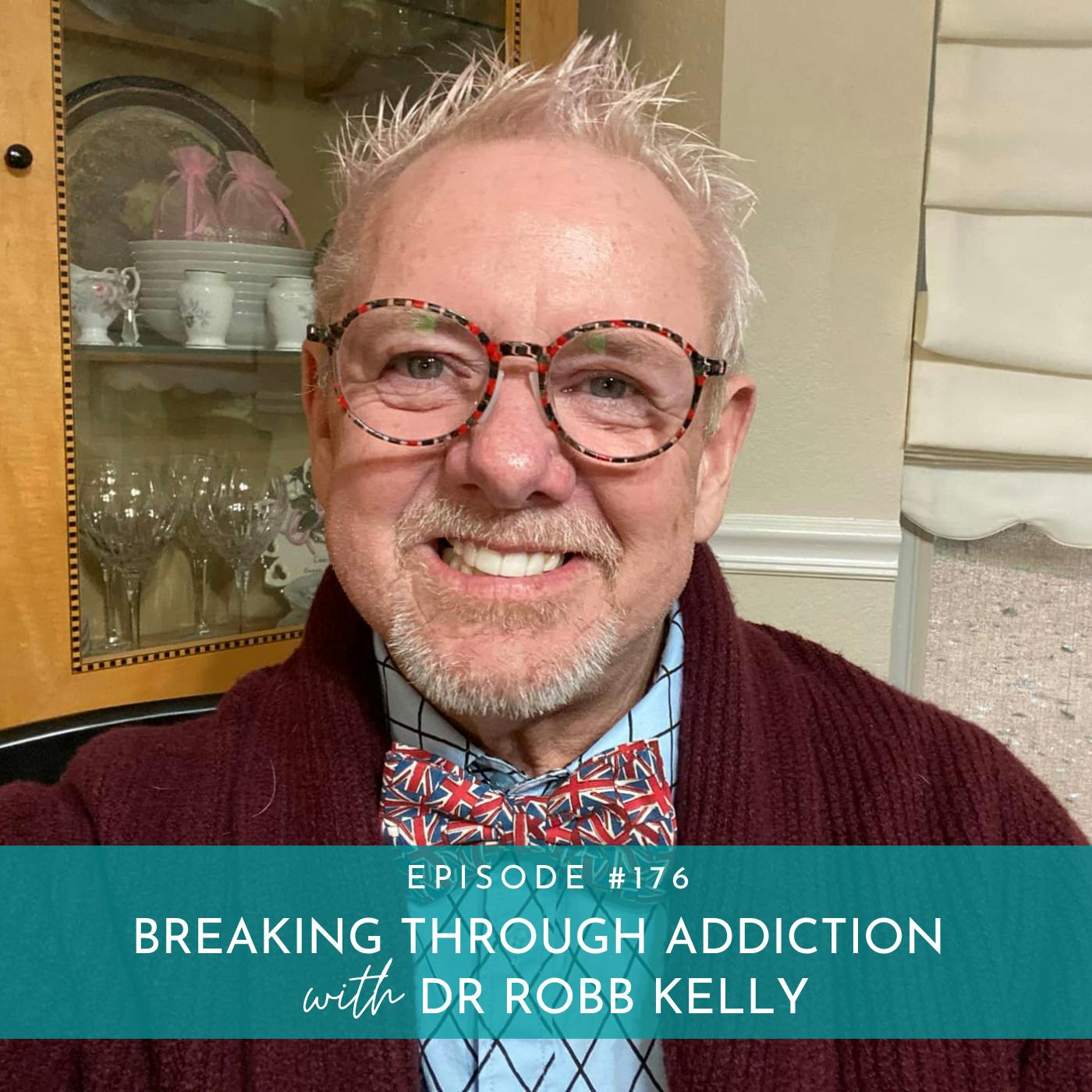
About This Episode
We're talking about addiction and sobriety in a new way on the show. You know I've been on my own journey with sobriety for several years now, and it's a daily choice. Part of my purpose is transforming my pain into helping others to rise above whatever circumstances may be driving them towards addiction. My friend Dr. Robb Kelly knows so much about how to do this. Being a recovered alcoholic himself, he helps addicts understand their family's role in their addiction in order to become sober for good. Here's just one insight he started off with: "Alcoholics are born, drug addicts are made."
Robb Kelly, PhD is a world-renowned addiction expert who believes in treating the problem, not the symptoms. He has worked for many years helping addicts and alcoholics to recover their lives from the disease of addiction. Based on his own experiences working with addicts and alcoholics over the last 20 years, combined with a PhD in psychology, and as a recovered alcoholic himself – he is a triple threat against the disease of addiction. Dr. Kelly's philosophy may seem unconventional and unorthodox. But, they are based on extensive research and behavior studies that he conducted over the last 20 years. He pulls the disease out of his clients and empowers them to fight their disease head on.
Some people have referred to him as "The Gordon Ramsay of the Addiction World" because of his direct, no-nonsense, and candid approach to recovery. He has discovered that in order to get his clients to change their thinking, they must confront their disease with candor and vigor. Dr. Kelly works to "make the road of recovery less of a mystery tour." Robb Kelly, PhD has worked with thousands of people including celebrities of film, music, and sports. He has lectured at many high profile universities and hospitals on the subject of addiction, and is recognized as a leading authority on addiction recovery methods that are changing lives all around the world. Today, he is living his dream, instead of dreaming of living.
In this episode, Dr. Robb shares powerful insights into addiction, sobriety, healing our bodies and minds, and much more. He is so generous, he even shared his personal cell phone number at the end of the episode to be available to anyone facing an addiction crisis!
Here's what you will learn:
- The ways that drug addiction differs from alcoholism (8:33)
- Why somatic experience works (13:21)
- How alcoholics respond to tone (20:10)
- How brainspotting works (29:27)
Tune in to this episode and learn something new! Share it on Instagram and tag me at @amberlylagomotivation and @drrobbkelly then share it with a friend!
Follow Robb
If you are ready to leave your mark by discovering your message and sharing it with the world, you've come to the right place!! Let's work together to build your influence, your impact, and your income! Join the tribe you have been waiting for to activate your highest potential and live the life you deserve! Join the "Unstoppable Life Mastermind!" and let us know you are ready for greatness!
Read the "True Grit and Grace" book here and learn how you can turn tragedy into triumph!
Thank you for joining us on the True, Grit, & Grace Podcast! If you find value in today's episode, don't forget to share the show with your friends and tap that subscribe button so you don't miss an episode!
You can also head over to amberlylago.com to join my newsletter and access free downloadable resources that can help you elevate your life, business, and relationships!
Want to see the behind-the-scenes and keep the conversation going? Head over to Instagram @amberlylagomotivation!
Audible @True-Grit-and-Grace-Audiobook
Full Transcript
Thank you for tuning in to the True Grit and Grace Podcast. I'm Amberly Lago and I'll be sharing inspirational stories of resilience and empowering ideas to elevate your business and your life, ignite your passion, and fuel your purpose. Hello and welcome to the True Grit Grace Podcast. I have a real treat for y' all today. Dr. Rob Kelly is with us. He's the founder and CEO of the Rob Kelly Recovery Group. He's a sought after recovery expert who believes in treating the causes of addiction and not the symptoms. He has appeared all over the news and media. You may have seen him on the doctor's TV or maybe Good morning Texas, USA Today. The list goes on and on. He's got his own show, his own podcast called Breaking Through Addiction, and he's got a book out called Daddy, Daddy, Please Stop Drinking. So I'm super excited and honored to have you here, Dr. Rob. Thank you for being here.
Oh, thank you for having me, Emily. It's, it's just a blessing to be here completely.
Well, I, I've really been looking forward to this, especially I got sober back in 2016 and so I really respect all that you share. But not only the, you know, you're a PhD, you have studied it, but you have lived the life of overcoming addiction. And you had this aha moment. You were living on the street. Can you please take our listeners back to the moment where you realized that it was so much about your thinking and not the actual drinking? That moment when you went to go buy some vodka.
Yeah, of course. It was a huge moment for me, of course. But I'm stood outside a liquor store that's also a news agent, sells all kinds of stuff in England. And they can sell alcohol at 10:00am forward to 10:00pm this was around 5:30 in the morning. I'm living on the streets. I'm actually dressed in a, in a small vest, pair of shorts, flip flops. It's snowing and I'm sweating profusely. My head is banging, I'm shaking. I feel like, oh, death completely. And I kind of know in my mind from previous times, if I don't get alcohol or get to the hospital in the next hour or so, I'm gonna go in to DTs and I'm probably gonna die. And this, oh, God bless this shopkeeper, Amberly. He, he opens the door because he knows me by now. He knows I suffer from some sort of drink problem. And he allows me in about 6am closes the door behind me, and I've got my 10 pound in my hand. I remember putting my 10 pound on the counter and he put the bottle of vodka on the counter. This day, I'd never noticed it before and this was my reaction. The shake stops, the headaches. When I felt great, the attitude changed. Excuse me. Everything changed right there and then. I remember looking at the shopkeeper, looking back to myself, back to the shopkeeper, back at the vodka and I went, oh my God, it's not the alcohol. And it was right there. And then I realized that it wasn't a drink problem. I had, I had a think problem. And that was the difference.
Right then and there you realized, wow, it is not the drinking, it's my thinking. But then how did you start to change your thinking?
Well, from then onwards I went, I was on the streets for 14 months, did everything imaginable to survive. And then.
And you were living in a million dollar home. Living in this beautiful home. And I, I just share that because there's, you know, addiction doesn't discriminate, doesn't matter.
Oh, I like that. Yeah.
Who you are, where you come from, once it gets a grip on you, it's got you until you can change that thinking. But then how do you start to change your thinking?
Well, there's a couple of things that we use our studies into alcoholism. I don't think anybody out there, any of the doctor like me, has studied the alcoholic brain, not the addictive brain with drugs and alcohol, but just purely alcohol. And what we found, there's two parts of the brain that act differently to the normal person or the drug addict. There's a difference. One is the hypothalamus. Let me tell you what that does. Hypothalamus is our fight off, like part of the deal. Tells us when to eat food and drink water to survive. It's the reason why we don't have to teach children to eat or drink because it's just a natural occurrence. So that's the hypothalamus. What happens to the hypothalamus with the alcoholic is after a period of time it tells the alcoholic to drink alcohol and not eat food or drink water. That's why alcoholics like me can go days, if weeks without food or water. So that's one part of the brain that differs. So we have to, we have to correct that manner. The other one is the basal ganglia. Now this is where it gets important and really interesting is the basal ganglia is in the brain. And that's how repetition strengthen and confirms part of the Brain. For instance, if a pilot wants to become a pilot, he has to do 10,000 hours in the air. It's that repetitive thing about learning. Then it becomes a daily action and then we can do it. So it's a bit like driving a car. When we first drive, it's huge and we're scared of hitting other cars. And a few months down the line we've taken our test, we're out on our own, reverse down the driveway, wait to the wife, talk to a friend, listen to radio at the same time. That's because that circle's been complete pertaining to that action. What happens with the alcoholic brain is the basal ganglia is damaged and it's usually around. If it's. If you look at the round clock, it's usually around 5, 2. Because we're born this way. So alcoholics are born, drug addicts are made. So this deformity in.
Wait, say that again. Alcoholics are born and drug addicts are made.
I know every time I said that people go, whoa.
Well, that's very interesting. I mean, I always thought I was so different from so many people in my family that were alcoholics. I'm like, oh, I'm the different one. I'm not like them. I'm the successful one. I'm the athlete. And lo and behold, it got a grip on me. Good. But. So that's very interesting that you say that alcoholics are born, drug addicts are made.
Yeah. So let me talk about the alcoholic for a second. It's a predisposition passed down from generation to generation. It may skip a generation and this why alcoholics are born. But we're born this way with the default hypothalamus and the basal ganglia different to anybody else, really, alcoholic. So if you think you're an alcoholic and there's alcoholism in the family, even though alcoholism is the only self diagnosed illness in the world, we can't trace it. You have to diagnose yourself. You're probably an alcoholic. If you're abusing alcohol, dad's an alcoholic, or mum or uncle or cousin. Okay. So we're actually born this way. As soon as we take the first drink of alcohol. Because everyone says we're allergic to alcohol, we're actually allergic to ethanol in alcohol. And as soon as that first drink is taken, what happens is a series of things within the body. The mental obsession, which is my two parts of the brain, hypothalamus telling me that I need alcohol and nothing else starts that disease off. And then as we go through the Cycle. Everything's good. And you know this, Emily, everything's good. Got the kids back, got the WI fi, everything amazing. Got a raise at work, got a new car, and then bang, out of nowhere, literally. If you ask an alcoholic why you relapse, give me one reason. He's not got one. He's got a thousand excuses, but not one reason. Because there isn't a reason. When that clicks about 5, 2, we go to self sabotage. Remember, it's not about the alcohol, but my self sabotage is alcohol. So we don't really stand a chance when we take that first thing. We're on that time clock. Now, that time clock could be 5, 10, 20, 30, 40, 50 years. But sooner or later the hypothalamus is going to tell me to drink alcohol only. And that's what it really takes off. And you have a few options that when your brain is telling you to do something, you either get treatment or you end up in jail or you die. And the latter is usually the case because people think that alcoholism is a choice. How can alcoholism be a choice when my brain is telling me to do something? So if you've ever been to the doctors and he gets that little hammer out and he taps your knee, your knee jerks, you've got no control over that. Me drinking alcohol was a knee jerk reaction because of my disease. I didn't choose anything over alcohol. I had no choice. And when I got well and recovered, I'm a recovered alcoholic. When I got well, I was giving my choices back.
That's powerful. Well, I. You explain it so well. A lot of people don't understand. And I remember, you know, realizing that I had a problem telling my husband, and he's a retired cop and he was he not an alcoholic by any means, you know, and was used to arresting people that were alcoholics. So imagine me coming to him and saying, hey, I think I got a problem, I think I might be an alcoholic. He was like, no, no, no, no there. Anybody would drink if they were dealing with what you're dealing with, you don't have a problem. But I knew I had a problem. What do you say the first step for someone to get help would be?
Well, let me answer this first. Most people that end up drinking past the three stages of alcoholism, the normal drinking, heavy drinking, abusing, and alcoholism, many wouldn't have gone to the final edges and probably stopped drinking in time, depending how far down the scale they got. If friends and husbands didn't say, oh no, you're not an alcoholic. So we go out there and go, I'm okay. Well, you're not okay if you trace it back. So the first thing I say to anybody is, start dialogue. End of story. The worst thing for an alcoholic is isolation. Most tests we've done on death row, we have a great prison over here in Texas. Probably about 90% of people that go to the chair were insane because of the isolation. So we tend to withdraw away. So dialogue is very important. And I tell parents all the time, you know, parents. Well, I'm. I'm sure he's drinking, but, you know, I've got to kind of respect his. His, you know, his privacy. No, if you. If there's alcoholism in the family and you think your child may be drinking, you need to get in there real quick and search that bedroom, because I would rather him not speak to you for a couple of weeks and be upset with you. Then it go to the full stages and he died. You know, you've got to find out if there's alcoholism. The family talks need to happen real early in life. And I'm talking six or seven or eight where we have to have that talk, because I didn't get that talk. Nobody knew about alcoholism back in the 70s and 80s.
Oh, it was very hushed there still. So I feel like so much stigma around it. And it's something I remember when I first got sober even, you know, my husband was like, oh, no, let's don't. Don't talk about, you know, being an alcoholic. Don't, you know, Because I was. Wanted to talk to my daughters about it. Now he has, you know, he is like, okay, I guess she is going to stick to this sober living this sober thing that she's doing. But it was, It. It was very hard. And now I talk to both of my daughters about, because I think it's important. And my oldest daughter, you know, her. Her fam, her dad's family, there's a lot of addiction there and on my side. And so she knows double whammy. She's got to be really careful with both parents. So what are. I looked at some of the things that you do for treatment, and something that I've really been interested in is you're a Somatic experience practitioner. What is that exactly?
Somatic experience has been around for years and years.
I've heard of it, and I just don't know what that is exactly.
Yeah, it's a form of meditation, but what we're listening to our body. So what happens is we release a lot of stuff during this meditation, but our Body tells us everything we need to know before it happens. So let's talk about the. The gut feeling. Everyone thinks, you know, it's kind of a Housewives myth. The gut feeling is so true. It goes back to the tribal days when one of the tribesmen would get gut feeling, meant they were danger near. So they get up, prepare to fight, or they would leave the area. We don't notice that today. If you notice that when you make a decision and it's wrong, most people go, I should have gone with my gut feeling. So somatic experiences are a little like that. We're feeling our body, we're feeling the numbness, we're feeling the pain. Somebody's lost somebody. There'll be heaviness across the chest. And what we do for a series of sessions is we get rid of. Of that heaviness and realize and feel it and understand exactly what's going on. And the reason why I did that, Amberly, is for one reason. That was nine years ago. I was in the height of my career. I was on TV every day on a national TV program. And there was trauma that I hadn't played up. And it came to fruition during all these high pressures. So they sent me away to the desert for this place that. That dealt with trauma. And somatic experience was one of the tools. And I got so much out of it that when I came out of there, I spent six weeks there. I said, I'm going to learn this, and I'm going to start teaching and practicing this because it's amazing which. Which we do today. So the couple of tools we use is obviously normal psychology. We use nlp, neuro linguistic programming. We use sc, Somatic experience, and we use brain spotting.
I want to talk to you about all of this, but I want to get back to what you had said. So your life was going great. You're on TV all the time. But there's a lot of pressure with that. And suddenly you are the person that people are turning to to get answers about addiction and recovery. And what was the trauma, if you don't mind me asking? That kind of resurfaced, started to. Were you feeling like you were triggered or what was going on?
Well, trauma is the gateway drug, period. Everyone who suffers from addiction, alcoholism was trauma, period. Now, let's. Let's define that trauma. And that's what I had to do. I thought I cleared up the streets, the loss of my children, but I hadn't. And there's one particular time when I was talking to the therapist and I don't know why it came about. He said, how many pairs of sneakers have you got? I said, about 80. He said, 80 pair of sneakers? Said, yeah, just, you know, buy them when they're on sale, stick them, wear them all the time. And he said, let me delve deep. And he took me through my childhood and an occasion came to me where we had to walk to school a couple of miles and in the snow. We only got two pairs of shoes a year. My. My parents were very poor. We were poor. So I would walk to school and there'd be holes in my shoe. At a certain point, my mommy used to cut around a cardboard box and stick the sole between my hole in my shoe and my sock. And I always had holes in my socks. So after about 10, 15 minutes, the snow would wear through onto my bare feet. And I'd, you know, obviously suffer from that. And he asked what my mom and dad did. I told him mum was a cleaner of houses and dad worked for the gas company. And when did they go out? And I said, they go out every Friday and Saturday night. He said, why did you have holes in your shoes? Smoke it on your Ford, you know, shoes twice a year. That's what we got told. And this is what he said that blew me away. He said, when your mom and dad go to the bar, they have holes in their socks and shoes. I just crumbled. It's things like that that I didn't know. So the correlation of what happens in trauma and what happens in real life here, as an adult, as a. As an individual, you will not put that together. It's impossible to put it together. So when you're talking about learned behavior and a measurement, depression can be passed down just one of the things from parents to child. Then you're talking like, everything that happened to you as a child, you really need to look at and describe and pick, uncover, discover, discard of this stuff, because the trauma will come back and it will kill you eventually. And people only just now last five or six years, we're looking at trauma as, oh, my goodness, this is it. So we came up with a saying a lot of people don't like, but it's so true. We don't make statements, okay? Unless we can back it up. Anything less than nurturing. I'm talking about alcoholics and maybe drug addicts. Anything less than nurturing is child abuse. You see, the alcoholic brain, here's things different to the normal brain. And give me instance. Me and my brother stood on the kitchen table one day My mom walks in and she says in this tone of voice and exactly. Get down off the table before your dad gets in. Get down. My brother jumps down. I freeze. Why have I frozen? What I hear. Get out of that table is what I hear. And people are like freaked out when they hear that is because our brain, the alcoholic brain, is always that fight or flight response in the background. And we notice and our stomach and we hear things differently. And you know, and people say, well, I've just said that to you. But we hear it differently. That's where people go, hey, we're very sensitive people. Yeah, that's kind of the whole umbrella to pick it up. We hear things and we see things differently than other people because it's all a drug. We're all, we're all addicted. It's not true. Now, they both present the same and 12 step programs. Therapy can heal any addiction. I agree with that. But when we start picking the brain, there's a difference.
Do you think. So what you're saying, do you think that alcoholics are more sensitive to tone 100?
So if, let's say a brain, if you want to calm down as an alcoholic or drug addict, the amygdala is where we want to hit. The amygdala will calm everything down. So how do we do that? We listen to songs with one coordinate, maybe a riff, but one chord. Whole Lot of Love by Led Zeppelin is a prime example. And what happened is the brain connects to that one chord repeatedly and starts to calm down. But if there's more chords, the amygdala is looking.
Oh, my goodness.
I know, right? Isn't that crazy?
Well, it just makes so much sense. And I, you know, I talked to my husband. He's Cuban, he grew up in a family that's very loud. And he says things with a certain tone. I am very sensitive to. My daughter is very sensitive to. And we'll both say, oh, my goodness. Why, why are you yelling? You don't have to yell. And he's like, I'm not yelling. And I'm like, you are. You know, and even at night, I have a nightly ritual where I call, I drink tea, I like candles, I like have calm music or nothing, complete silence. And I'm very sensitive to what's going on the tv. And, and. And my husband just oblivious to it. My daughter is very sensitive to. She's 14. And so all that you're sharing makes like. It makes so much sense. And with the trauma, I mean, things that I thought that I had dealt with, I'LL never forget I went to a therapist. And she goes, I didn't even tell her I was sexually abused as a kid. She goes, were you sexually abused? I'm like, yeah, but I've already dealt with that. I've already healed, that I've got. And she goes, no, you haven't. You know, and she knew, like I was like, golly, she's good. How'd she guess that? And so yeah, trauma is trauma. And you're. I just wonder, like, is something like. So I do a 12 step program. I have a healthy fear, I think, of any kind of pills, knock on wood. I've never been addicted to any kind of pills or drugs, but I have a healthy fear for that. I actually lost my sobriety after five and a half years for one day. And I got right back in it the, the next morning. But there was so much shame about that and losing my sobriety. Why do you think it is that we can be doing good? The obsession seems to have been lifted. Then out of the blue, without even thinking, we reach for drink or a pill or something.
Two things. First of all, the trauma and the basal ganglia has not been cleared. So you're always going to self sabotage. And the other one is, is a spiritual connection. You know, we need that spiritual connection. I'm gonna talk about, I'm talking about God, but. And you can choose any God, Hala, Jesus, Buddha, whatever you want to choose. But there's got to be that connection. There's trials and tests, is done, years and years and days were born with a fundamental idea of God and we lose it completely. So let me tell you this. Hang on to your seats at home, guys, if you're a 12 step person or not. When a spiritual awakening happens and a psychic change, which is change of neural pathways, the medical fraternity found out seven years ago, our DNA changes. Why is that important? Because the same man will take a drink again. Nothing changes. Nothing changes. So we go along, you know, going to AAA meetings, naca, everything like that. Meetings will never keep you sober, period. It's not, it's when we talk about 12 steps, it's not the meetings we make, it's the 12 steps we take when you do exactly what it tells you. And by the way, that book, we all have 27 years of studying the brain trauma, alcoholism, that's the best book I've ever read pertaining to the wellness of an alcoholic. But once we do that program, you cannot relapse if you follow the directions. And most of it is healing that basal ganglia is repeatedly doing things on a daily basis that take away self sabotaging neural pathways, which is my learned behavior from, from caregivers. So any one time I, my brain wants to self sabotage and make and kill me and make look like an accident. So I was at a place once, I spoke in front of a thousand people. 999 said it was amazing and one person said it was crap. Have a guess who I focused on and almost relapsed was that one guy. Because going back to what the brain hears and sees is completely, utterly different to other people though I think it's really understanding that you need a full knowledge of what you're suffering. Otherwise, you know, the medical fraternity are baffled. Therapists who are not alcoholics or addicts cannot treat people with alcoholism and addiction. Yes, there it is, guys. I said it, but it's so true. You know, I, I see a therapist and the first thing I asked her, we went for a couple are you alcoholic or addict? And she says no. I said, I don't think you can help me. Well, I've been to Harvard University for 10 years. And then, okay, here's a scenario. You've got a bottle of vodka behind your back and I have a knife. I'm going to repeatedly stab you till I get that vodka. She steps back and goes, whoa, that's a bit aggressive. Said, exactly. Goes to another guy, tells him the same story. He goes, oh yeah, me too, my God, me too. That's my guy. Because he understands what I'm going through. Well, people are misunderstood about a misinformed about alcoholism. They think it's a choice. When I lost my children, that wasn't a choice. You know, I was the choices. Not only whether I drank or not, but everything else in life was taken away from me. Because every time I build something up, I crash down. Every time I go around the basal ganglia goes self sabotage. Now the other people don't realize my self sabotage is never at the bar or the liquor store on a Monday. Take it back a couple of days, even a week. When I started an argument with the boss over nothing, that was my relapse. The rest is what they call a black mental spot. When you get to the alcohol, it's all over. That's not the relapse. The relapse is my behavior, my trauma and my thought pattern.
Wow. Yeah. That's how I had to kind of trace back like how did this, what happened? And it was a period of all these little things that added up. And then there, there it came you know. Well, how do you start to change that? The hypothalamus? How, how do you heal that? How do you. Is it ever healed? Can you change it?
Yeah, you can change it. And this is where that word God comes in. So we need a little help off a God. A God. 27000 gods. Just pick one. We need that spiritual frequency from something up there, you know, that's going to help us. Uncle Billy, God, you know, universe, whatever. We need an intervention from that. That's why the spiritual experience and also the basal ganglia, the self sabotaging neural pathways, once they're directed away from self sabotage, the brain starts to heal. Now a hypothalamus never heals correctly. And what I mean by that is if we're not doing things on a daily basis, we will self sabotage. Because there's more alcoholics are born with more neural pathways that self sabotage than, than, than. Don't. So let's say this is the main freeway out of your city. Let's call it. I tend to. That's disaster, that's drink. That's self sabotage. What happens when we start working, working in the program and under my care is, and these are the good ones, it kind of does this. Okay, so now the knee jerk reaction is good. Knee jerk reaction is healthy. Helping people, you know, being kind. But this guy's always here. So if we come away from that, you know, principles and program or therapy and we go, I kind of got this. My brain left to its own devices, will want to kill me, period. One little thing that goes wrong, I will make that huge. I ask people all the time, oh, I've had a bad day today, Rob. Was it really a bad day or was it five minutes that you spread around for 12 hours? Because that's what it usually is. That's the alcoholic brain. You know, it wants to go drink, it wants to self sabotage to their highest form. So we have to really keep on our guard and make sure. So there's four chemicals in the brain that needs to happen every single day for us to taste over and us to be happy. First of all, you've got endorphins. Get to the gym, walk around for 20 minutes, do anything, exercise type, and the endorphins will flow. The next is dopamine, the reward system. Compliment three people every day. Great shoes, great sneakers, great hair. Dopamine is released into my brain when I say that I love that serotonin. Get out and see some sun, go out and mix with people. The serotonin is the is a mix in the social belonging. And the last one but not least, oxytocin, which is our cuddling color, cuddling hormone. That's our intimate with another person. Not sex. Intimacy with somebody else. A close friend. Hugging people, being belonging once them four things are going and we've sorted out the two different parts of the brain and you, you can live happy, joyous and free for the rest of your life. I ask my guys all the time, how long are you going to be sober? Till I die. Well I thought it was one day at a time. No, no, no, no, no. That doesn't pertain to any 12 step meeting. That was, that was many years and years and years and years ago they came on that same with churches and spiritual guidance is 24 hours. Is it a coincidence that the two parts of the brain reset every 24 hours?
Wow.
Yes, wow.
So I, yeah, I definitely want to learn more now about the somatic experience. I have done nlp, but I wanted to ask you one more question. Brain spotting, what does that mean?
Brain spotting is away from. It's a bit like evmr. It's only been around for about two or three years. There's only six of us. I think that can do it. It's a direct import from the pupil to the subconscious brain. So we can pull trauma out that you don't recall. Many people think we have the eye and then we have like the optical strip and then we have the brain. The eyes are part of the brain. The eyes are bulging out from the brain now. Google it guys, I know you're not going to believe me. So it's part of the brain so we can go through the pupil, down the optic lens through to the subconscious brain with a technique, with a, like a, a kind of one thing that we do and we watch for the, watch for it to change. I use this, you know with the eye movement left and right and when you flicker that's where the trauma is. You can trace really. Yes. And we bring it out. We've brought so many people back because it's a subconscious brain. So what happens is if I'm going to relapse or depress at anything, what happens in the subconscious brain? It sends a message straight down to the central nervous system. Now I start getting that butterfly feeling. Now I just don't feel good. And that might be a day or two day I'm grumpy, I'm irritable. And what happens is it flips over the prefrontal cortex and we're done. Once it gets to the prefrontal cortex that has one job. Come up with a solution as fast as humanly possible to my problem. Well, I think, guess what? Alcohol was always my solution. And we go round and round and round and round and all sorts of crazy things happen and losses and bereavements and, you know, all this stuff that we do. Because nobody understands properly what alcoholism is. If you go out, if me and you went out your street now and do a survey in Texas and ask 100 people, what's alcoholism? You'll get answers like this. Somebody drinks so much alcohol, somebody who can't stop drinking, somebody that loves alcohol more than the kids. It's like, no, none of them are correct. I have a disease. I'm allergic to ethanol. I have a. I have a mental obsession over it. Now, for those guys who don't know what a mental obsession is, a mental obsession, the hypothalamus telling me this. You ready, guys? Drink, drink, drink, drink, drink, drink, drink, drink, drink. You can't think of anything else. Okay? Your head is going like crazy. It's like, oh, my God, what should I do? What should I do? What should I do? And eventually, if you want some peace and ease, you take that first drink and everything calms down. But the problem being is we can't stop now. That's the problem. That's the qualifying question. I ask, when you take a drink, can you stop? And if the answer's no, you're probably an alcoholic if it's in your family. But most people are misunderstood about that and don't know enough to tell the difference between a heavy drinker and an alcoholic. There's a difference. Your husband will know this probably difference between the Friday night drunk and a Friday night alcoholic. One needs to be locked up overnight to sober up. The other needs to go to treatment or hospital because it's not his choice. And I teach this with the police all the time and the guy that teaches at medical hospitals with doctors about alcoholism and addiction. So it's very important that we try and delve more into it and understand that alcohol is 1% of alcoholism. That's all it is. The rest is the disease itself with parts of the brain. And the final 80% part is trauma.
Wow.
Those guys that don't drink alcoholic, but born into an alcoholic family and go, hey, you know something? I'm not going to touch drink. Because what I've seen, they're the guys running Google, they're the guys running Facebook, they're the guys running Amazon because they're we're the smartest guys in the room when we don't put alcohol in there.
Wow. So you do you go to a lot of the prisons and teach?
Yes, I do. Wherever possible. I do. If some. Somebody comes up and goes, hey, Dr. Rob, I've got, you know, can you come here? Always Prisons. We do a monthly thing with our veterans. Want to talk about trauma and PTSD. We do 20% of our work is pro bono and for people who are, who are drowned in this disease. People are veterans. People are ex police officers suffering with trauma. We like to cover all of that giving back. We also give around $150,000 back to one parent families and trying to get sober. We'll pay for court costs, we'll pay for clothes for the interview. We'll give you six months rent. If you're a guy trying to see your kids, will pay for all your court bills. And, you know, it's just, it's part of what I have to do. And Amberly, you'll know this while I'm giving back and I'm squashing my dishes, right? You know, when everything's flowing and it's just, it's a must for me, you know, I could sit back now, right now and go, hey, you know something? Never have to work again. I'm going to sell a house, going to move to an island somewhere. I can do that 10 times over. But the reason I don't is because I was chosen to do this don't is because I'm chosen to save other people and their families going through that. That's my primary purpose in life, is to get people up. We're not in the addiction industry. We're in getting people's family back together industry. When their wife of the alcoholic is involved in the treatment program, the success of the alcoholic goes up by 40%. This is a big disease. It needs to be a family recovery.
It sure is. It sure is a family disease. And, and I had to explain to, you know, my husband, like, well, this is crazy. So I went from sneaking my drinking to sneaking going to recovery because it was like, he was like, that was very in, I think embarrassing for him to, you know, and it took a lot of courage. And there were times he'd be like, aren't you gonna have a drink? You can have a drink. And I'm like, no, I am not gonna have a drink. And I finally had to explain to him one time, like, in the very beginning, it was really hard to stay sober. I mean, I had the shakes and I Had to tell him that it, it's really hard. I don't, you know, I didn't appreciate him sliding a drink over to me or because it made it even harder. I know addiction is on the rise and I love that you share that. It is a family disease. It affects us all and I want people to be able to, you know, change their lives, change their families and I just loved it got me all teary when you said that how much you give back and you understand it. My husband gets upset sometimes at how much I do. He's like, you don't have to do so much. And I'm like it. For me it turns pain to purpose and I have, you know, purpose that keeps me sober. And so I would love for people, especially if they know someone and I think we probably pretty much all know somebody that is struggling with addiction to get help. How can they work with you? Can they get in your program? Can they work one on one with you as well?
It's just one on one only. I only take on between four and six patients any one time. If you're thinking of calling us, let me give me reassure you that we offer a money back guarantee if you relapse whilst following our program. Anytime after the program's finished, I personally will refund your money. First of all, Rob Kelly two Bs in my Rob R O B B K L O Y.com is the website. It's all one on one. We also have a family unit waiting to speak to your wife and we also have as I was estranged from my daughter and live for 20 something years, still not see my youngest one. My eldest daughter Charlie. Charlotte is my teen therapist over in man Manchester office uk. We got reunited three years ago. So we kind of got you covered guys if you need help with the guys and we guarantee our work for sure. And the other one I want to really say real quick, which I think is important going back to what you just said about really doing this for the right reasons is if you're sat at home now and you think that you're never going to amount to anything, if you think suicidal, if you think that this is it, first of all I want to apologize to you because somebody's put that there. We're born with million dollar minds but we hang around with 10 cent minds. That's our problem. And the second one, I would rather spend 10 minutes on the phone and give you a pep talk that will change your life then hear of your funeral. So here we go. My personal cell phone number. Guys 214-600-0210. You will cut through all the BS out there. You'll come straight through to me. Text is always first. And yeah, here to help. Guys.
You are incredible. Thank you so much. So can they find your, your show? Can they listen to. Because you host a show as well. Can they find that through your website as well?
Yeah, you can find on the website. You can also come on the show if you're struggling. We always say, you know, everybody knows somebody that struggles with this disease, and if you don't, then it's probably you. The other thing I'll mention is the book is on there. It's the last thing my eldest daughter said to me before I got back into, you know, talking to her many years later. And that's Daddy, Daddy, Please Stop Drinking is the name of the book. And the reason why I mentioned only is we don't take a cent of that book, but it's part of the $150,000 a year. We get back, get on there, buy it. And again, we're not all about the money. If you don't like it for whatever reason, send me a text. I'll refund your money. Pass it on to somebody who might enjoy it.
Oh, you are amazing. You are an angel on this earth. Thank you so much for being on the show and I believe I'm hoping that I get to see you in person. I think we're going to be speaking at the same event called Create with for Ken Joselyn in Atlanta, along with John Maxwell, Ed Mylett. So I'm looking forward to that. You guys take a screenshot of this, whether you're listening on Apple or you're watching on YouTube and tag us on Instagram. What's the best place on Instagram for people to tag you? Because I think you have a couple of different handles.
Maybe I do, but you know something? Oh, it's going to sound horrible, but my media girl does all that. I have no idea. Just Dr. Rob Kelly on Facebook. You'll get all the links from there.
Okay. Okay. So y' all can tag some. Some people might be on Facebook a little bit more. I'm mostly on Instagram, but yes, please reach out to him. That's so kind. If you're driving and you can find his number, the website, all the details in the show notes so you don't miss anything, but reach out and give him some love. Tell him that you heard his interview on True Written Grace. Thank you all for tuning in. And Dr. Rob Kelly, thank you again. For being here. I appreciate you.
Thank you so much, Sam.
Pain to purpose to joy.
Never Miss a Conversation
New episodes drop regularly. Subscribe on your favorite platform and never miss a conversation.