

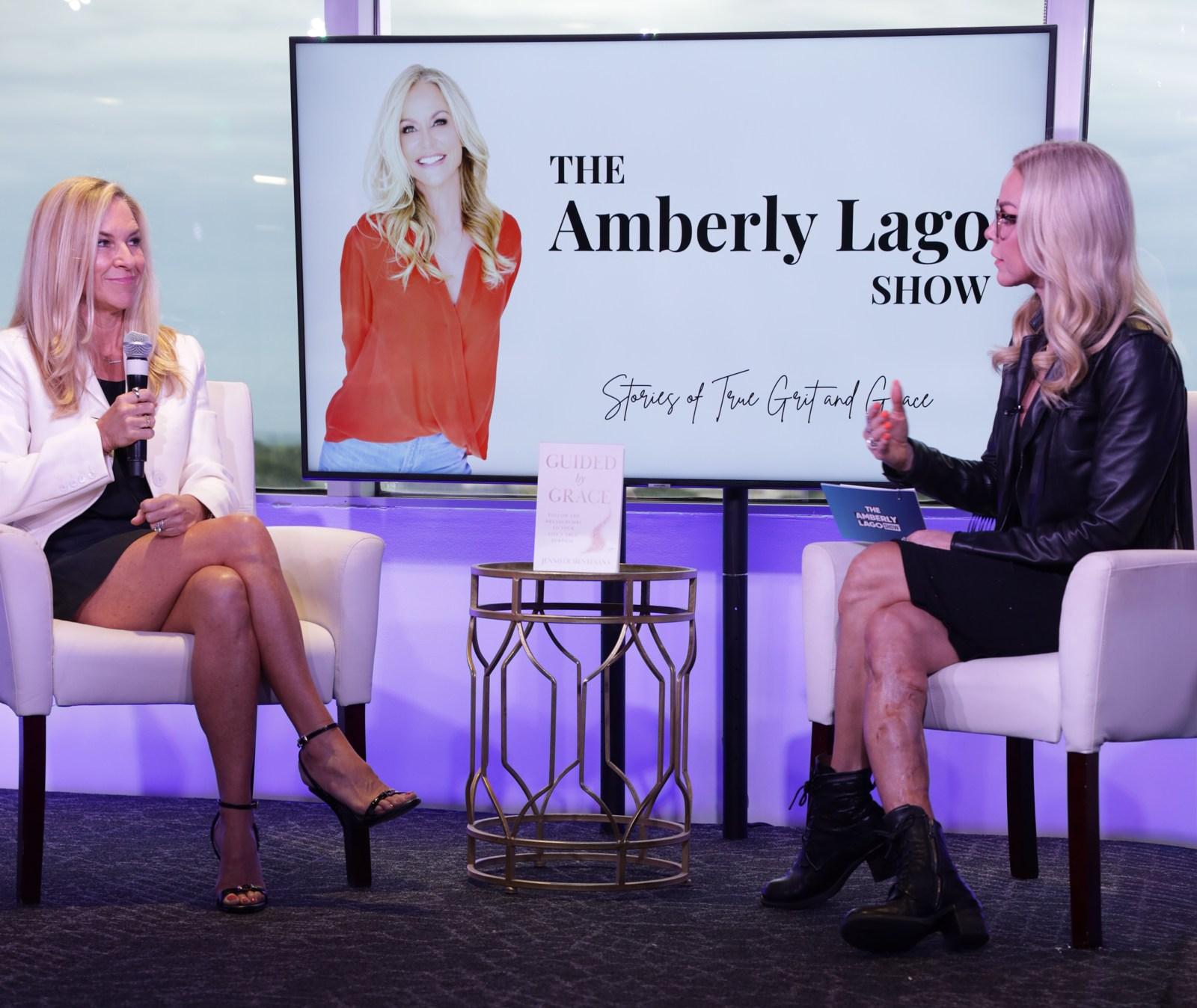
Season 5, Episode 209
Breaking Free from Codependency with Corrine Stokoe
A conversation with Corrine Stokoe

About This Episode
"It's the quality of your relationships is what's really going to move the needle."
In this episode of True Grit and Grace, host Amberly Lago welcomes her friend Corrine Stokoe, an inspiring entrepreneur and mother of five. She and her husband host the top 10 rated podcast Mint Arrow Messages.
In this inspiring episodes, Corrine shares her journey as the creator of Mint Arrow and her passion for using social media for good. They discuss Corrine's upcoming bootcamp, Code Free Bootcamp, and delve into the topic of breaking free from codependency. Get ready to be inspired by Corrine's real-life struggles and successes.
Notes:
- Explore the distinctions between cultivating a relationship with an audience over time versus experiencing rapid growth (9:30).
- Learn how to identify signs of codependent relationships and gain insights into recognizing such dynamics (14:25).
- Understand the universal applicability of the 12-step recovery process for both addicts and their families, shedding light on its broader impact (21:15).
- Delve into the narrative of how Corinne conceptualized and coined the term "codafree" (28:05).
- Differentiate between rules and boundaries, exploring their nuances and understanding their role in relationships (32:17).
Links mentioned in this episode:
- Codependent No More
book
- Sign up for the Becoming Codafree Bootcamp
Follow Corrine
If you are ready to leave your mark by discovering your message and sharing it with the world, you've come to the right place!! Let's work together to build your influence, your impact, and your income! Join the tribe you have been waiting for to activate your highest potential and live the life you deserve! Join the "Unstoppable Life Mastermind!" and let us know you are ready for greatness! Read the "True Grit and Grace" book here and learn how you can turn tragedy into triumph! Thank you for joining us on the True, Grit, & Grace Podcast! If you find value in today's episode, don't forget to share the show with your friends and tap that subscribe button so you don't miss an episode! You can also head over to amberlylago.com to join my newsletter and access free downloadable resources that can help you elevate your life, business, and relationships! Want to see the behind-the-scenes and keep the conversation going? Head over to Instagram @amberlylagomotivation! Audible @True-Grit-and-Grace-Audiobook Website @amberlylago.com Instagram @amberlylagomotivation Facebook @AmberlyLagoSpeaker
Full Transcript
Hey, there. I'm so excited to announce the Unstoppable success summit is back, y'. All. We are going to be in Dallas April 19th and 20th, and I want to see you there. Don't miss out on this opportunity to gain valuable insights and make valuable connections and leave with actionable takeaways so you can implement all of these things into your career and level up your life and your business. I've got Ben Newman, Rachel Luna, John Gordon, Rudy Rickstein. I've got a panel of speakers that specialize on publishing, pr, branding, podcasting, and TED Talks. And so if you are ready to level up, if you're like, I've got a message to share, and I really want to increase my influence, it's time to kick the limiting beliefs to the curb. It's time to move forward past your fear. It's time for you to invest in you to bet on yourself. So I want to see you in Dallas. It's my hometown, and I'm gonna make it, y'.
All.
I'm planning some big stuff. Okay? It's gonna be fun. My event planner keeps saying, amberly, you need to reel it in. I'm like, no. In. In Texas, we say, go big or go home. So go to go.amberly lago.com. that link will also be in the show notes to grab your early bird ticket. The early bird tickets will only last for a certain time, and There are only 100, so these tickets will go fast. You're the first to know about it. I want to see in Dallas, so hopefully I will see you there to hug your neck, and let's be unstoppable together. Okay, now on to the show. Thank you for tuning in to the True Grit and Grace podcast. I'm Amberly Lago, and I'll be sharing inspirational stories of resilience and empowering ideas to elevate your business and your life, ignite your passion, and fuel your purpose. Hey, Amberly Lago here, and I'm so excited that you have tuned in to True Grit and Grace, because I have a good friend of mine on the show today, and we were just talking before we hit the record button, and I was like, oh, my gosh. You inspire me so much, y'.
All.
She is amazing. She is an entrepreneur. She's got four kids. She lives in five now. Wait, what? Yeah. How did I miss that?
We just keep popping babies out here. It's easy to miss. They just keep coming.
Holy cow. I did not realize that.
Wow.
Okay, we've got to talk about that. Because, y', all, she. She is started with a blog. I'm gonna put all the links to everything that she does because you will definitely want to follow her and her journey. You'll be so inspired by her. But one of the things I love and is that she really shares the gospel of Jesus Christ and she shows people how to use social media for good. But she's the creator of Mint Arrow and she's been featured, oh, my gosh. In Forbes, Wall Street Journal, Allure magazine, like that. Those are just a few of the things she's been featured on. And today we're going to talk about, like, how to break free from being codependent. And she's got a boot camp coming up called Co Defree Boot Camp. So many other things about the real life struggles to success. So, Corinne Stoko, welcome to the show.
Oh, my gosh, Amberly, thank you so much. And you just are such a ball of joy. I love being around you or even just listening to anything to do because you're just. You make me want to be a better person. And those are the kind of people you want in your life.
Oh, I just got goosebumps. I swear that I call those God bumps.
Yes. I like that.
In the. In the right place at the right time. And I think it was. Was it Henry Amar that connected us?
Yes.
Oh, he's an angel.
He is.
He is an angel. And I know when he says I need to meet somebody that they definitely. I'm like, you're. You're with me for life. You're a friend for life. And so I had the honor of being on your show. I'm just so amazed at everything that you do with. And you started it basically by blogging. How many years ago did you start your business?
10 and a half years ago, I started blogging. And it was when I had my first baby and I had postpartum depression and just was like, is this the meaning of life is just breastfeeding and changing diapers? And I love being a mom. Obviously, I've done it over and over, but, you know, that postpartum depression was so hard. And so what pulled me out of it was just starting a hobby blog. That's all it was supposed to be, was a hobby. And then it just kept turning into something bigger and bigger. And for a long time I was like, okay, heavenly Father, are you sure this is what you want? Because I was going to be a stay at home mom. This was not the plan. And then once I finally put together that, oh, the reason I have this opportunity to reach so many people is so that I can share things that really matter, things that will help people find light and truth in their life and principles that help them to be happy and joyful and fulfilled. That's when it was like, oh, okay, now I get it. Now I understand why all this happened.
And you know what? I appreciate you sharing that you started that long ago, because a lot of times people, you know, can look on social media or they might see you and go like, oh, wow, she is just like an overnight success. And you're like, no. Like, I like, right now you're recording. If y' all aren't watching this on YouTube and you're listening to it on Spotify or Apple or wherever you're listening to. I love that she records in her closet. Like, her shoes are in the background, the purses, and I love that. But you, like, pulled your bootstraps up and you were like, okay, this is what I'm gonna do now. You've got this top podcast. You. You even have jewelry, sweatshirts. I love, by the way. I need to talk to you about that, because y' all have to check those out. How long did it take for you to gain some traction? I understand. Like, you were at first trying to just get through, like, the postpartum depression, which I had with both of my daughters as well. My husband was like, you need to go to a shrink because you're crazy. And I was a little. I was a little.
You feel crazy. You don't feel like yourself.
Yeah, at all. At all. It's really tough. So before we get into, like, how long it took to start that blog and gain some traction on it, was it just the blog that got you through the postpartum depression, or was there other things that you were able to do to get through those moments of where it's hard? I mean, you don't feel like yourself.
So the reason I started Mint Arrow was actually more of the backstory. I had so many people say, you can't just sit in your pajamas every day. And I would. I would sit in bed in my pajamas and feed the baby and put her down for a nap and just sit and feel sad. And it was winter, when it was getting dark at, like, 4:00'. Clock. So, yeah, you know, I was in this dark, isolated home, and so my mom and my friend said, you need to get out of the house at least once a day, even if it's just to go get a Diet Coke somewhere. Like, get out of the house. So we Would get up, get dressed, I would get myself dressed, I'd get the baby ready, you know, bundled up. And it was winter in Utah, so snowy everywhere. You couldn't like walk to the park or you know, spend a lot of time outside with a newborn. So we would walk the mall, Costco, Target, you name it. We would just walk around indoors. And I was finding good deals on things and posting them on my personal Instagram with this hashtag, someone go buy this. And so I would just share deals, even if they were deals that I didn't need. But I thought, well, maybe somebody else needs a deal on. The first thing I found was a Jenny Lind, a green Jenny Lind bed that was, you know, retailed for I don't know, 500. And it was something that I found locally for like 130 or I don't know, I'm just making it up. But it was really affordable. So I posted it and I said, I don't need this, but maybe somebody else does. So hashtag, someone go buy this. And so that is where Mint Arrow was born. Because so many people said, well, you're sharing these deals all the time. You should start something, start a blog or start a separate Instagram. So I did both. And where you talk about this was not an overnight success, you know, there, that actually is kind of a thing right now with the virality of TikTok and Reels where some people are blowing up overnight and that's awesome.
Like, well, on TikTok. Yeah, like, yeah. All of a sudden like my 15 year old daughter is getting millions of views on TikTok and her account went from like 13 people to over 10,000 like that. Like, but she has found her niche. She has found like her community and she knows how to do good tick tock videos. And I keep trying to get her to work for me and she hasn't yet, but I think she's gonna have to. But by the way, also, I love your latest deal with a skeleton. If you go to our house, we've got skeletons. That's the theme of our Halloween. So we've got skeletons everywhere. But. But I love, chose a hashtag and so I haven't looked at that hashtag.
Is it like, it's really not. It's a, it's not a thing anymore. I took that and instead of someone go buy this, you know, as my Instagram or I mean maybe in retrospect that would have been more clear, but we just decided to do Mint Arrow because Mint was supposed to represent money and arrow was supposed to represent like the deal hunting and started this blog. And that was before this was pre algorithm. This was before, you know, you could have a reel go viral. There was no such thing as virality in the early days of Instagram. It was just you built your followers one by one, very slowly. And that is where. When you say this wasn't an overnight success, I think that is where you can't really cheat. That sweat equity of years of building trust and building a relationship with your audience and showing up every day for them and showing them that you don't ever bring them stuff that isn't great quality. And once they experience so many wins over and over, whatever you're doing, it doesn't really matter what niche you're in. Like, whatever you do, if you continually show up and give people really good quality content or suggestions or tips or deals or whatever it is that you're into, that's where people will start to trust you and they'll stick with you for the long haul when you should. Oh my gosh, you're there for them. Yeah.
I could not agree more. And people ask me all the time, like, how did you, you know, grow your Instagram? And I feel like it's. I don't know about you, but I feel like my growth on Instagram has just kind of. It's a lot slower than it was in the beginning. I don't know if it's. There's so many people on Instagram and it's harder to be seen. I don't know. But with, with exactly what you did. I built my audience and just showed up every single day with value and built a genuine, like people that I've known now for six years on Instagram that have been with me from the very beginning, you know what I mean? And I think it's that, that sweat that you put into it. It's the grit that you put into it. Whereas, yeah, a lot of times, like on Tick Tock and stuff, it can just like, oh, wow, that, that video got a million views and that quick.
But where does that go? Where does it lead? You know, if it's, if it's a virality, if it's an overnight success kind of thing. Because I have a friend who, he grew really fast on Tick Tock, but he said none of those people buy from me because there's not a relationship there. You know, it's more just people are there to be entertained where I think if you grow in other place, and I'm not saying you can't grow a great audience on TikTok. But I'm just saying that I think that there, there's something to be said for the type of audience you have when there's a relationship. And, and I also think when you're talking about how fast or, sorry, how do you grow, where it feels like maybe some people feel stagnant, I actually think it's so much more important to have a high quality audience with maybe fewer numbers than to be growing like rapid fire, because it actually can hurt. I know, I don't know if this was supposed to be like the topic of today's podcast, but it actually can hurt you to be, to grow overnight. And I've talked to so many friends who have done that, where they're, they've had a couple reels take off, you know, tens of millions of views, and then they gain tons of followers. But the problem is those followers aren't quality followers. So then they actually hurt their engagement and reach. Because if you think about Instagram and the algorithm, when they get on the algorithm and they look at, you know, their bubbles and they see who's done their stories, if it's not somebody that you have a deep relationship with, they're going to scroll past you or they see you pop up and they're like, who's this person? Because they don't remember why they followed you. So then they, they slide past and scroll on to the next person and it shows the algorithm, oh, we shouldn't show this, these stories to this person's followers because they're not interested. These stories must not be that great. And it's not that your stories aren't great. It's that you don't have a relationship with all these new followers. So then it will actually start shrinking your reach. So growing super fast isn't always necessarily the best thing. It's the quality of your relationships is what's really going to move the needle.
So good. Like, we need to drop the mic on that one. Like, success is built on relationships. I really believe that.
Yeah.
And so thank you for, thank you for sharing that. And there's so many things like when we get on the phone or we have talked before, we could just like talk all day. Because I love everything you do and I'm always fascinated to learn as much as I can from you. And I want to talk about so many other things. There are a couple of things that I did want to talk about. First of all, I remember years ago, I was on a plane, I was being flown to Hawaii I was. This is back in my fitness days, and I was hired to go work with this tennis team throughout the week and do their nutrition and their fitness program and basically stretch them and get them ready for their meets. And so I'm on the plane, and one of the tennis players that was a client of mine threw a book at me, and it was called and Codependent no More. She's like, she knew I was in. She knew who I was dating, because
I literally have it. It's like my second right there.
Oh, my gosh. She. I didn't even know what codependent was, but obviously she knew the relationship that I was in was not healthy. And there are a lot of people out there that might be going, well, what is codependency? How can I break free? And so before we get into that, how did you get so, like, get to be the expert and have this boot camp and come up with your own word code free like that? I love it. That's going to be in Webster's Dictionary, by the way.
Just.
I know it's.
Yes, well, so codependency is something that I didn't even realize I was not. I'm. I wouldn't say I'm an expert at that, but I definitely was very good at codependency for a long time, and it's something that I fight every day because.
Was that with your husband? Is that where you noticed it first?
Yes. So my husband is really open about being a recovering addiction and.
Which I love that he shares about that. And I do want to talk about, like, if you're okay with that, about over recovering from pornography addiction.
Yes. So he actually told me that he was a pornography addict when we were dating, and he thought that was just going to give me closure after he dumped me. And I just, for whatever reason, really felt like, what I call the Holy spirit telling me, like, just listen. Just listen to him. Don't run away. And so we had this really deep, amazing conversation when he told me about his addiction problems. And we ended up dating for two years and eventually getting married. And we both kind of thought that was going to be the magic ticket. Like, we get married, and then that would solve all his problems, which, if you know anything about addiction, that's completely not true. And so that started out on a very long battle with him in, you know, recovery from pornography addiction. And then I didn't even realize that I was so codependent until we started taking, you know, these classes in an outpatient rehab for pornography addiction, where most of the men that came in with pornography addiction, brought like a partner, and they educated us about codependency, and you're probably codependent if you're here. And so I learned a lot about having the savior complex and wanting to fix him and wanting to control everything so that he couldn't possibly mess up. And there were so many things that I really fought at first because I was like, he's the problem, not me. Like, I don't have a problem here. I don't need help. Like, he's. Obviously, we're here because he needs help. And I hung onto that. I just, like, clung to that for years until I reached my rock bottom, where I woke up one morning after his last big relapse. And.
And what does that look like as a relapse for. For porno pornography addiction? Because I know I'm a recover, grateful, recovering alcoholic, and I know what that looked like for me.
Right.
But what does that look like as far as, like, a pornography addiction?
Great question.
What does a relapse look like?
Yeah. So for anyone who's like, a sex addict or a pornography addict, they have to set their own bottom line, you know, And. And I think that's true for most addictions. But for him, his bottom line is if I'm looking for something, if I'm actively seeking, not if I accidentally see something, but if I'm actively seeking something to then, you know, check out and lust act out all of that, then I've broken, you know, my. I'm no longer sober is what he calls it. And I, you know, a lot of people want to argue with me, too, when I bring this up and say, like, that's so healthy. That's, you know, not an addiction. That. And listen, I am not here to fight with people about whether porn is right or wrong. I know there are different belief systems around that, but here's where I can make sense of it, is that if you know someone who has food addiction, you know what their life looks like where they can't. They no longer have control over how much food they eat, because eating numbs the pain of life. And it's the same thing with a pornography addict where we're talking. It takes over your life. The unmanageability of having a pornography addiction has completely taken over your life. So when my husband would relapse, it was like he was back in that trance of he checks out anytime. Life is boring, sad, you know, lonely, any of those feelings. And I'm sure you relate to that as, you know, a Recovering alcoholic. Right.
And so you don't want to feel the pain, you don't want to feel the feelings. Exactly what you're saying, whether it's the sadness, the anxiety, or. Or. I think a lot of times it's when you're not. You don't feel aligned with who you are and what you're doing in the world that you want to just check out and be like, huh, let me. For me, it was. Let me knock one back to numb out this pain. Whereas him, I didn't know exactly what that looked like. As far as, like, recovering from pornography. It's basically the same. You're checked out. You're not thinking of your own reality, and you neglect your family. You're not a good, you know, spouse, parent, friend is what it.
Everything, what it looks like. Going second and third and fourth on the list, work. I mean, any of those things where. If you're a. What we call a normie, you know, people who are normies who can just show up for life without having to have a drug that gets them out of bed and through life and then to sleep at the end of the day, it kind of doesn't matter what your drug of choice is. If you're addicted, that's usually what life looks like. And so for him, his relapses were always paired with lies. Always. And so when I figured out that he was lying to me again and had relapsed and was in that, you know, cycle of using his addiction again to numb out life, I was so devastated that I woke up the next morning and felt like I don't want to live. And that realization that I was. That I felt that low because I felt crazy. I felt like I don't know when he's lying and when he's being honest. And I don't know black from white or. Or left from right. And I don't. I can't even tell what is real around me because I've been lied to so many times. And I felt like a crazy person. That was when I said, I actually. I called a friend who became my sponsor, who she really had introduced us to the 12 steps through our church. And I just said, I feel like my life is falling apart and I'm crazy, and I can't even tell now if he's lying to me. Like, I. He's lied to me so many times, and I just feel like I want to die. And she said, well, do you just need someone to listen to you or do you want to do something about it? And I said, I will do anything. And she said, okay, well, you need to do the steps. And that was the last thing I wanted to hear, because I didn't want to hear that I was the problem or that I needed to work on myself. I thought that was asinine. Know, you're going to tell me that I need to work on myself when I'm the victim.
And that's how, you know what the 12 steps for people who don't know, I think the 12 steps would be like, that should be offered in, in every elementary school or every class for life.
Yes.
It is like lifechanging. It teaches you to take accountability, teaches you how to make amends. It teaches you how to be a good human being.
Yes.
And it's. It wasn't easy. Hey, look, I. Look, I got, I got my book, my big book, 12 steps, right here on my desk. Because it's not something that I just did, and I'm like, oh, I'm all good. It's like, no, I work on it every day, every week.
Like, right. It's a design for life. It's. Once you go. Once you go 12 steps, you'll hopefully never go back. And it was so life changing for me to realize, oh, I am very codependent. And not only is it not helping, and it probably really actually was hurting his chances of actually getting some traction and recovery, but it also was making me so completely miserable. And that was the difference when I finally realized, like, oh, I can't live this way anymore. He can do whatever he wants. But for me to live under the, the misconception that controlling someone else was going to make me happy or make my life manageable, that was the lie for me that I had to square with and then say, okay, I, I don't want to live like this anymore.
So, so what does codependent, like, give the listeners a little bit of an example of what that looks like in a relationship, being codependent.
Okay, so my definition of codependency is when your happiness is in someone else's hands. So you can't be happy unless they're happy. You can't. You're not okay unless they're okay. So anytime you're so entangled in someone else's choices, that's when you're codependent. And for me, that was. I was so codependent with my husband, where I was like, if you're in a good place, then I can be in a good place and we're happy and we can be peaceful. But if you are out of control, then automatically I'm out of control. And we were both so entangled and enmeshed. And so I had to go to him and just say, whatever you choose, it's all you. That's on you. If you want to stay stuck in your addiction, that's your choice. But I'm, I'm going to work on myself now, so it's all you. And ironically, he will tell you that that was the point where his recovery changed too, where he could no longer pin it back on me and say, like, oh, my crazy wife. Or she gets so upset because we go in these cycles, like the drama triangle, you know, where he would blame me for getting upset with him and then that would just give him ammo to go, you know, use his addiction again and again and again and again. And so when I finally stepped out of his arena and said, this is all you, then he had to just sit with it and say, like, oh, do I want this life? And it also gave me the power to just not only start working on the steps, but as you said, it's such a life changing, transformative design for life where you start to uncover all of your character weaknesses, you look at an inventory of your life and you have to start making amends with people. And for me, because I'm a Christian and because I have a relationship with Jesus Christ, when I did my steps, what I realized this was probably the most powerful realization was that I felt like I was at the depths of humility where I was needing the Savior to help me. And I looked at my husband and I finally for the first time realized, oh, we're the same, we are the same. We need the same Savior. And for whatever that higher power is for you, that might be God, it might be the universe, but you need that same saving grace or the universe that equalize. It's the great equalizer for all things and karma and, and what goes around comes around whatever you believe. But for me, it was Jesus that I was like, we are the same. Like, your sins aren't worse than mine or I. And that's what I thought for so long was like, I'm here and you're, you know, I'm just going to be a little bit above you always because you're the one that messed up our life. And so you're going to always owe me just a little bit. But then when you start doing those steps and you have to ask people for forgiveness, you have to ask your higher power to take away your character weaknesses, there's no.
When you work on your own defects.
Yeah, exactly. There's no more like me versus you or I think I'm better than you. You just go, oh, we're all beggars before God. We're all, we all need him equally. There's not one person who's so perfect that they just don't need God's grace. So that really was so transformative for me. And then after working on my own journey with codependency for the last 13ish years, finally, and this is what's so interesting about how the becoming code of free boot camp came to be, was in May. I was the first day of May, I was doing this Instagram story and I just said in passing, you know, one of the best things I learned in my recovery is that you can change your mind. And someone replied to that in a DM and said, well, you just said recovery so casually. What do you mean? And I said, oh, I forget that some people don't know. I. I'm in recovery from codependency. And. And I did the 12 steps on that. And she said, well, what's codependency? And then I said, well, let's do a series about that. So all through the month of May, every day, I did some type of education piece on codependency. And there was such a huge response to that. So many people who watched these reels where I'm talking about, if you feel like you have to mirror your partner's emotions, then you are probably codependent. If they're angry, then you're angry automatically, you are codependent. Or if you lose sleep over an adult child's choices, you're probably codependent. And I'm teaching these things and people are so responsive to it that I said, I've got to teach people what I've learned in, you know, more than 10 years of deep, intense working on myself with codependency. And maybe I can help some people have breakthroughs faster than what it took me, which was more than 10 years of this self development work. And so that was where. And I really didn't want it to be a negative label. I love Melody Beatty so much. And this book, Codependent no More, changed my life completely. Like, I will always be grateful to her. I love her.
I have like, I think I have all her books actually like her. She's amazing. She is incredible.
But the negative Codependent no More. That there was a little bit of that that didn't sit right with me as Far as, okay, if I'm going to do something, I want it to be an empowering movement. I want to teach people something that's the opposite of codependency. And what is that? And there actually wasn't a word for it. It did not exist until you came up with it. Well, and that was God, I really feel like, you know, I did all of these things where I was journaling. I even, like, I went to Hawaii on this women's retreat, and the entire time I was there, I just was, like, praying and asking and trying to come up with the word and meshing things and using chat, GPT and all the things. And I were. Yes, I was trying to, like, you know, there were so many iterations of that, and nothing felt right. Nothing felt right. And I was kind of trying to force it. And then it was just one day where I was sitting at my desk working, and it was like, God just popped that word into my. My mind. Coda free. I was like, that's it. Coda free. The opposite of codependency being free from codependency. It's code of free. So that word came to my mind right when I needed it. We created the boot camp. And.
And tell me about the boot Camp. Like, what does this entail? It's like 30 days, right? Is it 30 days?
No. So it's actually been. And. And this has been like, our kind of just figuring it out. So the people that are in it right now are in the founders group, so they had a big discount because they were kind of, you know, my guinea pigs. But we did 10 private podcast episodes throughout the summer because I love to podcast, and that's just such an easy format for me, so.
You are so good at podcasting. Oh, my gosh. I listened to your show. You'll have to check out her show. I love when you. You and your husband are. Are talking and having conversations, too, especially. I just listened to your episode with the mini bar series.
Oh, thank you. You're so nice.
No, you're amazing. I beg my husband to go. I beg my husband and my daughter to go on my podcast with me. It took me a hundred episodes. I wanted my husband to be my first episode. Yeah, I wanted to be on the show with him because he's, like, the huge part of my journey. I mean, he has been there for me through every surgery, and he's the best dad. And so it took me to get to a hundred episodes, and I begged and begged. I was like, honey, I know you said no for the first and the second, the third and the fourth, I was like, but I made it to 100 episodes. Will you please be on the show with me? And do you know that that is still today the most downloaded episode?
Wow.
Yeah. So now I'm trying to get my, my 15 year old daughter on with me because everything she does, like, like, I think that the favorite stories that I do are with her. Like, she's just, she's, she's amazing. I just want her to be on. But I love your episodes with you and your husband.
Oh, thank you.
And that you have those conversations. And so with your boot camp series, you recorded like all these series of teachings and how long was each teaching?
Yep. Oh, anywhere from 30 to 40 minutes. So we did 10 private podcast episodes that dropped twice a week. So we did those 10 private podcast episodes over five weeks, so two a week. And then we had a couple weeks of a break. And then when all the kids went back to school in the fall, then I said, okay, then our school will be in session too. So every week we've had a live training. And so there have been. We've gone through seven of the 10 live trainings. So it's the same information, but just me going through slides and teaching. And the big difference is that during those video trainings, everybody has a worksheet. So they're putting pen to paper and doing the work as it relates to their story. As it relates to. So, like, when we went through boundaries, I'm walking them through how to create a healthy boundary with the people in their lives and the situations that they feel like they get trapped doing something they don't want to do.
Okay, tell me about that real quick.
A boundary. Yeah.
How do you create a healthy boundary when I mean. Yeah, how do you do.
So a boundary is there to protect your piece. That's the most important thing. It's not to force someone else to do something. These aren't rules. Like, sometimes people get boundaries mixed up with rules. Like, and this is how I explain that is when we get on the road, we all agree to the same rules. At least in the United States of America, we agree to the same rules. We all took a driver's test, we all signed when we got a driver's license, that when you see a stop sign, you stop at a red and then you don't go till it's green. Right. Those are the rules that we've all agreed to. A boundary doesn't require someone else's. They don't have to agree to it. They don't have to understand it. They don't have to respect it. It's something that you decide is going to protect your piece, and it doesn't require someone else to do something for it to work. So here's an example. If I have a boundary with my husband that if he is yelling at me that I will remove. And by the way, my husband's the nicest person ever, and he doesn't yell. So I'm just like, that's probably a bad example. I literally can't think of a time he's ever yelled at me. So that's probably really.
But you know what? Let's use that.
But a lot of people have somebody.
My husband is Cuban, and he's loud. He's an ex lieutenant commander.
Perfect.
He's the best hubby in the world. But you know what? He sometimes yells. And the thing, the craziest thing, he doesn't even understand that he's yelling. And I'll be like, ruby, my daughter. I'll be like, stop yelling. I'm very sensitive to that tone and that yelling. Stop yelling. And he doesn't even realize. He's like, I'm not yelling. I'm like, you're literally yelling right now. So.
So this is a great, great example then for you. So let's say that you have decided in your mind, and sometimes it's appropriate to tell the other person, and sometimes you just keep it to yourself. But you decide that your boundary is if someone starts yelling, you remove yourself from the situation so they don't have to comply. It's like, you tell. And so you might tell your husband, hey, I've realized that I cannot stay in my best self if I'm in a situation where you're yelling. And so if a conflict gets to the point where you're going to yell, then I'm just going to remove myself and then we can try again later. And he might not like that. He might not agree with it, but that's going to be your new boundary, is if somebody starts yelling, you remove yourself. So whether that's I go on a run or a walk or. Or I just go into another room, and then we try again in a couple of hours. And you could also say, if yelling starts, then I'm going to need at least two hours or I'm going to need 24 hours until we revisit that topic that got everyone really heated, whatever it is. So it's you decide what you don't want that is disturbing your peace. And then you Decide what your action item is in conjunction with that boundary. So again, it doesn't require someone else saying, okay, yeah, I agree to that. You just say, if this happens, this is what I'm going to do to protect my piece. And it puts you in the driver's seat, and it's no longer codependent. Right. Because codependent would say, I need you to not yell because it makes me feel crazy or it makes me feel like my world is falling apart. That's codependent. And the code of free way of living would be. I understand that you get really upset. I understand this is how you deal with your emotions. If this happens, this is what I'm gonna do. I'm just gonna remove myself. And that's a really good, healthy boundary.
That is so good. And. And you know what? I have to admit, recently I had a family member over, and I've had to set some healthy boundaries. And during their visit, I had to excuse myself and go upstairs where I knew they would not be able to come and just have my own time space, close my eyes for a little bit. And my husband was like, wow, I've never. I've never seen you like that. Like, you literally left. And. And I was like, yeah, because I needed to protect my peace.
Yes. Yes.
Yeah, for sure. So, yeah. Setting boundaries sometimes is hard, but I love that you teach it in a way that it's like you're protecting your peace. And when you do, you're in the driver's seat of your life and everything gets better. So you talk about boundaries in your boot camp. What are. I know we were. Our time's almost up, and I so appreciate you being here, but tell me, like, some other things that people can expect to learn when they do your boot camp as far as, like, they want to break the chain of being codependent. They want to be code free. What are some other things that you teach? Because I know boundaries is a big one.
Obviously it's a big one. It's so important. So we talk about detaching where you recognize that you're super entangled or attached to the person that you're codependent with and how to detach, hopefully in love, but sometimes in anger. And detaching an anger is better than not detaching. And so teaching how to hopefully detach with love and just lovingly give that person to your higher power and not try to control them anymore. We talk about boundaries. We talk about self care in a healthy way, not self indulgence, which I know that you're very aligned with this. But how you're truly protecting your energy by doing really great self care every day and dailies.
I. I have a question for you. If there's somebody listening that's like, well, I understand what codependency is now, and I think I might be a little codependent. Are there a series of questions, a few questions that you can share with us that will give some clarity to the listener to be like, oh, gosh, that's me. Yeah, I'm codependent, or, oh, I am not codependent. I don't know. I feel like some of us may have a little tendency to be codependent. I know, I do. Like, and it's hard to go, okay, am I just, you know, am I. Am I codependent or am this is how my relationship is with my husband, and it's all great and blah, blah, blah. Like, are there some questions that you could go, okay, ask yourself these three questions to finally realize, are you in a codependent relationship? And do you need to be code free?
Right. So I would first ask yourself. I would ask yourself this. And maybe this isn't the typical question, but after a negative interaction, do you walk away and obsess? Do you obsess about a negative interaction? Do you replay it in your mind a million times? Do you obsess about what the other person thinks of you? It's a very codependent thing to do. If you are truly not codependent or coda free, you let things go pretty fast. You don't really let them affect you. But if you're the kind of person that obsesses after a negative interaction, then you've probably got some work to do that would be so freeing and so powerful for you if you worked through some of that codependency. If you're losing sleep over a loved one, you're probably codependent. If you feel like you can't be okay unless other people are okay, and you've got people in your life who have pretty significant problems that end up causing a lot of chaos in your life, then you're definitely codependent. So going through some of those and thinking about is that me is going to help you realize, oh, yeah, I. That would really bless me a lot to work through that or no, I actually don't really let other people's problems keep me up at night. I mean, that's really the differentiator for me.
Oh, yeah, I. I agree. And it wasn't until I went through, you know, Doing a lot of healing work that I was able to just not like let other people's chaos or drama affect. Yeah, oh yeah, yeah, for sure. Is this for women and men? Because I have a family member in my life that I think needs this more than anything. So can men join this too?
Absolutely. It's just there, there actually isn't a community element and the reason for that is a lot of people who are working on this want to remain anonymous. They want anonymity. And so we're going to have, when we re release this in November, it's going to be just a, you know, private at home experience where you're either doing the audio course or the audio and video course. And then I'm also going to have an option to upgrade into a coaching package where people can be coached by me one on one. So. But a lot of the learning really can just be done on your own time. You put in your AirPods, you listen to it just like a podcast and it's going to be so helpful for you to recognize. Oh yes, not only yes, that's me. But my favorite thing about the Becoming code of Reboot Camp is that there's immediate answers. And as soon as you start applying these principles to your life, it feels so much better. You're like, oh, I don't have to give this person's problem so much power in my life. I don't have to wait for someone else to get better for me to feel better. You can start feeling better immediately. You can start taking control of those situations that feel out of control by having really good boundaries. You can have really good self care. You can do all of these things where I used to hear people say like, well, you need to work on yourself. And I would think like what is that? Where do I even start with that? This is such a good design map for here. All of the things that you can do to start becoming coda free instead of just living trapped in codependency.
So good. Tell us how people can stay in touch with you and become coda free. What's the best way to to be able to sign up for this?
Okay, so right now we have a really easy landing page where you can put your email in and then as soon as we re release it, you'll get an email. You'll be the first to know. It's just mintaero.combootcamp so if you go to mintaero.combootcamp you can get on the wait list and then as soon as we re release it, you'll be the first to know.
Awesome. Oh, my goodness. Y' all definitely check that out. I will have all the links if you're, like, on a jog or you're driving and you're listening to the podcast. First of all, thank you so much for listening. I appreciate you subscribing, downloading, sharing. In fact, take a screenshot if you're listening or if you're watching on YouTube and tag me at Amberly Lago Motivation. And do you want them to tag you at Mint Arrow or where would you. Or your personal.
It's actually at Corinne Stoco. So Mint Arrow is still going every day, but that's where we share our deals. So if you love a good deal, Mint Arrow is where it's at. But really, for all of the codependency training. And
that'll be your personal account?
Yep.
Okay.
It's Corinne Stoko. C O R R I N E S T O K O E. I know it's really long, but that's. That's my name, so. That's right.
That's awesome. And that will be in the show notes as well. But I always love when I see somebody that has listened to an episode. In fact, you know, I just messaged Dr. Joe Vitale, who he was in the. That movie the Secret. He's a really awesome guy, and I just sent him an email today. I was like, I am still having people reach out to me and say they love that episode with you, but it changed my life as well. Like, I did the episode for the listeners, but it really changed my life as well. So when I see people take a screenshot and share it, I'm like, oh, my gosh, that makes me so happy. So I see that, and I reshare it on my story. But I just appreciate you so much and all that you do. You inspire me. I mean, there's so many things we could just talk about, like being an entrepreneur and doing all these things and having this family with five kids. I mean, you're. You're. You're amazing.
So kind. Thank you.
You're. You're amazing. I appreciate you so much for taking the time to be on the show.
Thank you.
So thank you. And I will have your links up in the show notes. And thank you all for listening to the show. I appreciate you. It's because of you that you have made this a top 1% podcast. I couldn't do this without you. So thanks for tuning in to True Grit and Grace and thank you for being here. And I will. I'LL see you soon. Hopefully I'll be in California soon.
Yes, I hope so, too. Thank you so much, Amberly, for this wonderful experiences. Always so enlightening to just be around your light. And you are a ball of joy. And I love you.
Oh, I love you. Thank you.
Pain to purpose to joy.
Never Miss a Conversation
New episodes drop regularly. Subscribe on your favorite platform and never miss a conversation.