


Season 1, Episode 34
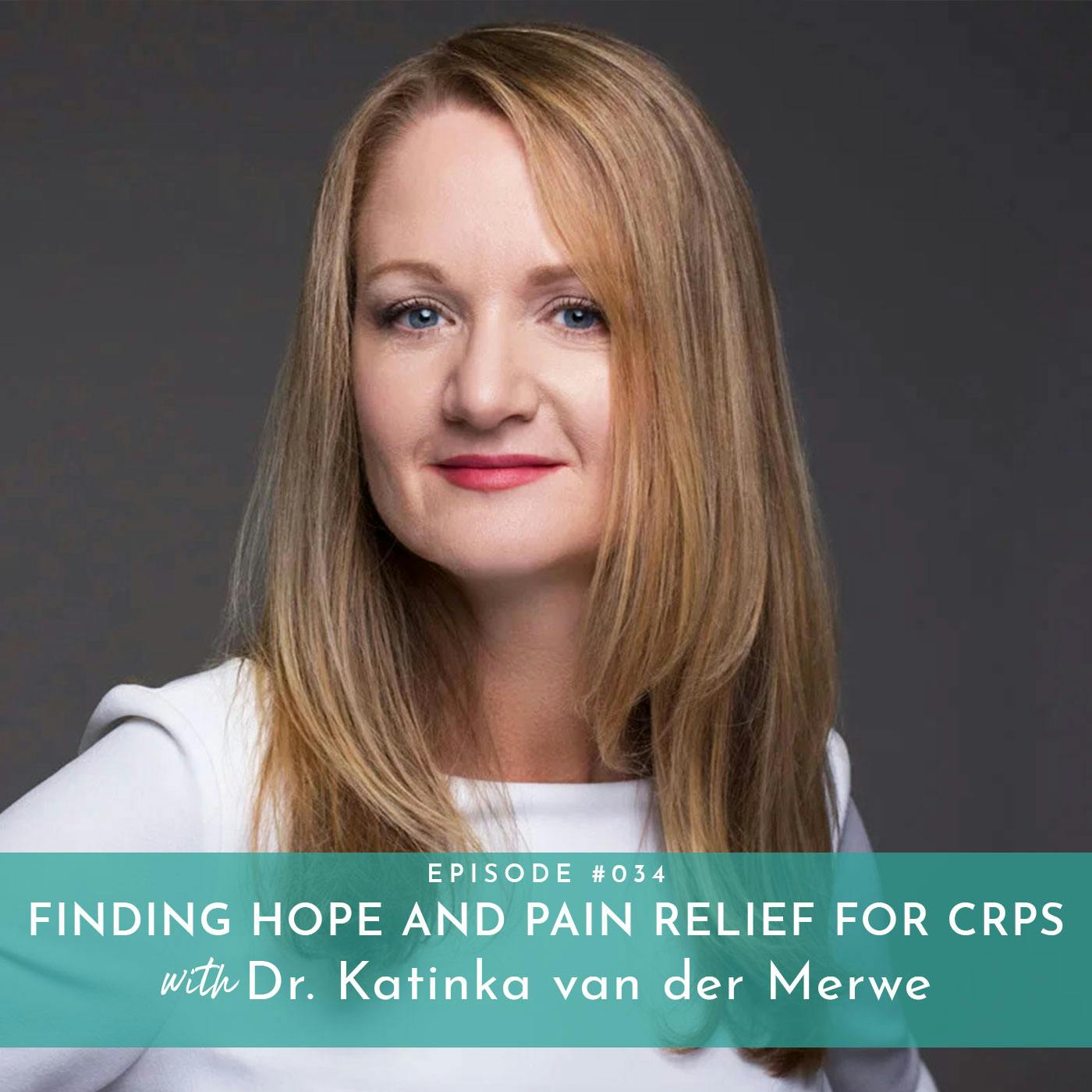
034: Finding Hope and Pain Relief for CRPS with Dr. Katinka van der Merwe
A conversation with Dr. Katinka van der Merwe
About This Episode
Here's what you will learn:
- CRPS & COVID, what we need to understand
- The holistic approach to curing CRPS incorporating the body, mind and spirit
- How bringing movement into the body is key to the recovery journey
- Hope is available and remission is possible
- Having a resilient body starts with having a resilient mindset
- Dr. Katinka's method for treating chronic pain
- Why CRPS patients are so tired of having to prove their illness
- The importance of having a support team in your CRPS court
- The Burning Limb Foundation--financial resources and support for Complex Regional Pain Syndrome patients
"Until they have spent a day in your pain, they will never understand."
--Dr. Katinka
Dr. Katinka van der Merwe, or Dr. K for short, has been the most requested guest on The Amberly Lago Show. I am so honored to have had an opportunity to chat with Dr. K about her outside-the-box approach to treating CRPS, miracles she is performing for patients with chronic pain, and hope she is spreading within the CRPS community.
If you are like me, and living with CRPS, there are probably days where you feel hopeless, want to give up, and the excruciating chronic pain from "the suicide disease" consumes your entire body completely draining you. First, I am glad you are here because you have found your support system. And second, this episode is full of the kind of HOPE that makes each cell of your being feel a little lighter.
Dr. K is the founder of Spero Clinic and a leading CRPS specialist who has created the world's leading 12 week pain relief program. She is on a mission to create a place of love, support, and hope for those who live with constant chronic pain. She is changing the lives of those who suffer from nerve pain and their family members who are impacted by it.
Restore your hope, get answers, and learn health tips to improve your overall well-being and reduce your pain.
Get in touch with Dr. Katinka:
Mentioned in this episode
Unlock your highest potential and start living the life you deserve!
Read the True Grit and Grace book here and learn how you can turn your tragedies into triumphs!
Thank you for joining us on the True, Grit, & Grace Podcast!
If you find value in today's episode, don't forget to share the show with your friends and tap that subscribe button so you don't miss an episode!
You can also head over to amberlylago.com to join my newsletter and access free downloadable resources that can help you elevate your life, business, and relationships!
Want to see the behind the scenes and keep the conversation going? Head over to Instagram @amberlylagomotivation!
Audible @True-Grit-and-Grace-Audiobook
Full Transcript
Welcome to True Grit and Grace, a podcast designed to empower you to claim your resilience and thrive through life's challenges. I am Amberly Lago, a mindset coach, fitness expert and best selling author. Each week I'll dive deep with the world's brightest thought and elite performers to share tangible tools and practical advice to inspire you to keep your eyes on the prize and forge ahead. So get ready to conquer your fears, heal any trauma, lead with your heart, and elevate your life with grit and grace.
Hi there and welcome back to True Grit and Grace. And if you're just listening, I'm so glad you're here today. I have someone very special. Actually, you have been requested more than any other guest for the podcast. So I'm so happy to be sitting here with Dr. K. Some people know her as Dr. K. She's getting around, especially in the CRPS community, as Dr. K. Or some people like to call her Dr. Katinka. She is the creator of the world's leading 12 week pain relief program. She's been featured on the Philadelphia Inquirer, Times Union, Yahoo, NBC and cbs. And you are really changing lives around the world, not just for patients, but for their families. You're giving people hope. And what you're doing is really near and dear to my heart because you're helping and even curing so many people with complex regional pain syndrome, which I was diagnosed with about 10 years ago. So, Dr. K, thank you so much for being here.
Thank you so much for having me and your kind words. It's such an honor to speak to you and just to be able to touch base with this community that I care so deeply about.
Well, it really shows that you care so much about your community and everything that you do. And I think that when people finally get to meet you in person and be at your clinic, they can feel just from the videos that I see that you post on Facebook and Instagram, there is hope. And that is what we need so much, is some hope, that glimmer of hope to carry us through. And first of all, I just wanted to say we're in the middle of a pandemic. We're sitting here in the pandemic. I'm at my home office and there's a gardener outside. So if you hear like a blower or something, everything's kind of wacky. I usually record on days when I know that the gardener's not going to be here. I just feel grateful that we still have a gardener out there in the middle of a pandemic so if you hear something in the background, that's what it is. But anyway, are you working? Are you still able to treat patients during the pandemic?
Yes, we're considered to be essential healthcare workers in Arkansas. So we're very, very lucky to have been able to keep our doors open.
Oh, thank goodness. Thank goodness. Well, first of all, there may be some people that I have a lot of listeners that do live with chronic pain or crps, but there may be some people who don't. And could you tell us about what you treat? Because I know you treat more than CRPs, you also treat pots, fibromyalgia and other things. But because you have basically worked miracles in people's lives with curing them from a disease that is incurable, could you tell us a little bit about what you do, how you got to where you are? And then I'll get into questions because so many people want to know, how do you treat CRPs?
It always sounds strange when I say this, but I tell people we don't actually treat CRPS or Ehlers Danlos syndrome or pots, and they'll say, what are you talking about? Your wedding is filled with these people. That is true. But what our focus is helping the nervous system, the central nervous system, to heal from within, approaching the body as a whole so that the body can get on its feet again. If you think of a boxer that's just being beaten up and they're on the ground and you're just waiting for someone to say the match is over, that's where most patients start. And we help them to get their so called feet underneath them so they can stand up and fight from the inside. And so we don't cure a thing. The body heals itself from within. And that's where our focus is. We see a lot of complex regional pain syndrome patients from all over the world. A lot of Ehlers Danlos syndrome patients, that's actually really starting to pick up. A lot of those patients also have pots, fibromyalgia, any really chronic pain condition that patients feel, there's absolutely no hope for them. To me, those are fighting words and they motivate me.
Yeah, I hear a lot of people with complex regional pain syndrome that also then have POTS or they do have other symptoms. And there was one thing that I read in a post that you did on Instagram and I have to be honest with you, it kind of scared me. Well, when I was first diagnosed with crps, it was really scary when I looked out there because I saw no Hope. All I saw was it was incurable. It's dubbed the suicide disease. It's ranked highest on the pain scale. I was told to get in my wheelchair, that I would be confined to a wheelchair and be permanently disabled. And so I felt really hopeless. And also I looked for some support groups, and those were depressing. The ones that I found anyway, were all about just a pity party. It was very depressing because people were just. And I. Look, I know we have to express our feelings and express ourself, but I just needed, like, that glimmer of hope. And that's what I see you're giving so many people. But I have to say, I am so happy to hear that you're like, oh, I'm treating the person. I'm not like, putting a band aid on this. I'm, like, not treating the symptom. I'm, like, treating where that symptom is coming from. But the post that I read that you just did on Instagram, I was like, oh, my gosh, I have so many of these symptoms that you talk about. You listed 10 symptoms that you're finding that most people with CRPs have in common. And some of those were asthma. Was that childhood asthma or just asthma in general?
We find if we go in and do a questionnaire, so we try to trace it back. Because I always say healthy patients do not go into surgery and wake up with complex regional pain syndrome or have an injury and suddenly get complex regional pain syndrome. It always feels like it was one event, but that's not true. It is the straw that broke the camel's back. And so we kind of look at this whole camel. How did this thing come about? And we go all the way back to childhood. And a very, very common denominator we have found is that patients have suffered from asthma as a child. And the reason for that, we think, is because the automatic or autonomic nervous system, even in childhood, is malfunctioning. And then a big sign of that is childhood asthma, because the vagus nerve, which is one of the cranial nerves, affects the bronchioles and the lungs and will lead to asthmatic symptoms. So it's just a clue that the autonomic nervous system and the child isn't healthy. Not to say every kid with asthma is going to develop complex regional pain syndrome.
Well, what interests me so much about that list is I did have asthma as a child, and it was really scary when you're a kid and I was running and then all of a sudden I couldn't breathe. Mostly it was exercise induced asthma and I outgrew that. I think my last asthma attack was probably 20 years ago. But then you also said bladder infections, and now I had chronic bladder infections as a child and my mom only discovered it because she actually saw blood in my diaper. She thought, what's going on here? And so as a young child, I think I was like six years old, I actually had a procedure done because I was having constant bladder infections. And so that was another thing that I read. And then there was another thing about. This is something I've heard and I wondered if you find this to be true in your practice. Do you find a tie with sexual abuse and then complex, like sexual abuse as a child, people with those, or some kind of sexual abuse as a child having complex regional pain syndrome later on in life? Have you heard of that? Because that's something that I've heard in some of the support groups and I didn't know if that was something that you hear about in your practice.
I would not say it's a theme that carries through. Not as common, let's say, as the childhood asthma or GI problems as a child. We have found it with quite a few of our patients, disproportionately female patients, but again, I think just in society as a whole that is so much more prevalent than we realize. It's an emotional stress that can trigger this Pandora's box. I suspect, and these are all theories that I have just from working with hundreds and hundreds and hundreds of complex regional pain syndrome patients, that there is a genetic subset or a genetic vulnerability. Part of that is the MTHFR gene mutation and things like that, where you have this Pandora's box with horrors in it, but it has a lock on it, and if that lock stays closed, you're good. And the lock usually unlocked all at once. It's a little bit at a time. You're wiggling that key. Wiggling that key. And so part of that wiggling could be physical, chemical or emotional stress, one of which could be childhood sexual abuse or even adult.
What are some of the other symptoms? Because I listed a couple. What are some of the other symptoms that you're finding that the CRPS patients have in common?
I would say everyone comes in with post traumatic stress disorder. And that's because of so many different things. Right. And it's so isolating to be so sick and hopeless. Lots of times medical procedures, just going from doctor to doctor. The majority of doctors, there are great doctors out there, don't get me wrong. But so Many doctors do not understand. And so that just leads to more and more trauma and then the toll it takes on your family relationships, your personal relationships, how you are as a mom or a dad. Brain fog is a huge one. Huge. Yes, huge.
Let me tell you.
Huge. I tried to put myself in my patient's shoes as much as possible and say, okay, I have felt nerve pain in this instant in my life, or I had horrible brain fog when I was pregnant, because you have the same kind of reaction in the brain going on. And I remember just getting out of my core when it was still on in drive, you know, just exiting my car and not thinking about it or leaving the room and not remembering why I just went downstairs, coming upstairs, remembering, going back downstairs, forgetting again. I lost 30 IQ points in my pregnancies, and that's what I see in my patients. Chronic bladder infections, a past viral and or bacterial infection. So biggest one we see is Epstein Barr infections. And almost always the patient will remember. Yes, I had mono in high school or in college, and then I just got over it. And our doctor checked me, and I'm clear for viruses, but they're looking at the wrong things. Just looking for elevated white blood cells, and that's not enough for chronic infections. There's so many markers you need to check, because the autonomic nervous system can be switched off at two different locations. One is in the cervical spine, but another hidden one is in the GI tract. And all you need is a small infection, bacterial and or viral infection, in the right place. And then you have these small messenger cells called glial cells, that go to the vagus nerve. They're messengers, and they tell the vagus nerve, we're being attacked. We're under massive attack. And then that infects the vagus nerve, which then acts sort of like a ladder up to the brain, and it causes inflammation in the brain as well. So while those infections are raging, the patient is likely to have chronic nerve pain.
Wow. And now there are a lot of people that are in fear right now because of the coronavirus going around. And people are a little more vulnerable when they have health issues. Do you think that people with CRPs are a little more vulnerable or at risk for maybe the coronavirus more so than your average person without CRPs?
Yes. I find that a common theme with CRPs patients is a decreased immune system and overwhelmed immune system, because your nervous system governs your immune system, specifically your vagus nerve. And if that is not functioning the way it should be, you are certainly more at risk not to scare anyone, because I have a clinic full of complex regional pain syndrome patients now that are nine us because that's not a choice. You know, they're here from Europe or all over the world. They can't go home. We have to proceed with treatment. And we have not had any sick people in here, but we're upregulating their immune systems. And so there are so many good things you can take, like liposomal, vitamin C and acetylcysteine is another great thing. And then just being extra careful right now, if you do have a compromise, the nervous system is a good idea.
I was explaining to my husband, we're in California. The trails are closed, the beaches are closed, everything's closed. And I've been telling him, please be careful. Wash your hands, wear your mask when you have to go to the store, and this and that. And I felt a little fear coming up. He's like, why are you so worried? You're perfectly healthy. And I said, honey, I have complex regional pain syndrome, and that affects my immunity. And he goes, you're healthy. What's the big deal? I don't know the details, but I have heard that it can weaken your immune system or immunity. But I always thought, for me, I feel like I'm on fight or flight when I'm fighting pain all the time. And a lot of people look at me and they're like, you're in pain? Or, why are you limping today? Or, why can't you stand up anymore? Or they see me working out one day, and the next day I'm on the couch, and people don't really understand what's happening. CRPS is. And even my own husband who lives with me, I don't think he really, truly understands. Yes, he can see the pain in my eyes, but little things like, no, my immunity is compromised because I'm in fight or flight all the time, or because of CRPs. I have to be very careful. And that's not to say that I'm going around living in fear. It just was a quick moment of fear. I acknowledged it, and then I thought, okay, what can I do about this? Well, I can be the healthiest that I can be. I'm taking elderberry, I'm taking vitamin C, eating the healthiest that I can eat. I'm exercising to the best of my ability so I can try to boost my immunity as much as I can. And then, of course, I'm taking precautions around other people and just having to go out. But I think it's hard on Families too, when they don't quite understand. And just going back to that brain, I have to say probably my worst fear with CRPs is I'm like, okay, I know I can take the pain. I can take it. I'm tough. I got this. I can do it. My worst fear about it is the brain fog. Because when that pain gets so bad, I can't think anymore. I can't even put together, forget about walking upstairs and forgetting something. I really can't even put together a proper email. I can't thanks straight enough to figure out how to do things. And so that's what scares me. So I would love to talk about what can you do when you start to feel like I can feel when the brain fog's starting to get worse. What would you suggest to your patients who are like, oh my gosh, I've got brain fog. My family doesn't understand. I feel like I can't work because I can't even write an email. What would you do or tell your patients to do in that circumstance?
You certainly want to watch inflammation, global inflammation in the body. We do food sensitivity tests here in our lab, IgG tests. It's not food allergies, it's just what is my body sensitive to that's going to increase inflammation. But not everybody, especially right now, have access to those types of tests. So some of the big things we notice that come up as allergens are nuts. Gluten is a big one. So if you can keep your diet as pure as possible and sort of lock out all the inflammatory foods, all the processed foods, all the tree nuts and those things that are common allergens, that really helps.
So what are some of the foods that are very inflammatory? For me, I know that I had to cut out alcohol. I used to love wine. I actually used to self medicate with wine. And that worked until it didn't at all. It got really bad because it was like this vicious cycle where it would numb out my, you know, I'd be like, wow, this kind of helps with my pain. Why didn't the doctor just tell me to have a glass of wine? This works. It worked until it didn't. And I would wake up the next day and my ankle would be the size of a large grapefruit and the inflammation would be worse and my pain would be worse. And it was this vicious cycle. So I cut out processed foods, all alcohol, all wine, you know, beer, anything like that, because it was so inflammatory. What are some of the foods that you tell patients besides the things with gluten, tree nuts. Because the allergens in those, what are some of the things that are usually inflammatory for people to eat even? This is for people that don't have CRPs. This is for health reasons.
In general, you hit on the big ones, you know, sugar, complex carbs, all your bad fats, everything that comes out of a bag or is pre made. But sometimes you can be sensitive to something perfectly innocent like fish or chicken. So a good trick is to, to really watch your weight. Keep a food diary for a while and watch your weight. And if you jump two or three pounds the next morning, if you weigh every morning, that's water retention. And that is a clue that you ate something that was inflammatory to your system. So if you start seeing those patterns, wow, every time I eat beef, this seems to be a problem. Then you know that you're probably sensitive to that food. So that is just an easy trick to kind of flush your sensitive foods out for yourself.
I remember when I decided I was like, okay, this wine is not working for me. I dropped ten pounds within like two weeks. And that wasn't just fat, it was a lot of inflammation, water retention. And people are looking at me going, wow, what did you do? What's different? You're like shredded right now. But you could see it in my face. And I keep that picture of me as a reminder to never drink again because I looked like a blowfish. Like I have an allergy, a physical allergy to the alcohol. But that is such a good idea to keep a food journal and look at your weight. Because I usually weigh myself, especially when times are tough right now and I'm not able to do the exercise that I'm able to exercise, but not what I usually do. I've been changing it up. And so if they can't get to your facility or another facility to check for food sensitivities and food allergies, they can really do it themselves by really paying attention to what they're eating. Keep a food journal and look on the scale to see if that's scale jumps up to three pounds.
Yes, that is a telling clue right there. You'll learn a lot. We believe leaky gut has a lot to do with it. So you have particles of food basically entering your bloodstream through. Think of it as tiles. There are just really thin cells lining your GI tract. And when you have holes in those tiles, now you've got food particles entering your bloodstream and your body attacks it as an allergen. And so if you have a leaky gut. And if you have CRPs, there's a 95% chance that you do. Then foods that you love all the time definitely will become something that you're sensitive to. So if you drink almond milk every single day, I can almost bet the farm that you've become sensitive to almonds. So the things that you love and go to all the way you want to mix it up, go to really, as much as you can, pure an organic diet. If you cannot do that, I wish I could think of a name right now, and I can send you the link afterwards.
Okay.
But we have one of the biggest ozone supply companies right here in Arkansas in my backyard, and they have a pod that you drop in your sink for 20 minutes with all your produce to remove not only dirt and things, but also pesticides that have entered.
Wow.
And so that's an initial investment. I want to say it's about $200, but it will allow you to go to Walmart and buy fruits and vegetables. So you don't always have to purchase organic, because that's super expensive.
It is. Well, how do you test somebody for leaky gut?
You really go by the clues. I don't know that the tests that are out there are that reliable. And so we just approach every case as leaky gut. There is a fantastic supplement that you can buy on Amazon, and it's called Restore for GI Health. If you go look at the picture, by the way, I'm not affiliated with this company.
Okay.
Who makes that?
Zach Bush MD I think Dr. Zach Bush has a supplement out there, and I think it was called Restore, But I could be wrong. I was taking it for a while. It's a drink that you drink. It tastes pretty much like dirt, but that's kind of what it is. But it's supposed to help with leaky gut. Now, I've also heard that drinking celery juice every morning cures a leaky gut.
Yes. Celery juice is another great thing, but you just want to be careful that you're not having that water game, because we have tested allergies to celery, so I can't see the company here, but that is the picture. Is this the same one?
Yep, that's it.
So you're right. That's a product that will repair the GI Lining over time. And honestly, I just give a teaspoon to each of my kids every morning because we're just in touch with so many environmental toxins now just as a protective barrier.
Well, I love that. One of the things that you do is that you look at every patient for the patient as the whole, that you don't put them in a box. You've got crps, so I'm going to give you Lyrica or gabapentin and maybe some pain pills and send you on your way. You're like, nope, let's look at the person, let's look at their history, let's look at what they're eating, let's look at their sleep patterns, what they're doing in their life right now. Are they walking, are they bedridden? And you treat each patient very specifically. And I love that because a lot of times when I was diagnosed, I went to three other doctors because I wanted to hear them say, no, you don't have this. I was like in denial. I didn't want to believe it. And I've had people ask me, did it take a long time for you to get your diagnosis? And I was like, no. I tried to go get a doctor to not give me a diagnosis to tell me that I didn't have it. And they would always see me go, oh, no, you got it. And so I've done so much research. I've had very invasive procedures like the spinal stimulator. I've done ketamine infusions, which honestly did nothing for me. I know it's worked for some people, but it did nothing for me but kind of drug me up for the day and empty my pocketbook. It was like $2,000 a pop every time I did that. And I did it, I think, eight times. It's crazy medically what I've spent just to get better. I spent a lot of money on some snake oil too. I mean, I've bought a machine that was $4,000 that you stick these electrodes to your leg. I may as well been putting scotch tape on me. Didn't feel a thing. Can you tell me some of the things that. And I wanted to tell you this too. I was on the doctor's TV sharing about crps and I was so excited about it. It was like a 10 minute segment. And then you never know how they're going to edit that down. So they took it and made it into a two and a half minute show. So it basically shows that I was in this horrible accident, then I had these surgeries and then this is what I do and I'm all better. And it's like, no, no, no, no. They cut out the part where I've tried all these things and then I really had to adjust my mindset. Because I feel like everything we do, if we don't have our mindset wrapped around with acceptance and gratitude for what we can do and have the right mindset going in towards being healed or being treated, then nobody can do it for us. We have to be willing to do it ourselves, and we have to have the right attitude about it. And it's hard. I'm not saying it's easy. It's hard. And it's a struggle every day to get up and be willing to go, okay, I got another day of this. Let's see if I can get through this day. But I love that you treat people as a whole. But the question that I get time and time again is, what do I do for my pain? So I'd like to ask you, what do you do for people for their pain? Because I know you work a lot with their vagus nerve, but can you explain what that is exactly?
Sure. So when a new patient starts now, we used to wait to draw blood because as you know, a needle prick can spread CRPs, and I never want that to happen on my watch. So we would wait till people were about at least 50% pain free before drawing blood. But now that is just too long because we know everybody pretty much will have viral infections. So right away we start on the antiviral antibacterial protocol. Because we use supplements, we don't use medications for those or medical antivirals that don't work as well. We have figured out this really powerful recipe and we start that immediately to set the table. And then we start vagus nerve stimulation. And we do that in two ways. So we have light touch on the cervical spine. And that works even if a patient comes in. I had a new patient from Florida that had a car accident. She had four car accidents, and her CRPs started in her gums and jaw. And still we can touch her here. So it's a very, very light touch to lightly stimulate the vagus nerve. But then we also use infrared light and allergy vials for bacteria and viruses to light into specific organs. So it's kind of like you ask the liver to prod the vagus nerve and say, hey, wake up like you're shaking your teenage child to get them up to school. It takes a while in the beginning, but usually almost immediately that will start dropping the patient's pain because that nerve controls inflammation in the central nervous system. Then we will start neuromuscular re education, which thank goodness for the therapists that I have here, because they've learned on the Ground. And they are absolutely incredible. They spend an hour a day with each patient where the patient is hooked up to a direct current. That sounds super scary for CRPS patients, but we even manage that with children, with our pediatric patients, where we coax them through movements. If you go on our Facebook page this week, you're going to see a picture that was taken underwater where we have a patient's hand in water.
I saw that. That was amazing.
That patient stood up today for the first time in, oh, my gosh, I don't even know how many years. It was huge. When you slowly bring movement back into the body, so the current comes into the body and it's like you have a superman or a Supergirl that comes in. And that current helps your body to break through barriers that your body hasn't been able to do in many, many years. So it's physical therapy, but physical therapy on steroids?
It sounds like it. Now, does that current, is it one that you can feel like a TENS unit, or is it something that you don't feel, but it is like a microcurrent?
No, we do use microcurrent for different therapy. We use 16 different therapies. I call it shock and awe. I'm addicted to finding the perfect recipe and helping 100% of people. I'm not happy with 84%. And it is a current that you can feel. It does get super intense. If I can relate it to anything. It feels kind of like holding on to an electric fence and it's really rising and then it gets super intense. But our therapists are trained to take you through the process and you don't get there in one day or one week. It is a slow buildup of strength where we celebrate every step you take, so we never push your body further than it can go.
Well, you know, that reminds me when I had this spinal stimulator, when they first put it in. This is a long time ago. This is like eight years ago, maybe. She turned up the dial and it was such a big pulse that my leg shot up off the bed and it scared me to death. I cried because I thought it hurt. My leg popped up off the bed. I felt so out of control, and I didn't know how bad it was going to get. And I hear you talk about your therapist, like, on your website and on your social media, and I can tell you guys are a family. And I love that you really care about your patients and that you're there to hold their hand through this treatment. Because I know for me when you have pain, there's a lot of emotions that come along with it. The fear and anxiety of is it going to get worse? But then there's also this doubt. There's a lot of self doubt. There's a lot of. When you've tried so many things and I'm sure you probably get people who tried everything and you may be their last resort. And I still want to come see you, by the way. In fact, I was planning on coming to see you when I got back in town and I got back in town and all of this happened with the quarantine and everything. My hope is to still be able to come and see you. But do you offer any kind of scholarship programs? Do you take insurance? Do you work with Burning Limb or RSDSA to help patients get to you?
We work with the Burning Limb Foundation. They have been absolutely incredible. And one of the biggest tools they've made available is that they help patients to start fundraising. Because who has all this money sitting under their pillow at home right in that vegetable garden? People don't have that kind of money. People always tell me on Facebook, why, why don't you take insurance? And our side of it is, it is not up to us. We could have 10 clinics, one in every big city. As insurance companies said, yes, we would cover these investigative procedures, but they simply don't. The vagus nerve procedure that we do, there is no template for that. I developed that. We're doing a study with Kent State University. We're now behind because of the coronavirus fiasco, but we were planning on starting that in October. But I am looking at research which eventually will open possible insurance coverage. But for now, a lot of what we do just isn't covered by insurance. So Burning Limb helps you to get started with fundraisers. And so everyone that contributes to your fundraising campaign will be able to deduct that on their taxes, which is really a big part of deal.
That's huge.
Yeah, we've had patients fundraise for two years before they were able to come here. So we realized it's a very big deal. I do offer in house scholarships, but those are very personal and handpicked and I keep them very quiet. You know, I just see where the need is and then I step in and help people wherever I can. And at the same time, I have staff to pay you. We have buildings. We can help more people. So we do have to approach it as a business so we can stay open and keep helping people.
I know, you know, that's the hard thing. It's like I created a 12 week course and it's a mind, body, spirit transformational course. And it's one on one with people coaching, it's a group coaching, it's a workbook and another book and another playbook that comes. It's a lot. And I've spoken, spent a year working on this and there are so many people like me with CRPs that I'm like, I want to give this to them. But my family's like, but you can't just keep working for free because we have to pay bills so you're going to have to charge. And it's so hard. But I totally understand. Like you said, you've got a staff and things are expensive. The treatments that you do, all of that is expensive. I know all the physical therapy things that I've tried have been expensive. Now I did at one time I was on homeopathic pills and I went to this guy who he hooked electrodes up to my head and on my arms and he like figured out what was going to work for me and what wasn't and he gave me all these pills. I spent over $1,000 on homeopathic supplements and I was taking 73 homeopathic pills a day. It didn't do anything for me. I did not feel one bit difference. I stuck to it for three months. It was horrible. How, on an average, how many supplements are your patients taking a day? On an average, I know everybody's different, but average, how many supplements a day?
I actually spend a lot of time taking people off of supplements when they come in because, you know, you're on Facebook and you see maybe Sarpo Meta is good or you just keep adding and adding and adding to your system becomes so overwhelmed because it still has to process all these supplements and they're not always good for you, for a lot of people, but not for you. So we make it very case specific and I would say we like to keep it under 10 where we can. And it will fluctuate, you know, as we track your blood work and your viral infection, your numbers go down. Then we'll remove what we can.
Oh, I like to hear that. Yeah, I would eventually like to be off of everything. I'm currently taking Lyrica and that seems to work for me. I'm on a pretty low dose and I'd like to get off of that. There's this thing in me where I've never liked to take any medication, not even aspirin, nothing. My drug of choice has always been endorphins. And so thank goodness I knew how that could make me feel mentally, not just physically, but how it just makes me feel mentally so much better. I always say, I just had somebody with CRPs reach out to me on Instagram today and they saw me working out and I was like, move your body. In my story, I was saying, move your body if you want to even think about exercise. I do something called the filthy 50 where I do 50 jumping jacks, 50 push ups, 50 lunges. And I started naming everything and she messaged me and she goes, how do you do that when you have CRPs? And I said, well, it started with just being able to stand up for seconds at a time. Then it started with me being able to walk. And then it started with, okay, I could go to the gym and do some things in my wheelchair. Now I can walk on my own. And now I still do jumping jacks, but I do most things most of the time on one leg. I try to really build up. I have CRPs in my right leg and I try to really strengthen that leg. But some days it just doesn't want to be touched or anything. But I do what I can to keep my strength up. And I think what I want people to know more than ever is just because you have been diagnosed with CRPS or fibromyalgia or anything doesn't mean, you know, everybody's different. You know, I had a doctor tell me I'd be in a wheelchair forever. Well, I fought to get out of that chair. Some people might be in a wheelchair, but you can still do stuff with your upper body. You can still move. Maybe you can't move, maybe you can't move your arms. You can still go outside and take some deep breaths. So I just think whatever you can do, and it's really starting where you are using what you have and doing what you can do. You use exercise. And part of what you do in your 12 week program, do you have people move their body and exercise?
The neuromuscular re education that you guys see on film involves movement. And we try to progress from just standing up. We had someone walk for the first time today without her walker. So like you said, baby steps. But when you're hooked up to this current, which is very unique, every minute on the machine is roughly the equivalent of 250 physical therapy minutes, whatever movement through that minute.
Man, hook me up
and listening to you. I mean, we'd love to have you, but I have just a therapist in mind for you. I match up my patients with my Therapist. It's kind of like matchmaking in a way. Spiritually and emotionally, they have to be a good match.
I love that. And you know what? I love that you talk about. It's mind, body and spirit. And it is a transformation when you are going through a hard time. It is all three of those things that you really have to get your mind right. You have to get your body right. And, man, I need something bigger than me to rely on to get me through those harder days. So it is. I love that you have therapists that you're like, okay, who can I match up with Amberly? The wild one, the crazy one? Let's see. But, yeah, you know, you might have. As any doctor or anybody who is performing miracles, you might have some skeptics out there. Yeah, you know, there's people that are skeptical of me, and I got my first taste of that after I was on the doctors, where people were downright mean, actually, in some of the support groups, to me. And it really. Oh, my God, it just hurt my heart. And I understand. Look, I understand. They saw a short clip. They didn't know what all these things that I've tried, they don't see my life. They saw me dressed up in a nice dress with actually makeup and my hair done, staring at the doctor. And let me tell you, if you were looking at that doctor, he's gorgeous. I was like, you'd be smiling, too. You know, that's one thing that I don't like to see in the support groups is when you feel like you have to prove your illness. And I feel like a lot of times people spend half their time proving their illness and the other half their time pretending that they don't have it. Or for me, anyway, it's like, I'd like to forget I don't have it. And a lot of times we'll try to ignore it. And I'll do crazy stuff. Like, my daughter and I were taking the dog out for a walk, and we were on our razors, the little scooters, and we've learned how to jump on them. Well, I can barely jump. And I was like, my husband decided to go with us, and he saw us, like, jumping on the razors. He's like, what are you crazy? Oh, my God, you're not going to be able to walk tomorrow. Don't you remember? You've got crps. So it's funny. He'll remember when I'm trying to run or I'm dancing or doing some crazy exercise, and he'll remind me really quick. But then when I'm telling him I'm sitting down and I'm like, I'm really tired, and I feel like I can't get up to make dinner, he's like, what is wrong with you? And I'm like, what do you mean, what's wrong with me? I've been fighting to get through the day, all day with this pain, and it has completely zapped my energy. Do you have, like, a support group there? I know you have therapists on staff. Are they therapist or psychiatrist or psychologist there on staff, too, or do you have a support group? Or can people find that mainly through your Facebook or Instagram? To do that, to connect, sort of a backstory.
We moved into this building three years ago, and we went from two and a half thousand square feet to 6,000 square feet. And I thought, this is where I'm going to grow old and die and see my last patient one day. And within two years, we had completely outgrown our walls. We're busting at the seams. Our waiting list is uncomfortably long. And so we're building a clinic about three times the size of this one. Wow. Long story short, I don't even have a little hole for a mouse right now to put a therapist, but I have the perfect therapist in mind. He was a patient here. He's just an angel. He is so inspiring to be around. He had CRPS for 12 years. He's studying to become a therapist because I did not want somebody in a chair talking to my patients about their pain if I haven't walked in their shoes. If anyone's watching this, your spouse or partner or parent can love you with the fullest heart and utmost love. But until they have spent a day in your pain, they're not gonna get it. They're gonna spend their whole life trying to understand, but you bet your life. And I get it. They're gonna get frustrated with you. They're gonna wish things were different. They're gonna mourn parts of you that are missing, and they haven't felt your pain, so they cannot possibly begin to understand. My biggest support group are my staff. Because I don't hire one person that's here for a paycheck. I. I want a staff member that goes home at night and they cannot sleep because their patient's not getting better. That's who I want on my staff, somebody that actually cares. And then our fellow patients, when you walk in our front door, we're the opposite of clinical surroundings. There are no, you know, yeah, you're in a private room with your therapist. But you also walk up and down the hallway when you're doing exercises. You walk out of the waiting room and people are cheering and crying and taking videos of each other because you just walked for the first time. So our patients are promoted to be the support network for each other. And we're a big loving group when you're here, we break down barriers and we want people to connect and form lifetime friendships here when they're under care.
Oh, I love that. And if you're listening or watching, head over to to your Facebook and to your Instagram. I'm mostly on Instagram. But can you tell people where to find you on Instagram? Because I would love for people to be able to see your videos. Because I watch those videos and I see people that are walking for the first time and it just fills my heart. And I actually have a video of when I walked for the first time. And I still get tears in my eyes when I see it because it's huge when you haven't been able to walk and that moment that you're able to walk again, it's like an unforgettable moment. So can you tell people where to find you on Instagram and on Facebook?
Yes. So we're the Spiro Clinic. S P E R O Clinic on both Facebook and Instagram. Spiro means hope in Latin. That's where you'll find us. And also Our website is thespiroclinic.com oh, and it is.
It just gives me such hope. I am so grateful that I finally, I had heard about you and our paths finally crossed and that I got to talk with you and I just appreciate you being here so much and all that you do. And as soon as we are out of this lockdown, I want to come see. See you. I want to try that machine. I want to meet the therapist that you're thinking of matching me with. And I'm just big on. I think community is a huge part in how we get better. We can really support each other and cheer each other on. And that is what gets me through a lot of my hardest days is just when I have some close knit friends that are also CRPs warriors and they get it because they have walked in my shoes. They know that it may look like you show up and you are there for work, but inside sometimes you're hurting so bad that you want to just cry or you do cry. And so I think community is everything. And I love to see the community that you have built and the Other patients cheering the patients on when they're walking. I love the videos that you share. So thank you so much for taking time out of your day with patients to just share your wisdom with the listeners and the viewers. I just appreciate you so much.
Oh, thank you so much for having me. Our voices are just so much the same. I feel such a kinship with you. I have such incredible deep pride of what you've accomplished on your own and done for our community. I just wish more support groups had your drive and that positive motion behind it. We have so many support groups out there where people can get so negative. I hate saying it, but we can't ever post our videos and our hopeful voice anywhere. You know, when someone gets better, let's just say they drank sweet potato juice. Who cares? Give them a chance. Listen to what they have to say. Let's celebrate each recovery we're seeing because a win for one of us is a win for for us as a community and as hope. And you're spreading hope. And thank you to spread hope because that's my message.
Oh, thank you. Thank you. And I can't wait to see you in person someday.
I can't wait to meet you. Thank you so much. And thanks everybody for taking the time to watch me.
Thanks.
Thank you so much for joining us this week on the True Grit and Grace podcast. Don't forget to hit that subscribe button and it would be so awesome if you rated and maybe left a review. That would help too. And also I have some exciting news for you. If you are ready to learn a mindset that will get you through any challenge, ready to really transform any limiting beliefs, and finally find the wellness routines that work with your lifestyle and keep your body healthy and thriving. You're in the right place. You're hearing this for all the right reasons because it's your chance, your chance to join. Right now. It's a 12 week course. It's so much fun because we're going to go live in a webinar with plenty of time for Q and A. It's called you'd Unstoppable Life Mastermind. And there's going to be a daily mantra and a like minded community to support you along your way to reach all those goals. So head over to amberly lago.com mastermind and sign up now. Okay. Have a great week and I hope to see you in the Mastermind.
Pain to purpose to joy.
Never Miss a Conversation
New episodes drop regularly. Subscribe on your favorite platform and never miss a conversation.